

/https%3A%2F%2Fprofilepics.canalblog.com%2Fprofilepics%2F1%2F0%2F100183.jpg)
/https%3A%2F%2Fstorage.canalblog.com%2F03%2F02%2F119589%2F96711876_o.jpg)
/https%3A%2F%2Fstorage.canalblog.com%2F11%2F31%2F119589%2F94773502_o.jpg)
/https%3A%2F%2Fstorage.canalblog.com%2F20%2F83%2F119589%2F94772815_o.jpg)
/https%3A%2F%2Fstorage.canalblog.com%2F26%2F72%2F119589%2F75604929_o.jpg)
/https%3A%2F%2Fstorage.canalblog.com%2F59%2F60%2F119589%2F26458628_o.jpg)
A rare blue, amber and cream-glazed pottery figure of a young girl - Tang dynasty (618-907)
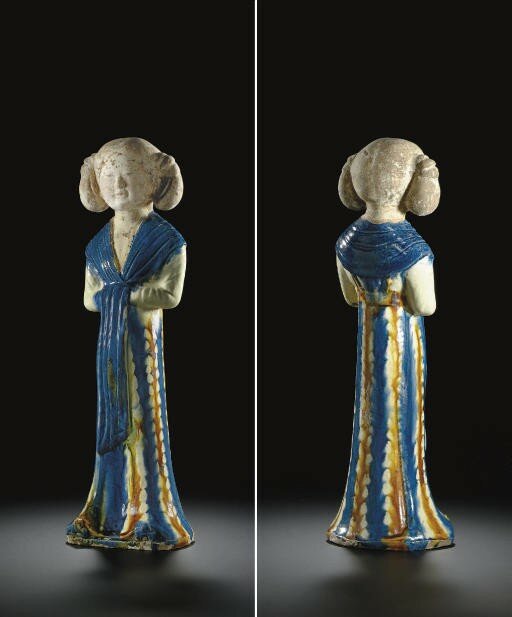
A rare blue, amber and cream-glazed pottery figure of a young girl - Tang dynasty (618-907)
The slender figure shown standing with her hands clasped beneath her long blue-glazed shawl worn over a cream-glazed, long-sleeved top and a long skirt decorated in stripes of blue, amber and cream resist dots, her hair dressed in two loops that frame her round face modeled with small nose and mouth, with traces of black, red and flesh-colored pigments
13½ in. (34.2 cm.) high, box - Estimate: $150,000-180,000
Provenance: Acquired in 1996.
Notes: This charming figure of a young girl belongs to a distinctive group of figures which have broader child-like faces in contrast to the more oval faces seen on the vast majority of Tang sancai ladies. While the current figure wears the style of dress seen on the elegant court ladies who make up the procession in the mural on the eastern wall of the front chamber in princess Yongtai's tomb, illustrated in The Silk Road - Treasures of Tang China, Singapore, 1991, pp. 66-7, her face and her hair-style mark her out as a young girl. It is interesting to note that the tomb of Princess Yongtai, which was excavated in 1964, dates to AD 706, and a standing figure dressed in the same style as the current figure is also depicted on a silk hanging scroll unearthed from the tomb of Zhang Lichen (AD 655-702) at Astana, Turfan, Xinjiang province, illustrated in Gems of China's Cultural Relics, Beijing, 1993, p. 315, no. 129. Comparing the current figure with these paintings suggests that the figure probably dates to the first decade of the 8th century.
The figure's long striped skirt appears to have been very popular at the time, as does her diaphanous blouse and long shawl. These shawls were either worn with one end tucked into the front of a band just under the bust and the other taken around the neck to hang down the other side, or, as with the current figure, the shawl goes around the back of the neck and both ends hang down in the front and often appear wrapped around the hands. This is one of the few periods in which Chinese ladies wore garments with low necklines, which provoked the Tang poet Fang Gan (died c. AD 888), in his poem To Beauty to remark "The highs and lows of those vermillion lips imitate cherries, Half covered breasts are snow on a sunny day" (quoted in J.C.Y. Watt, ed., China - Dawn of a Golden Age, 200-750 AD, New York, 2004, p. 293). While some figures dressed in this style emphasize the throat and breast area, that is not the case on the current figure, probably because of her youth.
The hairstyle of this figure with its distinctive heavy loops framing her face is quite unusual among sancai figures, but appears to denote a young, unmarried, girl. The hairstyle can be seen on a blue-robed figure standing under a tree in a Tang dynasty painting in colors on paper in the Atami Art Museum, Japan, which has been designated by the Japanese authorities as an Important Cultural Property, illustrated in Mayuyama, Seventy Years, vol. 2, Tokyo, 1976, color pl. VI. Two ceramic figures with the same two bunches on either side of the face excavated in 1972 in Henan province are illustrated in Zhongguo gudai shi cankao tulu - Sui Tang Wudai shiqi, Shanghai, 1990, p. 112 (upper image). Another figure dressed in the same style and with similar hairstyle and round face in the Alsdorf collection is illustrated in Chinese Art from the collection of James W. and Marilynn Alsdorf, Chicago, 1970, no. c29.
The result of Oxford Authentication Ltd. thermoluminescence test number C207h38 is consistent with the dating of this lot.
Christie's. Fine Chinese Ceramics & Works of Art. 19 March 2008, 2:30 pm. 20 Rockefeller Plaza, New York


/image%2F1371349%2F20260929%2Fob_f80682_39122.jpg)
/image%2F1371349%2F20260929%2Fob_bd0d49_39105.jpg)
/image%2F1371349%2F20260928%2Fob_bd008d_39081.jpg)
/image%2F1371349%2F20260928%2Fob_1b4eb8_39061.jpg)