

/https%3A%2F%2Fprofilepics.canalblog.com%2Fprofilepics%2F1%2F0%2F100183.jpg)
/https%3A%2F%2Fstorage.canalblog.com%2F03%2F02%2F119589%2F96711876_o.jpg)
/https%3A%2F%2Fstorage.canalblog.com%2F11%2F31%2F119589%2F94773502_o.jpg)
/https%3A%2F%2Fstorage.canalblog.com%2F20%2F83%2F119589%2F94772815_o.jpg)
/https%3A%2F%2Fstorage.canalblog.com%2F26%2F72%2F119589%2F75604929_o.jpg)
/https%3A%2F%2Fstorage.canalblog.com%2F59%2F60%2F119589%2F26458628_o.jpg)
12th Century Survival Takes Pride Of Place At Exhibition Of Buddhist Manuscripts
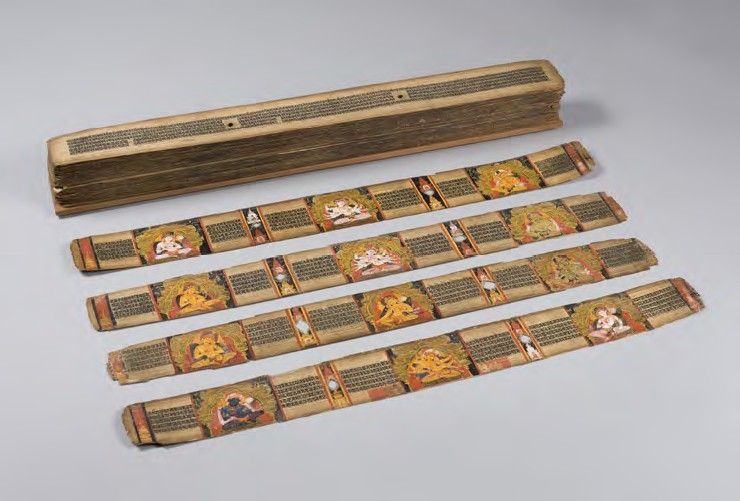
Sam Fogg Ltd is pleased to announce the discovery of a previously unknown, extremely rare and important example of an early illuminated Buddhist manuscript from India, few of which survive. Containing 218 pages, including four leaves each with three miniatures, an intact colophon states its date of completion as the 30th year of the elapsed reign of the monarch Govindapala, equivalent to c.1191 AD, as well as providing the name of the scribe and the place of completion. The style is associated particularly with the Pala monarchs who, from a base in Bengal, came to rule most of eastern Indiaat the height of their power in the 11th century. Its price is in the region of £300,000.
The present manuscript belongs firmly to the eastern style from Bengal, which is generally more linear and likes to place the divinities within multi-layered shrines creating a more ‘baroque’ style, suggesting that it must be from Bengalitself, which by this time was mostly ruled by the Hindu Sena dynasty. They were not inimical to Buddhism but nonetheless Buddhist manuscripts tended to preserve the fiction that their creators were still part of the Buddhist Pala Empire.
All the divinities in this manuscript are beneficent comprising different Bodhisattvas, including Avalokitesvara or Padmapani, Maitreya, Manjusri, Vajrapani etc. in their different forms, as well as three female divinities: Tara, Vasudhara and Prajnaparamita, the eponymous Perfection of Wisdom, round whose feet are depicted stylised portraits of the donors of the manuscript. This concentration on beneficent divinities links this manuscript with one in the Victoria and Albert Museum which dates from the 36th year of Ramapala (c.1110), although that is in the ‘western’ classical style. Another comparable manuscript is in the British Library and has a multiplicity of shrines and a Bengali provenance from c.1130. The Sanskrit text of the sutra is written in five lines of exquisite Siddhamatrika script with a pronounced twist at the bottom, very close to that in British Library manuscript which was possibly created at the great monastery at Paharpur now in Bangladesh.
The manuscript will be the highlight of the exhibition The Art of Enlightenment: Buddhist Manuscripts from the Himalayas, India, China, Japan and South-East Asia on view from 30 October to 21 November 2008, which presents over 40 manuscripts from the 8th to the 20th century, covering the whole breadth of Buddhist art and writing from the Himalayas, India, China, Japan and South-East Asia and illustrates the diverse and innovative artistry within this spiritual tradition that continues to influence millions of people across the world.

Detail from The Perfection of Wisdom (Prajnaparamita Sutra. Eastern India, Kondandmanandala, 1191 AD
SAM FOGG. 15d Clifford Street, LondonW1S 4JZ. Tel: 0207 534 2100 Fax: 0207 534 2122


/image%2F1371349%2F20260315%2Fob_d4bea3_1000057754.jpg)
/image%2F1371349%2F20260113%2Fob_ba6bd3_1000048233.jpg)
/image%2F1371349%2F20260113%2Fob_81431c_1000048213.jpg)
/image%2F1371349%2F20250827%2Fob_ba4642_1000028956.jpg)