

/https%3A%2F%2Fprofilepics.canalblog.com%2Fprofilepics%2F1%2F0%2F100183.jpg)
/https%3A%2F%2Fstorage.canalblog.com%2F03%2F02%2F119589%2F96711876_o.jpg)
/https%3A%2F%2Fstorage.canalblog.com%2F11%2F31%2F119589%2F94773502_o.jpg)
/https%3A%2F%2Fstorage.canalblog.com%2F20%2F83%2F119589%2F94772815_o.jpg)
/https%3A%2F%2Fstorage.canalblog.com%2F26%2F72%2F119589%2F75604929_o.jpg)
/https%3A%2F%2Fstorage.canalblog.com%2F59%2F60%2F119589%2F26458628_o.jpg)
The Lesotho I diamond, Harry Winston
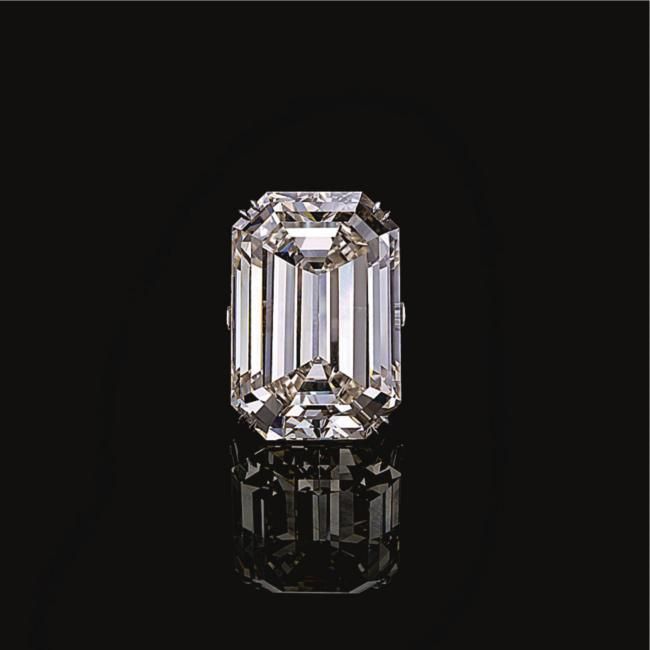
The Lesotho I diamond, Harry Winston
The step-cut diamond weighing 71.73 carats, mounted as a ring by Harry Winston, set between tapered baguette shoulders, mounted in platinum, unsigned, maker's marks for Jacques Timey, case by Harry Winston. size 57, Estimate 3,360,000—5,600,000 CHF - Unsold.
Accompanied by GIA report no. 12565266 stating that the diamond is VVS2 Clarity, Excellent Polish, Excellent Symmetry and a GIA diamond type classification report stating that the stone is determined to be a Type IIa diamond.
Further accompanied by a letter from the GIA relating the history of the 'Lesotho 1' diamond.
LITERATURE AND REFERENCES: Cf: Ian Balfour, Famous Diamonds, London 1987, pages 200-203;
Laurence S. Krashes, Harry Winston: The Ultimate Jeweler, Harry Winston Inc., and the Gemological Institute of America, New York: 1988 (Third Revised Edition), page 100;
Diamond Promotion Service, Notable Diamonds of the World, edited by Barbara Gleason, pages 25-26.
NOTE:
Lesotho: The Lesotho, a spectacular rough diamond of 601 carats, was the first and only major diamond to be discovered by a woman. Subsequently, in the hands of Harry Winston, the rough was eventually cut into eighteen gems weighing a total of 252.40 carats.
The present stone, the Lesotho I, an emerald-cut diamond of 71.73 carats, was the largest to be cut from the rough. This remarkable diamond was sold to the present owner by Harry Winston himself, and it has remained in her collection ever since.
Third in the sequence, the Lesotho III, a marquise-shaped diamond of 40.42 carats, was in the collection of Jacqueline Kennedy Onassis. It was an engagement gift from Aristotle Onassis; the couple were married on Onassis' private island Skorpios in Greece in October of 1968. The ring was later sold by Sotheby's in New York on April 24, 1996 for $ $2,587,500. See the catalogue the Estate of Jacqueline Kennedy Onassis, lot 453.
The history of the Lesotho diamond begins with Ernestine Ramaboa, wife of miner Petrus Ramaboa, who came upon a large rough on May 26, 1967. As a couple, the Ramaboas had experienced a certain degree of luck finding smaller stones that Petrus would occasionally set off to sell. It was during her husband's absence that Ernestine discovered the huge rough at Letseng-la-Terai while sifting gravel. Despite the fact that the stone was covered in mud and gravel, she was certain that it was a diamond; she placed it in her pocket and made her way home to await her husband's return.
Together the Ramaboas made their way on foot to Maseru, the capital of Lesotho, where they hoped to find a buyer. They were rewarded for their efforts; the stone was purchased by a South African dealer who, in turn, sold it to a dealer from Europe.
In October of 1967, the Lesotho, like many other famous rough diamonds, made its way into Harry Winston's hands. He invited the Ramaboas to New York to participate in a press conference where the stone was introduced to the American public. Winston also arranged for the stone to be exhibited at the Smithsonian Institution in Washington, D.C. and the Museum of Natural History in New York. After months of deliberation, the rough was cleaved by Pastor Colon, one of Winston's master cutters, eventually yielding eighteen gems of various cuts and sizes. The initial cleaving of this diamond was so significant that it was broadcast live on television.
It is highly unusual for a diamond of this size and significance to remain in the hands of a single owner for over four decades. Sotheby's is honoured to sell yet another of the extraordinary Lesotho diamonds.
Sotheby's. Magnificent Jewels. 19 Nov 08. Geneva. Photo courtesy Sotheby's. www.sothebys.com


/http%3A%2F%2Fstorage.canalblog.com%2F65%2F56%2F119589%2F132529155_o.jpeg)
/http%3A%2F%2Fstorage.canalblog.com%2F67%2F04%2F119589%2F131098920_o.jpg)
/http%3A%2F%2Fstorage.canalblog.com%2F15%2F84%2F119589%2F130698780_o.jpg)
/http%3A%2F%2Fstorage.canalblog.com%2F11%2F76%2F119589%2F130698704_o.jpg)