

/https%3A%2F%2Fprofilepics.canalblog.com%2Fprofilepics%2F1%2F0%2F100183.jpg)
/https%3A%2F%2Fstorage.canalblog.com%2F03%2F02%2F119589%2F96711876_o.jpg)
/https%3A%2F%2Fstorage.canalblog.com%2F11%2F31%2F119589%2F94773502_o.jpg)
/https%3A%2F%2Fstorage.canalblog.com%2F20%2F83%2F119589%2F94772815_o.jpg)
/https%3A%2F%2Fstorage.canalblog.com%2F26%2F72%2F119589%2F75604929_o.jpg)
/https%3A%2F%2Fstorage.canalblog.com%2F59%2F60%2F119589%2F26458628_o.jpg)
Néfertiti avait subi un lifting...

Si elle est devenue banale, la chirurgie esthétique n’est pas un phénomène nouveau. La reine d’Egypte, connue pour sa beauté légendaire, Néfertiti aurait subi en son temps un lifting. C’est ce que prouvent les chercheurs de l’Ecole de médecine attachée à l’hôpital de la Charité de Berlin en réalisant une étude pour la revue Radiology. En effectuant une tomographie de la sculpture de Néfertiti, pièce majeure de la collection du Neues Museum de Berlin, les chercheurs ont découvert sous le stuc qui recouvre la pierre calcaire, que la reine avait à l'origine une petite bosse sur le nez, des pommettes moins saillantes, des rides aux commissures des lèvres et des paupières moins marquées. Cette sculpture, régulièrement réclamée par l’Egypte a été découverte par l’archéologue Ludwig Borchardt au début du XXème siècle. Elle sera exposée au Neues Museum dès le mois d’octobre. Julie De Los Rios www.elle.fr
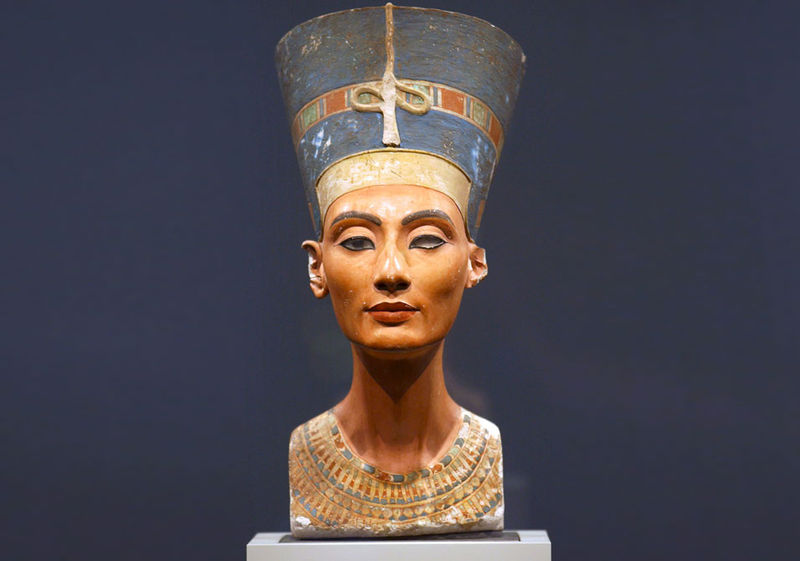
Image of bust taken at the Old Museum, Berlin, Germany. Reprinted, with permission, from State Museums of Berlin, Egyptian Museum and Papyrus Collection, Berlin, Germany; inventory no. 21300; Photo: EFE/Stephanie Pilick
OAKBROOK, ILL.- Using CT imaging to study a priceless bust of Nefertiti, researchers have uncovered a delicately carved face in the limestone inner core and gained new insights into methods used to create the ancient masterpiece and information pertinent to its conservation, according to a study published in the April issue of Radiology.
"We acquired a lot of information on how the bust was manufactured more than 3,300 years ago by the royal sculptor," said the study's lead author Alexander Huppertz, M.D., director of the Imaging Science Institute in Berlin, Germany. "We learned that the sculpture has two slightly different faces, and we derived from interpretation of the CT images how to prevent damage of this extremely precious art object."
Nefertiti, the wife of the Egyptian pharaoh Akhenaten, was the most renowned Great Royal Wife of all 31 Egyptian dynasties. Considered one of the greatest finds of ancient Egypt, the bust of Nefertiti was discovered in 1912, during excavation of the studio of famous royal sculptor Thutmose.
The Nefertiti bust consists of a limestone core covered in layers of stucco of varying thickness. The bust was examined using CT for the first time in 1992, but recent advances in CT technology allowed the researchers to analyze the statue in 2007 with greater precision.
"CT has changed significantly since 1992," Dr. Huppertz said. "We can now acquire three-dimensional (3-D) images at a much higher resolution."
Dr. Huppertz and colleagues used a 64-section spiral CT technique with submillimeter section thickness to examine the bust and assess its conservation status, gain information on its creation and provide a 3-D surface reformation of the inner limestone sculpture.
The results showed that a multi-step process was used to create the sculpture. The stucco layer on the face and ears is very thin, but the rear part of the reconstructed crown contains two thick stucco layers. CT images showed several fissures and non-uniform bonding between the layers.
The inner limestone face was delicately sculpted and highly symmetric. Compared to the outer stucco face, the inner face exhibited some differences: less depth in the corners of the eyelids, creases around the corner of the mouth and cheeks, less prominent cheekbones and a slight bump on the ridge of the nose. The ears on the inner sculpture were similar to those visible on the exterior.
Thin-section CT was able to provide detailed images of the inner structure in a completely nondestructive manner and showed the limestone core to be not just a mold, but a skillfully rendered work of art. Retouching the creases in the corners of the mouth and smoothing the bump on the nose on the outer face may have been the artist's choice and reflective of the aesthetic ideals of that era.
CT findings also may be important in preventing future damage to the bust. The findings of multiple, varying layers of stucco, as well as fissures in the shoulders, lower surface of the bust and rear of the crown, indicate vulnerable areas requiring very careful handling, and pressure on the layers of thick stucco is to be avoided.
"Noninvasive CT technology and very advanced 3-D post-processing tools allow us greater insight into the internal composition and conservation status of the sculpture," Dr. Huppertz said. "This knowledge will greatly contribute to the preservation of this priceless antiquity."
The Nefertiti bust is part of the collection of the Egyptian Museum of Berlin and will be moved in October 2009 to the recently restored New Museum in the historical center of Berlin.

Three-dimensional volume-rendered reformations of (a) visible outer layer and (b) hidden inner layer. Threshold value for surface depiction was set to level higher than 900 HU to subtract outer stucco layer. (a) More pronounced shaping of eyelid corners (_) in comparison with inner layer can be seen. (b) Creases in corners of mouth (arrows) were detected. Note slightly bumpy surface caused by boundary artifacts between stucco layer and limestone core. (c) Photograph of lateral view of bust. (Reprinted, with permission, from State Museums of Berlin, Egyptian Museum and Papyrus Collection, Berlin, Germany; inventory no. 21300; photograph taken by Jurgen Liepe.) (d) Oblique surface rendering of face shows hidden inner core and added thin layer of stucco (depicted transparently in red). Detailed surface rendering of nose of (e) visible outer layer and (f) hidden inner layer. On f, outer layer is depicted with red and high level of transparency to facilitate comparison between surfaces


/http%3A%2F%2Fstorage.canalblog.com%2F83%2F71%2F119589%2F97991347_o.jpg)
/http%3A%2F%2Fstorage.canalblog.com%2F95%2F32%2F119589%2F53481054_o.jpg)
/http%3A%2F%2Fstorage.canalblog.com%2F90%2F24%2F119589%2F48578946_o.jpg)
/http%3A%2F%2Fstorage.canalblog.com%2F50%2F15%2F119589%2F48123548_o.jpg)