

/https%3A%2F%2Fprofilepics.canalblog.com%2Fprofilepics%2F1%2F0%2F100183.jpg)
/https%3A%2F%2Fstorage.canalblog.com%2F03%2F02%2F119589%2F96711876_o.jpg)
/https%3A%2F%2Fstorage.canalblog.com%2F11%2F31%2F119589%2F94773502_o.jpg)
/https%3A%2F%2Fstorage.canalblog.com%2F20%2F83%2F119589%2F94772815_o.jpg)
/https%3A%2F%2Fstorage.canalblog.com%2F26%2F72%2F119589%2F75604929_o.jpg)
/https%3A%2F%2Fstorage.canalblog.com%2F59%2F60%2F119589%2F26458628_o.jpg)
Christie's to offer imperial Chinese porcelain from a distinguished American collection
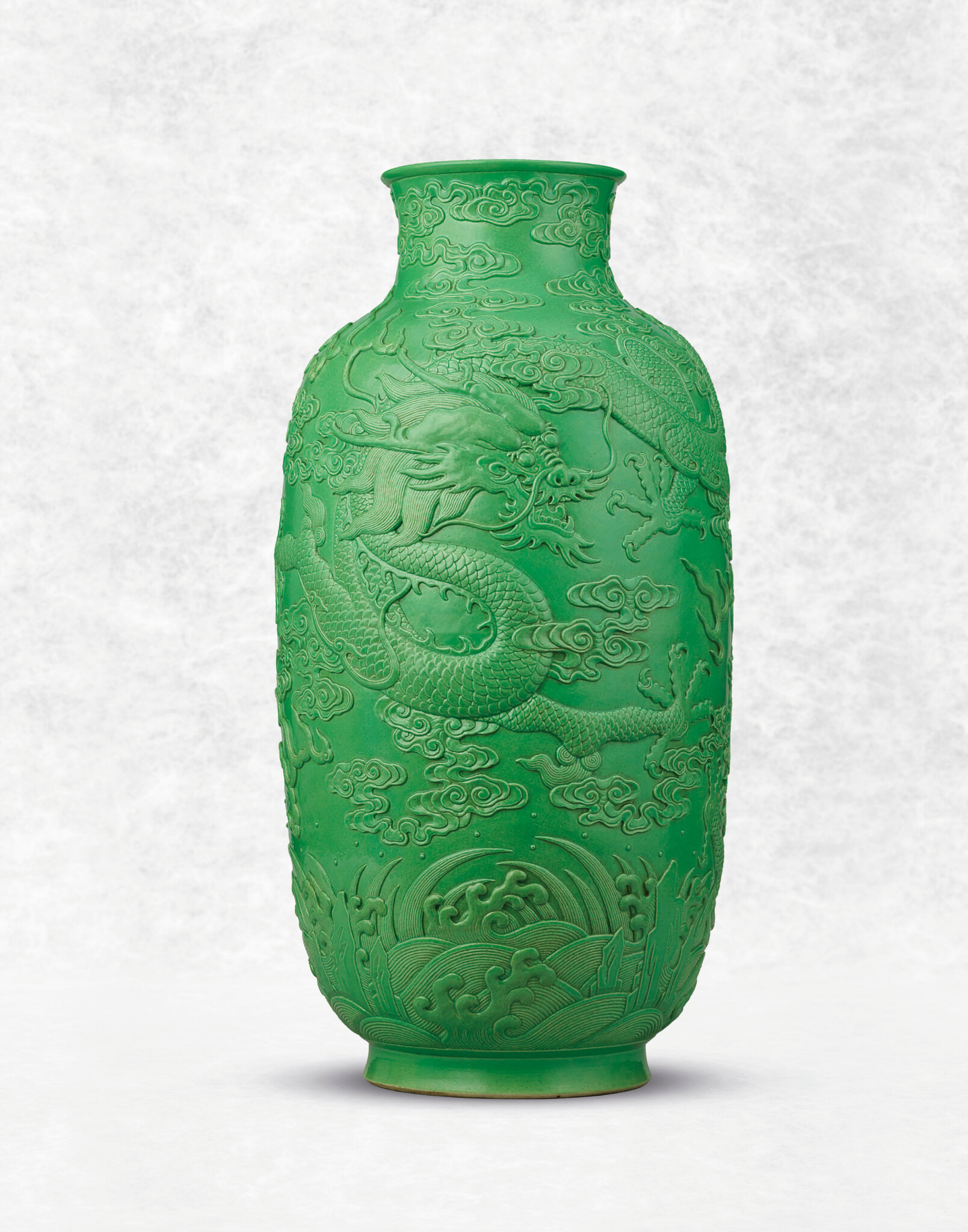
Lot 3207. A magnificent and very rare carved apple-green enamelled `dragon' lantern vase, Qianlong impressed six-character seal mark and of the period (1736-1795); 17 7/8 in. (45.6 cm.) high. Estimate: HK$18,000,000-25,000,000 / US$2,400,000-3,200,000. Price realised HKD 30,360,000. © Christie's Images Ltd 2013.
HONG KONG.- On November 27, 2013, Christie’s Hong Kong will present Imperial Chinese Porcelain: Treasures from a Distinguished American Collection, as part of its autumn auctions of Chinese Ceramics and Works of Art. Comprising 14 pieces and estimated to realize in excess of HK$55 million (US$7 million), this group of porcelain spans from the early Ming to the mid-Qing periods and represents some of the best monochrome as well as doucai, famille rose and iron-red decorated polychrome wares produced during the Ming and Qing dynasties.
Leading the sale is a very rare carved apple-green enamelled `dragon' lantern vase with a Qianlong impressed six-character seal mark and of the period (1736-1795) (Sale 3265, Lot 3207, Estimate: HK$18,000,000-25,000,000/US$2,400,000-3,200,000). The vase is magnificent not simply for its large size, but for its exceptional decoration and successful portrayal of the power of the imperial dragons which encircle its sides. The five-clawed dragon, the most potent symbol of imperial majesty, is depicted on the vessel in carved relief.
The carving on the vase is crisp and consummately skillful. The decorator has created multiple planes within the low-relief, allowing different parts of the decoration to overlap, and giving the dragons added vitality. The enamel on the vase is intense in colour but applied to the biscuit-fired body of the vessel, producing a richness that enhances the contours of the design. This is particularly evident on the bodies of the dragons, where the scales exhibit clarity of form and texture, allowing these magnificent dragons to encircle the vase emanating vitality and power.


Lot 3207. A magnificent and very rare carved apple-green enamelled `dragon' lantern vase, Qianlong impressed six-character seal mark and of the period (1736-1795); 17 7/8 in. (45.6 cm.) high. Estimate: HK$18,000,000-25,000,000 / US$2,400,000-3,200,000. Price realised HKD 30,360,000. © Christie's Images Ltd 2013.
The elongated ovoid body stands on a slightly splayed foot below a waisted neck, and is crisply moulded and carved in shallow to high relief with a ferocious five-clawed dragon striding amidst lingzhi-shaped clouds and turning to face his smaller companion below, above rolling and crashing waves and rocky outcrops around the base, all covered in an opaque enamel of brilliant apple-green tone.
Provenance: A Southeast Asian family collection, acquired in the first half of 20th century
Sold at Christie's Hong Kong, 28 October 2002, lot 714
Sold at Christie's Hong Kong, 1 November 2004, lot 901
Christie's 20 Years in Hong Kong, Chinese Ceramics and Works of Art Highlights, Hong Kong, 2006, p. 168 : Christie's 20 Years in Hong Kong, Chinese Ceramics and Works of Art Highlights, Hong Kong, 2006, p. 168
The Power of the Imperial Dragon
Rosemary Scott, International Academic Director, Asian Art
This rare and imposing vase is magnificent not simply for its size, but for the exceptional quality of its decoration and the successful manner in which it portrays the power of the imperial dragons which encircle its sides. As is the case with the majority of fine imperial vases, this example was one of a pair with essentially mirror image decoration, and its companion vase was sold by Christie's Hong Kong on 3rd November 1996, lot 730 (fig. 1), and included in the Min Chiu Society's exhibition In Pursuit of Antiquities, Hong Kong, 2001, no. 187.
Vessels of this shape are often called 'lantern' vases or 'lantern' jars because of their similarity to the form of porcelain lanterns, such as the Kangxi (1662-1722) overglaze enamelled example and 18th century doucaiexample in the collection of the Victoria and Albert Museum, London (illustrated by Rose Kerr in Chinese Ceramics - Porcelain of the Qing Dynasty 1644-1911, London, 1986, pp. 104-5, pls. 84 and 85). However, the more cylindrical form of the current vessel may also be linked to an earlier porcelain shape, which came to prominence in the Ming dynasty Yongle reign (1403-24). This early 15th century form, which usually appears with underglaze blue decoration (illustrated in The Complete Collection of Treasures of the Palace Museum 34 Blue and White Porcelain with Underglaze Red (I), Hong Kong, 2000, p. 45, no. 43), seems to have been inspired by jars made to hold medicines and ointments in Egypt, Syria and Iran. The form was also introduced to Italy in the 15th century, where it was copied in majolica (tin-glazed earthenware) and earned the name 'albarello' jar. The Islamic inspiration for the Chinese version of the form is reinforced by the underglaze blue decoration seen on the early 15th century Chinese porcelain vessels, which almost invariably includes an Islamic-style lattice - as is the case on the Palace Museum example. Both the shape and underglaze blue decoration of the early 15th century 'albarello' jars was meticulously copied at the imperial kilns in the 18th century.
In fact the form represented by the current vessel is an elegant compromise between the true lantern form - as represented by the Victoria and Albert Museum examples - and the albarello-style jars. It has less rounded sides than the lanterns, but less severely cylindrical sides than the albarello-style jars. It may also be noted that both the other forms have vertical feet and necks, which are of approximately the same radius as each other, while the current vase has a slightly splayed foot, which is noticeably wider than its everted mouth. This form seems to have been particularly popular during the Qianlong reign, when it may be seen in different sizes and with some variations in the width and height of the neck - see, for example, the red-glazed 'lantern' vase in the collection of the Palace Museum, Beijing (fig. 2) (illustrated in The Complete Collection of Treasures of the Palace Museum 37 Monochrome Porcelain, Hong Kong, 1999, p. 38, no. 34), and the overglaze enamelled 'lantern' vase in the collection of the Victoria and Albert Museum (illustrated by Rose Kerr, op. cit., p. 116, pl. 99). The large size and elegant proportions of the current vase, however, make it very rare, although an even larger 'lantern' jar decorated in underglaze cobalt blue is preserved in the Palace Museum, Beijing (illustrated in The Complete Collection of Treasures of the Palace Museum 34 Blue and White Porcelain with Underglaze Red (III), Hong Kong, 2000, p. 149, no. 135).

fig. 2. A red-glazed 'lantern' vase, Qianlong mark and period in the collection of the Palace Museum, Beijing
The decoration on the current vessel depicts the most potent symbol of imperial majesty - the five-clawed dragon - in carved relief. The powerful five-clawed imperial dragon with horns was the symbol of the emperor, and appears in many forms on the Chinese decorative arts, sometimes alone, and sometimes accompanied by the phoenix, symbol of the empress. The Chinese dragon, unlike his European counterpart, was believed to be a beneficent creature. He was not only the essence of yang (male) properties, but is also a bringer of rain. The dragon was believed to rise from winter hibernation among the waves at the Spring Equinox to bring the rain necessary to water the crops, which is why the creature on this Qianlong vase is depicted rising from the waves and flying amongst clouds. The dragon was also one of the si ling - creatures of the four quarters - the green dragon representing the east, while the west was represented by the white tiger, the south by the red bird, and the symbol of the north was the so-called dark warrior, usually depicted as a tortoise and snake combined.
Powerful relief-carved dragons amongst clouds and above waves can be seen on a large Yongzheng bowl with inverted rim and pale celadon glaze in the collection of the Palace Museum, Beijing (illustrated in The Complete Collection of Treasures of the Palace Museum 37 Monochrome Porcelain, op. cit., p. 149, no. 135). However, the majority of the vessels with this type of low-relief carved dragon decoration date to the Qianlong reign. A large Qianlong lantern vase of similar size and proportions, and with very similar relief dragon decoration to that on the current vase, but under a turquoise, rather than green, glaze in the collection of the Palace Museum, Beijing is illustrated by Feng Xianming, Geng Baochang and Ye Peilan (eds.) in Selected Porcelains of the Flourishing Qing Dynasty at the Palace Museum, Hong Kong, 1994, p. 355, no. 92 (fig. 3). The turquoise vase shares with the current vessel not only similar dragons, but the form of the clouds and the waves, including the unusual sickle-shaped waves rising from the upper surface of the sea. A white-glazed Qianlong vase in the Tianminlou Collection is decorated with similar carved dragons, but this vase does not have the sickle-shaped waves, and the clouds are depicted in a more mannered style with spiral details (illustrated in Chinese Porcelain - The S.C. Ko Tianminlou Collection, Hong Kong, 1987, no. 135) (fig. 4). A Qianlong porcelain hat stand with pale, opaque, lime green glaze in the collection of the National Palace Museum Taipei is also decorated with lively carved dragons, but in this case the dragons are amongst lotus scrolls, which they grasp with their clawed feet (illustrated in Catalogue of a Special Exhibition of Ch'ing-Dynasty Monochrome Porcelains in the National Palace Museum, Taipei, 1981, p. 101). The dragons on the hat stand also lack some of the authority of those on the current vessel. An unmarked globular vase with similar carved relief dragons under a celadon glaze is in the collection of the Metropolitan Museum of Art (fig. 5) (illustrated in The World's Great Collections - Oriental Ceramics Volume 11 The Metropolitan Museum of Art, New York, Kodansha Series, Tokyo, 1982, colour plate 29), and another is illustrated by S.W. Bushell in Oriental Ceramic Art Illustrated by Examples from the Collection of W.T. Walters, New York, 1896, fig. 183. Interestingly, somewhat less powerful dragons amongst clouds decorate a Qianlong albarello-shaped lidded jar with celadon glaze in the Palace Museum, Beijing (illustrated in The Complete Collection of Treasures of the Palace Museum 37 Monochrome Porcelain, op. cit., p. 192, no. 174).

fig. 3. A large turquoise-glazed 'dragon' lantern vase, Qianlong mark and period in the collection of the Palace Museum, Beijing.

fig. 4. A white-glazed 'dragon' vase, Qianlong mark and period in the Tianminlou Collection.

fig. 5. A celadon glaze globular 'dragon' vase, Qianlong period in the collection of the Metropolitan Museum of Art.
It is noticeable that the carving on the current vase and on the similar turquoise-glazed vessel in the Palace Museum is particularly skilful. The decorator has created multiple planes within the low-relief, allowing different parts of the decoration to overlap in a convincing manner, and adding vitality to the dragons themselves. The carving is also very crisp, and that crispness is in no way clouded by the glaze. Both the green glaze on the current vase and the turquoise glaze on the similar vase in the Palace Museum, are densely coloured but with thin glazes applied to the biscuit-fired body of the vessel, producing a richness of colour without the glaze pooling and filling delicately carved areas of the design. This is particularly evident on the bodies of the dragons, where the scales retain clarity of form and texture. The magnificent dragons thus encircle the vase emanating vitality and imperial power.
A very rare tianbai-glazed anhua-decorated ‘pomegranate’ bottle vase, yuhuchunping, from the Yongle period (1403-1425) (Sale 3265, Lot 3211, Estimate: HK$8,000,000-12,000,000/US$1,100,000-1,500,000) is another notable piece in the collection. The production of white-glazed porcelain during the Yongle period achieved technical virtuosity, distinguished by the very fine white body clay and luminous white glaze, which earned the name tianbai or ‘sweet white’ glaze. The pear-shaped vases (yuhuchunping) from the Yongle reign represent the most elegant manifestation of this classic form and this vase in particular is potted to perfect proportions and symmetry.
The sophistication of the production of white-glazed porcelain during the Yongle period of the Ming dynasty may be attributed to the Emperor’s personal fondness for white vessels. It is recorded that in the 4th year of his reign (AD1406), the Yongle Emperor received a jade bowl as tribute from the Muslim ruler of a Western state. The Emperor returned the bowl, however, with a message that the Chinese porcelain he used every day was so pure and translucent and therefore there was no need for him to use jade bowls. This white-glazed vase would have additional appeal to the Emperor with its auspicious decorations of flowering and fruiting pomegranate branches. The motif of a ripe pomegranate bursting to expose its seeds, is symbolic of liukai baizi, 'Pomegranate revealing one hundred sons', or qianzi tongmo, 'One thousand sons within the same generation', conveying the wish for numerous sons.


Lot 3211. A Fine and Very Rare Tianbai-Glazed Anhua-Decorated 'Pomegranate' Bottle Vase, Yuhuchunping; Yongle period (1403-1425); 12 5/8 in. (32.1 cm.) high. Estimate: HK$8,000,000-12,000,000/US$1,100,000-1,500,000). Price realised HKD 27,000,000. © Christie's Images Ltd 2013.
The vase is finely potted with a pear-shaped body gently tapering to an everted rim and supported on a slightly flaring foot. It is delicately incised to the body with flowering and fruiting pomegranate branches above a register of lingzhi lappets, between bands of classic scroll and ruyi-heads at the neck and a band of Wan symbols around the foot. The vase is covered with an even unctuous white glaze.
Provenance: Sold at Sotheby's New York, 22-23 September 2004, lot 275
Exceptional Elegance
Rosemary Scott - International Academic Director, Asian Art
For many connoisseurs the pear-shaped vases (yuhuchunping) of the Yongle reign represent the most elegant manifestation of this classic form. While Yuan dynasty vessels often have a pleasing delicacy, they are rarely well-finished and their luting lines are often all too evident. In the Hongwu reign the bodies of pear-shaped vases became significantly wider, to the extent that in a number of cases the harmony of the shape was lost, while evidence of luting lines often remained a problem. In the Yongle reign the proportions of pear-shaped vases achieved what many would regard as a perfect balance - with the widest point of the vessel occurring lower down the sides of the vase and providing pleasing proportions with the width of the neck and mouth. The finishing of these vessels is also fine, with luting lines skillfully disguised. While these features are important to those vases decorated in underglaze blue, they can best be appreciated on exquisite white-glazed vases such as the current example.
White-glazed pear-shaped vases from the Yongle reign are extremely rare. However, two white-glazed yuhuchunping of much coarser quality than the current vessel were excavated in 1960 from the tomb of Song Sheng, Marquis of Xining, who died in AD 1407. The original 1962 excavation report in Kaogu stated that four of these pear-shaped bottles were found and that they measured 31 cm. in height, but the Nanjing and Beijing authorities confirmed to Sir John Addis that there were only two and these measured 26 cm. in height (illustrated and discussed by J.M. Addis in Chinese ceramics from datable tombs, London and New York, 1978, p. 94-5, pl. 37j). Judging from illustrations these excavated vases, from a tomb dating to the beginning of the Yongle reign, are closer in form to those of the mid-14th century than to those of the early 15th century.
Excavations undertaken in Yongle strata at the Imperial kiln at Jingdezhen have revealed that more than 90 per cent of the pieces found were white-glazed. Although no images of excavated tianbai pear-shaped vases appear to have been published, excavators have recorded that amongst the early Yongle white wares unearthed in 1982-4 from stratum four and stratum five in the middle section of Zhushan Road were pear-shaped vases (see Liu Xinyuan in Imperial Porcelain of the Yongle and Xuande periods Excavated from the Site of the Ming Imperial Factory at Jingdezhen, Hong Kong, 1989, pp. 58-9). Illustrations have been published of a tianbai-glazed vase of more compressed and flattened, but essentially pear-shaped, form which was also excavated from the early Yongle strata in 1984 (illustrated ibid., p. 103, no. 10). This latter vase has a peach-shaped raised panel on each side, and provided the prototype for later vases of the Jiajing reign. However, a pear-shaped vase decorated with underglaze blue five-clawed dragons excavated in 1984 from the late Yongle stratum at Jingdezhen is much closer in form to the current vase, although slightly smaller (illustrated ibid., p. 169, no. 43). Two more Yongle blue and white yuhuchunping, which are similar in size to the current tianbai-glazed vase, have been published (illustrated in Imperial Hongwu and Yongle Porcelain excavated at Jingdezhen, Taipei, 1996, nos. 60 and 61). These vases, which are both decorated with floral scrolls, were excavated in 1994 from the Yongle strata at Dongmengtou, Jingdezhen.
The beautiful white glaze on this vase is of a type known as tianbai 'sweet white'. As discussed in the introductory essay in this catalogue (pp. 10-11) the Yongle emperor had a particular fondness for white - especially white jade and white porcelain. It is probably this imperial preference that inspired the development of the so-called tianbai glaze. This glaze has a rather different appearance to that of earlier white glazes. The tianbai glaze has virtually none of the bluish or greenish tinge, which was seen on the earlier qingbai and Shufu glazes made at Jingdezhen in the Song and Yuan dynasties. It was made almost entirely from glaze stone with little or no glaze ash. The glaze was lower in calcium oxide than earlier white glazes, and was higher in potassium oxide. The body of tianbai wares had a higher proportion of aluminium oxide than previous Jingdezhen porcelains and required a higher firing temperature. The result of these changes in composition and firing was a whiter body covered with a purer white glaze than had previously been achieved. The texture of the glaze was also different to that of previous Jingdezhen white wares. The glaze had a silky, unctuous texture, with none of the glassiness seen on qingbai wares. The glaze contained many tiny bubbles, densely distributed in the glaze, which scattered the light as it passed through, imparting an almost jade-like quality. The tiny bubbles which burst on the surface of the glaze also created tiny pin-prick holes, and gave the surface its subtle, characteristic, 'orange-peel' effect.
Research by the Chinese scholar Liu Xinyuan has revealed that this glaze was not known as tianbai in the 15th century (Liu Xingyuan in Imperial Porcelain of the Yongle and Xuande Periods Excavated from the Site of the Ming Imperial Factory at Jingdezhen, op. cit., p. 71-2). Liu discovered that it was not until the late 16th century that Huang Yizheng in his Shiwu gan zhu, published in the 19th year of the Wanli reign (AD 1591) used the phrase zong yan tian bai. It seems likely that by zong yan, which literally means 'bristle holes', he meant the tiny little pin-prick holes left by the burst bubbles on the glaze surface. Presumably the author was likening these tiny holes to those that might be left if the ends of single hairs were pressed into the surface. Liu also draws an interesting parallel between the use of the term tianbai, sweet white, and the discovery of a method for making white sugar at some point in the Jiajing reign (1522-66). This discovery is noted in a Qing dynasty publication Hexiangguan suo yan, a miscellany by Ding Guojun. Liu suggests that as white sugar, as opposed to dark sugar, was a relatively new phenomenon and was a fashionable condiment in the late 16th century, Huang Yizheng may well have been inspired to use it as a reference for the greatly admired white glaze.
Liu Xinyuan has also noted that imperial admiration for white porcelain continued into the early part of the Xuande reign (See discussion ibid., p. 70). Liu believes that white wares were probably still predominant in the early part of the reign and cites Korean archives (Li Chao shi lu) relating to the gifts brought by Chinese imperial envoys to the Korean court in 1428 and 1429. The first gift consisted of equal numbers of white-glazed and blue and white porcelains, while the second gift consisted of white porcelains for fifteen table settings. Imperial gifts bestowed on honoured Chinese subjects also included white porcelain in the early Xuande period, as in the case of Yang Rong, who, according to his selected writings in Yang Wenmin Gong ji, received in 1426 not only writing implements used by the emperor himself, but also a variety of white porcelain vessels. Four years later the emperor bestowed upon Yang gifts of 'platinum, pearls, cash and white porcelain ...'. These records seem to confirm Liu Xinyuan's view that the refined tianbai glaze, developed in the reign of the Yongle Emperor, continued to find considerable favour with his successor.
This current vase is enhanced by very refined decoration, which does not detract from its elegant form and subtle, jade-like glaze. The decoration is incised with a very fine point into the body, beneath the glaze. It is only if the viewer has the privilege of handling the vase that they can fully appreciate the decoration. As discussed in the introduction to this catalogue (pp. 10-11), the form of fruiting sprays in decoration on Yongle porcelains was almost certainly inspired by woodblock-printed illustrations in books such as materia medica. It is significant, for example, that the decoration on the current vase depicts both fruit and flowers on the pomegranate sprays, as this is how they were shown in such books on plants. The pomegranate would have been chosen for its auspicious wishes, since a ripe pomegranate, its skin split and its seeds visible, provides the rebus for liukai baize, 'Pomegranate revealing one hundred sons', or qianzi tongmo, 'One thousand sons within the same generation'. It was important for every family, especially the imperial family, to have sons. The flowers of the pomegranate also carried an auspicious wish, since pomegranate flowers were often worn by women, because of the fruit's association with the provision of sons, and the red colour of the flowers were believed to ward off evil, especially during the festival of Duanwujie.
A similar white-glazed pear-shaped vase with incised floral scrolls is in the collection of the Topkapi Saray Museum, Istanbul. The neck of this vessel has been cut down and 17th century metal mounts have been added by Ottoman craftsman turning it into a matara flask (illustrated by J. Ayers and R. Krahl, Chinese Ceramics in the Topkapi Saray Museum Istanbul, vol. II, p. 525, no. 635). Related Yongle vessels include a vase formerly in the Tsui Museum of Art and illustrated in the museum catalogue, Hong Kong, 1991, no. 60; another in the Pilkington Collection, illustrated by Adrian M. Joseph, Ming Porcelains, Their Origins and Development, London, 1971, no. 94; and one formerly in the H.R.N. Norton Collection, sold at Sotheby's London, 26 March 1963, lot 56. An example from the Baur Collection, decorated with pomegranates within quatrefoil medallions, is illustrated by Daisy Lion-Goldschmidt in La Porcelaine Ming, Fribourg, 1978, p. 76, no. 41 (fig. 1).
Note: The present vase is very rare and only a few other examples of this form and incised decoration are known. One was formerly in the Tsui Museum of Art and illustrated in the museum catalogue, Hong Kong, 1991, no. 60, sold at Christie's Hong Kong, 3 November 1998, lot 918; another in the Pilkington Collection, illustrated by Adrian M. Joseph, Ming Porcelains, Their Origins and Development, London, 1971, no. 94; and a third formerly in the H.R.N. Norton Collection, sold at Sotheby's London, 26 1963, lot 56. A related yuhuchunping incised with pomegranate within quatrefoil medallions is in the Baur Foundation, illustrated by Daisy Lion-Goldschmidt, La Porcelaine Ming, Fribourg, 1978, p. 76, no. 41 (fig. 1); while another slightly shorter example (29 cm.) incised with a lotus design from the Meiyintang Collection, was sold at Sotheby's Hong Kong, 7 April 2011, lot 49.

fig. 1. A rare 'sweet-white' (tianbai) yuhuchunping with lotus scrolls, Ming dynasty, Yongle period (1403-1424); 29 cm., 11 1/2 in., from the Meiyintang Collection, sold for 4,820,000 HKD at Sotheby's Hong Kong, 7 April 2011, lot 49.
Cf. my post: A rare 'sweet-white' (tianbai) yuhuchunping with lotus scrolls, Ming dynasty, Yongle period (1403-1424)
For other early Ming tianbai-glazed vessels of vertical form, compare to a very rare ewer incised with hibiscus flowers, formerly in the Manno Art Museum, sold at Christie's Hong Kong, 28 October 2002, lot 555 (fig. 2); and a very rare meiping incised with a peony scroll sold at Christie's New York, 17 September 2008, lot 245 (fig. 3).

fig. 2. A very rare early Ming tianbai-glazed ewer incised with hibiscus flowers, formerly in the Manno Art Museum, sold at Christie's Hong Kong, 28 October 2002, lot 555.

fig. 3. A very rare early Ming tianbai-glazed meiping incised with a peony scroll sold at Christie's New York, 17 September 2008, lot 245.
Excavations at the Imperial kiln sites at Jingdezhen indicate that white wares were popular in the Yongle reign, although no white-glazed pear-shaped vase appears to have been excavated to date. However, excavated examples of blue and white yuhuchunping have been found from the Yongle stratum at Jingdezhen, such as the two vases illustrated in Imperial Hongwu and Yongle Porcelain excavated at Jingdezhen, Chang Foundation, Kaohsiung, 1996, nos. 60 and 61.
Another highlight in the collection is a fine and rare copper-red and underglaze-blue decorated ‘apple-form’ water pot, Kangxi mark and period (1662-1722) (Sale 3265, Lot 3206, Estimate:7,500,000-9,500,000/US$970,000-1,200,000). With a deep interest in ceramics, the Kangxi Emperor took active measures to rebuild and develop the imperial kilns in Jingdezhen after he came to the throne. As early as the 1670s, painting on porcelain in underglaze copper-red had been rediscovered. Not content with contemporary techniques, potters kept exploring new styles. One of the most successful endeavours was painting formal designs using very fine outlines, as seen on this water pot. It is important to note that firing underglaze copper-red is very challenging, demanding precise control of heat, kiln atmosphere and air circulation, as well as careful preparation of the copper pigment. The most notable qualities of this vessel are seen in the well-executed penciled floral designs, and the bright raspberry tone of the copper-red, which is closely related to peachbloom glaze.


Lot 3206. A Fine and Rare Copper-Red and Underglaze-Blue Decorated 'Apple-Form' Water Pot, Kangxi mark and period (1662-1722); 3 3/4 in. (9.5 cm.) wide. Estimate: 7,500,000-9,500,000/US$970,000-1,200,000). Price realised HKD 7,840,000. © Christie's Images Ltd 2013
The globular body is well potted with an inturned mouth and inverted rim, skilfully painted in crushed-raspberry tones on the rounded sides with four detached full-faced blooms of lotus, hibiscus, chrysanthemum and peony, each borne on a leafy spray. The main decoration is set above a band of triangular leaves around the foot between two underglaze-blue lines, and below classic scroll border outside a lotus scroll band around the mouth. The reign mark is inscribed on the sunken base, stand, box.
Provenance: The Yuen Family Collection, Hong Kong, sold at Christie's Hong Kong, 30 April 2000, lot 591
Sotheby's Hong Kong, 23 October 2005, lot 352
Note: When the Kangxi Emperor came to the throne he immediately began to show an interest in the production of imperial porcelain. Even before he dispatched a commission to report on the state of the imperial kilns and subsequently to rebuild them, the imperial potters were encouraged to experiment, improve and rediscover, even as early as the 1670s, painting on porcelain in underglaze copper-red.
Not content with rediscovering the technique of painting and firing with underglaze red, potters during the Kangxi reign also experimented with new styles. One of the most successful endeavour of these new styles is that of painting formal designs using very fine outlines, as seen on the current water pot. Firing underglaze copper-red is very difficult, requiring the precise control of heat, kiln atmosphere and air circulation in the kiln, as well as the careful preparation of the copper pigment. The most notable qualities of the present vessel are seen in the well-executed pencilled floral designs, and the bright raspberry tone of the copper-red which is closely related to that of the peachbloom glaze. Compare to a similarly shaped peachbloom-glazed water pot but with a cylindrical neck from the Jingguantang Collection, sold at Christie's Hong Kong, 3 November 1996, lot 557.
Apple-shaped water pots belong to a group of vessels for the scholar's table known as Badama, 'Eight Great Numbers' manufactured during the Kangxi reign. This group was previously thought to comprise a total of eight differing shapes. John Ayers identified a possible ninth form of the Badama by pointing out the existence of two slightly different globular water pots. The first is pingguo zun, 'apple jar' such as the current example; and the other with a raised, low, neck (similar to a stalk) that maybe referred to as a shiliu zun, or 'pomegranate jar'. See, J. Ayers, 'The 'Peachbloom Wares of the Kangxi Period (1662-1722), Transactions of the Oriental Ceramic Society, vol. 64, 1999-2000, p. 49.
Other water pots of similar shape and painting style from important collections include one from the C.P. Lin Collection included in the exhibition, Elegant Form and Harmonious Decoration, Percival David Foundation, London, 1992, illustrated by R. Scott, Catalogue, no. 113; another is illustrated by R. Krahl, Chinese Ceramics from the Meiyintang Collection, vol. II, London, 1994, no. 733; one in the Palace Museum, Beijing, illustrated in Kangxi Yongzheng Qianlong, Hong Kong, 1989, p. 39, pl. 22 (fig. 1); and one in the Shanghai Museum, illustrated in Underglaze Blue and Red, Hong Kong, 1987, pl. 118. Compare also the water pot from the E.T. Chow Collection, sold at Christie's New York, 19 March 2008, lot 644 (fig. 2); another one also from E.T. Chow Collection, sold at Christie's New York, 19 September 2007, lot 391; and one sold at Christie's Hong Kong, 1 December 2009, lot 1885.

fig. 1. A Copper-Red and Underglaze-Blue Decorated 'Apple-Form' Water Pot, Kangxi mark and period (1662-1722) in the Palace Museum, Beijing.

Fig.2. A Copper-Red and Underglaze-Blue Decorated 'Apple-Form' Water Pot, Kangxi mark and period (1662-1722) from the E.T. Chow Collection, sold at Christie's New York, 19 March 2008, lot 644.
A very rare doucai and famille rose basin dating to the Qianlong period (1736-1795) is also of notable interest (Sale 3265, Lot 3214, Estimate: HK$3,800,000-5,500,000/US$500,000-710,000). During the Yongzheng period, famille rose enamels had first been incorporated into the doucai palette. Their range of transparent, translucent and opaque colours, stand in strong contrast to the cobalt blue contours, creating an unprecedented visual interplay, which is rich in colour and texture. During the Qianlong period, the production of doucai wares was taken to new heights, with more elaborate designs that required advanced level of painting and enamelling. The basin is a perfect example that testifies to such technical dexterity and artistic sophistication. The outlines of the design were meticulously painted in underglaze blue with a very complex but well-balanced composition; famille rose enamels were then painstakingly filled in with great precision, and the addition of gilt highlights, which were new to the doucai palette, further provides the colourful and much textured picture with greater resplendence. No other identical example appears to have been published to date.


Lot 3214. A Very Rare Doucai and Famille Rose Basin, Qianlong period (1736-1795); 17 5/8 in. (45 cm.) diam. Estimate: HK$3,800,000-5,500,000/US$500,000-710,000). Price realised HKD 7,000,000. © Christie's Images Ltd 2013.
The basin is well-potted with shallow and slightly rounded sides rising from a flat base to an everted rim. The interior is enamelled in doucai with a lotus flower medallion encircling four stylised Shou characters further enclosing a gilded Wan emblem, surrounded by a band of lotus scroll with each bloom centred by a Shou character. The same design is repeated on the cavetto, both sides of the rim and the exterior side, and interspersed with borders of ruyi clouds and alternating bats and Wan emblems. The base of the exterior is decorated in famille rose enamels with a lotus bloom in the centre encircled by two concentric bands of bats. The mouth rim, and selected Shou characters and Wan emblems are highlighted in gilt.
Provenance: Sold at Sotheby's Hong Kong, 2 May 2005, lot 605.
Note: Famille rose enamels were first incorporated into the doucai palette during the Yongzheng period, their range of transparent, translucent and opaque colours, stand in strong contrast to the cobalt-blue contours, creating an unprecedented visual interplay both rich in colour and texture. During the Qianlong period, the production of doucai wares was taken to new heights, bringing more elaborate designs that required exceptionally high level of painting and enamelling. The present basin is a wonderful example that testifies to such technical dexterity and artistic sophistication. The outlines of the design had been meticulously painted in underglaze blue with a very complex but well-balanced composition, famille rose enamels were then painstakingly filled in with great precision, and the addition of gilt highlights, which was new to the doucai palette until this stage, further endows the colourful and much textured picture with resplendence.
No other examples of this exact design appears to have been published, but one unmarked basin decorated with the Eight Daoist Treasures in doucai and famille rose was sold in Sotheby's Hong Kong, 7 May 2002, lot 533, which is closely associated with the current example both in terms of its shape and decorative techniques.
The sale also includes a pair of rare iron-red decorated ‘dragon and phoenix’ jars and covers, with Daoguang iron-red six-character seal marks and of the period (1821-1850) (Sale 3265, Lot 3213, Estimate:HK$4,000,000-6,000,000/US$520,000-770,000). The jars are painted in gradated tones of iron red with details picked out in gilt, creating an elaborate visual effect. Adding to their rarity is the retention of their original covers, also similarly painted with pairs of dragons and phoenix. The combination of dragon and phoenix on each jar is symbolic of imperial unity, with the dragon representing the emperor and the phoenix representing the empress. This suggests that this pair of exquisite jars was possibly commissioned as a wedding gift to the emperor.


Lot 3213. A pair of rare iron-red decorated ‘dragon and phoenix’ jars and covers, Daoguang iron-red six-character seal marks and of the period (1821-1850); 11 1/4 in. (28.7 cm.) high. Estimate:HK$4,000,000-6,000,000 / US$520,000-770,000. Price realised HKD 9,160,000. © Christie's Images Ltd 2013.
Each jar is finely painted in shades of iron-red and with details picked out in gilt, with a striding five-clawed dragon and a long-tailed phoenix in flight, reserved on a dense ground of undulating peony meander, which is repeated on the domed cover. The decoration on the jar is set between stylised overlapping lotus petals around the foot and cloud collars at the shoulder. The waisted neck is encircled with a further peony scroll between gilt borders.
Provenance: Sold at Sotheby's London, 18 November 1998, lot 871.
Note: One of the earliest symbolic motifs from antiquity which continued to have resonance was the ultimate symbol of power, the dragon (emperor), and his consort, the phoenix (empress). The form of rank and importance became formalised in the Yuan period (1279-1367) when three-clawed (princely), and five-clawed (Imperial) dragons first appear in jade and porcelain before male and female Imperial beasts were conjoined in symbolic Imperial union in the early Ming. Into the Qing court, the combination of dragon and phoenix was particularly popular in Kangxi famille verte ware, including Kangxi-marked dishes and bowls in the collection of the Palace Museum, see Porcelains in Polychrome and Contrasting Colours, The Complete Collection of Treasures of the Palace Museum, Hong Kong, 1999, pls. 133 and 135. These examples depicting striding five-clawed dragons and fanciful phoenixes amidst flowers are believed to be made for Imperial use.
The current pair of jars painted with similar elaborate dragons and phoenix in iron-red appears to be a unique design made for the Daoguang court. Compare to a smaller Kangxi-marked lidded jar depicting dragons chasing pearls amidst clouds in the doucai technique with green glaze, also bordered between small cloud collars and lotus lappets, ibid., pl. 190.
Compare also to a pair of qin-shaped covered boxes of Daoguang mark and period, decorated in iron-red with the same motif of dragons and pheonix amidst a peony scroll, illustrated in Qingdai ciqi shangjian, Hong Kong, 1994, no. 315.


/http%3A%2F%2Fstorage.canalblog.com%2F57%2F58%2F119589%2F116765787_o.jpg)
/http%3A%2F%2Fstorage.canalblog.com%2F06%2F10%2F119589%2F104000642_o.jpg)
/http%3A%2F%2Fstorage.canalblog.com%2F54%2F32%2F119589%2F124679335_o.jpg)
/http%3A%2F%2Fstorage.canalblog.com%2F30%2F21%2F119589%2F119724409_o.jpg)