

/https%3A%2F%2Fprofilepics.canalblog.com%2Fprofilepics%2F1%2F0%2F100183.jpg)
/https%3A%2F%2Fstorage.canalblog.com%2F03%2F02%2F119589%2F96711876_o.jpg)
/https%3A%2F%2Fstorage.canalblog.com%2F11%2F31%2F119589%2F94773502_o.jpg)
/https%3A%2F%2Fstorage.canalblog.com%2F20%2F83%2F119589%2F94772815_o.jpg)
/https%3A%2F%2Fstorage.canalblog.com%2F26%2F72%2F119589%2F75604929_o.jpg)
/https%3A%2F%2Fstorage.canalblog.com%2F59%2F60%2F119589%2F26458628_o.jpg)
A fine and rare pink-ground famille-rose vase with poems, Seal mark and period of Qianlong


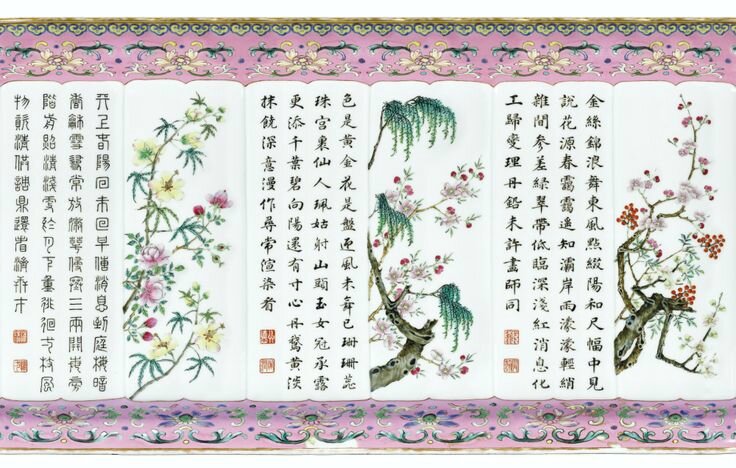
Lot 3050. A fine and rare pink-ground famille-rose vase with poems, Seal mark and period of Qianlong (1736-1795); 28.8 cm, 11 1/4 in. Estimate 6,000,000 — 8,000,000 HKD. Lot sold 19,720,000 HKD. Photo: Sotheby's.
the finely potted cylindrical body resting on a slightly splayed foot and rising to a short waisted neck below a flaring mouth, the exterior moulded in six lobed panels enclosing alternating inscriptions of poems written in seal script, running script and standard script, and delicately enamelled clusters of flowering and budding hibiscus and rose, prunus and willow, and prunus and nandina berries, all between the rich pink-ground neck and foot filled with stylised lotus scrolls, the interior and base enamelled in turquoise, with a central square on the base reserved in white for the iron-red six-character seal mark.
Provenance: Estate of the Late Mr. L.J. Pead, England, in his collection since before 1961.
Note: Vases elegantly decorated with verses and corresponding flower illustrations were marvels of the Qianlong period. Inspired by scroll paintings, this type of design provided the craftsman the challenge of transferring a two-dimensional painting onto a three-dimensional ceramic piece. This transferral has been successfully achieved in the present vase by the use of finely moulded panels to frame the inscriptions and floral images, all of which are placed between pink ground borders reminiscent of textile versions on scroll paintings.
The three poems may be translated as follows:
Golden threads in brocade waves
dance in an eastern breeze,
A balmy warmth in dots and stitches
here in a foot-size picture.
It’s said that at Peach Blossom Spring
springtime had a misty lushness,
And we know from afar how the banks of the Ba
lie in drizzling rain.
For so does light patterned gauze appear here
intermittently among varied greens,
And swathes of emerald look down on
reds both deep and pale.
If the Creator with Its power of change and transformation
returned to revise and adjust,
Perhaps even It might apply the colours
just as the painter did.
Seals: Qianlong and Chen Han ('written by His Majesty')
Their colour yellow gold,
the blossoms round as disks,
Greet the breeze, though not quite dancing
flutter, flutter so.
In the Palace of Budded Pearls
immortals wear them at the waist,
And on the summit of Mount Guye
the jade maiden wears them as a cap.
Once moistened with dew they acquire another
thousand deep green leaves,
When even facing the sun their tiny hearts
still remain red.
Goose yellow lightly applied,
enhances their deep meaning,
Their colour not painted casually
the way it usually appears.
Seals: Bide ('Compare yourself to jade') and Langrun ('Bright and lustrous')
Up in the sky the spring sun
returns but isn’t quite back,
To transmit its transformative power early
to the garden prunus,
Releasing the subtle fragrance as usual
to mix with snow,
Tender calyxes, though invaded by cold,
still opening in twos and threes.
Wherever they lean over before the steps
they cast images on clear shallows,
Even more so when beneath the moon
they linger there again.
With a bough of this common thing
I make a pure offering,
For even blending flavours in a caldron
may reveal one’s capacity to save the world.
Seals: Weijing ('Be wholly meticulous') and Weiyi ('Be wholly one')
The poems are recorded in Yuzhi leshan tang quanji dingben (Definitive Edition of the Complete Works From the Delight in Goodness Hall, by His Majesty) (Siku quanshu ed.), juan 24:15a, for which the Qianlong emperor composed a preface dated 1737. The writings in this collection date from before he became emperor. Written in praise of peach blossoms and willow, mallow, and prunus, these poems were also included in a set of five paintings by Jiang Tingxi (1669-1732) bearing the imperial inscriptions, the remaining two illustrating the lotus, and pine and peony. This vase represents Qianlong’s personal taste, which gravitated towards porcelain designs that were artistically complex and disclosed his appreciation for scholarship as expressed in his writings and poems.
Vases that combine panels of imperial poems and corresponding floral designs include two ovoid vases with tall trumpet necks decorated in a related fashion, bearing an imperial poem and floral designs in panels; one with a gilt-ground, from the Qing Court collection and still in Beijing, illustrated in The Complete Collection of Treasures of the Palace Museum. Porcelains with Cloisonné Enamel Decoration and Famille Rose Decoration, Hong Kong, 1999, pl. 137; and a large turquoise-ground vase, from the Wang Xing Lou collection, included in the exhibition Imperial Perfection. The Palace Porcelain of Three Chinese Emperors, Minneapolis Institute of Arts, Minneapolis, 2004, cat. no. 53. See also an octagonal vase decorated with two floral panels and two poems against a gilt-decorated blue ground, in the National Palace Museum, Taipei, included in the Museum’s Special Exhibition of K’ang-hsi, Yung-cheng and Ch’ien-lung Porcelain Ware from the Ch’ing Dynasty in the National Palace Museum, 1986, cat. no. 80; and a square section example sold in these rooms, 8th April 2013, lot 3025.
Sotheby's. Fine Chinese Ceramics and Works of Art, Hong Kong, 08 April 2014


/http%3A%2F%2Fstorage.canalblog.com%2F68%2F45%2F119589%2F130437877_o.jpg)
/http%3A%2F%2Fstorage.canalblog.com%2F43%2F90%2F119589%2F130080182_o.jpg)
/http%3A%2F%2Fstorage.canalblog.com%2F65%2F90%2F119589%2F129993341_o.jpg)
/http%3A%2F%2Fstorage.canalblog.com%2F29%2F27%2F119589%2F129013103_o.jpg)