

/https%3A%2F%2Fprofilepics.canalblog.com%2Fprofilepics%2F1%2F0%2F100183.jpg)
/https%3A%2F%2Fstorage.canalblog.com%2F03%2F02%2F119589%2F96711876_o.jpg)
/https%3A%2F%2Fstorage.canalblog.com%2F11%2F31%2F119589%2F94773502_o.jpg)
/https%3A%2F%2Fstorage.canalblog.com%2F20%2F83%2F119589%2F94772815_o.jpg)
/https%3A%2F%2Fstorage.canalblog.com%2F26%2F72%2F119589%2F75604929_o.jpg)
/https%3A%2F%2Fstorage.canalblog.com%2F59%2F60%2F119589%2F26458628_o.jpg)
An iron-red and green enamelled 'Buddhist lions' dish, Jiajing six-character mark and of the period (1522-1566)

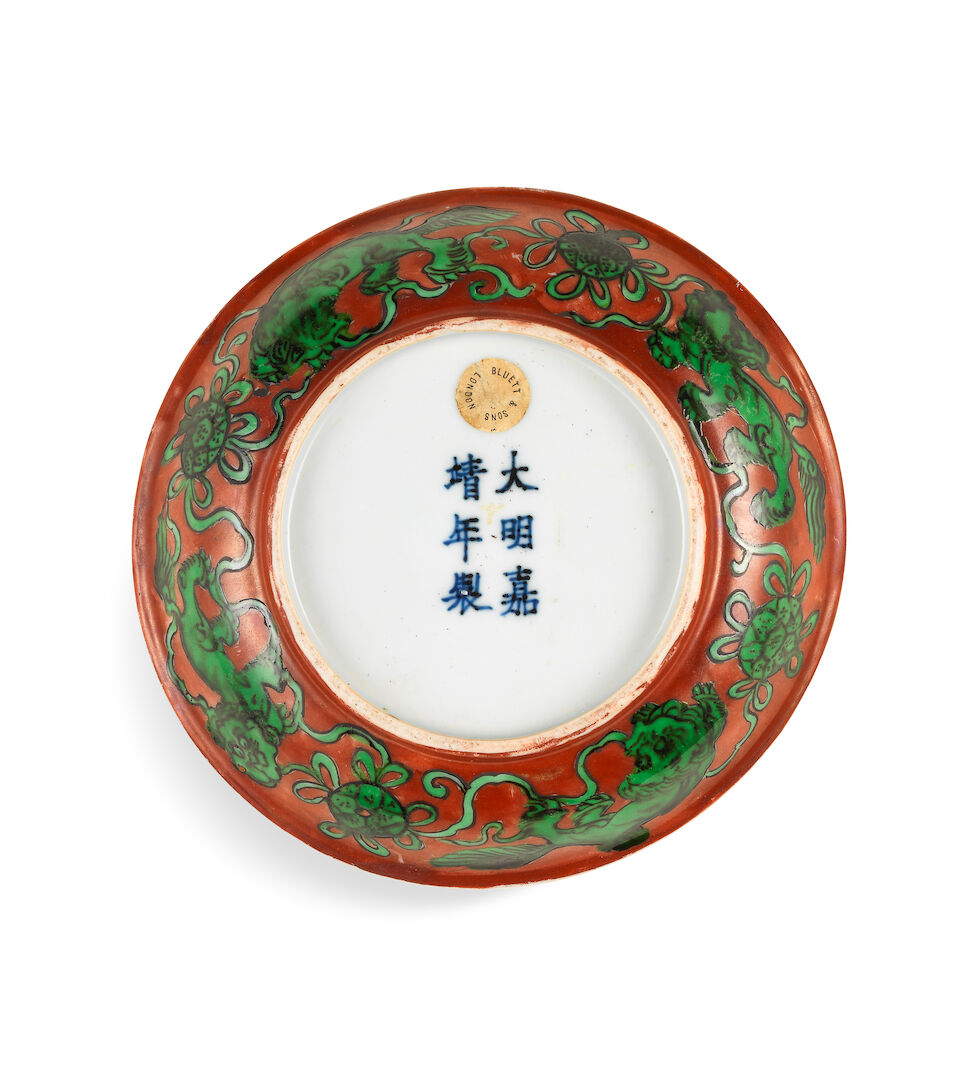
Lot 1. An iron-red and green enamelled 'Buddhist lions' dish, Jiajing six-character mark and of the period (1522-1566); 15.2cm (6in) diam. Estimate HK$ 120,000 - 180,000 (€14,000 - 21,000). Sold for HK$ 525,000 (€ 62,336). Photo: Bonhams.
The shallow dish with gently rounded sides rising to an everted rim, decorated on the exterior with four Buddhist lions, each interspersed by a beribboned brocade ball, the interior with a large central medallion enclosing another pair of Buddhist lions with a brocade ball, all on a vibrant dark red ground, the base with a six-character kaishu mark.
Provenance: Bluett & Sons, London (label)
Richard Meyerhoff collection, sold at Sotheby's London, 13 May 1958, lot 17
Wilfred A. Evill collection (d.1963), sold at Sotheby's London, 30 November 1965, lot 48
Sotheby's London, 13 December 1983, lot 271
Hans Goldstein collection and thence by descent
Hans Goldstein grew up in Germany between the Wars in a family steeped in music and culture. As a consequence of the Second World War, he and his wife became refugees and ended up in Malaysia where he became a successful consulting civil engineer. His work took him to all parts of the Far East and this in turn stimulated his interest in Oriental art and in particular Chinese porcelain. His collection developed gradually and initially concentrated on inside-painted snuff bottles. As he became more knowledgeable, he began to collect blue and white porcelain and other Chinese ceramics and works of art that attracted his keen sense of shape, colour and artistic quality. Following his semi-retirement in the mid-1960s and his move to set up the firm's offices in the UK, he continued to collect by regularly visiting art dealers and the main auction houses in London. On his death, his collection was bequeathed to his family.
Notes: The image of Buddhist lions pursuing and playing with brocade balls forms the rebus ershi gunxiuqiu or shuangshi xiqiu, and provides the auspicious wish for an abundance of blessings and joy. The present dish is a typical example of Ming-style Buddhist lions which is characterised by a loose and whimsical quality.
Compare two dishes in the British Museum, with the same design of Buddhist lions and colour combination, illustrated by J.Harrison-Hall, Ming Ceramics, London, 2001, p.256, nos.9:95 and 9:96. Another similar dish in the Asian Art Museum of San Francisco is illustrated by He Li, Chinese Ceramics, A New Comprehensive Survey, London, 1996, no.457.
BONHAMS. FINE CHINESE CERAMICS AND WORKS OF ART, 4 Jun 2015 10:30 HKT - HONG KONG, ADMIRALTY


/http%3A%2F%2Fstorage.canalblog.com%2F67%2F82%2F119589%2F114111751_o.jpg)
/http%3A%2F%2Fstorage.canalblog.com%2F48%2F10%2F119589%2F113977420_o.jpg)
/http%3A%2F%2Fstorage.canalblog.com%2F35%2F89%2F119589%2F113859464_o.jpg)
/http%3A%2F%2Fstorage.canalblog.com%2F18%2F30%2F119589%2F104127109_o.jpg)