

/https%3A%2F%2Fprofilepics.canalblog.com%2Fprofilepics%2F1%2F0%2F100183.jpg)
/https%3A%2F%2Fstorage.canalblog.com%2F03%2F02%2F119589%2F96711876_o.jpg)
/https%3A%2F%2Fstorage.canalblog.com%2F11%2F31%2F119589%2F94773502_o.jpg)
/https%3A%2F%2Fstorage.canalblog.com%2F20%2F83%2F119589%2F94772815_o.jpg)
/https%3A%2F%2Fstorage.canalblog.com%2F26%2F72%2F119589%2F75604929_o.jpg)
/https%3A%2F%2Fstorage.canalblog.com%2F59%2F60%2F119589%2F26458628_o.jpg)
Chinese bronze mirrors at Compton Verney Art Gallery

Five T mirror, Eastern Zhou dynasty, Warring States Period (475-221 BC). Bronze. D: 15.5 cm. CVCSC 0393.A © Compton Verney
This is the oldest mirror in the Compton Verney collection, dating to the Warring States period. The five T-shapes on this mirror are known as the shan (or mountain) designs, because they resemble the Chinese character for mountain. Very similar designs have been found in woven and embroidered fabrics from the period.

Mirror, Western Han dynasty (206 BC-AD 24). Bronze. D: 13.9 cm. CVCSC 0374.A © Compton Verney
The so-called caoye (grass and leaf) mirror was one of the most popular designs in the period of the Western Han dynasty, decorated with symmetrically-placed clusters of stylised grasses and leaves. The square frieze in the centre, in common with other mirrors of this type, bears an inscription which reads: jian ri zhi guang fu le wei lai (as you look upon the light of the sun, wealth and pleasure lie ahead).

Xingyun (star and cloud) mirror, Western Han dynasty (206 BC-AD 24). Bronze. D: 15.9 cm. CVCSC 0394.A © Compton Verney
This mirror is particularly striking for the contrast of bright silvery-white details against a black background.

Immortal and beast mirror, Eastern Han dynasty (AD 24-220). Bronze. D: 22.6 cm. CVCSC 0395.A © Compton Verney
This mirror features the deities Xiwangmu (the Queen Mother of the West) and her consort Daongwanggong (the King Father of the East), with the Azure Dragon and the White Tiger, which also feature on another mirror in this collection. The Queen Mother of the West was said to rule over a paradise in the Kunlun Mountains, far to the west. She was thought to control access to heaven and to possess the elixir of life. The cult of Xiwangmu seems to have begun among the peasants, but by the time this mirror was made, it had spread to the gentry.
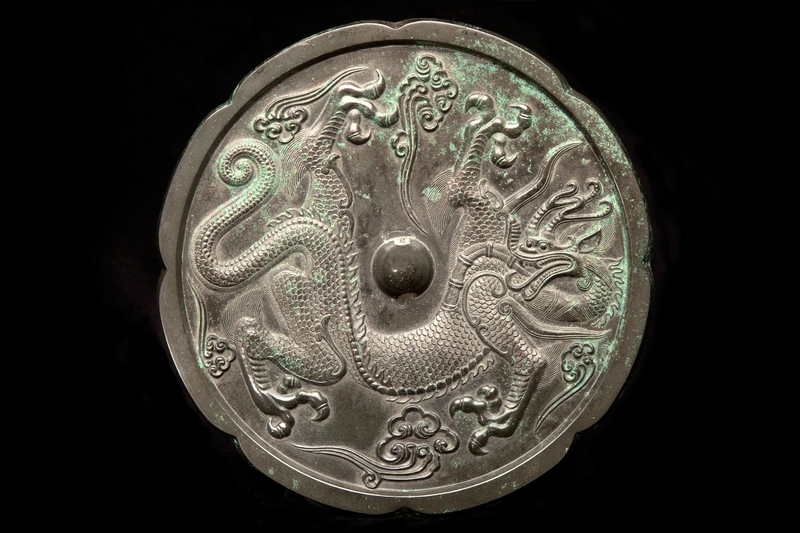
Lobed mirror, Tang dynasty (AD 618-906). Bronze. D: 22.8 cm. CVCSC 0375.A © Compton Verney
This mirror, dating from the Tang dynasty, is decorated with an elaborate dragon motif surrounded by trailing clouds. Designs on earlier mirrors are usually symmetrical and have circular designs reflecting the round shape of the mirror.

Animal and grapevine mirror, Tang dynasty (AD 618-906). Bronze. D: 13.7 cm. CVCSC 0396.A © Compton Verney
The decorated side of this mirror features a lion and grape motif, one of the most common designs of the Tang dynasty. During this period, new varieties of grape began to be imported from Central Asia, and in about AD 640 the Chinese learned from the people of Turkestan the art of fermenting grapes to make wine.
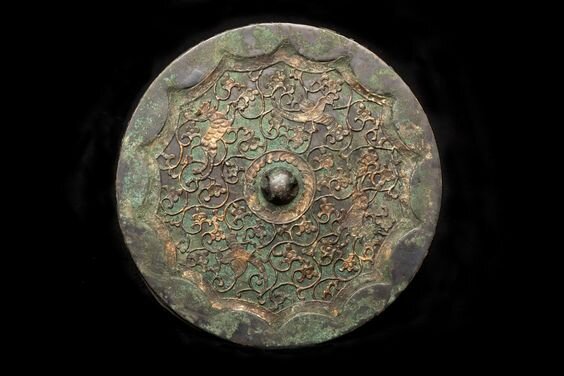
Goldsheet-applied mirror, Tang dynasty (AD 618-906). Bronze. D: 22 cm. CVCSC 0371.A © Compton Verney
This mirror is richly decorated with an animal and foliage design surrounded by scrolls. Mirrors were valuable objects and were buried in tombs for use in the afterlife. The use of gold in this mirror attests the wealth and status of its owner.

Square flying deity and crane mirror, Tang dynasty (AD 618-906). Bronze. H: 11.8 cm x W: 11.8cm square. CVCSC 0397.A © Compton Verney
The predominant shape for mirrors until the Tang dynasty was round. During the Tang more shapes appear, including lobed and, as in this case, square. This unusual example features a crane, a phoenix and two flying deities, surrounded by cloud scrolls. Cloud designs relate to the belief that the soul could travel on a cloud to join the world of immortal beings.

Phoenix mirror, Tang dynasty (AD 618-906). Bronze. D: 16 cm. CVCSC 0379.A © Compton Verney
Mirrors were luxury items and status symbols of the privileged classes. Although they remained the preserve of the élite, by the time this mirror was produced they had become more widespread, and their ownership had broadened to include the rising merchant classes. The central design of this mirror features two phoenix, surrounded by motifs of insects and floral sprays.

Lobed mirror, Song dynasty (AD 960-1279). Bronze. D: 14.5 cm. CVCSC 0376.A © Compton Verney
This mirror is cast in the form of a six-petalled flower, featuring four boys surrounded by lotus scrolls and floral designs.


/image%2F1371349%2F20250430%2Fob_6c9730_1000016356.jpg)
/image%2F1371349%2F20250117%2Fob_ad946b_1000007906.jpg)
/image%2F1371349%2F20250117%2Fob_ac36ae_1000007904.jpg)
/http%3A%2F%2Fstorage.canalblog.com%2F87%2F88%2F119589%2F134044818_o.jpg)