

/https%3A%2F%2Fprofilepics.canalblog.com%2Fprofilepics%2F1%2F0%2F100183.jpg)
/https%3A%2F%2Fstorage.canalblog.com%2F03%2F02%2F119589%2F96711876_o.jpg)
/https%3A%2F%2Fstorage.canalblog.com%2F11%2F31%2F119589%2F94773502_o.jpg)
/https%3A%2F%2Fstorage.canalblog.com%2F20%2F83%2F119589%2F94772815_o.jpg)
/https%3A%2F%2Fstorage.canalblog.com%2F26%2F72%2F119589%2F75604929_o.jpg)
/https%3A%2F%2Fstorage.canalblog.com%2F59%2F60%2F119589%2F26458628_o.jpg)
Court Lady and Man, China, Tang dynasty, 8th century
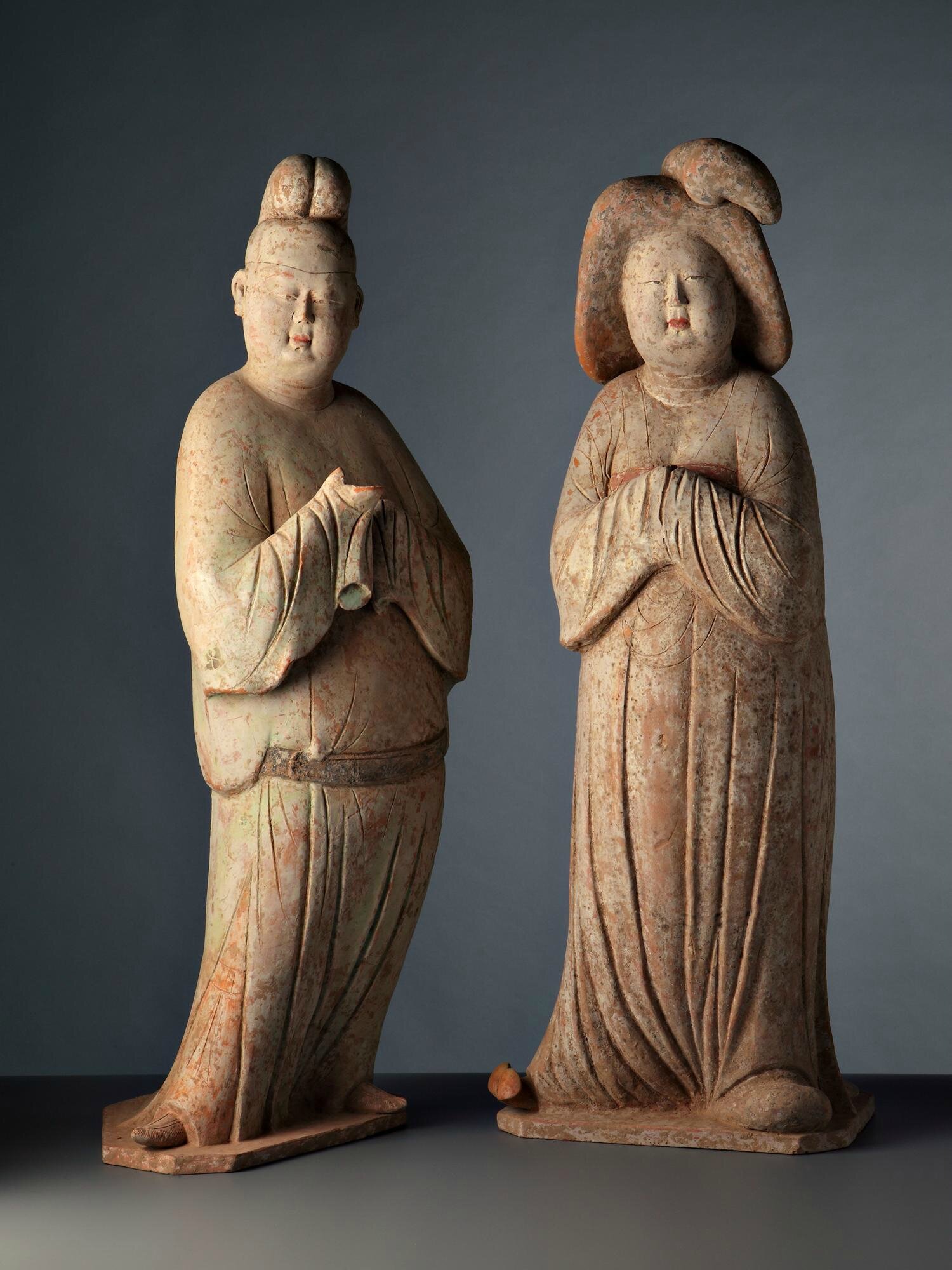


Court Lady and Man, China, Tang dynasty, 8th century . Height: 77,5 & 78. TL-tested by Oxford, U.K. Vanderven Oriental Art at Brafa Art Fair, Brussels, 21-29 january 2017.
Naturalistically rendered, the elegant lady wears a loose gown with long sleeves that hide her clasped hands; Her elaborate coiffure, with hair piled up toward the left side, presumably reflected the fashion of the time. The traces of the colourful pigments, still visible on the robe, may have depicted the typical, tie-dye, or brocade patterns, of Tang luxury silk garments.
The man stands with his weight slightly forward, his head turned slightly to the right and hair forming two long whiskers, gathered into a bun and hidden under a turban on top of the head; he wears a long, soft wide sleeved, belted tunic and pointy shoes.
The plumpness of the figures, ubiquitous found in pottery figures and tomb frescoes dating from the 8th century, may have been the result of a great impact played by the full-figured concubines of Emperor Xuanzong (r. 713-756). It may be more probable, however, that the sedentary lifestyle and the greater availability and variety of food delicacies, imported from the neighboring countries, determined an increase in weight among members of the society. “There is nothing that cannot be eaten”, an eight century general declared, clearly suggesting a great interest in food devoted at the time. Golden peaches from Samarkand graced the tables of the emperors and his favourites; pistachios, imported from Persia, started to be also grown in the Southeast by the 9th century; the best pine seed and ginseng roots originated from Korea, mangoes were imported from Southeast Asia. The emperor hosted great feasts for the members of his household, involving several meal supervisors and cooks managing the delicacies sent to the court as tribute. A record mentions that in 644, 768 and 826 the throne feasted thousands of officers and women of the palace and members of the imperial family.
Comparable examples are found in the collection of leading museums around the world, such as the British Museum (London), the Ashmolean Museum (Oxford), the Metropolitan Museum (New York) and the Victoria and Albert Museum.
Vanderven Oriental Art. Chinese early ceramics from the Han & Tang Periods, Ming & Qing porcelains & works of art including Jades, Bronzes, hardstones and wood. Japanese porcelains, 20th century lacquer & bronzes. Nachtegaalslaantje 1, 5211 LE s-Hertogenbosch, Netherlands.


/https%3A%2F%2Fstorage.canalblog.com%2F56%2F88%2F119589%2F113968941_o.jpg)
/https%3A%2F%2Fstorage.canalblog.com%2F03%2F91%2F119589%2F113998841_o.jpg)
/https%3A%2F%2Fstorage.canalblog.com%2F47%2F43%2F119589%2F113998783_o.jpg)
/https%3A%2F%2Fstorage.canalblog.com%2F10%2F17%2F119589%2F113934339_o.jpg)