

/https%3A%2F%2Fprofilepics.canalblog.com%2Fprofilepics%2F1%2F0%2F100183.jpg)
/https%3A%2F%2Fstorage.canalblog.com%2F03%2F02%2F119589%2F96711876_o.jpg)
/https%3A%2F%2Fstorage.canalblog.com%2F11%2F31%2F119589%2F94773502_o.jpg)
/https%3A%2F%2Fstorage.canalblog.com%2F20%2F83%2F119589%2F94772815_o.jpg)
/https%3A%2F%2Fstorage.canalblog.com%2F26%2F72%2F119589%2F75604929_o.jpg)
/https%3A%2F%2Fstorage.canalblog.com%2F59%2F60%2F119589%2F26458628_o.jpg)
‘THE EASTERN RENAISSANCE’. Important Ming Imperial Works of Art from the Le Cong Tang Collection

© Christies Images Ltd 2017
‘THE EASTERN RENAISSANCE’
THE SPIRIT OF ART
Master of Le Cong Tang
Compared to many animals, we humans fall far behind when it comes to certain physical abilities. Birds fly effortlessly in the sky and fish breathe underwater, neither of which human can do; nor can human compete in speed and strength with some ferocious animals. Yet, humans consider themselves as the “spirit” of all species on Earth. Why?
Personally, I think humans surpass animals in at least three important aspects:
First of all, humans have the ability to form abstract thoughts, leading to the development of mathematics and science, as well as technology and skills.
Second, humans have a sense of aesthetics, are inspired by beauty and have the ability to transform their experience into art.
Finally, humans are capable of showing respect, whereas animals merely resort to force and violence. There are many things that people respect, including deities, nature, life, tradition, erudition, and art.
These three aspects form the “spirit” of humanity. In fact, the reason why humans are superior is precisely because animals lack such kind of “spirit”.An artist can create outstanding art works only as a result of three factors. Firstly, the artist needs numerous years of hard work to develop his or her technique and skill. Secondly, the artist must possess a transcendent sense of aesthetics. Thirdly, the artist needs to have the utmost respect for art, and endeavours for perfection. Works that come from the “soul” must thus be full of “spirit.”
People often ask, “If forgeries are just as good as the originals, why can’t they be appreciated on the same level?”
The problem with forgeries, however, is that they lack “spirit.” The forgers apishly imitate the techniques of the original in an attempt to deceive the public in the quest for illicit profit. As a result, forgeries are full of malicious intent and unrighteousness.
Seemingly inanimate, art works actually convey strong messages. Original art works are created with a sense of sincerity that is full of “spirit”, like a breath of fresh air, imbuing viewers with vitality. On the other hand, forgeries poison the viewers, lulling them into a state of vulgarity.
The point of collecting is not hoarding things to make a profit but to gather the “spirit” and then share it with others.
The success of collectors lies not in how much profit they can make from their collections.
The value is derived from the amount of “spirit” that can be discovered and passed on.

The famous collector J.M Hu, the master of Zande Lou (Studio of Temporary Enjoyment).
MING PORCELAIN AND LACQUER FROM THE LE CONG TANG COLLECTION
Having known collectors of many types over decades, I have concluded that three elements make for a great collector. First is a sense of beauty and the good taste that comes and develops with it. Second is the ability and willingness to devote ample resources, including time, to collecting and researching. This is especially true of Chinese art. Third is a willingness to seek out the best advice possible, technical and general, and to pay heed to it. With regard to the Master of the Le Cong Tang collection, these three elements are all present in abundance.
I have had the good fortune to be in regular contact with the Master of the Le Cong Tang Collection for a number of years and it has been a stimulating experience. It is not an exaggeration to say that there has hardly been a dull moment. His enthusiasm has been infectious. The principal and overriding criterion in forming the collection has been aesthetic quality, irrespective of other factors such as academic importance, rarity or provenance. Nevertheless, the collection has come to include many items with significant provenances that are rare and important as well as beautiful. The thirteen Ming items here clearly demonstrate this.

Cao Xingcheng, the master of Le Cong Tang.
PORCELAIN
The Ming imperial kilns were established at Jingdezhen in the Hongwu period (1368–1398), but following the disruption of international trade at the fall of the Mongol Yuan dynasty, high-grade Middle-Eastern cobalt had ceased to be available to Jingdezhen. As a result of this, the Hongwu reign is unique in the Ming and Qing dynasties as the only one in which cobalt blue was not the major type of underglaze decoration. In this period the chief colorant on imperial porcelain was copper. Copper produces a red colour when fired under the glaze in the right conditions, but it is far more difficult to control than cobalt and requires a strict reducing (de-oxidising) atmosphere in the kiln. The colour all too easily becomes brown, grey or blurred. The cup stand (lot 8001) is an example of a successful firing of underglaze red decoration. The design is clear and the colour is evenly red. The oval chrysanthemum flowers that constitute

Lot 8001. A rare copper-red decorated bracket-lobed cup stand, Hongwu period (1368-1398). © Christies Images Ltd 2017
Up until the Xuande reign (1426–1435), the Ming court also ordered celadon wares from the Longquan kilns of Zhejiang province. The massive jardinière (lot 8003), decorated with dense peony in high relief, is one of the largest known examples of this early Ming imperial celadon type and is one of the rarest forms. The exceptionally strong high relief of the decoration creates variety in the depth and tone of the glaze.

Lot 8003. A rare massive carved Longquan celadon jardiniere, Ming dynasty, early 15th century. © Christies Images Ltd 2017
The Yongle reign (1403–1424) was one of the most dynamic periods in the history of China and this is clearly reflected in the quality and diversity of the art works, in different media, produced to imperial order. New and exotic foreign influences appeared on imperial porcelain at Jingdezhen, especially those of Islam, of which the blue and white basin (lot 8002) is a clear example. Its distinctive form, previously unknown in China, was made in metal and glass in Egypt and Syria from about the 13th century onwards. It is believed that such Islamic forms were first made in porcelain in order be sent to the Middle East on the fourth and subsequent voyages (1414–1433) of Admiral Zheng He. An example of the form now at the Topkapi Saray Museum, Istanbul, Turkey1 probably reached the Middle East in that way. However the type also appears to have met with imperial approval, as some examples were retained in China, including those now at the Palace Museum, Beijing2 and the National Palace Museum, Taipei3.

Lot 8002. An important and extremely rare blue and white basin, Yongle period (1402-1425). © Christies Images Ltd 2017
New glazes were developed in the early fifteenth century, including the imperial yellow glaze.
The use of the imperial yellow colour on any material was restricted to the emperor. This restriction was especially relevant to textiles and porcelain. The Xuande period (1426–1435) inverted bell-shaped bowl (lot 8012) has such an imperial yellow glaze. It is a very rare combination of form and colour. The National Palace Museum, Taipei, appears to have the only similar example4.

Lot 8012. A fine and extremely rare yellow-enamelled bowl, Xuande incised six-character mark within a double circle and of the period (1426-1435). © Christies Images Ltd 2017
Another rarity is the fahua vase, meiping, decorated with lotus (lot 8004). The special characteristics of fahua decoration are dark background colours and relief outlines in trailed slip. The fahua scheme appeared on pottery in Shanxi province in the Yuan period (1280–1368) and was developed to a higher technical level on porcelain at Jingdezhen in the fifteenth century. The meiping is one of the best examples of the latter genre. On it the white lotuses and waves contrast beautifully with the dark purplish-blue background as if they are seen in moonlight. There are other examples of fahua with various similar forms and subjects, but the Musée Guimet, Paris, appears to have the only other vase with this combination of form and design5.
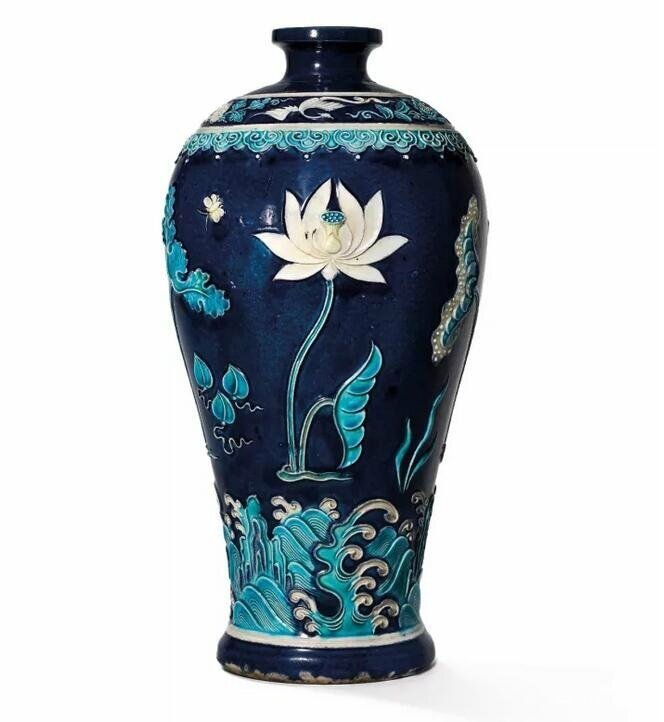
Lot 8004. A finely decorated fahua ‘lotus pond’ vase, meiping, Chenghua period (1465-1487). © Christies Images Ltd 2017
The Chinese term wucai means ‘five colours.’ On porcelain the vivid wucai colour scheme reached maturity in the Jiajing reign (1522–1566) when the overglaze colours, yellow, iron-red and green, with black outlines, were used in combination with underglaze blue. Among the various forms and sizes of wucai porcelain made for the court, the jar and cover (lot 8006) represents the largest and most ambitious type. The Jiajing emperor was an ardent Daoist with a keen desire for auspicious symbolism. Fish symbolize surplus and wealth. On the jar there are eight fish, an auspicious number. The cover also has the bajixiang (eight precious emblems). A small number of such jars have survived with their original covers, including examples in museums in China, Japan, France and the U.S.A. This example, one of the finest, was formerly in the collection of J.M. Hu in Shanghai. Later, it made art market history in 2000 when it was sold at auction6 for a then world record price for Chinese porcelain.

Lot 8006. A highly important and extremely rare wucai ‘Fish’ jar and cover, Jiajing six-character mark in underglaze blue and of the period (1522-1566). © Christies Images Ltd 2017
‘Children at play’ is a subject often depicted in paintings from the Song dynasty onwards. It suggests a peaceful world in which children can play happily and safely and was one of the auspicious subjects favoured by the Jiajing emperor. On the jar (lot 8005) eight boys are at play with various toys, including a hobby horse and a model pagoda. The subject is more commonly found on blue and white porcelain in this period, but here it is painted in the richer wucai palette, including the aubergine-purple colour. On the dragon jar of the same period (lot 8010) only the ‘hot’ and ‘warm’ colours, red and yellow, were employed. The result appears as yellow dragons on a red background. In fact the exterior of the jar was first covered in an imperial yellow glaze and fired, then the design was outlined in black lines and the background was painted red. This fiery colour scheme is one of the distinctive features of Jiajing imperial porcelain.

Lot 8005. A very rare wucai 'Boys' jar, Jiajing six-character mark in underglaze blue and of the period (1522-1566). © Christies Images Ltd 2017

Lot 8010. An exceptional and rare red and yellow-enamelled ‘Dragon’ jar , Jiajing six-character mark in underglaze blue and of the period (1522-1566). © Christies Images Ltd 2017
Blue and white porcelain was the dominant type of imperial porcelain for most of the Ming dynasty, but the quality of the cobalt blue colour varied greatly and was dependent in part on the availability of high quality cobalt from the Middle East. The Wanli reign (1573–1619) exemplifies this wide variation. The square box and cover (lot 8013) demonstrates Wanli underglaze blue at its bluest and best. It is painted with peony and chrysanthemum branches around a strange elegant rock resembling a finger citron.

Lot 8013. A blue and white square box and cover, Wanli six-character mark in underglaze blue and of the period (1573-1619). © Christies Images Ltd 2017
In the same period certain distinctive forms were made to imperial order, including the gourd-shaped wall vase, of which the wucai example, painted with phoenixes (lot 8008) is an example. The gourd form is auspicious; it symbolizes proliferation in plants and in human life, such as having many children and more grandchildren. When gourd-shaped wall vases were again popular at court in the eighteenth century, they were typically flatter in form. This more voluminous Wanli type has survived in far fewer numbers. The Palace Museum, Beijing7, and the Tianjin Museum8 both have examples with similar phoenixes on the upper part, but with differences in the decoration on the other parts.

Lot 8008. A rare wucai ‘phoenix’ double-gourd form wall vase, Wanli six-character mark in underglaze blue within a double rectangle and of the period (1573-1619). © Christies Images Ltd 2017
LACQUER
For lacquer, as with other media, the Yongle period was climactic. The imperial workshops excelled in the production of carved cinnabar-red lacquer in this and the following Xuande reign. Such early Ming lacquer has a fluency and a three-dimensional quality that compares very favourably with other periods. The box and cover (lot 8009) is a fine example. It is carved with tree peony on the top. The blooms are shown from different angles and in different stages of development; the leaves are dense and lush. On the sides are other species, including lotus, chrysanthemum and camellia. Between the many upper layers of red and the ochre-brown background there is a thin black layer that as a ‘guideline’ to the carver. Whereas only a minute proportion of Yongle imperial porcelain was written with a reign mark, lacquer that met the imperial standard was regularly inscribed with a reign mark. On the box, the Yongle mark is written, typically, in small characters in a single column at the side of the base. The Qianlong emperor (reigned 1736–1795) owned a box with very similar peony decoration. He clearly valued it and in 1782 he had an inscription added to the interior of the cover. It is now at the National Palace Museum, Taipei9.

Lot 8009. A superbly carved cinnabar lacquer box and cover, Yongle incised six-character mark and of the period (1402-1425). © Christies Images Ltd 2017
The Jiajing period (1522–1566) imperially-marked ewer (lot 8011) is carved with ruyi clouds, a popular pattern in lacquer design. The highly distinctive form is taken from Islamic metalwork. Most lacquer has a wood core, but a wood core would have made the very slender neck, spout and handle too vulnerable to breakage, so the ewer was made with a metal core. It appears to be unique in red lacquer. One other ewer of similar form is recorded, with a variant ruyi cloud pattern10, but it is in black lacquer and has no reign mark.

Lot 8011. A highly important cinnabar tixi lacquer hexagonal ewer, Jiajing incised six-character mark and of the period (1522-1566). © Christies Images Ltd 2017
The red chrysanthemum-form dish (lot 8007) is another product of the imperial lacquer workshops of the Jiajing period. It is decorated with a five-clawed dragon pursuing a sacred pearl and with a hibiscus branch. Here the decoration is in two techniques, firstly the qiangjin technique in which the outlines are incised and gilt, secondly in the tianqi technique in which areas within the outlines are painted in different colours from the background. The reign mark on the base is in the qiangjin technique. The Palace Museums in Beijing11 and Taipei12 both have similar dishes.
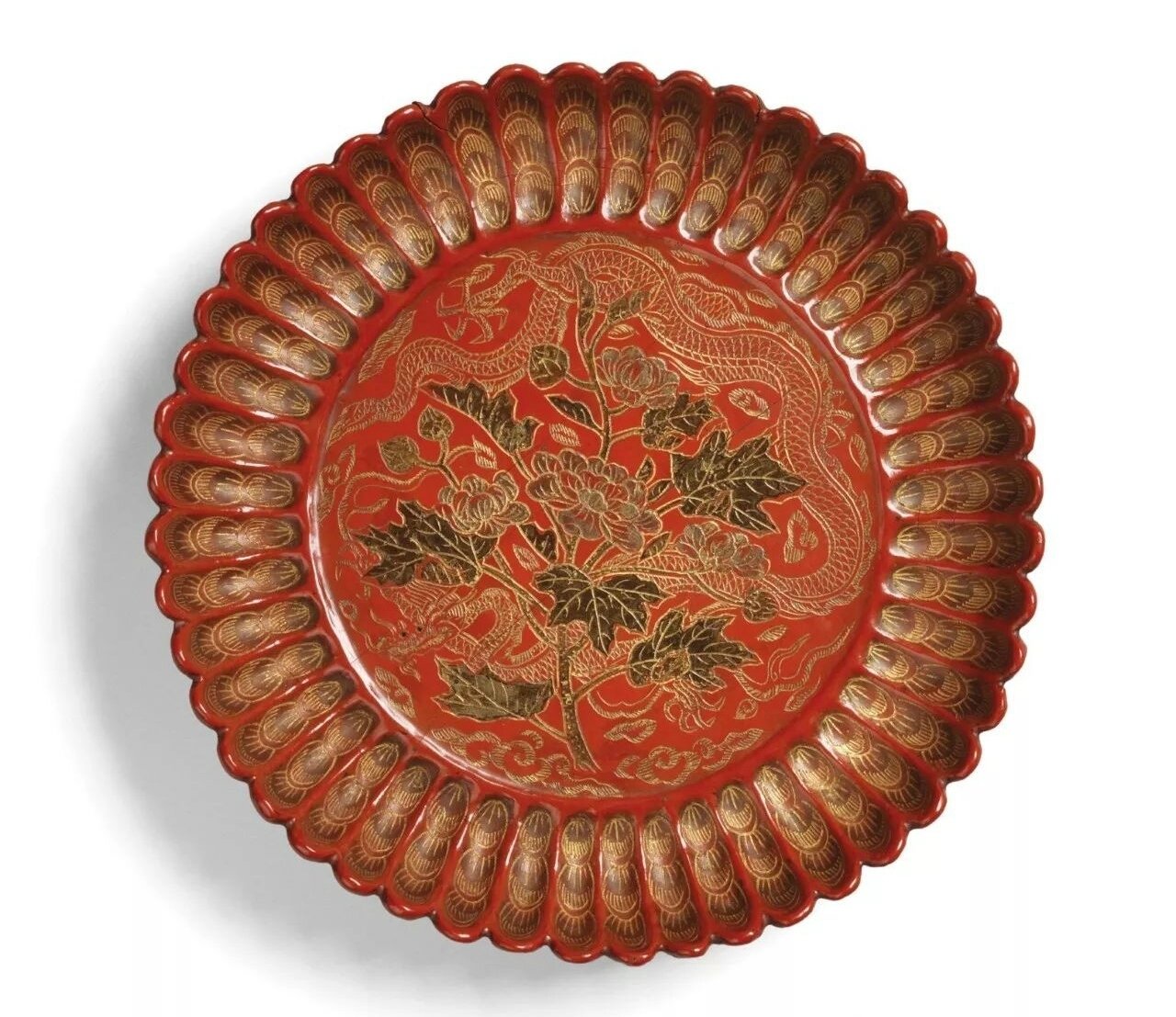
Lot 8007. An extremely rare imperial qiangjin and tianqi ‘Dragon’ chrysanthemum-shaped dish, Jiajing incised and gilt six-character mark and of the period (1522-1566). © Christies Images Ltd 2017
CONCLUSION
I believe the Ming porcelain and lacquer offered here will allow collectors to add highly significant items to their collections. I hope they will have the same enthusiasm for them as the Master of the Le Cong Tang collection. I hope too that future collectors will be willing, as he has, to lend them to exhibitions. The imperial porcelain and lacquer is up to the standards of any major museum and deserves to be seen and enjoyed by the public.
JAMES SPENCER
Mr James Spencer first joined Christie’s London in 1969 and was transferred to the Chinese department in 1971 where he became a director in 1979. He set up the Christie’s Hong Kong office in 1983. In 1987, Mr Spencer left Christie’s to join the Chang Foundation Museum of Art, Taipei, where he remained a curator until his retirement in February 2017. At present he is a consultant to the Chang Foundation.
NOTES:
1. Regina Krahl (ed. John Ayers), Chinese Ceramics in the Topkapi Saray Museum Istanbul, vol. 2, Yuan and Ming Ceramics, London, 1986, no. 611, pp. 421 and 516 (TKS 15/1472)
2. Blue and White Porcelain with Underglaze Red (I), Hong Kong, 2000, nos. 49 and 50, pp. 52-53
3. Mingdai chunian ciqi tezhan mulu (Calatalogue of the Special Exhibition of Early Ming Porcelain), 1982, no. 45, fig. 2, p. 110
4. Jingdezhen chutu Ming Xuande guanyao ciqi (Xuande Imperial Porcelain Excavated at Jingdezhen), Chang Foundation, Taipei, 1998, nos. 115-1 and 115-2.
5.Reference 故宮12497/院199
6. Sotheby’s Thirty Years in Hong Kong, 2003, no. 175, pp. 178-179
7. Ceramics Gallery of the Palace Museum, Beijing, 2008, Part II, p. 353
8. Zhongguo taoci quanji (The Complete Works of Chinese Ceramics), vol. 13, Ming period part 2, Shanghai, 1999, no. 110, pp. 109 and 235
9. Gugong Qiqi Tezhen (Special Exhibition of Lacquer at the National Palace Museum), Taipei, 1981, no. 7
10. From the collection of Professor and Madame Robert de Strycker, sold at a Piasa auction, Paris, 5 December 2007, lot 56
11. Lacquer Wares of the Yuan and Ming Dynasties, The Complete Collection of Treasures of the Palace Museum, Hong Kong, 2006, no. 159 (fig 1), p. 201
12. Carving the Subtle Radiance of Colors, Treasured Lacquerware in the National Palace Museum, 2007, no. 093, p. 104


/http%3A%2F%2Fstorage.canalblog.com%2F37%2F80%2F119589%2F133887613_o.jpg)
/http%3A%2F%2Fstorage.canalblog.com%2F45%2F17%2F119589%2F124881724_o.jpg)
/http%3A%2F%2Fstorage.canalblog.com%2F61%2F26%2F119589%2F118202900_o.jpg)
/http%3A%2F%2Fstorage.canalblog.com%2F69%2F40%2F119589%2F118180923_o.png)