

/https%3A%2F%2Fprofilepics.canalblog.com%2Fprofilepics%2F1%2F0%2F100183.jpg)
/https%3A%2F%2Fstorage.canalblog.com%2F03%2F02%2F119589%2F96711876_o.jpg)
/https%3A%2F%2Fstorage.canalblog.com%2F11%2F31%2F119589%2F94773502_o.jpg)
/https%3A%2F%2Fstorage.canalblog.com%2F20%2F83%2F119589%2F94772815_o.jpg)
/https%3A%2F%2Fstorage.canalblog.com%2F26%2F72%2F119589%2F75604929_o.jpg)
/https%3A%2F%2Fstorage.canalblog.com%2F59%2F60%2F119589%2F26458628_o.jpg)
Sotheby's Hong Kong Chinese Works of Art Sales to take place on 31 May and 1 June

Lot 12. A superb and extremely rare inlaid zitan ‘Scholars examining a handscroll’ box and cover, attributed to Zhou Zhu, Ming dynasty, Jiajing period (1522-1566); 8.2 by 16.4 by 12.7 cm, 3 1/4 by 6 1/2 by 5 in. Estimate: HK$1,500,000-2,500,000 / US$192,000-319,000. Courtesy Sotheby's
HONG KONG.- Sotheby’s will present two mid-season sales of Chinese works of art at its Hong Kong Gallery: Scholarly Art from the Collection of Mr and Mrs Gerard Hawthorn (30 May) and Chinese Art (31 May – 1 June). Known for his eclectic and expansive scopes of interest in Chinese Works of Art, Gerard Hawthorn had, over the years, amassed sizeable collections of bamboo, Yixing stoneware and bronzes. These are categories which have gained long overdue traction in comparison to their jade and ceramics counterparts, which have for the most part, embodied the canon of Chinese Works of Art collecting in the West in the past. In tandem with this great collection is the Chinese Art Sale, which constitutes fine selections from several private Hong Kong collections, in particular, a selection of scholarly items from the Peony Collection. The sale includes an assorted array of classic ceramics examples from the Song, Ming and Qing dynasties, huanghuali furniture, and Ming and Qing jade animal carvings and jade snuff bottles. All works will be exhibited for public viewing from 25 – 30 May, 2018.
SALE HIGHLIGHTS
SCHOLARLY ART FROM THE COLLECTION OF MR AND MRS GERARD HAWTHORN | 31 May


Lot 12. A superb and extremely rare inlaid zitan ‘Scholars examining a handscroll’ box and cover, attributed to Zhou Zhu, Ming dynasty, Jiajing period (1522-1566); 8.2 by 16.4 by 12.7 cm, 3 1/4 by 6 1/2 by 5 in. Estimate: HK$1,500,000-2,500,000 / US$192,000-319,000. Courtesy Sotheby's
exquisitely inlaid with mother-of-pearl, malachite, soapstone, stained horn and various hardstones, the cover depicting three scholars seated around a low table examining a handscroll underneath an overhanging pine tree, looked on by an attendant while another attendant brews tea on a stove set nearby, the sides decorated with blossoming prunus branches, fitted with original internal tray.
Note: This exquisite box belongs to a small group of inlaid containers typically produced in precious zitan wood. The exceptional workmanship displayed here, especially in the quality of the beautiful inlay, suggests that it is by the hand of the Ming master carver Zhou Zhu, recorded in the writings of the Ming and Qing literati as having worked in Yangzhou in Jiangsu province during the reign of the Jiajing Emperor. He was famous for his perfection of the technique of inlaying a wide variety of precious stones and other materials onto wood and lacquer. What distinguishes Zhou's works from others is his use of a much broader range of material and the complexity of the inlay itself. On the present box, and on others attributed to him, are kaleidoscopic range of materials including soapstone, malachite and horn. His inlay technique is extremely multifaceted, as he deployed inlay upon inlay, not just setting different material next to each other but creating a three-dimensional effect. He also used precious metals such as gold and silver, often creating stunning multi-layer works of art. Later versions, even very fine and complex works from the height of the Qing dynasty, rarely employed such a wide range of complex inlay techniques.
While Zhou's birth date is unknown, the Jiajing period attribution to his work is confirmed by an inlaid box that bears an inscription of a date corresponding to 1537 inscribed in red lacquer on the base, richly embellished with a scene from a Mongolian hunt, sold twice in these rooms, 17th May 1988, lot 351, and 8th October 2010, lot 2192, from the Water, Pine and Stone Retreat Collection. Zhou Zhu's work is discussed by Chi Jo-Hsin, 'Chou Chu and the Craftsmanship of Chou Chih works', Proceedings of the International Colloquium on Chinese Art History, National Palace Museum, Taipei, 1991, p. 657; in National Palace Museum Monthly of Chinese Art, Taipei, 1993, p. 110; and by Craig Clunas in O.C.S. Exhibition of Chinese Ivories, Birtish Museum, London, 1984, pp. 127-128.
The subject matter depicted on the present box is that of an elegant gathering known as yaji in Chinese, where a group of scholars and like-minded literati gather to enjoy music, discuss literature and talk about antiquity. A larger box depicting a related but more complex scene, the sides embellished with rich blossoming branches, was sold twice in these rooms, 16th/17th November 1988, lot 256, and again, 4th April 2012, lot 179, from the Water, Pine and Stone Retreat Collection. Compare also an inlaid box and cover, sold in these rooms, 2nd June 2016, lot 88, also from the Water, Pine and Stone Retreat collection.


A massive inlaid zitan box and cover, attributed to Zhou Zhu, Ming dynasty, Jiajing period (1522-1566); 14.2 by 58.4 by 26.5 cm., 5 1/2 by 23 by 10 3/8 in. Estimate: 18,000,000 — 25,000,000. Lot sold 20,820,000 HKD at Sotheby's Hong Kong, 4th April 2012, lot 179, , from the Water, Pine and Stone Retreat Collection. Courtesy Sotheby's
of rectangular form raised on four L-shaped feet, the cover masterfully inlaid with gathering scene centred with a scholar grasping a ruyi sceptre in his hand, accompanied by further gentlemen, ladies, and an attendant, their hats, robes, shoes and accessories in finely detailed different colours of soapstone, malachite, azurite, lacquer, horn, gold, silver and pearls, all in a garden setting with furniture and antiques similarly decorated in various colours of soapstone, lacquer, coral, jade and gilt-bronze, amid plantain and paulownia trees against a rich dark wood ground, the sides densely inlaid with blossoming branches of prunus, plum, tea and hydrangea, the flowers with soapstone and pearl petals, the rim of the cover and box with inlaid silver wire scroll bands, the wood of a deep reddish brown, fitted brocade box.
Provenance: Sotheby's Hong Kong, 16/17th November 1988, lot 256.
Literature: Sotheby's Hong Kong Twenty Years, Hong Kong, 1993, pl. 406.
Note: This exquisite box belongs to a small group of inlaid containers typically produced in the precious zitan wood, and occasionally in huanghuali. Generally they are of rectangular form and are finished with elegantly rounded covers and sides. The present example stands out for its magnificent size and within the group it is the largest example recorded. It is also of exceptional quality with the inlay decoration applied both to the cover and the sides which is rarely seen on other boxes of this type. Only one three-tiered box appears to bear such floral side decoration, illustrated in Zhongguo wenwu jinhua dacidian, Shanghai, 1996, pl. 116.
The exceptional workmanship displayed here, especially in the quality of the beautiful inlay suggests that it is by the hand of the Ming master carver Zhou Zhu, famed for his invention of the technique of inlaying a wide variety of precious stones and other materials onto wood and lacquer. What distinguishes Zhou's works from others is his use of a much broader range of material and the complexity of the inlay itself. On the present box, and on others attributed to him, one finds coral, silver, gold, malachite, lacquer, different types of horn, mother-of-pearl and even gilt-bronze, suggesting that he had access to a wide range of crafts and materials within a single workshop. His inlay technique is extremely multifaceted, as he deployed inlay upon inlay and not just setting different material next to each other but creates a three dimensional effect. He also used precious metals such as gold and silver, often creating stunning multi-layer works of art. Later versions, even very fine and complex works from the height of the Qing dynasty, rarely employed such a wide range of complex inlay techniques.
Zhou had many talents and also excelled at carving. He is said to have made furniture such as lacquered wood screens, tables, chairs, cupboards and bookcases. He is recorded in the writings of Ming and Qing literati as having worked in Yangzhou in Jiangsu province during the reign of the Jiajing emperor. While his birth date is unknown, the Jiajing period attribution to his work is confirmed by an inlaid box that bears an inscription of a date corresponding to 1537 inscribed in red lacquer on the base, sold in these rooms, 8th October 2010, lot 2192, richly embellished with an inlay decoration depicting a scene from a Mongolian hunt. Another related cinnabar lacquer box depicting a similar hunt, was also sold in these rooms in the same sale, lot 2213. The two boxes are undoubtedly the products of the same workshop and possibly made by Zhou himself. It is worth noting that the sides of the lacquer box mentioned above are richly carved with blossoming branches, not dissimilar in style to that seen on this box, suggesting that the idea for the decoration may have derived from carved lacquer vessels.
The subject matter depicted on the present box is that of an elegant gathering known as yaji in Chinese, where a group of scholars and like-minded literati gather to enjoy music, discuss literature and talk about antiquity. There is a further indication that a birthday celebration is taking place at the same time with coral branches placed in large vessels in front of the main figure. This would suggest that the box may have been commissioned as a special birthday gift.
Zhou Zhu is discussed in a number of publications; for example see Paul Moss, Escape from the Dusty World. Chinese Paintings and Literati Works of Art, London, 1999, p.226; and Craig Clunas, Chinese Furniture, London, 1988, p. 94, where the author notes that the technique used by Zhou is known as Zhou zhi or 'Zhou's work' which was developed in the late 16th century with the first textual reference to it appearing in the encyclopaedic work by the Ming scholar Gao Lian Zun sheng ba jian ('The Eight Discourses on Living') published in 1591. Works by Zhou are further examined in Chi Jo-Hsin, 'Chou Chu and the craftsmanship of Chou Chih works', Proceedings of the International Colloquium on Chinese Art History, National Palace Museum, Taipei, 1991, pp. 659-679, where it is mentioned that Zhou enjoyed the patronage of the Grand Secretary and Imperial confidant Yan Song (1480-1565). Yan's sponsorship would suggest that Zhou's pieces were well known by the court and possibly to the emperor himself. The fitted case for this box, the interior covered with a yellow silk brocade with the dragon motif, suggests that the piece was part of the Imperial collection during the Qing dynasty. See an imperial case, lined with a similar yellow brocade, containing a Kangxi period Imperial painting album, published in The National Palace Museum Monthly of Chinese Art, no. 4, 1983, p. 11.
The most comprehensive group of related inlaid-boxes can be found in the Palace Museum, Beijing, illustrated in The Complete Collection of Treasures of the Palace Museum. Bamboo, Wood, Ivory and Rhinoceros Horn Carvings, Hong Kong, 2002, cat. nos. 219-248. A box decorated with a hunting scene, most probably the work of Zhou, is published in The Palace Museum Collection of Elite Carving, Beijing, 2004, pl. 100, together with a container luxuriously embellished on all sides with gems forming flowers, fruits and birds, pl. 99.
The only piece known to be signed by Zhou is an inkstone box that bears a Qianlong poem composed in 1784, illustrated in Treasures from the Scholar's Studio, Tokyo, 1992, pl. 205, and also in The National Palace Museum Monthly of Chinese Art, no. 18, 1984, p. 48, with the signature shown on p. 49. The signature, inlaid on the base of the box in silver wire reads Wumen Zhou Zhu (Zhou Zhu of Wumen) in seal script. The inkstone itself is inscribed with a Xuande reign mark and the Imperial poem notes that it was a Xuande inkstone copied from a Song dynasty original. The inscription suggests that Zhou made a cover for an existing 15th century work from the Imperial collection, which was later inscribed with Qianlong's poem.


An Inlaid ‘Hunters’ Zitan Box and Cover, Attributed to Zhou Zhu, Ming Dynasty, Jiajing Period (1522-1566); 9 by 25 by 14.9 cm, 3 1/2 by 9 7/8 by 5 7/8 in. Est. HKD 2 – 3 million / USD 260,000 – 390,000. Lot sold 3,440,000 HKD (442,797 USD) at Sotheby's Hong Kong, 2nd June 2016, lot 88, also from the Water, Pine and Stone Retreat collection. Courtesy Sotheby's.
Cf. my post: Sotheby's Hong Kong Chinese Works of Art June Auction series to take place on 2-3 June
The most comprehensive group of related inlaid-boxes, can be found from the Qing court collection and still in Beijing, is illustrated in The Complete Collection of Treasures of the Palace Museum. Bamboo, Wood, Ivory and Rhinoceros Horn Carvings, Hong Kong, 2002, pls 219-48. A box decorated with a hunting scene, most probably the work of Zhou, is published in The Palace Museum Collection of Elite Carving, Beijing, 2004, pl. 100.


Lot 3. An imperial inscribed zitan stand, yuti mark and period of Qianlong, dated guiwei year (corresponding to 1763); 34 cm. Estimate: HK$80,000-120,000 / US$10,200-15,300. Courtesy Sotheby's.
intricately carved overall with archaistic motifs, one side incised and picked out in gold with an imperial poem in clerical script, signed Qianlong guiwei zhongchun yue yuti ('Imperially inscribed by the Qianlong Emperor in the second month of the guiwei year'), followed by two seals reading jixia yiqing ('When does one have the leisure to delight the heart?') and de jiaqu ('obtaining refined enjoyment').
Note: Elaborately carved zitan stands of this type were designed to serve as a complementary companion to the ancient jade bi discs, which were treasured and collected by the Qianlong Emperor. A number of related zitan stands is known, including two in the National Palace Museum, Taipei, incised with poems dated to 1772 and 1784 respectively, illustrated in Teng Shu-p'ing, Neolithic Jades in the Collection of the National Palace Museum, Taipei, 1992, pl. 100; one mounted with an archaic jade bi, with an inscribed poem dated to 1764, sold in these rooms, 4th November 1997, lot 1202; and another, inscribed with a poem dated to 1775, also sold in these rooms, 8th April 2013, lot 3010.


Lot 6. An imperial inscribed and gold-decorated hardwood shrine, Qing dynasty, dated to the 25th year of the Qianlong period (in accordance with 1760); 46.3 cm. Estimate: HK$80,000-120,000 /US$10,200-15,300. Sold for HK$1,250,000 (159,312 USD) to an Asian Trade. Courtesy Sotheby's.
the tripartite screen supported on a tiered plinth, each section finely painted in gold with three sets of five bats amidst dense scrolling clouds, surrounding a medallion used for framing the head of a copper-alloy figure of Shakyamuni Buddha, all below a stylised angular scroll formed from pairs of kui dragons, the reverse inscribed with three sets of inscriptions in Chinese, Manchu, Mongolian and Tibetan, the base with additional inscriptions, reading tianzi sanhao ('Heaven number three') and shuzhi hao ('character shu').
The Third Zhangjia Hutuketu (lCang-skya Hutuktu), Rolpay Dorje (Rol-pa'i rdo-rje, 1717-1786), one of the heads of the Mongolian branch of lamaism, was the highest incarnation of the lamas of the Gelugpa sect, also known as the Yellow Church. In his youth he was educated together with the future Qianlong Emperor and he remained a trusted advisor throughout his life. When Qianlong ascended the throne in 1736, he became Grand Lama at Beijing, and when he died, Qianlong had a hall in the Pavilion of Raining Flowers (Yuhuage), the largest Tantric chapel of Tibetan Buddhism in the Qing palace, devoted to his memory. It still houses a magnificent silver statue of Rolpay Dorje commissioned by Qianlong as well as a pair of hanging scrolls with a couplet written in his memory by the emperor (Cultural Relics of Tibetan Buddhism Collected in the Qing Palace, Hong Kong, 1992, pls 36 and 112).
Another gilt brass sculpture depicting Rolpay Dorje from the State Hermitage, Leningrad, is illustrated in Bartholomew, op.cit., fig.1. In an essay entitled 'Fo kan/Buddhist Shrines' Wang Jiapeng states in the exhibition catalogue Buddhist Art from Rehol, Taipei, 1999, p.173f. (Chinese) and p.258f. (English), that the Qianlong Emperor repeatedly commissioned shrines to be made for Buddhist images that had been given to him by Mongolian princes and Tibetan lamas, and that these shrines were all made by the zaobanchu of the Yangxin Hall in the palace. According to Wang Jiapeng, 'Zhangjia Hutuketu xiang xiaokao [A study on the portrait statue of Zhangjia Hutuketu]', Gugong Bowuyuan yuankan, 1987, no.4, p.48, many Buddhist sculptures and paintings of the Qianlong period in the Palace Museum collection are inscribed with the phrase also inscribed on the present shrine, stating that they were donated by the Rolpay Dorje, and one such image donated in 1779, is illustrated in Cultural Relics, op. cit., pl.35.
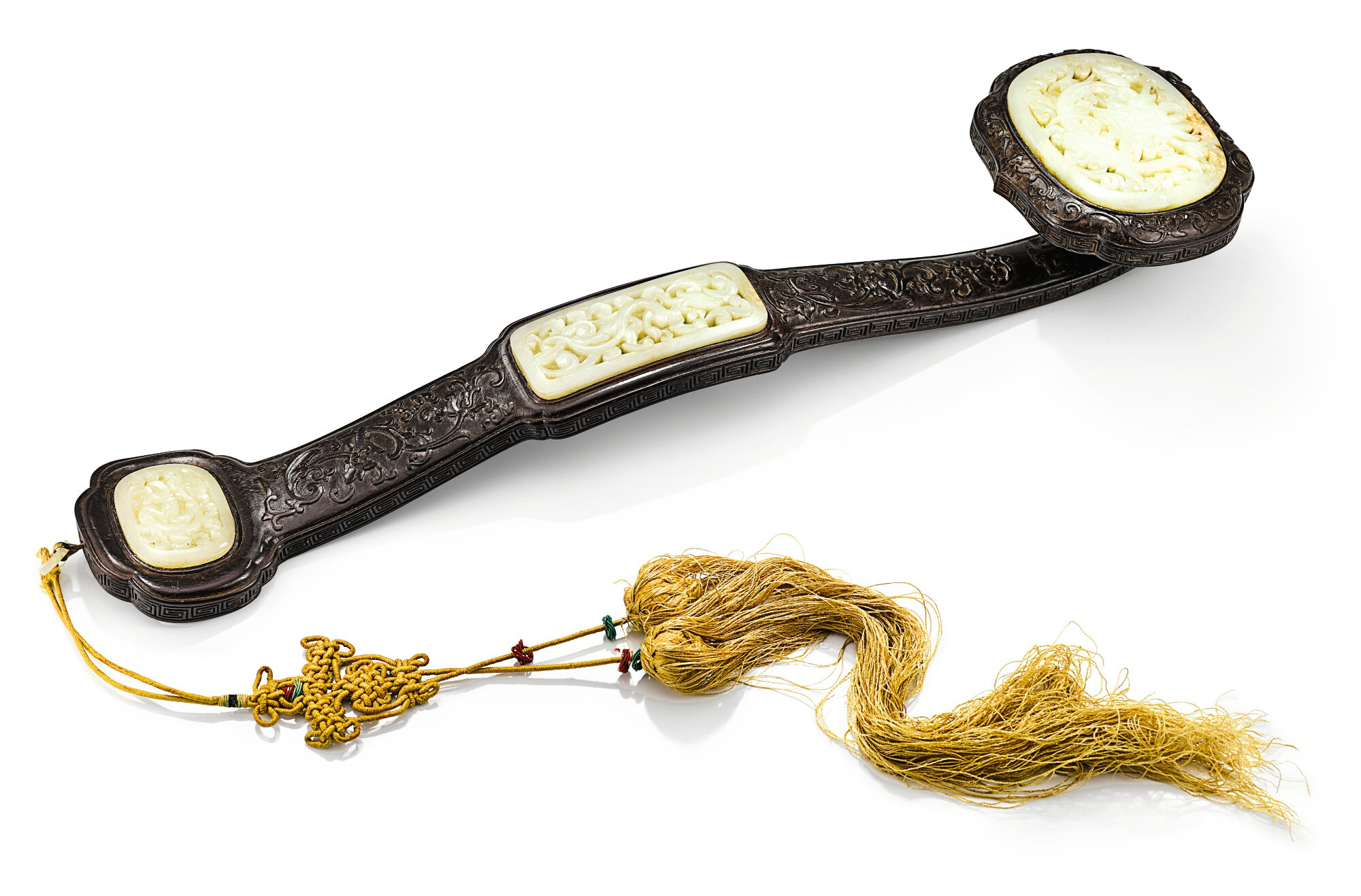

Lot 11. An impressive celadon jade-inlaid zitan 'Dragon' ruyi scepter, Qing dynasty, Qianlong period (1736-1795); 48 cm. Estimate: HK$500,000- 700,000 / US$64,000-89,500. Courtesy Sotheby's.
the head, the mid-shaft and the terminal each inset with a celadon jade plaque, depicting a ferocious en face dragon, a sinuous chilong and a smaller coiled chilong respectively, the zitan frame carved in low relief with floral scrolls, the edges bordered with key-fret bands, the terminus pierced with an aperture to thread a tassel.
Note: The ruyi (literally meaning ‘as you wish’) sceptre is a talisman presented to bestow good fortune. Believed to have originated from the end of the Warring States Period to the beginning of the Western Han dynasty, it was later adapted by Daoists who introduced the heart-shaped head rendered as a lingzhi, the fungus of immortality, to express well-wishing. It was during the Yongzheng (r. 1723-35) reign that the auspicious tradition of the ruyi sceptre was revived, and reached unprecedented demand under the Qianlong (r. 1736-95) Emperor, who was so fond of such objects. Its auspicious nature was subsequently complemented with the choice of material and high level of craftsmanship and often presented at imperial birthdays and New Year celebrations.
The present sceptre is striking for the combination of materials which have been skilfully executed resulting in a harmonious composition. The jade inlaid on the ruyi head has been elaborately carved with a ferocious five-clawed dragon, while two playful chilong, rendered in different postures, adorn the jade plaques inset on the centre and end of the shaft. Together with the naturalistically rendered floral scrolls that decorate the zitan shaft, this piece boasts the power, abundance and creativity of the Qianlong reign.
Zitan sceptres embellished with jade insets were an innovation of the Qianlong period, and it is rare to find examples that incorporate dragons into the decorative scheme. Compare zitan and jade sceptres of this type, but with variations in decorations, such as one, bearing the signature of Wang Jie, the white jade plaques carved with cranes surrounded by peaches, and the shaft rendered with cranes and deer amidst pine tree, rocks and other vegetation, sold in our New York rooms, 19th/20th March 2013, lot 422; and another, the jade carved with peach, pomegranate and citrons respectively, sold in these rooms, 27th April 2003, lot 8.


A zitan and white jade inlaid 'Longevity' ruyi scepter, Qing dynasty, Qianlong period (1736-1795). Length 17 1/2 in., 44.5 cm. Estimate: 50,000 — 70,000 USD. Lot sold 112,500 USD at Sotheby's New York, 19th/20th March 2013, lot 422. Courtesy Sotheby's.
the stem of the scepter gently curved and elaborately carved on the upper section with two cranes, the lower section with two deer, one grasping a lingzhi branch in its mouth, all amid pine trees, rocks and other vegetation, the center, tip and head set with Ming dynasty pierced white jade plaques carved with further cranes surrounded by large longevity peaches, the underside carved with a two-line poetic couplet and signed Wang Jie with two seals reading chen and Wang Jie.
Note: The inscription may be translated as:
Made by imperial command
May happiness proliferate and your days on this earth extend
May the spring joy you feel be at one with nature
Respectfully inscribed by servant Wang Jie
According to the Zhongguo meishujia renming cidian, Shanghai Renmin Meishu Chubanshe, 2006, p.84, Wang Jie (1725-1805) was ranked first in the official examinations in the twenty-sixth year of Qianlong‘s reign (1761). According to Arthur W. Hummel, Eminent Chinese of the Ch'ing Period, Taipei, 1970, p.75, Wang actually came in third, but because no one from Wang's home province of Shaanxi had ever come in first before, Qianlong ordered Wang to be ranked first. Wang also went by the names Weiren, Xingyuan, and Baochun. He was a respected calligrapher and served in the courts of both Qianlong and Jiaqing. In 1776 Wang was the Commissioner of Education in Zhejiang, and from 1787 till 1802, Wang served as Grand Secretary. In 1803 Wang retired and returned to Shaanxi. For his eightieth birthday in 1804, Jiaqing sent him numerous gifts, and in order to thank the emperor in person, Wang made the arduous trip to Beijing. Unfortunately, shortly after arriving in Beijing, he took ill and passed away in 1805.
The inscription on the scepter appears to be a birthday wish, and it is possible that Qianlong ordered the inscription in Wang's calligraphy carved onto the scepter as an official gift. We know that Qianlong admired Wang's calligraphy because there are examples of Wang's calligraphy in the Imperial collection. One example affixed with five of Qianlong's collector seals sold at Christie's Hong Kong, 28th November 2005, lot 123.
For an example of a similar Qianlong zitan and jade ruyi see Christie's Hong Kong, 26th April 1999, lot 528.

Lot 8. A pair of gilt-lacquer vases, Qing dynasty, Early 18th century; 28 cm. Estimate: HK$350,000-450,000 / US$44,600-57,500. Sold for HK$437,500 (55,759 USD) to an Asian Private. Courtesy Sotheby's.
of quatrefoil section, the bulbous body rising to a waisted neck and an upturned rim, splendidly lacquered in gold, each lobed side decorated in low relief with an ornate lotus scrollwork enclosing a peach, a wan symbol and a descending bat, the neck adorned with a frieze of archaistic plantain leaves.
Note: This sumptuous pair of vases splendidly lacquered in gold and encapsulates the opulence of the Qing court. The design successfully fuses the auspicious motifs of bat, wan symbol and peach with elements derived from Western art, evident in the intertwined scrolling leaves on the lower body. This echoes the Rococo architectural components that adorned European style palace buildings of the Yuanming yuan, created to satisfy the Emperor’s lavish taste for the exotic as well as his desire to be seen as a universal ruler.
Related vases of this type are rare, although one of similar shape in the Palace Museum, Beijing, decorated in low-relief with a panel on each quatrefoil section depicting rockworks and vegetation, surrounded by bats and ‘Eight Buddhist Emblems’, is illustrated in Zhongguo qiqi quanji [Complete series on Chinese lacquer], vol. 6, Fuzhou, 1993, pl. 153.
Compare also other carved lacquer vases of quatrefoil form, attributed to the Qianlong period, including one decorated with figures and landscape within panels, in the National Palace Museum, Taipei, included in the Museum's Special Exhibition of Palace Lacquer Objects, Taipei, 1981, cat. no. 62; another sold at Christie’s New York, 21st September 2000, lot 68, and again in these rooms, 7th April 2015, lot 3735; and a third example sold in our London rooms, 8th November 2017, lot 51.

A large finely carved polychrome lacquer vase, Qing dynasty, Qianlong period (1736-1795); 31.1 cm., 12 1/4 in. Estimate: 250,000 — 300,000 HKD. Lot sold 500,000 HKD at Sotheby's Hong Kong, 7th April 2015, lot 3735. Courtesy Sotheby's.
of quatrefoil section, the baluster body resting on a splayed foot and surmounted by a tall flaring neck, each lobe of the main body carved through the red outer layer to the dark green and ochre layers with a panel enclosing a scene of figures attended by acolytes, the neck bordered with a band of upright cicada lappets, the neck with a band of floral scroll, all between two key-fret bands encircling the lobed mouthrim and footrim, the interior and base lacquered black, inner metal liner.
Provenance: Christie’s New York, 21st September 2000, lot 68.
Note: The vase is impressive for its large size. Another example of this form, carved with a similar scene of figures in a landscape, is illustrated in Masterpieces of Chinese Carved Lacquer Ware in the National Palace Museum, Taipei, 1971, pl. 32; two pairs were sold in our London rooms, one pair, 24th February 1976, lot 80, and again, 1st /2nd November 1984, lot 230, and the other pair, 14th May 2014, lot 46; another pair was sold in our Monte Carlo rooms, 12th February 1979, lot 617.

A cinnabar lacquer vase, Qing dynasty, Qianlong period (1736-1795); 31.1 cm., 12 1/4 in. Estimate: 215,000 — 20,000 GBP. Lot sold 22,500 GBP at Sotheby's London, 8th November 2017, lot 51. Courtesy Sotheby's.
of quatrelobed section, the rounded lobed sides rising from a spreading foot to a waisted neck and flared rim, intricately carved in various levels of relief with vertical panels of figures standing in gardens beneath pine and wutong in mountainous river landscapes, bordered with stylised lotus scrolls on a diaper ground, with a band of archaistic plantain leaves to the neck below a thin band of keyfret at the rim and suspending lappets and a further keyfret band at the foot.
Note: A similar vase in the National Palace Museum, Taipei, was included in the Museum's Special Exhibition of Palace Lacquer Objects, Taipei, 1981, cat. no. 62; a slightly larger one in the Victoria and Albert Museum, London, is published in the Museum's website, accession no. 904-1873; and another, but applied with three different colours of lacquer, in the Palace Museum, Beijing, is illustrated in Gugong bowuyuan cang. Diaoqi [Carved lacquer in the Palace Museum], Beiijing, 1985, pl. 278.
CHINESE ART INCLUDING SELECTED WORKS OF ART | 31 May - 1 June


Lot 373. A rare and exceptionnally large Qingbai lobed basin, Song dynasty (960-1279); 31 cm. Estimate: HK$150,000-200,000 / US$19,200-25,500. Sold for 750,000 (95,588 USD) to an Asian Trade. Courtesy Sotheby's.
beautifully potted with deep rounded sides rising from a flat base to a flared six-lobed rim, covered overall in a translucent glaze, save for the flat base left unglazed revealing a smooth white body slight browned in the firing.
Exhibited: Exhibition of Far Eastern Ceramics, Tokyo National Museum, Tokyo, 1970, cat. no. 44.
Note: The present basin is notable for its exceptionally large size and graceful form. Qingbai wares ranged from robustly potted and elaborately decorated types to a more delicate and thinly potted form, such as the present example. The six-lobed flower shape of this piece appears to derive from Ding porcelain of the late Tang dynasty, reflecting the degree of dialogue between northern and southern ceramists active in the Song dynasty.
Compare a qingbai dish of this form, but of smaller size and covered in a pale-blue glaze, in the Palace Museum, Beijing, illustrated in The Complete Collection of Treasures of the Palace Museum. Porcelain of the Song Dynasty (II), Hong Kong, 1996, pl. 162. See also a smaller Ding dish of this form, attributed to the Song dynasty, from the collection of Mr. and Mrs. F. Brodie Lodge, included in the Oriental Ceramic Society Exhibition Sung Dynasty Wares, Ting, ying,ch’ing and Tz’u Chou, London, 1949, cat. no 143, and sold in our London rooms, 7th June 1988, lot 127.

Lot 375. A Yaozhou brown-painted 'Floral' box and cover, Song dynasty (960-1279); 11.4 cm. Estimate: HK$40,000-60,000 / US$5,100-7,700. Courtesy Sotheby's.
the cover decorated in brown slip with a central bloom, surrounded by liberal streaks, all against a creamy-white slip, the shallow recessed base unglazed revealing the grey body.
Provenance: Collection of Kitaouji Rosanjin.
Exhibited: humi Kotouki Dai Tenrankai: Great Exhibition of Antique Ceramics, Takashimaya Department Store Art Department, Osaka, 1935 (with Kurahashi Tojiro and Kitaouji Rosanjin as advisers).

Lot 452. A huanghuali continuous yokeback side chair, Ming dynasty, 17th century; 109 by 50.5 by 39 cm. Estimate: HK$100,000-150,000 / US$12,800-19,200. Courtesy Sotheby's.
elegantly proportioned with slender members, the top rail carved with a headrest in the centre and hidden mortised and tennoned into the stiles on both ends, the stiles extending through the seat frame and continuing as back legs, a plain S-shaped back splat tongue-and-grooved into the top rail and tennoned into the seat frame, the seat of standard mitre, mortise and tenon construction with exposed tenons, moulding inward, a wide flat-banded-edged spandrelled apron butt-joined to the underside of the seat and continuing tongue-and-grooved into the legs, the aprons on the sides similarly shaped, the slightly splayed legs joined by rounded stretchers and a footrest in front set above a humpback-shaped apron.
Provenance: Grace Wu Bruce, London.
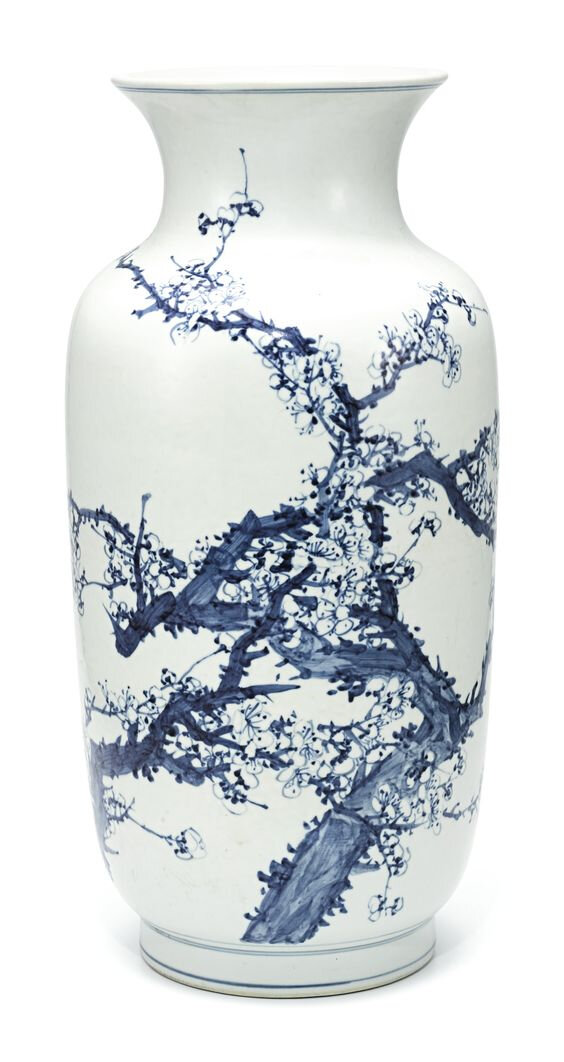

Lot 513 A blue and white 'Prunus' vase, Seal mark and period of Guangxu (1875-1908); 43.3 cm. Estimate: HK$80,000-120,000 / US$10,200-15,300. Courtesy Sotheby's.
the cylindrical body rising to a waisted neck and a flared rim, painted with two gnarled interlocking prunus branches.


Lot 468 A pair of inlaid white jade table screens, Late Qing dynasty; panel: 25.6 cm. Estimate: HK$30,000-50,000 / US$3,850-6,400. Courtesy Sotheby's.
each panel inlaid in jade, lapis lazuli, coral and coloured hardstones, decorated to one side with the 'Three Friends of Winter' and a bat hovering by, the other side with fruit bearing plants and trees issuing from rockwork with a large butterfly above, all within a spinach-green jade gilt key-fret band inlaid with small bats, both set on wood stretchers.
Literature: Geoffrey Wills, Jades of the East, New York, 1972, pl. 75 and 76.
Note: A pair of related jade screens decorated with vibrantly coloured design, embellished with carnelian, agate, jasper, quartz and serpentine depicting birds and a bat among leafy peach branches, but of circular form, was sold at Christie’s London, 3rd May 1978, lot 158.

Lot 363. A Longquan celadon bowl, Song dynasty (960-1279); 14 cm. Estimate: HK$100,000-120,000 / US$12,800-15,300. Courtesy Sotheby's.
well potted with lobed rounded sides resembling the petals of a lotus flower, rising from a tapered foot to an incurved rim, covered overall save for the footring in a soft sea-green glaze, metal-bound rim, Japanese wooden box.


/image%2F1371349%2F20260905%2Fob_7e5144_34806.jpg)
/image%2F1371349%2F20260815%2Fob_e37f96_2026-hgk-24527-1001-000-a-rare-set-of.jpg)
/image%2F1371349%2F20260625%2Fob_70db1f_20177.jpg)
/image%2F1371349%2F20260513%2Fob_1d39fa_2026-cks-24656-0008-000-a-rare-and-imp.jpg)