

/https%3A%2F%2Fprofilepics.canalblog.com%2Fprofilepics%2F1%2F0%2F100183.jpg)
/https%3A%2F%2Fstorage.canalblog.com%2F03%2F02%2F119589%2F96711876_o.jpg)
/https%3A%2F%2Fstorage.canalblog.com%2F11%2F31%2F119589%2F94773502_o.jpg)
/https%3A%2F%2Fstorage.canalblog.com%2F20%2F83%2F119589%2F94772815_o.jpg)
/https%3A%2F%2Fstorage.canalblog.com%2F26%2F72%2F119589%2F75604929_o.jpg)
/https%3A%2F%2Fstorage.canalblog.com%2F59%2F60%2F119589%2F26458628_o.jpg)
Dante Gabriel Rossetti, Proserpine
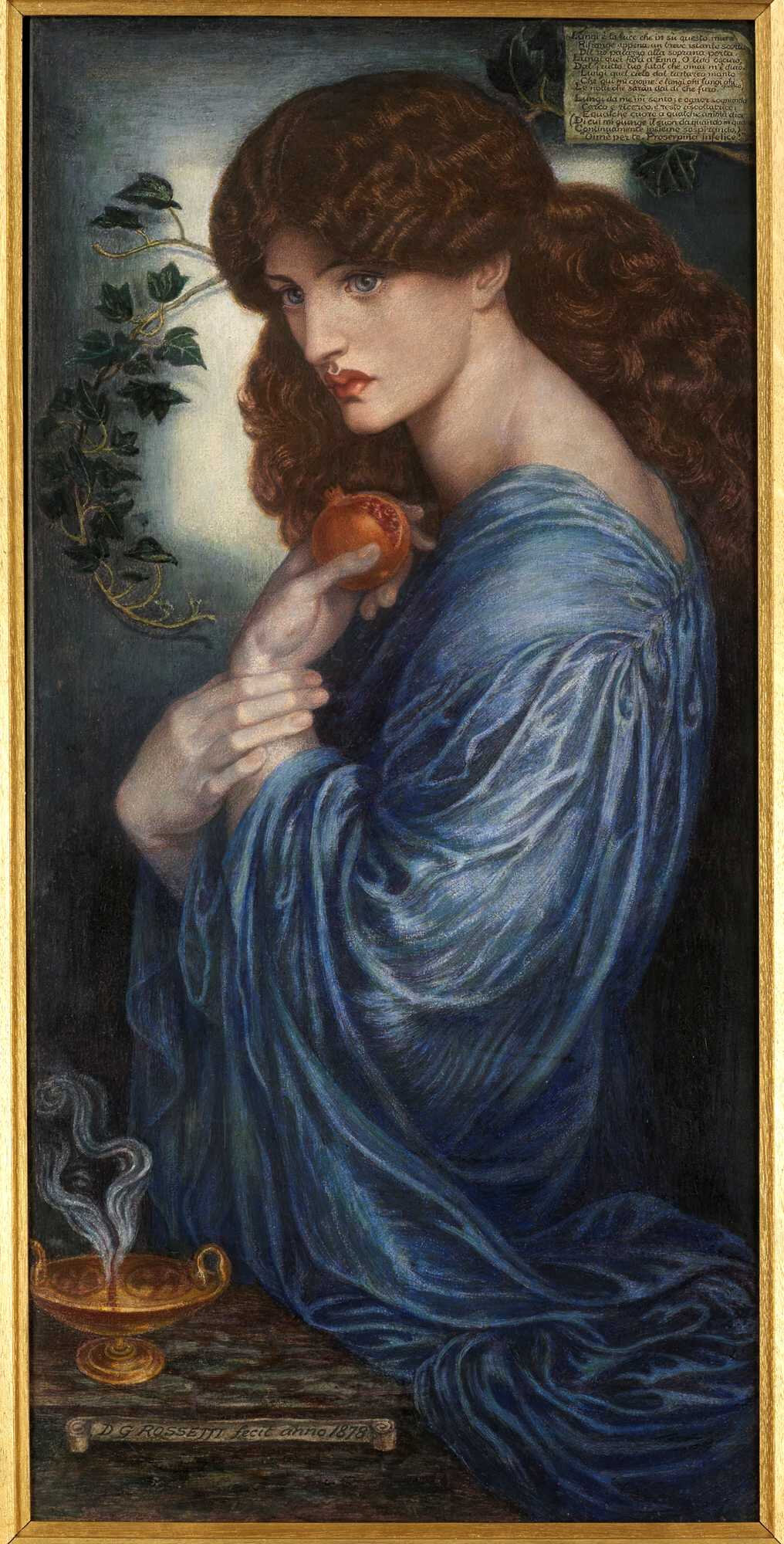
Dante Gabriel Rossetti, Proserpine. Courtesy Agnews
Truly “iconic” paintings define an artist’s oeuvre, are milestones in an artistic movement and pivotal images in history. Dante Gabriel Rossetti’s haunting image of Proserpine is one such picture that should be regarded as no less than an icon of European art – representing the artist at the zenith of his originality and one of the most immediately recognizable images of the nineteenth century.
The painting tells the story of the mythological goddess Proserpine, daughter of Ceres, who was abducted while picking flowers in a meadow by Pluto, King of the Underworld, and carried off to his subterranean realm. Ceres begged Pluto to let her daughter return to earth, and he agreed on condition that Proserpine had not eaten any of the fruits of Hades. However, it was discovered that she had consumed one pip of a pomegranate, and was thus forced to remain. Here in a shadowed corner stands the beautiful Queen of the Underworld. In her elegant pale hands she holds the fated pomegranate fruit, her right hand rests on the wrist of her left as if in an attempt to restrain herself. Her face conveys the melancholy of her incarceration, but is also defiant and powerful. A lamp before her emitting curls of smoke, its flame extinguished by the sudden opening of a portal which casts the patch of light and reveals Proserpine's “sin”. The spectator is placed in the position of Pluto himself, discovering his wife eating the fruit. Like Eve who was tempted in the Garden of Eden to taste the forbidden fruit, Proserpine has been caught with the fruit-juice staining her pouting lips. She is hidden away, her beauty unseen by the eyes of the Overworld, clad in a gown of striking blue which mirrors the pale beauty of her eyes. Although Proserpine inhabits the palace of death, the golden glow of her flesh and the warmth of her lips makes it clear that she represents life, waiting to be freed and reborn. She also personifies female virginity; like the fruit which is both delicious and forbidden, she reflects the contradictions of illicit temptation, irresistible but unable to be had. Founded in 1848 by William Holman Hunt, John Everett Millais and Rossetti, the Pre-Raphaelite Brotherhood grew to become an extended body of English painters, poets and critics, joined by a shared desire to reject the Classical poses of Raphael and return to the intensely-coloured, complex compositions of Quattrocento art. The decadent, staggeringly beautiful and highly original works that were produced by these Bohemians of Victorian art, whose visions stood out from those around them, stand as remarkable icons of one of the fastest-changing and most dynamic eras in history. It is no exaggeration to say that Rossetti played a major role in the reshaping of modern ideas of female beauty. The beauty of Jane Morris and Rossetti’s illicit and obsessional love for her, combined with his extraordinary artistic talent, created an image of womanhood that moved away from the mainstream Victorian ideal towards the more sensual and exotic beauty that became popular towards the end of the nineteenth century. Pale with sensual full-lips, deep soulful eyes and waves of luxuriant hair, the women who posed for the Pre-Raphaelites inspired some of art history’s most striking images. ‘The stunners’ — as they collectively came to be known, with their characteristic angular features and wistful expressions, animated some of the movement’s most celebrated paintings. Perhaps this is truer of none more than Jane Morris, the wife of Rossetti’s friend, William Morris, Rossetti’s muse and his lover with whom he was completely infatuated. Proserpine has often been seen as symbolic of the couple’s predicament, exploring the concept of forbidden fruit and the subject as a metaphor for Jane’s captivity in marriage. Of all the subjects that Rossetti treated, that of Proserpine was the one into which he invested the most personal associations in his later years and the image has come to represent the artist’s identity and tormented soul. By his own admission, Proserpine was the most beautiful of all his inventions, describing it as "the best picture I ever painted". Without the Symbolism of images like Proserpine, with its connection to nature and to the beauty of the female form, the movements of Art Nouveau and the exotic excesses of the Fin de Siecle would not have found their sinuous, organic forms. The distancing from traditional forms to an art that was more abstracted and suggestive also paved the way for Expressionism and eventually Abstraction. Rossetti’s art was as avante garde and as daring as the work of the Impressionists, presenting a different view of both outward beauty and the psyche. With its strong verticality and a monolithic female figure with a fierce exotic beauty and grasping slender hands, Gustav Klimt's famous Judith II of 1909 appears to owe much to Rossetti's Proserpine. Rossetti’s influence on artists such as Odilon Redon and Fernand Knopff is well known, but his femme fatales would have a more far-reaching effect on artists such as Gauguin, Munch and Picasso. Picasso in particular was an admirer of Rossetti’s works, and the melancholic tension of Proserpine anticipates by several decades the shadowy introspection of Picasso's Blue Period.
Provenance: Bought from the artist in 1878 by Frederick Startridge Ellis for £262. James F. Hutton of Victoria Park, Manchester; Christie’s, London, 10 May 1884, lot 86 (240 gns to Agnews). Sold by Agnews (their stock no. 3246) to Mrs Bloomfield Moore of 12 Great Stanhope Street, Mayfair, on 15 May 1884 for £277. Mrs Clara Jessup Bloomfield Moore (†); Christie’s, London, 5 May 1900, lot 51 (320 gns to Clarence von R. (i.e. Knoedler). With Bernhard Magaliff, Stockholm. With Daniel Katz, London, in the mid-1970s, and acquired from him by a previous owner.
Literature: William Sharp, Dante Gabriel Rossetti: A Record and a Study, London, 1882, p. 234, and Appendix, no. 310 (misdated to 1880). Joseph Knight, The Life of Dante Gabriel Rossetti, London, 1887, p. xvii, no. 386 (misdated to 1880). William Michael Rossetti, Dante Gabriel Rossetti as Designer and Writer, London, 1889, pp. 104, 288, no. 363. H.C. Marillier, Dante Gabriel Rossetti: An Illustrated Memorial of his Art and Life, London, 1899, pp. 174, 199, 256, no. 295 (misdated to 1880). Oswald Doughty and J.R. Wahl (eds), Letters of Dante Gabriel Rossetti, Oxford, 1965–7, vol. 4 (1967), p. 1546. Virginia Surtees, The Paintings and Drawings of Dante Gabriel Rossetti: A Catalogue Raisonnée, Oxford, 1971, vol. 1, p. 132, under no. 233. John Bryson and Janet Camp Troxell (eds), Dante Gabriel Rossetti and Jane Morris: Their Correspondence, Oxford, 1976, pp. 50, 53 (note 4), 74, 75 (note 1). William E. Fredeman et al. (eds), The Correspondence of Dante Gabriel Rossetti, Cambridge, 2002–, vol. 8 (2009), pp. 15, 16 (note 5), 29–30, 126–7 (note 1), 131.
AGNEWS, Stand A24 at Masterpiece London 2018


/http%3A%2F%2Fstorage.canalblog.com%2F27%2F12%2F119589%2F133077897_o.jpg)
/http%3A%2F%2Fstorage.canalblog.com%2F41%2F18%2F119589%2F132277112_o.jpg)
/http%3A%2F%2Fstorage.canalblog.com%2F56%2F90%2F119589%2F131522395_o.jpeg)
/http%3A%2F%2Fstorage.canalblog.com%2F72%2F93%2F119589%2F130805831_o.jpg)