

/https%3A%2F%2Fprofilepics.canalblog.com%2Fprofilepics%2F1%2F0%2F100183.jpg)
/https%3A%2F%2Fstorage.canalblog.com%2F03%2F02%2F119589%2F96711876_o.jpg)
/https%3A%2F%2Fstorage.canalblog.com%2F11%2F31%2F119589%2F94773502_o.jpg)
/https%3A%2F%2Fstorage.canalblog.com%2F20%2F83%2F119589%2F94772815_o.jpg)
/https%3A%2F%2Fstorage.canalblog.com%2F26%2F72%2F119589%2F75604929_o.jpg)
/https%3A%2F%2Fstorage.canalblog.com%2F59%2F60%2F119589%2F26458628_o.jpg)
Veiled world of Qing Empresses revealed in Smithsonian's Freer│Sackler exhibition

WASHINGTON, DC.- “Empresses of China’s Forbidden City, 1644–1912” is on view at the Smithsonian’s Arthur M. Sackler Gallery March 30 through June 23. This major international exhibition, the largest at the Freer|Sackler in more than a decade, explores empresses’ lives during the emperor-centric Qing dynasty. Despite the empresses’ accomplishments and status, they are largely missing from Qing court history. Through imperial portraits, narrative paintings, furnishings, attire (jewelry and costume) and religious art, the exhibition reveals and fills in the little-known details about the world of these women and how they were able to influence court history in many spheres, including religion, art and politics. Nearly 135 objects made for, by and about the empresses are on display, bringing these women out of the silence that history imposed upon them.
Celebrating the 40th anniversary of the establishment of U.S.–China diplomatic relations, the exhibition is organized by three institutions, the Smithsonian’s Freer|Sackler, the Palace Museum in Beijing and the Peabody Essex Museum in Salem, Massachusetts. The majority of the objects come from the Palace Museum in Beijing, also known as the Forbidden City, and include rare treasures that have never been on display in the U.S.

Map of the Forbidden City. Based on illustration by Chiu-Kwong-Chiu, Design and Cultural Studies Workshop, Hong Kong, published in Empresses of China’s Forbidden City, 1644-1912.
“The Freer|Sackler is honored to host this spectacular exhibition, which gives visitors a rare glimpse into the world of these women and forms part of an important international partnership,” said Chase Robinson, The Dame Jillian Sackler Director of the Arthur M. Sackler Gallery and Freer Gallery of Art. “We look forward to sharing all the exhibition has to offer—from glorious images and objects to fascinating stories and deep cultural insights.”
The Qing dynasty founded in 1644 by the Manchus, a group from northeastern Asia, was a multiethnic and multicultural empire. The Manchu rulers adopted the Forbidden City in Beijing as their center of governance and main residence. Manchu women possessed more rights than their Han Chinese counterparts, and they were encouraged to ride horses, practice archery and hunt alongside men. The Manchu empresses were also learned, appreciated art and supported religion at the court.

Exterior of the Main Hall of the Palace of Longevity and Health © Palace Museum.

Floor plan of the Palace of Longevity and Health, adapted from the floor plan by the Exhibition Design Department, The Palace Museum.

Detail showing the Splendid Palaces Filled with Joy, from scroll four of Celebrating Empress Dowager Chongqing’s Birthday. Ding Guanpeng (act. 1726–1770), Zhang Gao (act. 18th century), Zhang Tingyan (1735–1794), Wu Weiqian (act. 18th century), Chen Zhaolong (act. 18th century), and other court painters, Beijing and Suzhou, Jiangsu Province. Qianlong period (1736–95), 1751–61. Handscroll; ink and color on silk. Palace Museum, Gu8618-4/4 © The Palace Museum.

Ritual space in the Main Hall of the Palace of Longevity and Health © Palace Museum.
Manchu emperors had multiple wives, but only one empress at a time. All the imperial wives were selected from the descendants of the conquering elite—those who helped to overthrow the Chinese Ming dynasty and establish the Qing. Each wife pledged total allegiance to the imperial family when she entered the palace. Some empresses used their intimate relationship with the emperor to exert influence on him and how he shaped Qing dynasty history.
Through the beautiful objects in this exhibition, including imperial robes, jewelry and portraits (many of which have never left the Palace Museum before) visitors are able to look behind the walls of the Forbidden City and discover the sumptuous lives of five empresses, who represent much about the experience of being an imperial woman. Out of the approximately two dozen Qing empresses, the exhibition focuses on five: Empress Xiaozhuang (1613–1688), Empress Dowager Chongqing (1693–1777), Empress Xiaoxian (1712–1748), Empress Dowager Ci’an (1837–1881) and Empress Dowager Cixi (1835–1908).
Each of these empresses helped shape the Qing dynasty, leaving a lasting impact and legacy. The five women were religious patrons, art collectors, managers of family affairs and advisors to the emperor.
Empress Xiaozhuang was the mother of the Shunzhi emperor and grandmother of the Kangxi emperor, each of whom ascended the throne as a youth. She was crucial in helping guide them. Faith was deeply important to her and through her promotion of Tibetan Buddhism she helped shape the religious history of the Qing dynasty.

Portrait of the Imperial Consort Zhuang, later Empress Xiao Zhuang Wen, 17th century. © Palace Museum.

Official imperial portrait of Empress Dowager Xiaozhuang. © Palace Museum.

Empress Dowager Xiaozhuang, Unknown date, before 1688. © Palace Museum.
Empress Dowager Chongqing entered the palace as a servant and was promoted to a third-rank consort of the prince who became the Yongzheng emperor. At 18, she bore her only child, a son who would eventually ascend to the throne, becoming known as the Qianlong emperor. He greatly respected and doted upon his mother and promoted her to Empress Dowager and honored her with the title “Sage Mother.”

Empress Dowager Chongqing at the Age of Seventy. Probably Giuseppe Castiglione (Lang Shining; Italy, 1688–1766) and other court painters, Beijing, Qianlong period, about 1761, hanging scroll, ink and color on silk, Palace Museum, Gu6452. © The Palace Museum.

Empress Dowager Chongqing at the Age of Eighty. Ignatius Sichelbarth (Ai Qimeng, 1708–1780), Yi Lantai (act. ca. 1748–86), and Wang Ruxue (act. 18th century), Beijing. Qianlong period (1736–95), 1771. Hanging scroll; ink and color on silk. Palace Museum, GU6453 © The Palace Museum.


Court robe. Embroidery by Imperial Silk Manufactory, Suzhou, Jiangsu Province. Tailoring by Imperial Workshop, Beijing. Yongzheng period (1723–35) or Qianlong period (1736–95), 1723–95. Embroidery, polychrome and metallic-wrapped silk threads on silk satin, and coral. Palace Museum, GU43478 © The Palace Museum.
Empress Xiaoxian was genuinely adored by her husband, the Qianlong emperor whom she married at the age of 15 when he was still a prince. She was well respected as a manager of imperial family affairs, but died tragically at age 36 and no one would ever replace her in Qianlong’s heart. Mourning his wife, the emperor brushed a poem revealing his intense affection. This poem is a rare treasure that is on display in the exhibition.
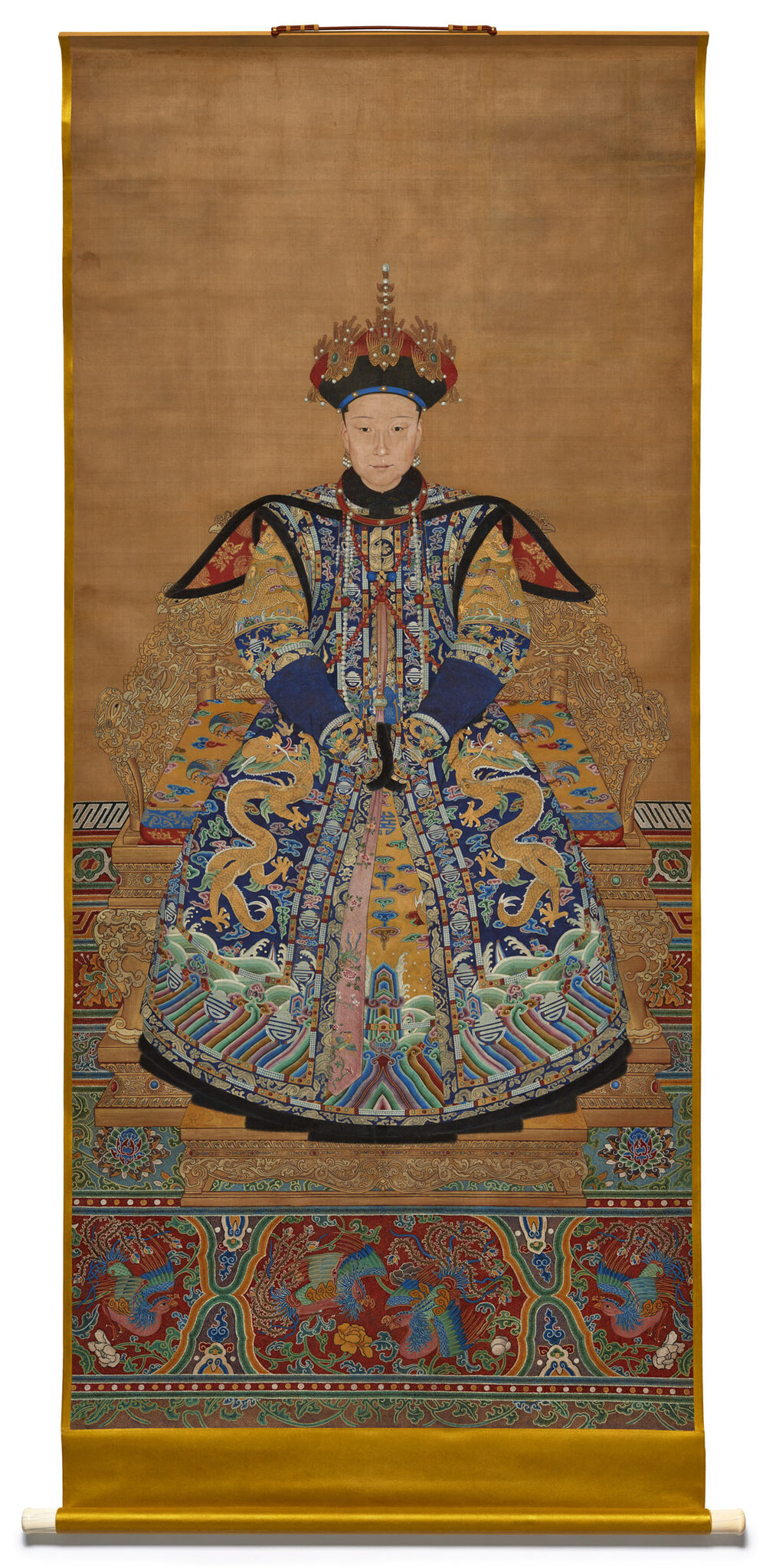
Empress Xiaoxian. Ignatius Sichelbarth (Ai Qimeng, 1708–1780) and Yi Lantai (act. ca. 1748–86) and possibly Wang Ruxue (act. 18th century). China, Qianlong period, 1777, with repainting possibly 19th century. Hanging scroll; ink and color on silk. Peabody Essex Museum (PEM), gift of Mrs. Elizabeth Sturgis Hinds, 1956, Peabody Essex Museum, E33619.
Empress Dowager Ci’an was the empress and widow of the Xianfeng emperor. She was childless, but her position and rank made her the “formal” mother of the Tongzhi emperor who was born to a lower-ranking consort, soon to be known as Empress Dowager Cixi. When the young boy ascended to the throne at 6 years old, the two women allied, instigated a coup to gain political power and ruled together as co-regents. Ci’an was known for more traditional motherly values. In contrast, Empress Dowager Cixi applied her intelligence, networking skills and ambition to become the most powerful empress in the Qing and arguably in all of Chinese history. Cixi challenged the tradition of “women shall not rule.”

Empress Dowager Cixi. Katharine A. Carl (1865–1938). China, Qing dynasty, 1903. Oil on canvas with camphor wood frame. Transfer from the Smithsonian American Art Museum. Arthur M. Sackler Gallery, S2011.16.

Empress Dowager Cixi with foreign envoys’ wives in the Hall of Happiness and Longevity (Leshou tang) in the Garden of Nurturing Harmony (Yihe yuan). Photographed by Yu Xunling (1874–1943). China, Guangxu period, 1903–1905. Print from glass-print negative. Freer Gallery of Art and Arthur M. Sackler Gallery Archives, FSA A.13 SC-GR-249.

Empress Dowager Cixi. Photographed by Yu Xunling (1874–1943), Guangxu period, 1903–05, print from glassplate negative, Freer Gallery of Art and Arthur M. Sackler Gallery Archives, FSA A.13 SC-GR-262, Smithsonian Institution, Washington, DC, Purchase.
“For me, this exhibition is the exciting culmination of nearly four years of extensive research and collaboration with my co-curator, Daisy Yiyou Wang from the Peabody Essex Museum and many dedicated staff at the Palace Museum in Beijing,” said Jan Stuart, the Melvin R. Seiden Curator of Chinese Art at the Freer|Sackler. “We are thrilled to be able to shine a spotlight on the previously understudied realm of the Qing empresses and help people understand their complex and dynamic roles at court. We hope we have lifted the veil obscuring the empresses’ world.”
A multi-author, full-color catalog distributed by Yale University Press features a series of essays focusing on the multidimensional role the empresses played in shaping Qing court history and the artwork associated with their lives. An accompanying website will provide insights into the lives of these spectacular women, from an overview of the palace of Empress Dowager Chongqing to decoding the symbolism of two exquisite robes. It will also include resources to learn more about the Qing dynasty, particularly for children and educators.

Drinking Tea from Yinzhen’s Twelve Ladies. Court painters, Beijing, possibly including Zhang Zhen (active late 17th–early 18th century) or his son Zhang Weibang (about 1725–about 1775), Kangxi period, 1709–23, hanging scroll, ink and color on silk, Palace Museum, Gu6458-7/12. © The Palace Museum.

Looking at Plum Blossoms from Yinzhen’s Twelve Ladies Court painters, Beijing, possibly including Zhang Zhen (active late 17th–early 18th century) or his son Zhang Weibang (about 1725– about 1775) Kangxi period, 1709–23 Hanging scroll, ink and color on silk 72 7⁄16 × 38 9⁄16 in. (184 × 98 cm) Palace Museum, Gu6458-8/12.

Pair of socks with phoenixes and other birds Workshop, probably Jiangsu or Zhejiang province Kangxi period, 1662–1722 Embroidery, polychrome, metallic-wrapped, and peacock-filamentwrapped threads on silk satin with silk damask and silk lining 19 1⁄16 × 9 5⁄8 in. (48.5 × 24.5 cm) each Palace Museum, Gu61795.

Detail, Heart of the Perfection of Wisdom Sutra. The Kangxi emperor (1654–1722). Kangxi period (1662–1722), 1702. Album, gold and color on paper. Palace Museum, Shu7768 © The Palace Museum.

One of a pair of “precious treasures” display cabinets (detail) Yongzheng or Qianlong period, 1723–95 Lacquer with gold on wood core, metal with gilding, and ivory 63 3⁄8 × 34 1⁄16 × 13 9⁄16 in. (161 × 86.5 × 34.5 cm) Palace Museum, Gu207580.

Tray with boys at play (detail). Workshop, Suzhou, Qianlong period, 1742–43, carved polychrome lacquer on wood core, Palace Museum, Gu108653. © The Palace Museum.

Five-panel screen with phoenixes and birds in landscape (detail). Workshop, probably Guangzhou, Qianlong period, probably 1775 or earlier. Panels: cloisonné, copper alloy with polychrome enamels and gilding; frame: zitan wood and nan wood, 116 15⁄16 × 151 3⁄16 × 12 3⁄16 in. (297 × 384 × 31 cm) Palace Museum, Gu210730.

Celebrating Empress Dowager Chongqing’s eightieth birthday (detail). Yao Wenhan (act. 1740s–70s), Zhou Ben (act. 1760s–70s), and Yi Lantai (act. 1748–86). Qianlong period (1736–95), 1771–72. Ink and color on silk. Palace Museum, Gu6541 © The Palace Museum

Amitayus Buddha in a niche (detail). Workshop, probably Tibet, Qianlong period, 1771, copper alloy with gilding and pigments; niche: zitan wood with silk damask, Palace Museum, Gu203040. © The Palace Museum.


Stupa containing Empress Dowager Chongqing’s hair and Amitayus Buddha. Imperial Workshop, Beijing, Qianlong period, 1777, gold and silver alloy with coral, turquoise, lapis lazuli, and other semiprecious stones, and glass; pedestal: zitan wood, Palace Museum, Gu11866. © The Palace Museum

Lobed fan with cranes, peaches, and rocks. Qianlong period, 1736–95, appliqué, silk fabric on silk gauze with pigments; handle: wood and ivory, Palace Museum, Gu136152. © The Palace Museum.

Hand warmer with landscapes. Workshop, probably Suzhou, Jiangsu Province. Qianlong period (1736–95). Lacquer with gold and pigments on metal core. Palace Museum, Gu113194 © The Palace Museum.

Ewer with dragons and clouds. Probably Imperial Workshop, Beijing, Qianlong period, 1736–95, gold alloy, Palace Museum, Gu11455. © The Palace Museum

Ewer with lady and boy in garden on two sides; Imperial Workshop, probably Beijing; Qianlong period, probably 1760s or 1770s. Cloisonné and painted enamel, copper and gold alloy with polychrome enamels and gilding, coral, turquoise, and lapis lazuli; 15 3⁄8 × 11 in. (39 × 28 cm); Palace Museum, Gu11450.

Dressing case with mirror stand and handheld mirror. Qianlong period, mid- to late 18th century, with later repairs, lacquer with gold and polychrome decoration on wood core, zitan wood, suanzhi wood, mother-of-pearl, bone, metal with gilding; wood-framed mirror with embroidered silk case, 16 3⁄4 × 16 1⁄4 × 16 1⁄4 in. (42.5 × 41.3 × 41.3 cm) with the case closed, Palace Museum, Gu180527

Festive robe with bats, clouds, and the character for longevity Probably Imperial Silk Manufactory, Nanjing (weaving), and Imperial Workshop, Beijing (tailoring) Qianlong period, 1785 or earlier Patterned silk satin and embroidery, polychrome silk and metallicwrapped threads on silk fabric 56 5⁄16 × 70 1⁄16 in. (143 × 178 cm) Palace Museum, Gu42136.


Front and back of a festive robe. Weaving and embroidery by Imperial Silk Manufactory, Suzhou, Jiangsu Province; tailoring by Imperial Workshop, Beijing. Qianlong period (1736–95), 1736–77. Embroidery, polychrome silk threads on silk satin. Palace Museum, Gu42151 © The Palace Museum

Festive robe with bats, lotuses, and the character for longevity. Probably Imperial Silk Manufactory, Suzhou (embroidery), and Imperial Workshop, Beijing (tailoring), Jiaqing period, 1796–1820, embroidery, polychrome and metallic-wrapped silk threads on silk tabby, Palace Museum, Gu43302. © The Palace Museum.

Festive robe with eight dragon-phoenix roundels and twelve imperial symbols. Imperial Silk Manufactory, Suzhou (embroidery), and Imperial Workshop, Beijing (tailoring), Guangxu period, about 1888–89, embroidery, polychrome and metallic-wrapped silk threads on silk tabby, Palace Museum, Gu44219. © The Palace Museum

Hairpin with figure and vase 18th or 19th century Pearls, sapphire, coral, turquoise, kingfisher feather, and silver with gilding 5 3⁄8 × 2 1⁄8 in. (13.7 × 5.4 cm) Palace Museum, Gu10130.

Hairpin with crab and reed Daoguang period, 1834 or earlier Jade (nephrite), kingfisher feather, pearls, ruby, and silver with gilding 7 7⁄8 × 2 3⁄4 in. (20 × 7 cm) Palace Museum, Gu10223.


Court hat with phoenixes. Probably Imperial Workshop, Beijing 18th or 19th century. Sable, velvet, silk floss, pearls, tiger’s-eye stone, lapis lazuli, glass, birch bark and metal with gilding, and kingfisher feather, 14 1⁄2 × 10 3⁄5 in. (37 × 27 cm), Palace Museum, Gu60084

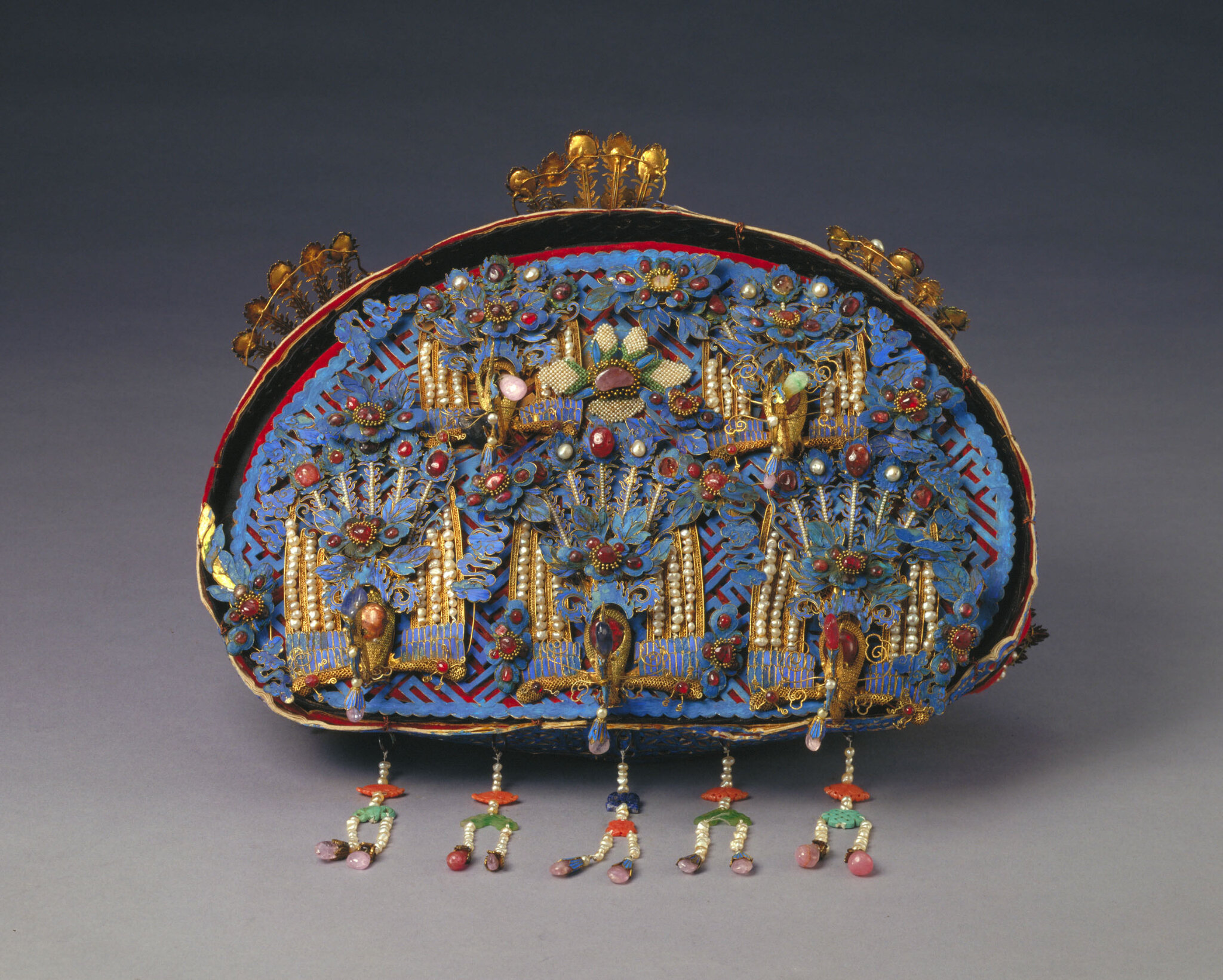
Festive headdress with phoenixes and peonies. Probably Imperial Workshop, Beijing, Tongzhi or Guangxu period, probably 1872 or 1888–89, silver with gilding, kingfisher feather, pearls, coral, jadeite, ruby, sapphire, tourmaline, turquoise, lapis lazuli, and glass; frame: metal, wires with silk satin, velvet, and cardboard, 7 3⁄4 × 11 7⁄8 × 8 1⁄2 in. (19.6 × 30.2 × 21.6 cm), Palace Museum, Gu59708.

Pair of bracelets with bats, peaches, and flowers Probably 19th or early 20th century Tortoiseshell with coral, kingfisher feather, pearls, ruby, jadeite, tourmaline, and silver with gilding 2 7⁄16 in. (6.2 cm) interior diam. Palace Museum, Gu10371.

Pair of platform shoes with tiger heads, the character for longevity, and bats Guangxu period, 1875–1908 Appliqué, silk satin; platforms: wood core covered with cotton, glass beads 6 7⁄8 × 8 1⁄4 × 3 15⁄16 in. (17.5 × 21 × 10 cm) each Palace Museum, Gu61568.

Seal of empress with double-headed dragon with box, tray, lock, key, and plaques Imperial Workshop, Beijing Republican period, 1922 Gold alloy with silk tassels Seal: 4 × 5 1⁄2 × 5 1⁄2 in. (10 × 14 × 14 cm) Palace Museum, Gu167075.


/image%2F1371349%2F20260926%2Fob_fe9efe_38657.jpg)
/image%2F1371349%2F20260928%2Fob_36d164_39028.jpg)
/image%2F1371349%2F20260928%2Fob_b8ee3f_39026.jpg)
/image%2F1371349%2F20260928%2Fob_2ac9fd_39022.jpg)