

/https%3A%2F%2Fprofilepics.canalblog.com%2Fprofilepics%2F1%2F0%2F100183.jpg)
/https%3A%2F%2Fstorage.canalblog.com%2F03%2F02%2F119589%2F96711876_o.jpg)
/https%3A%2F%2Fstorage.canalblog.com%2F11%2F31%2F119589%2F94773502_o.jpg)
/https%3A%2F%2Fstorage.canalblog.com%2F20%2F83%2F119589%2F94772815_o.jpg)
/https%3A%2F%2Fstorage.canalblog.com%2F26%2F72%2F119589%2F75604929_o.jpg)
/https%3A%2F%2Fstorage.canalblog.com%2F59%2F60%2F119589%2F26458628_o.jpg)
A rare blue and white 'Heavenly Horse' jar, Yuan dynasty (1279-1368)
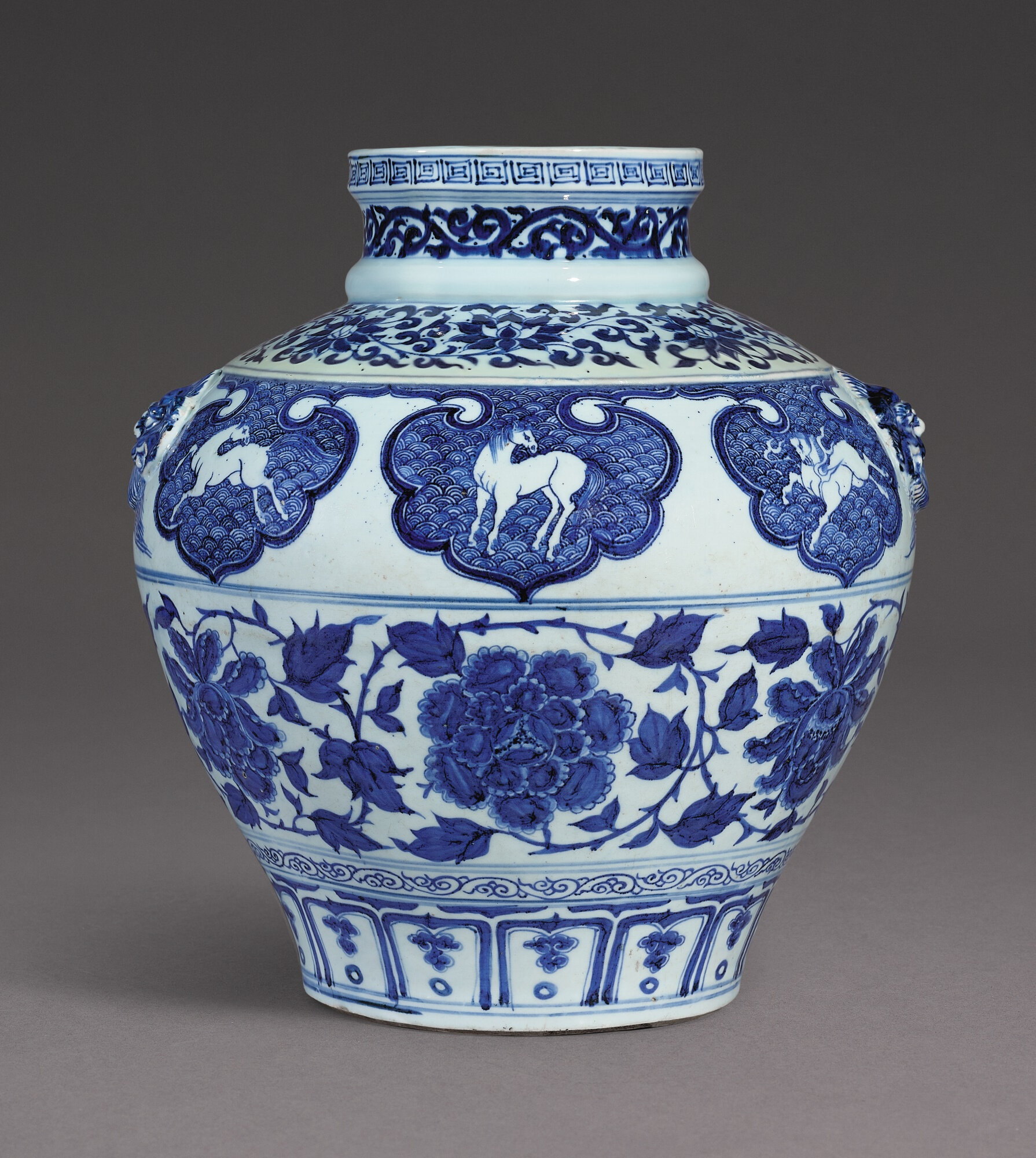


Lot 3006. A rare blue and white 'Heavenly Horse' jar, Yuan dynasty (1279-1368); 37.9 cm, 14 7/8 in. Estimate 2,200,000 — 2,800,000 HKD (280,478 - 356,972 USD). Unsold. Courtesy Sotheby's.
robustly potted with a baluster body sweeping up to a broad shoulder surmounted by a constricted neck and galleried rim, the body divided into two main registers, the upper register decorated in rich cobalt-blue tones with six large pendent ruyi motifs, each enclosing a Heavenly Horse against a ground of waves, interrupted by two mythical beast mask handles flanking the vessel, the lower rendered with large peony blooms borne on and wreathed by undulating leafy scrolls, all above classic scroll and upright lappet borders skirting the lower body, the neck and shoulder painted with classic and lotus scrolls friezes interrupted by a raised rib, all below a keyfret band encircling the rim.
Provenance: A Japanese private collection.
Exhibited: Chūgoku kotōji meihin 70 sen: heisei gannen shūki tokubetsuten [70 selected masterpieces of ancient Chinese ceramics: Special Autumn exhibition in the first year of the Heisei period], Fukuyama Castle Museum, Fukuyama, 1989, cat. no. 40.
Yuan and Ming Blue and White Porcelain, David Lin & Co., Taipei, 2000, cat. no. 2 and cover.
Note: In its material, form and design, this impressive guan is a striking representation of blue and white porcelain from the Yuan dynasty, a highly innovative and experimental period when cobalt blue began to be used on porcelain. The painting of the floral scroll is bold yet elaborate, with careful shading and finely combed details, and white flying horses are depicted in strikingly lively poses over a ground of waves.
Revered as animals of perseverance and speed, horses were often depicted on paintings and works of art of the Yuan dynasty. Fine horses were highly valued at the Mongol court, and large suburban areas in and around the Yuan capital, Dadu, were reserved for the pasture of royal horses. White horses were particularly sought-after by the people inhabiting the Eurasian steppe, and in the Yuan dynasty their milk drunk solely by members of the court. Here, the horses are depicted flying over expanses of water, their movement captured in their naturalistic and lively poses, and some feature flaming haunches. This rendition of horses evokes the story of the white horse that was devoured by a dragon while carrying Buddhist scriptures from India to Xuanzang, a Tang dynasty (618-907) monk. On orders from Guanyin, the bodhisattva of Compassion and Mercy, the dragon was forced to turn itself into a white horse and complete the journey.
Jars painted on the shoulder with this design of horses are very rare, although a slightly larger jar and cover, illustrated in numerous publications including Ye Peilan, Yuandai ciqi [Yuan dynasty porcelain], Beijing, 1998, col. pl. 58, was sold in these rooms, 11th April 2008, lot 2927. Another jar of this form and painted with horses, but with two dragons replacing the lotus scroll at the shoulder, from the collection of Ottoman Sultans, in the Topkapi Saray Museum, Istanbul, is illustrated in Regina Krahl, Chinese Ceramics in the Topkapi Saray Museum, ed. John Ayers, Istanbul, London, 1986, vol. 2, col. pl. 586; one with petals, in the Ashmolean Museum, Oxford, is published in Sir Harry Garner, Oriental Blue and White, London, 1973, pl. 21; and another from the collection of G. Rogers and later in a Japanese collection, was sold in our London rooms, 3rd December 1963, lot 93. See also a meiping painted with this motif, in the Topkapi Saray Museum, illustrated op.cit., pl. 585.
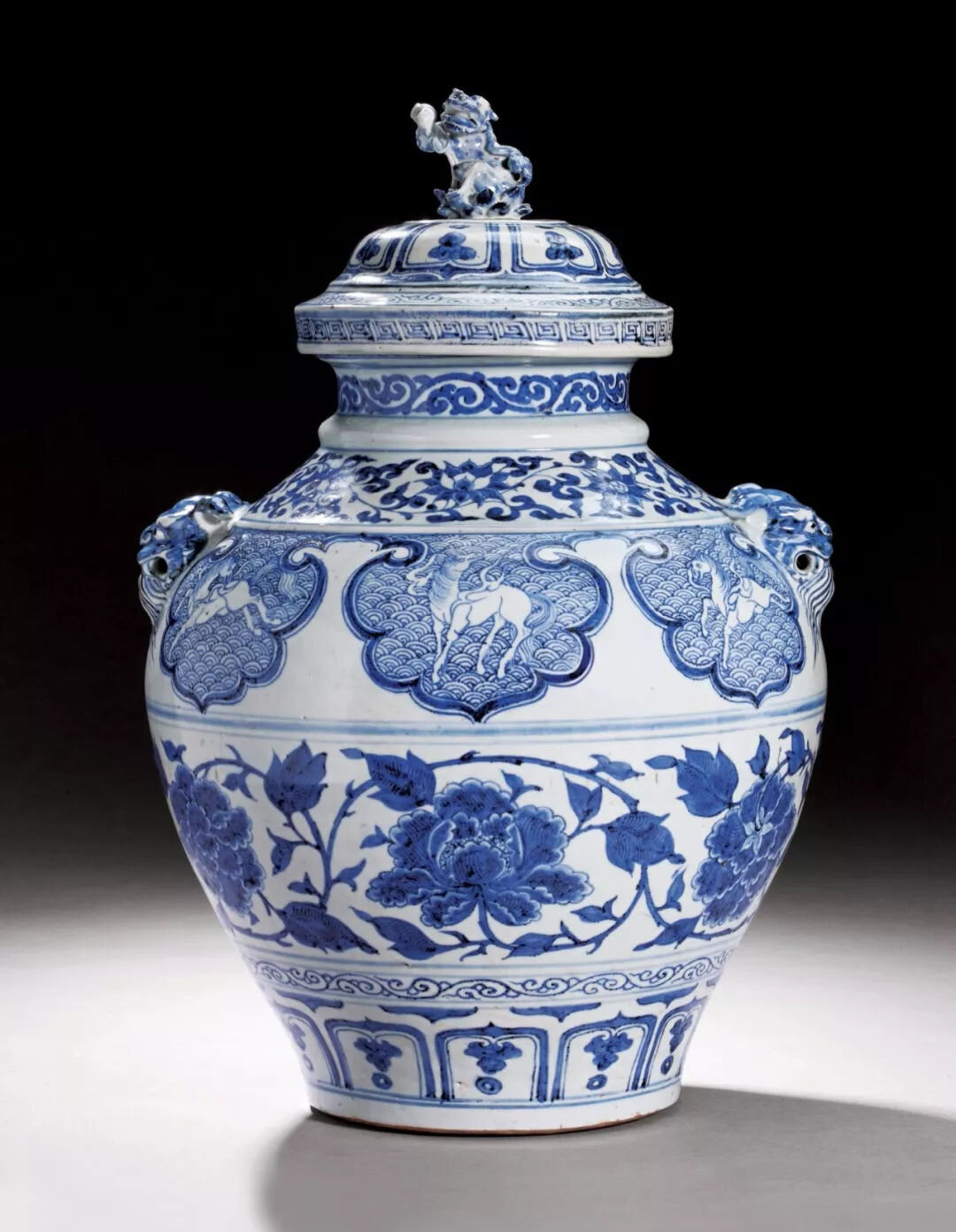
An extremely rare and important blue and white jar and cover, Yuan dynasty (1279-1366). Overall height 42cm., 16 1/2 in. Jar height 31.8cm., 12 1/2 in. Estimate 20,000,000 — 30,000,000 HKD. Lot sold 22,727,500 HKD (1,846,463 EUR) (2,917,984 USD) at Sotheby's Hong Kong, 11th April 2008, lot 2927. Courtesy Sotheby's 2008.
Cf.my post: An extremely rare and important blue and white jar and cover, Yuan dynasty (1279-1366)
Jars of this form are also known painted on the ruyi-shaped panels with birds and scattered lotus flowers against waves, such as two jars sold in our London rooms, 11th July 1967, lot 92, and 6th June 1995, lot 208 respectively.
The pendent ruyi motif on the shoulder is a recurrent design on blue and white porcelain of the Yuan period and may derive from nomadic traditions of the time. In the painting Lady Wenji's Return to the Han Court, by the 13th century Jin dynasty (1115-1234) court painter Zhang Yu, Lady Wenji is depicted wearing an elaborate cloud collar draped over her clothing (Zhongguo meishu quanji. Huaha bian [Complete series on Chinese art. Painting], vol. 3, Beijing, 1988, pl. 59).
Sotheby's. An Important Collection of Chinese Ceramics, Hong Kong, 08 Oct 2019


/image%2F1371349%2F20260327%2Fob_ea80a1_1000060128.jpg)
/image%2F1371349%2F20251215%2Fob_58f5d1_telechargement-61.jpg)
/image%2F1371349%2F20251215%2Fob_e86cf1_telechargement-24.jpg)
/image%2F1371349%2F20250316%2Fob_a520eb_telechargement-10.jpg)