

/https%3A%2F%2Fprofilepics.canalblog.com%2Fprofilepics%2F1%2F0%2F100183.jpg)
/https%3A%2F%2Fstorage.canalblog.com%2F03%2F02%2F119589%2F96711876_o.jpg)
/https%3A%2F%2Fstorage.canalblog.com%2F11%2F31%2F119589%2F94773502_o.jpg)
/https%3A%2F%2Fstorage.canalblog.com%2F20%2F83%2F119589%2F94772815_o.jpg)
/https%3A%2F%2Fstorage.canalblog.com%2F26%2F72%2F119589%2F75604929_o.jpg)
/https%3A%2F%2Fstorage.canalblog.com%2F59%2F60%2F119589%2F26458628_o.jpg)
Exhibition of early European open-air painting reveals new scholarship and recently discovered works

Léon-François-Antoine Fleury, French, 1804 - 1858, The Tomb of Cecaelia Metella, c. 1830, oil on canvas, National Gallery of Art, Washington, Gift of Frank Anderson Trapp, National Gallery of Art, Washington.
WASHINGTON, DC.- An integral part of art education in the late 18th and early 19th centuries, painting en plein air (in the open air) was a core practice for artists in Europe. Intrepid painters—developing their abilities to quickly capturing effects of light and atmosphere—made sometimes arduous journeys to study landscapes at breathtaking sites, ranging from the Baltic coast and Swiss Alps to the streets of Paris and ruins of Rome. True to Nature: Open-Air Painting in Europe, 1780–1870 presents some 100 oil sketches made outdoors across Europe by artists such as Carl Blechen, Jules Coignet, André Giroux, Anton Sminck Pitloo, Carl Frederik Sørensen, and Joseph Mallord William Turner. On view in the West Building of the National Gallery of Art, Washington, from February 2 through May 3, 2020, the exhibition presents dozens of recently discovered studies and explores issues of attribution, chronology, and technique.

Jules Coignet, French, 1798–1860, View of Bozen with a Painter, 1837, oil on paper, mounted on canvas, National Gallery of Art, Washington, Gift of Mrs. John Jay Ide in memory of Mr. and Mrs. William Henry Donner.
"The Gallery is fortunate to have one of the finest public collections of landscape sketches by 18th- and 19th-century European painters, largely due to acquisitions made by the late Philip Conisbee during his time as the Gallery's senior curator of European paintings from 1993 to 2008," said Kaywin Feldman, director, National Gallery of Art, Washington. "True to Nature builds on recent scholarship as well as the discovery of paintings that have come to light since the 1996 exhibition organized by Conisbee, In the Light of Italy: Corot and Early Open-Air Painting. That exhibition sparked curatorial and collector interest in this genre, and True to Nature continues to expand our understanding of this relatively unstudied, yet central, aspect of European art history. The Gallery is grateful to work with the Fondation Custodia, Collection Frits Lugt, and the Fitzwilliam Museum to bring together highlights from the best collections of European landscape sketches from this period."

Jean-Charles Rémond, French, 1795 – 1875, Eruption of Stromboli, 30 August 1842, 1842, oil on paper, mounted on canvas, Private Collection, London.
True to Nature begins as European artists would have in the late 18th and early 19th century—in Rome. The study of ancient sculpture and architecture, as well as of Renaissance and baroque art, was already a key part of an artist's education, but Pierre-Henri de Valenciennes's influential treatise on landscape painting, published in 1800, went further to recommended that young artists develop their skills by painting oil sketches out of doors. Valenciennes advised exploring the Roman countryside, as he had in Study of Clouds over the Roman Campagna (c. 1782/1785). This section includes examples by a range of European artists who followed his advice, such as Michel Dumas, Christoffer Wilhelm Eckersberg, and Johan Thomas Lundbye. Also included is The Island and Bridge of San Bartolomeo, Rome (1825/1828) by Jean-Baptiste-Camille Corot. Corot was a key figure in 19th-century landscape painting, bringing the practice of open-air painting back to France and inspiring a younger generation of impressionist painters.

Jean-Baptiste-Camille Corot, French, 1796 - 1875, The Island and Bridge of San Bartolomeo, Rome, 1825/1828, oil on paper on canvas, National Gallery of Art, Washington, Patrons' Permanent Fund.
Other sections focus on both natural and man-made features that proved challenging to painters, such as waterfalls, trees, skies, coastlines, and rooftops. Examples include rare studies by well-known artists such as John Constable's Sky Study with a Shaft of Sunlight (c. 1822, Fitzwilliam Museum), Jean Honoré Fragonard's Mountain Landscape at Sunset (c. 1765), and Odilon Redon's Village on the Coast of Brittany (1840–1916, Fondation Custodia) as well as sketches by lesser-known painters like Louise-Joséphine Sarazin del Belmont, one of the few known women artists active during this period. True to Nature illustrates how pervasive plein-air painting became across Europe with examples by many Belgian, Danish, Dutch, German, Swiss, and Swedish artists who studied in Italy before returning home to paint their native surroundings. Sketches by Carl Blechen include an example from his time in Italy, View of the Colosseum in Rome (1829, Fondation Custodia), as well as a study made at home in Germany, View of the Baltic Coast (1798-1840), Fondation Custodia).
February 2 – May 3, 2020

Jean Honoré Fragonard, French, 1732 - 1806, Mountain Landscape at Sunset, c. 1765, oil on paper, National Gallery of Art, Washington, Chester Dale Fund.

Louis Dupré, French, 1789 – 1837, View of Santa Trinità dei Monti in Rome, c. 1817, oil on paper, mounted on canvas, Fondation Custodia, Collection Frits Lugt, Paris, Gift of Jacques and Brigitte Gairard.

Richard Parkes Bonington, British, 1802 – 1828, Dezenzano, Lake Garda, 1826, oil on millboard, The Syndics of the Fitzwilliam Museum, University of Cambridge.
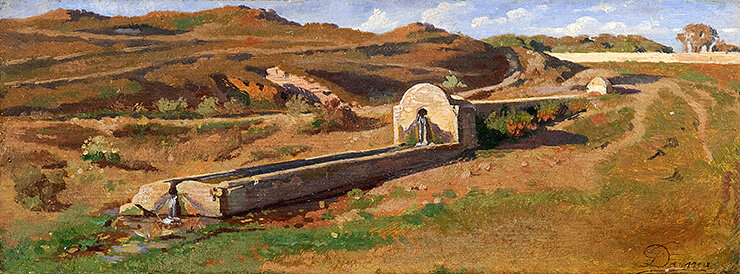
Michel Dumas, French, 1812 – 1895, Fountain in the Roman Campagna, c. 1838 – 1840, oil on canvas, mounted on wood panel, Private Collection, London.

August Kopisch, German, 1799 – 1853, View of Capri, oil on wood panel, Fondation Custodia, Collection Frits Lugt, Paris.

Louis Léopold Robert, French, 1794 – 1835, View of Naples with Vesuvius, 1821, oil on paper, mounted on canvas, Fondation Custodia, Collection Frits Lugt, Paris, Bequest of Carlos van Hasselt and Andrzej Niewęgłowski.

Baron François Gérard, French, 1770 – 1837, A Study of Waves Breaking against Rocks at Sunset, oil on millboard, Private Collection, London.

Carl Frederik Sørensen, Danish, 1818 – 1879, Rough Sea beside a Jetty, 1849, oil on canvas, The Syndics of the Fitzwilliam Museum, University of Cambridge.

Johan Carl Neumann, Danish, 1833 – 1891, Landscape with Dunes, oil on paper, mounted on canvas, Fondation Custodia, Collection Frits Lugt, Paris.

Louise-Joséphine Sarazin de Belmont, French, 1790 – 1870, Grotto in a Rocky Landscape, oil on paper, mounted on canvas, Private Collection, London.

Carl Wilhelm Götzloff, German, 1799 – 1866, Limestone Rocks, Sorrento, 1858, oil on paper, mounted on cardboard, Fondation Custodia, Collection Frits Lugt, Paris.

Achille-Etna Michallon, French, 1796 – 1822, The Oak and the Reed, 1816, oil on canvas, The Syndics of the Fitzwilliam Museum, University of Cambridge.

Janus La Cour, Danish, 1837 – 1909, Olive Trees near Tivoli, 1869, oil on canvas, Fondation Custodia, Collection Frits Lugt, Paris.

Johann Jakob Frey, Swiss, 1813 – 1865, Cloud Study (4), oil on paper, mounted on canvas, Private Collection, London.

Anton Melbye, Danish, 1818 – 1875, Skrim (Kongsberg, Norway), 1846, oil on paper, mounted on cardboard, Private Collection, London.

Frederik Rohde, Danish, 1816 – 1886, Rooftops, oil on canvas, Fondation Custodia, Collection Frits Lugt, Paris.

André Giroux, French, 1801–1879, Santa Trinità dei Monti in the Snow, 1825/1830, oil on paper, mounted on canvas, National Gallery of Art, Washington, Chester Dale Fund.


/http%3A%2F%2Fstorage.canalblog.com%2F66%2F58%2F119589%2F33595843_o.jpg)
/http%3A%2F%2Fstorage.canalblog.com%2F82%2F05%2F577050%2F39275164_p.jpg)
/http%3A%2F%2Fstorage.canalblog.com%2F56%2F05%2F119589%2F109831882_o.jpg)
/image%2F1371349%2F20260529%2Fob_f096cc_15302.jpg)