

/https%3A%2F%2Fprofilepics.canalblog.com%2Fprofilepics%2F1%2F0%2F100183.jpg)
/https%3A%2F%2Fstorage.canalblog.com%2F03%2F02%2F119589%2F96711876_o.jpg)
/https%3A%2F%2Fstorage.canalblog.com%2F11%2F31%2F119589%2F94773502_o.jpg)
/https%3A%2F%2Fstorage.canalblog.com%2F20%2F83%2F119589%2F94772815_o.jpg)
/https%3A%2F%2Fstorage.canalblog.com%2F26%2F72%2F119589%2F75604929_o.jpg)
/https%3A%2F%2Fstorage.canalblog.com%2F59%2F60%2F119589%2F26458628_o.jpg)
A gilt-bronze 'tianlu' paper weight, Late Ming dynasty

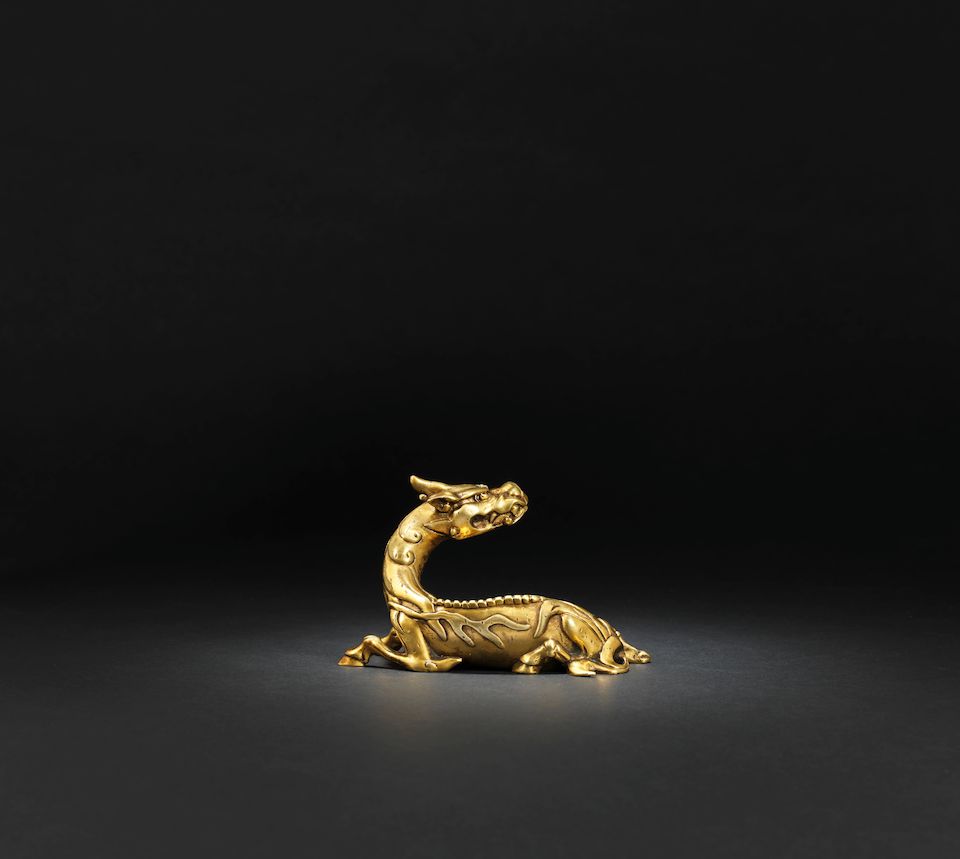
Lot 535. A gilt-bronze 'tianlu' paper weight, Late Ming dynasty; 6.7cm high. Sold for HK$ 162,500 (€ 19,294). © Bonhams.
Cast in the form of a coiled mythical beast poised in recumbent position, the creature with the head of a dragon and body of a deer, its outstretched neck turned right and looking upwards, revealing ferocious expression and sharp teeth framed by a pair of ears and horns, the back of the head with silky mane running down its spine ending in a furry tail, the body flanked by hoofed feet and engulfed in flames.
Provenance: A German private collection, Hamburg, 1987.
Note: The Tianlu, also known as a qilin, is a legendary mythical beast considered a symbol of prosperity with the power to ward off evil. There is an old saying which translates as, "tianlu knows all good and evil in the mortal realm, like a spirit and travelling in ghastly speed between the lands, if one meets its acquaintance, one will be blessed with wealth, longevity, healthiness and prosperity".
Paperweights are used to hold down paper at the four edges, so as not to interfere with reading, calligraphy and painting. Weights first appeared during the Warring States period and became widely used in the Han dynasty. They are often found in the form of animals, and were originally for weighing down the four corners of floor-seating mattresses, before gradually becoming paperweights after the Han dynasty.
It is recorded on the thirty-seventh page, thirty-eighth scroll of Xiqing Gujian compiled by Imperial decree, by Liang Sizheng in the fourteenth year of Qianlong period (1750), which mentions a paperweight in the form of a tianlu which is very similar to the current lot. It is recorded in this Scroll that the mentioned paperweight existed since the Revolt of the Seven Kingdoms, and that another such paperweight was also recorded in Kaogu Tu by Lu Dalin, illustrated in Liang Sizheng, Xiqing Gujian. Yangzhou, p.815 (fig.1). See also another comparable examples in the Victoria and Albert Museum, London, illustrated by Rose Kerr, Later Chinese Bronzes, London, p.101, no.87; and another sold at Sotheby's London, 9 June 1987, lot 16.
Bonhams. Fine Chinese Ceramics and Works of Art, Hong Kong, Admiralty


/image%2F1371349%2F20260821%2Fob_9e84b7_telechargement-12.jpg)
/image%2F1371349%2F20260706%2Fob_93560d_22335.jpg)
/image%2F1371349%2F20260404%2Fob_51bf07_1000061399.jpg)
/image%2F1371349%2F20251218%2Fob_e0c35f_2025-par-23803-0072-000-paire-danses-r.jpg)