

/https%3A%2F%2Fprofilepics.canalblog.com%2Fprofilepics%2F1%2F0%2F100183.jpg)
/https%3A%2F%2Fstorage.canalblog.com%2F03%2F02%2F119589%2F96711876_o.jpg)
/https%3A%2F%2Fstorage.canalblog.com%2F11%2F31%2F119589%2F94773502_o.jpg)
/https%3A%2F%2Fstorage.canalblog.com%2F20%2F83%2F119589%2F94772815_o.jpg)
/https%3A%2F%2Fstorage.canalblog.com%2F26%2F72%2F119589%2F75604929_o.jpg)
/https%3A%2F%2Fstorage.canalblog.com%2F59%2F60%2F119589%2F26458628_o.jpg)
A carved bamboo 'Orchid Pavilion' brushpot, bitong, 18th century

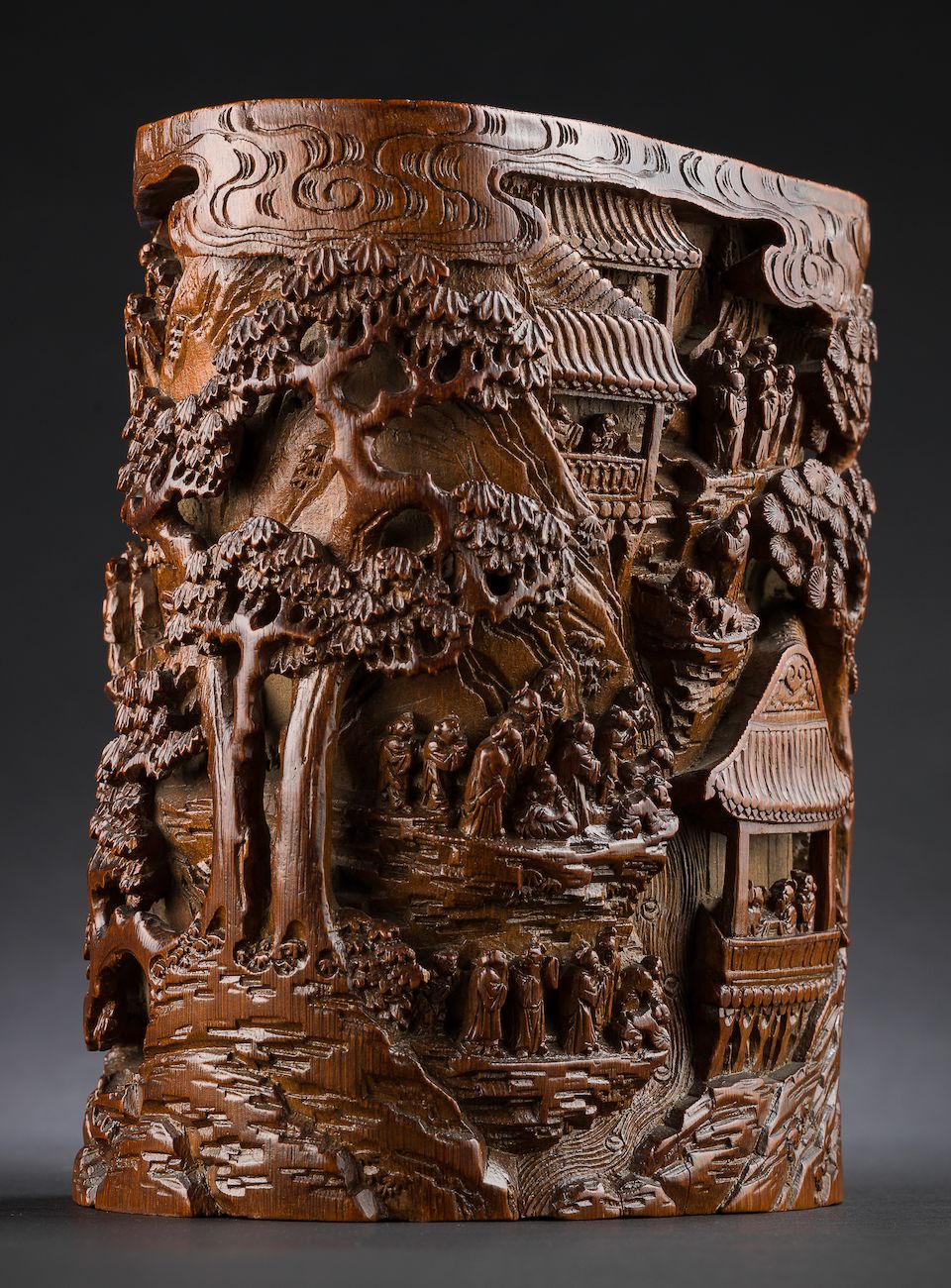
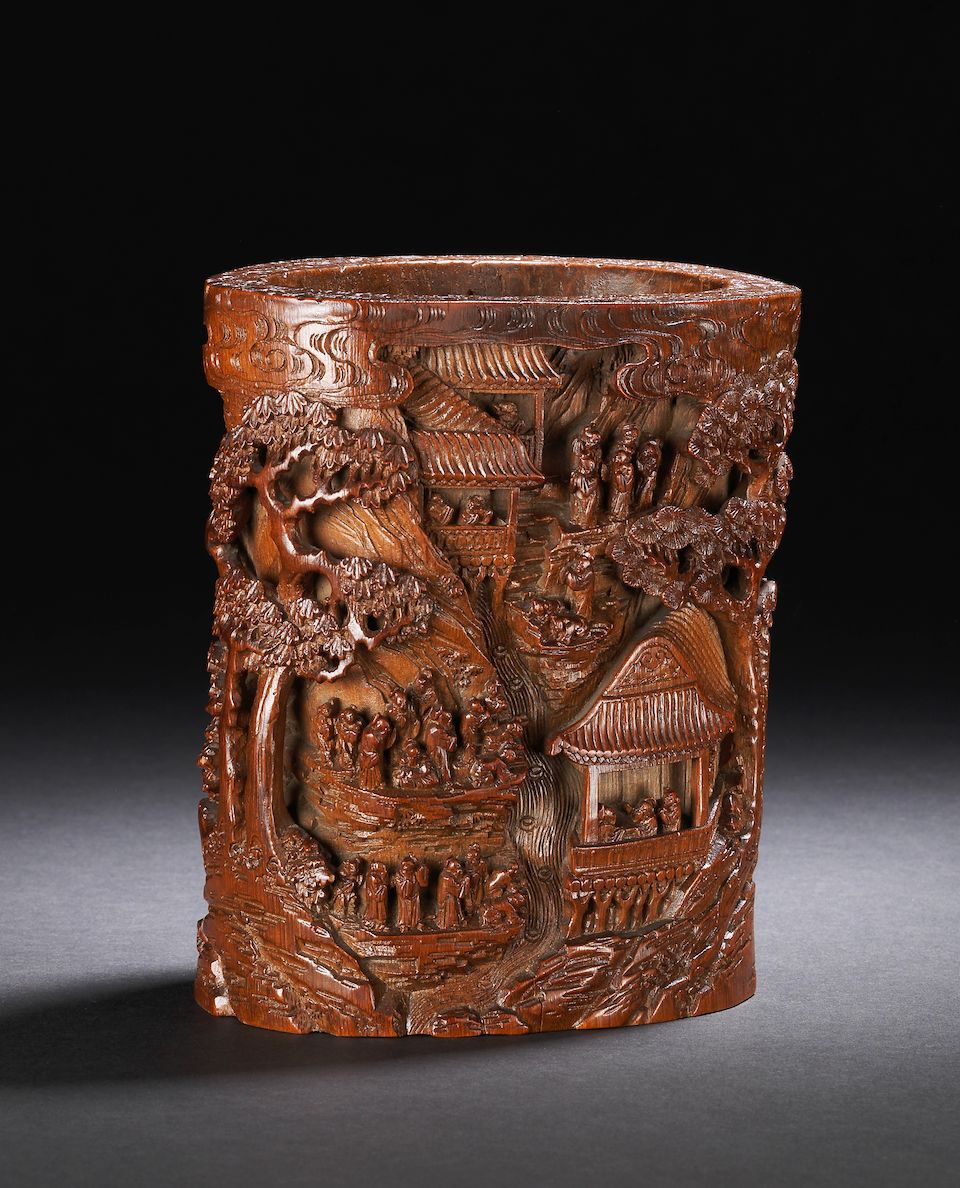
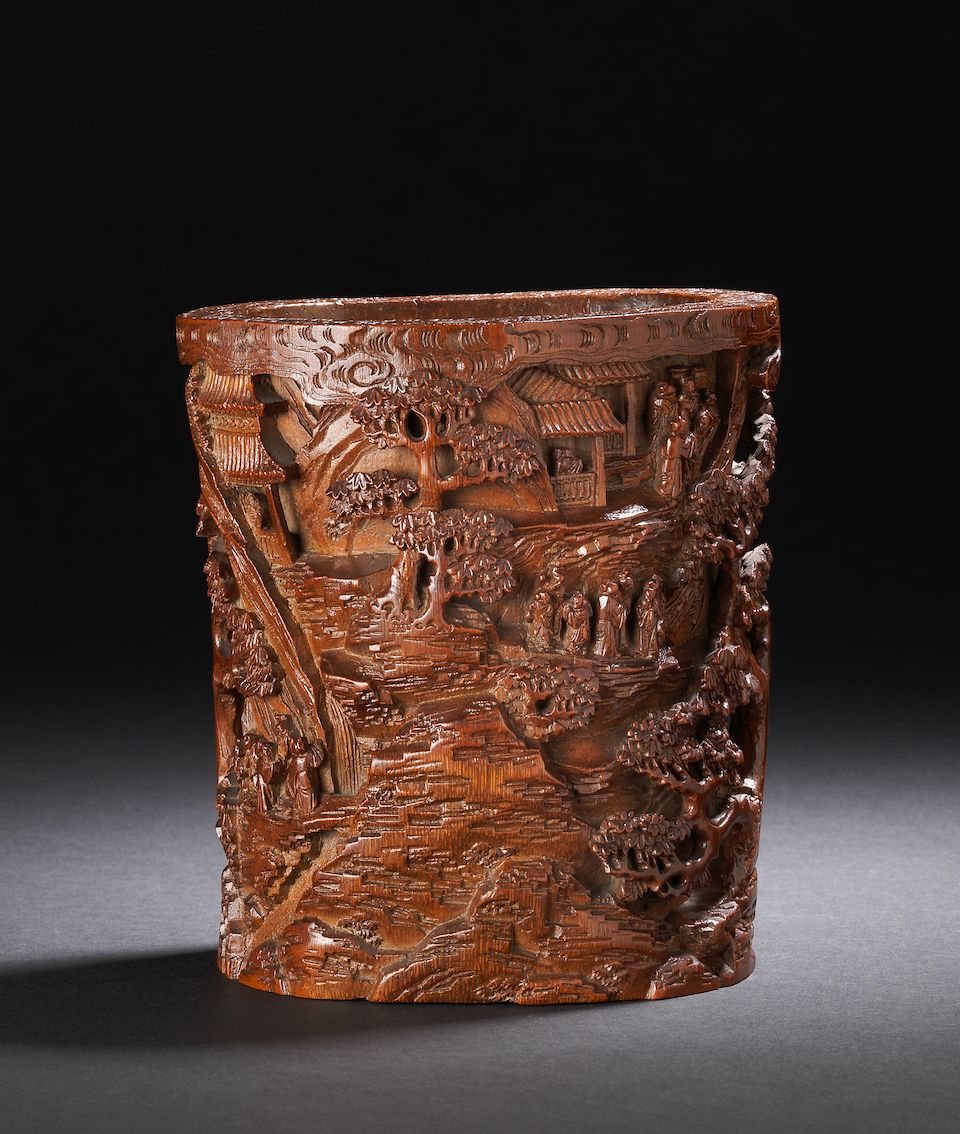
Lot 25. A carved bamboo 'Orchid Pavilion' brushpot, bitong, 18th century; 16.7cm (6 1/2in) high. Estimate HK$150,000-200,000. Sold for HK$ 237,500 (€ 28,377). Photo Bonhams.
Masterfully carved around the exterior in varying levels of relief depicting a continuous scene from the Lanting Xu, 'Orchid Pavilion Preface', enclosing a multitude of scholars engaged in leisurely pursuits along a stream within a mountainous landscape with pavilions amidst jagged rockwork and dense clusters of pine and wutong trees, all beneath billowing clouds.
Provenance: Spink & Son Ltd., London, 1989 (label).
Exhibited: Spink & Son Ltd., London, The Minor Arts of China IV, 1989, no.21 (label).
Note: The present lot took its inspiration from the very well-known preface Lanting Xu (Preface to the Orchid Pavilion) composed by the most celebrated Chinese calligrapher, Wang Xizhi (c.303-361), regarded as 'the Sage of Calligraphy'. The scene illustrated on the brushpot took place in the ninth year of the Yonghe reign, of the Eastern Jin dynasty, when forty-two scholars were invited to the Orchid Pavilion (Lanting), near Shanyin, Zhejiang province, for the Spring Purification Festival. Scholars were required to take part in a poetry competition and a drinking contest with wine cups flowing down a winding creek; those who failed to come up with a poem would have to drink in forfeit.
Lanting Xu was one of the most celebrated works of literature and had a profound influence on later generations. Literati thereafter copied this canonical preface onto stone and ink-rubbings, table screens, ink cakes, and many other scholarly objects, see for example a 'Lanting Gathering' ink-rubbing compilation dated to the late Ming dynasty (1592), illustrated by G.Tsang and H.Moss, Art from the Scholar's Studio, Hong Kong, 2011, pp.66-69, pl.28. This highly favoured subject matter was also used as a decoration on Imperial works of art made of various materials including jade, porcelain, lacquer and bamboo. The impact continued into the Qing dynasty where the Qianlong emperor, who was known for his admiration for Wang Xizhi's talent, also commissioned to build a Floating Cup Pavilion, Liubei Ting (流杯亭) in the Pavilion of the Purification Ceremony, Xishang Ting (禊賞亭) in the Forbidden City, see N. Berliner, The Emperor's Private Paradise: Treasures from the Forbidden City, New Haven and London, 2010, pp.96-97.
The present brushpot exemplifies the lively craftsmanship during the mid-Qing dynasty, demonstrating a high level of vibrant and crisp carving skills with naturalistic rendering of pine and wutong trees, rockwork and flowing water.
Bonham's. Fine Chinese Ceramics and Works of Art, Hong Kong, 2 June 2016


/image%2F1371349%2F20250220%2Fob_49852c_1000010699.jpg)
/image%2F1371349%2F20250209%2Fob_958514_1000009375.jpg)
/image%2F1371349%2F20240625%2Fob_8c2ce5_2024-par-23000-0022-000-pot-a-pinceaux.jpg)
/http%3A%2F%2Fstorage.canalblog.com%2F67%2F92%2F119589%2F133950080_o.jpg)