

/https%3A%2F%2Fprofilepics.canalblog.com%2Fprofilepics%2F1%2F0%2F100183.jpg)
/https%3A%2F%2Fstorage.canalblog.com%2F03%2F02%2F119589%2F96711876_o.jpg)
/https%3A%2F%2Fstorage.canalblog.com%2F11%2F31%2F119589%2F94773502_o.jpg)
/https%3A%2F%2Fstorage.canalblog.com%2F20%2F83%2F119589%2F94772815_o.jpg)
/https%3A%2F%2Fstorage.canalblog.com%2F26%2F72%2F119589%2F75604929_o.jpg)
/https%3A%2F%2Fstorage.canalblog.com%2F59%2F60%2F119589%2F26458628_o.jpg)
Jewellery auction to star the largest Burmese 'Royal Blue' Sapphire offered at Sotheby's in the last two decades


A Highly Important 102.39-Carat D Colour Flawless Oval Diamond. Estimate upon request. Courtesy Sotheby's.
HONG KONG.- Two days after the unprecedented single-lot sale of 102.39 carat D Colour Flawless Oval Diamond, offered without reserve, Sotheby’s Hong Kong Magnificent Jewels auction on 7 October will be spearheaded by another rarity in the mythical world of 100-carat stones: a 118.88-carat unheated Burmese ‘Royal Blue’ sapphire – the largest Burmese ‘Royal Blue’ sapphire offered at Sotheby’s in the last two decades (estimate upon request). The sale will celebrate colours, with an impressive selection of rare coloured gemstones and diamonds, including stones set in avant-garde designs by Hong Kong artist-jewellers FORMS and Nicholas Lieou.
“We are excited to present another exceptional season of Magnificent Jewels, and offer some of the world’s finest gemstones – a 118.88 carat Burmese sapphire, one of the largest Burmese sapphire ever offered at Sotheby’s, and a 6.41 carat Unheated Burmese ‘Pigeon’s Blood’ ruby ring designed and mounted by FORMS, sourced from important private collections. The jewellery market has proven to be highly resilient, with our clients in Asia eyeing the best quality jewels on offer. This auction is distinguished by invaluable treasures that will surely dazzle collectors across the region and beyond.” - Wenhao Yu, Deputy Chairman, Jewellery, Sotheby's Asia.
Featuring 118 lots, this season’s Magnificent Jewels auction will present rare and exquisite treasures of nature ranging from impressive gemstones sourced from illustrious mines to imperial green jadeite of the utmost importance, in addition to regal collectibles and superior designs from distinguished jewellery brands, including a ‘Holly Wreath’ Diamond necklace by Harry Winston (est. HK$8,000,000-12,000,000 / US$1,040,000-1,560,000), an Art Deco Emerald and Diamond Brooch by Cartier (est. HK$1,000,000-1,300,000 / US$130,000-169,000), to name a few.


Lot 1754. ‘Holly Wreath’ Diamond necklace, by Harry Winston. Estimate: HK$8,000,000-12,000,000 / US$1,040,000-1,560,000. Courtesy Sotheby's.
Set with brilliant-cut, pear- and marquise-shaped diamonds weighing approximately 125.00 carats in total, mounted in platinum, signed Winston, length approximately 380mm.
Accompanied by two GIA reports no. 7358897011 and 7351897044, both dated 1 September 2020, stating that diamonds weighing 2.05 and 1.51 carats are both D Colour, VS2 and VS1 Clarity respectively. Also accompanied by GIA report no. 7356897052, dated 1 September 2020, stating that diamond weighing 1.76 carats is E Colour, VVS2 Clarity.


Lot 1652. Art Deco 11.13 carats Colombian Emerald and Diamond Brooch by Cartier. Estimate: HK$1,000,000-1,300,000 / US$130,000-169,000. Courtesy Sotheby's.
Set with a step-cut emerald weighing 11.13 carats, decorated with old-mine- and old European-cut diamonds, signed Cartier.
Accompanied by AGL report no. 1101950, dated 5 November 2019 and Gübelin report no. 20023054, dated 18 February 2020, both stating that the emerald is of Colombian origin, with insignificant clarity enhancement.
THE LARGEST BURMESE ‘ROYAL BLUE’ SAPPHIRE OFFERED AT SOTHEBY’S IN THE LAST TWO DECADES


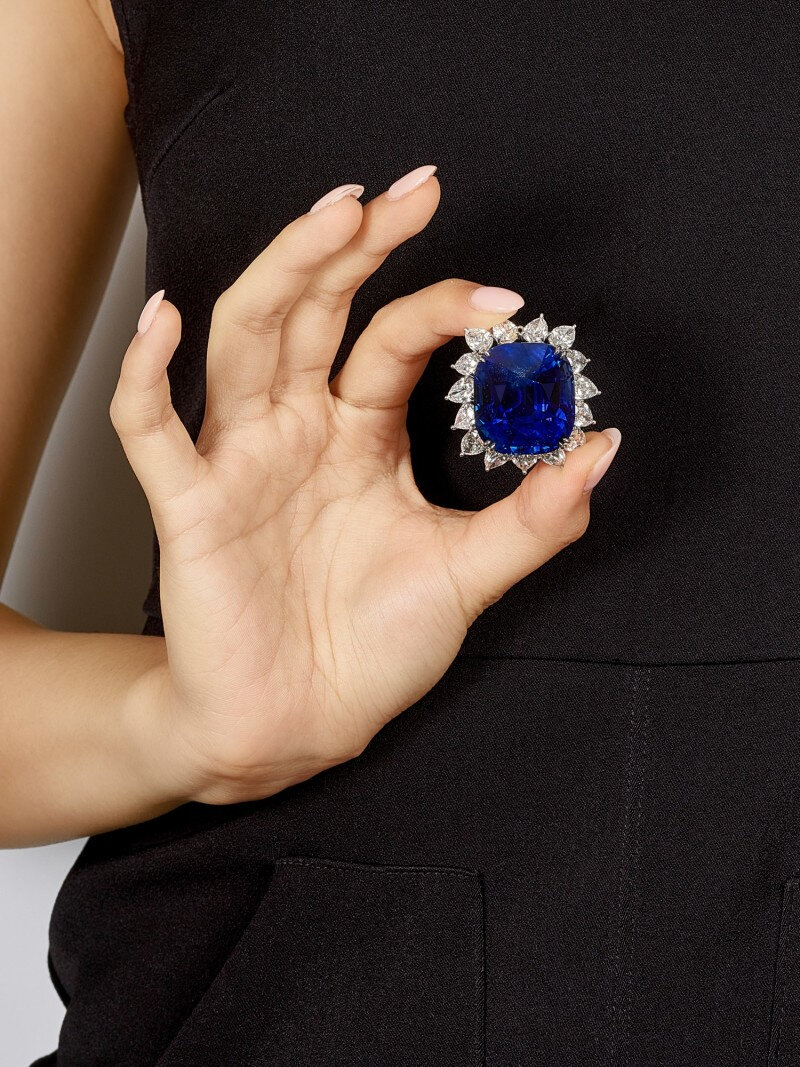
Lot 1755. An Extraordinary 118.88 Carat Burmese Unheated ‘Royal Blue’ Sapphire and Diamond Pendant. Estimate Upon Request. Courtesy Sotheby's.
Set with a cushion-shaped sapphire weighing 118.88 carats, within a surround of pear-shaped diamonds weighing 16.06 carats in total.
Accompanied by SSEF report no. 73209, dated 11 March 2014 and Gübelin report no. 14038086, dated 29 March 2014, both stating that the sapphire is of Burmese origin, with no indications of heating, this colour variety may also be called "royal blue" in the trade. Also accompanied by SSEF Premium appendix letter stating that "the sapphire exhibits an highly impressive size..., combined with a very attractive and well-saturated blue colour, poetically referred to as 'royal blue', and an excellent purity... A natural sapphire from Burma of this size and quality is extremely rare and thus can be considered a true treasure of nature".
Further accompanied by Gübelin appendix letter stating that "the 118.88 ct natural sapphire...displays a homogeneous and richly saturated royal blue colour, which typifies the finest of these gems... In addition, this remarkable gemstone has been spared thermal treatment. Such a combination of characteristics is very rare in Burmese sapphires of this size."
Also accompanied by fourteen GIA reports stating that the diamonds ranging from 1.19 to 1.01 carats are D to F Colour, VVS1 to VS2 Clarity; further accompanied by a GIA dossier stating that the 1.17 carat diamond is F Colour, VVS2 Clarity.
Burmese Royals
Burmese sapphires of the finest quality are known for its royal blue colour and enticing luster. The best Burmese sapphires display a rich, intense, slightly violetish blue colour, with a strong saturation. Prized possessions of royalty and discerning collectors, untreated Burmese sapphires have been esteemed and passed down from generation to generation for centuries.
Untreated Sapphires of fine quality are very rare. Initially mined heavily in gem producing countries, for sapphires even with heavy mining - the rate of return on fine sapphires proved exponentially less than the production and availability of most other gemstones. For this reason, specifically natural untreated sapphires combined with their rarity presents good opportunity and investment.
Burmese sapphires of notable sizes are extremely rare. A legendary natural Burmese sapphire, better known as the Rockefeller Sapphire, is a 62.02 carat rectangular step cut stone. Acquired in 1934 by financier and philanthropist John D. Rockefeller, Jr (1874 – 1960) from an Indian Maharaja. The gem was subsequently recut and remounted over the years finding its journey through auction. Initially sold at Sotheby’s in Zurich, the gemstone achieved around US$170,000, less than a decade later, the sapphire sold for nearly US$1.5 million. Two years later, the sapphire achieved a record price at the time of US$2.85 million, finally commanding an impressive return of over US$3 million in 2001.
Nearly a decade later, we are proud to present an exceedingly exceptional 118.88 carat Burmese ‘Royal Blue’ sapphire, almost double the size of the Rockefeller Sapphire and the largest sapphire of its kind ever to be offered at Sotheby’s. Of comparable gem quality, Lot 1755 will grace the market with highly collectable potential, fit for the most sophisticated collectors and royals.
‘PIGEON’S BLOOD’ RUBY


Lot 1743. An Exceptional 6.41 Carat Unheated Burmese ‘Pigeon’s Blood’ Ruby and Diamond Ring, Designed and Mounted By FORMS. Estimate: HK$17,000,000-22,000,000 / US$2,210,000-2,860,000. Courtesy Sotheby's.
Set with a cushion-shaped ruby weighing 6.41 carats, within a surround of French-cut diamonds, the band and gallery decorated with brilliant-cut diamonds, mounted in 18 karat white and yellow gold, size 6.
Accompanied by AGL report no. CS 65283, dated 12 December 2014, stating that the ruby is of Burmese origin, with no gemmological evidence of heat and no clarity enhancement; AGL further stating that the origin of this material would be classified as Classic™ Burma. Also accompanied by AGL Jewelfolio™ stating 'A beautiful 6.41ct Burmese ruby of this color and quality is very rare...Its size, provenance and outstanding quality signify a gem ruby of unique rarity and beauty... This ruby has received one of the highest color grade determined by AGL: 2.5... Burmese rubies of this shade and appearance are typically decribed as having a Pigeon Blood color '. Further accompanied by SSEF report no. 78749, dated 11 March 2015, stating that the ruby is of Burmese origin, with no indications of heating; also accompanied by SSEF Appendix letter stating 'The natural ruby...exhibits an attractive vivid colour and a fine purity, rarely encountered in rubies from Burma...A natural ruby from Burma of this quality is rare and exceptional'.
Note: Rich in colour, regal in stature, and steeped in history, the ruby is legendary. For centuries, European royalty have sought some of the world’s most prized rubies to adorn their jewels. From The Sunrise Ruby (sold at Sotheby’s, for a world auction record price for a ruby), to jewels from the Royal Parma Family, rubies are highly esteemed for their mystique and beauty.
Less than 10% of all gem-quality rubies are unheated, making them both rare and impressive. Darker rubies are often heated to enhance their shade, but unheated rubies are naturally intense and vibrant.
EXCEPTIONAL BLUE DIAMONDS


Lot 1756. An Exceptional 4.84 Carat Fancy Vivid Blue Internally Flawless Diamond and Diamond Ring. Estimate: HK$55,000,000-65,000,000 / US$7,150,000-8,450,000. Courtesy Sotheby's.
Set with a pear-shaped fancy vivid blue diamond weighing 4.84 carats, between two brilliant-cut diamonds each weighing 1.10 carats, mounted in platinum and pink gold, size 5½.
Accompanied by GIA report no. 2201694224, dated 10 February 2020, stating that the 4.84 carat diamond is Fancy Vivid Blue, Natural Colour, Internally Flawless. Also accompanied by two GIA reports no. 5213561878, dated 20 January 2016 and no. 2207713352, dated 28 August 2015, stating that both the 1.10 carat diamonds are D Colour, VVS2 Clarity, Excellent Cut, Polish and Symmetry.


Lot 1753. An exquisite and unique pair of 1.95 and 1.63 carats Fancy Intense Blue Diamond and 5.95 and 5.24 carats Type IIa Diamond Pendent Earrings. Estimate: HK$28,000,000-35,000,000 / US$3,640,000-4,550,000). Courtesy Sotheby's.
Each suspending a pear-shaped diamond weighing 5.95 and 5.24 carats respectively, from a brilliant-cut fancy intense blue diamond weighing 1.95 and 1.63 carats respectively, mounted in 18 karat white gold, post and butterfly fittings.
Accompanied by two GIA reports no. 2205947463, dated 3 March 2020 and no. 2215033134, dated 8 July 2020, stating that the 5.95 and 5.24 carat diamonds are both D Colour, Internally Flawless; also accompanied by two diamond type classification letter stating that both diamonds are determined to be a Type IIa diamond. Type IIa diamonds are the most chemically pure type of diamond and often have exceptional optical transparency. Further accompanied by two GIA reports no. 1112845814, dated 29 July 2020 and no. 2193503399, dated 29 July 2020, stating that the 1.95 and 1.63 carat diamonds are both Fancy Intense Blue, Natural Colour, VVS1 and VS1 Clarity respectively.
Brilliant Blues
Blue diamonds have the most marvelous and enchanting hues earning its stripes as one of the most coveted, valuable and extraordinary gemstones in the world. Since the 17th century, the value of coloured diamonds have been on a consistent incline, largely due to the recognition of its rarity in comparison to their near colourless counterparts along with the intriguing variations in hues and intensities which have been discovered. What makes these spectacular gemstones a true treasure is embodied in the combination of their magnificent hues and tones owing to the trace element of boron within the crystal structure and its brilliant cutting style.
The pair of round brilliant-cut fancy intense blue diamonds showcase impeccable craftsmanship through the diamond cutter’s ability to retain such a high level of saturation within a brilliant-cut. The round brilliant-cut is rarely employed on coloured diamonds due to the high wastage of diamond rough involved with creating the shape. A diamond rough of at least double its final carat weight is required to fashion a diamond into this highly lustrous and sought-after shape. Due to the rarity of rough coloured diamonds, most cutters would opt to maximize the use of the diamond rough and cut into more commonly seen shapes such as cushion-shapes or radiant-cuts which retain more rough material and produce higher carat weights.
The strength of a coloured diamond’s colour is evaluated based on its intensity level in accordance with the Gemological Institute of America’s eight level grading scale ranging from Faint Blue to Fancy Vivid Blue. Fancy Intense is the second highest acclamation that a coloured diamond can achieve, combined with the pure blue colour, absent of any modifying secondary hues, Lot 1753 is an exquisite example of its kind.
Reveling in the presence of one exquisite round brilliant-cut fancy intense blue diamond over 1 carat is a marvel in itself, but to be presented with two well-matched as a pair is beyond rare. Together with a pair of D Colour, Internally Flawless, Type IIa diamonds, the two stunning occurrences paired together are incredible to even the most discerning collectors.
IMPERIAL GREEN JADEITE
Following the strong results for jadeite achieved in the rescheduled spring sale of Magnificent Jewels in Hong Kong, this season’s sale will offer a selection of ‘imperial green’ jadeite – the finest specimen of “Type A” jadeite with a vibrant emerald green colour that is almost transparent – led by


Lot 1662. An Extremely Rare and Exceptional ‘Imperial Green’ Jadeite Bead and Diamond Necklace. Estimate upon request.
Composed of forty-three jadeite beads of highly translucent brilliant emerald green colour weighing approximately 630.00 carats in total, clasp set with brilliant-cut and baguette diamonds, length approximately 535mm. Jadeite beads approximately from 13.00 to 11.26mm.
Accompanied by Hong Kong Jade and Stone Laboratory certificate no. SJ 195539, dated 7 September 2020, stating that the jadeite tested are natural, known in the trade as "A Jade". Further accompanied by a gemmological report stating that the jadeite "may also be called "Imperial Green" in the trade. This term refers to the finest specimen of "Type A" jadeite jade.
Imperial Reverence
In the glittering world of jewellery, jadeite is a fascinating and unique material – one that is inextricably linked to Chinese culture. Jadeite may not have the dazzling brilliance of a diamond, but it has a luminosity that seems to come from within. In the rough, jadeite is encased within a shell of weathered stone, and it is worthless if left uncut and unpolished. Only after it is carved and polished is its splendour revealed to the world. Jadeite has the character of an unassuming gentleman who is not quick to show his talents. According to The Book of Rites, ‘A gentleman would find that jadeite is akin his virtues; soft and smooth, its qualities appear just like his benevolence.’ In the Confucian intellectual ideal, the gentleman is held up as paragon of character, thus it is entirely fitting to compare such impeccable moral character to fine jadeite.
What is generally called “jadeite” actually refers to two different minerals: nephrite and jadeite. It can come in many colours, including green, lavender, yellow, red, white, and black, but the most sought-after colour is a deep emerald green called “Imperial Green,” found almost exclusively in Myanmar jadeite (jadeite). The best quality jadeite has a refined, smooth texture (grade) and excellent translucency (lustre). As the light passes through the stone, the jadeite captures the light within, diffusing it evenly so that the suffused light resembles gentle ripples on a clear pool. Currently, Myanmar is the only place in the world that produces jewellery-quality jadeite. The best jadeite pieces have a deep green colour, a smooth, exquisite texture, and a pure, even translucency. This kind of jadeite is as revered and rare as an emperor, so it is called “Imperial Green Jadeite”.
A good stone requires cutting and polishing before the beauty of jadeite can be fully realised. The bead is a classic shape for jadeite. The technique for cutting beads is akin to sculpture. The contours of the beads must be round and symmetrical, and its length and width must be harmoniously proportional. When cutting a set of beads, significant amounts of stone must be wasted in order to achieve the optimal visual effect. The jadeite beads (Lot 1662) have been crafted from the best quality “Imperial Green Jadeite” with excellent colour, grade, and translucency. The beads are beautifully and symmetrically matched with a rounded, full shape. These pieces represent the perfect union of nature’s gifts and human artistry.
With collectors currently showing a strong interest in contemporary designs, the sale includes A Unique and Rare Jadeite, Fancy Vivid Purplish Pink Diamond and Diamond Ring designed by Nicholas Lieou (est. HK$11,000,000-15,000,000 / US$1,430,000-1,950,000), who has paired an ‘imperial green’ grade jadeite cabochon with pink diamond in the design, bridging Eastern and Western aesthetics in an unexpected marriage of materials


Lot 1745. A Unique and Rare Jadeite, Fancy Vivid Purplish Pink Diamond and Diamond Ring designed by Nicholas Lieou. Estimate: HK$11,000,000-15,000,000 / US$1,430,000-1,950,000. Courtesy Sotheby's.
Set with a highly translucent jadeite cabochon of intense emerald green colour weighing approximately 24.88 carats, within a surround of brilliant-cut diamonds of pink tint, and an oval fancy vivid purplish pink diamond weighing 2.08 carats, within a surround of marquise-shaped diamonds, mounted in 18 karat white and pink gold, size 5¾.
Cabochon approximately 20.75 x 17.35 x 9.21mm.
Accompanied by Hong Kong Jade & Stone Laboratory certificate no. KJ 102041, dated 31 August 2020, stating that the jadeite is natural, known in the trade as "A Jade". Also accompanied by a gemmological report stating that the jadeite may also be called "Imperial Green" in the trade. This term refers to the finest specimen of "Type A" jadeite jade. Further accompanied by GIA report no. 5202928233, dated 11 March 2020 stating that the 2.08 carat diamond is Fancy Vivid Purplish Pink, Natural Colour, SI2 Clarity.
Accompanied by Hong Kong Jade & Stone Laboratory certificate no. KJ 102041, dated 31 August 2020, stating that the jadeite is natural, known in the trade as "A Jade". Also accompanied by SSEF report no. 114561, dated 16 September 2020, stating that the jadeite is of Burmese origin, with no indication of treatment, may also be called 'jadeite-jade (Fei Cui) type A' in the trade. The colour of this jadeite-jade may also be called 'Imperial green' in the trade. Further accompanied by a SSEF appendix, stating that 'a natural jadeite-jade from Burma of this size and quality can be considered rare and exceptional'.
Also accompanied by GIA report no. 5202928233, dated 11 March 2020 stating that the 2.08 carat diamond is Fancy Vivid Purplish Pink, Natural Colour, SI2 Clarity.
Please refer to the certificate and reports for further details.
Jadeite cabochon is of intense emerald green colour and very good translucency. Marquise-shaped diamonds and diamonds of pink tint are bright and lively. Metal in as new condition. Overall in excellent condition.
Please note that brilliant-cut diamonds of pink tint have not been tested for natural colour origin.


/image%2F1371349%2F20260926%2Fob_fe9efe_38657.jpg)
/image%2F1371349%2F20260928%2Fob_36d164_39028.jpg)
/image%2F1371349%2F20260928%2Fob_b8ee3f_39026.jpg)
/image%2F1371349%2F20260928%2Fob_2ac9fd_39022.jpg)