

/https%3A%2F%2Fprofilepics.canalblog.com%2Fprofilepics%2F1%2F0%2F100183.jpg)
/https%3A%2F%2Fstorage.canalblog.com%2F03%2F02%2F119589%2F96711876_o.jpg)
/https%3A%2F%2Fstorage.canalblog.com%2F11%2F31%2F119589%2F94773502_o.jpg)
/https%3A%2F%2Fstorage.canalblog.com%2F20%2F83%2F119589%2F94772815_o.jpg)
/https%3A%2F%2Fstorage.canalblog.com%2F26%2F72%2F119589%2F75604929_o.jpg)
/https%3A%2F%2Fstorage.canalblog.com%2F59%2F60%2F119589%2F26458628_o.jpg)
'Facets of Authority: A Special Exhibition of Imperial Portraits from the Nanxun Hall', National Palace Museum, Taipei

Is "authority" something that can be seen...?
The idea of authority may be abstract and difficult to grasp but has always found expression in the visual arts, where its presence has long been seen and felt. The subject of this special exhibition, "imperial portraiture," has often been considered among scholars as simply a form of illustrating these important rulers in history. However, imperial portraits are not only fine works of art, they also represent the fundamentals and "face" of authority itself in Chinese history.
The emperors and empresses in these portraits reflect people of the highest status and power at the time. But how were the portraits produced to represent the lofty and noble hierarchy of these figures as being above and different from that of ordinary folks? Furthermore, how did viewers of these works discern the figures therein as leaders truly invested with the "authority" to rule?
To answer these questions, this special exhibition features a select group of imperial portraits done over the dynasties that were stored at the Nanxun Hall in the imperial court during the Qing dynasty. As presented here, the display seeks to demonstrate how artists at different times in the past rendered such facets as visage, pose, apparel, seating, screen arrangement, and decoration on the surface of these paintings to express the majesty of emperors and empresses, thereby allowing the glory of their "authority" to emanate from within.
Finding the "Facets of Authority" in Imperial Portraits
Despite the unsurpassed power of emperors and empresses in Chinese history, determining exactly what they looked like is sometimes difficult. Nonetheless, these imperial portraits, both standing and seated, are almost always formal and solemn appearance, seeming to have a sense of calm demeanor and resolute power--solemn pose is one "facet of authority" in these imperial portraits.
The clothing and accessories of emperors and empresses over the ages differ considerably, the robes for ceremonial and daily use also varying somewhat. However, these distinctive kinds of clothing are a most direct expression of their status--exclusive apparel is likewise a "facet of authority" in the portraits.
Those with great authority often have vast consumer resources at their disposal. In these portraits, all kinds of expensive goods were used as a means of adornment--consummate luxury is another "facet of authority."
The application of signs with symbolic importance can also highlight the authority of the person. Such symbols of rank and status on imperial clothing as the sun, moon, stars, and dragon originally conveyed expectations for and praise of a user's moral standing. Later, however, they became signs symbolizing supreme authority--symbolic signs became one more "facet of authority."
Consummate colors delicately painted on pieces of finely woven silk demonstrate the effort put into producing these imperial portraits. It indicates that no expense was spared in materials and manpower in the pursuit of perfection—so-phisticated materials and workmanship are the final "facet of authority" on display here.
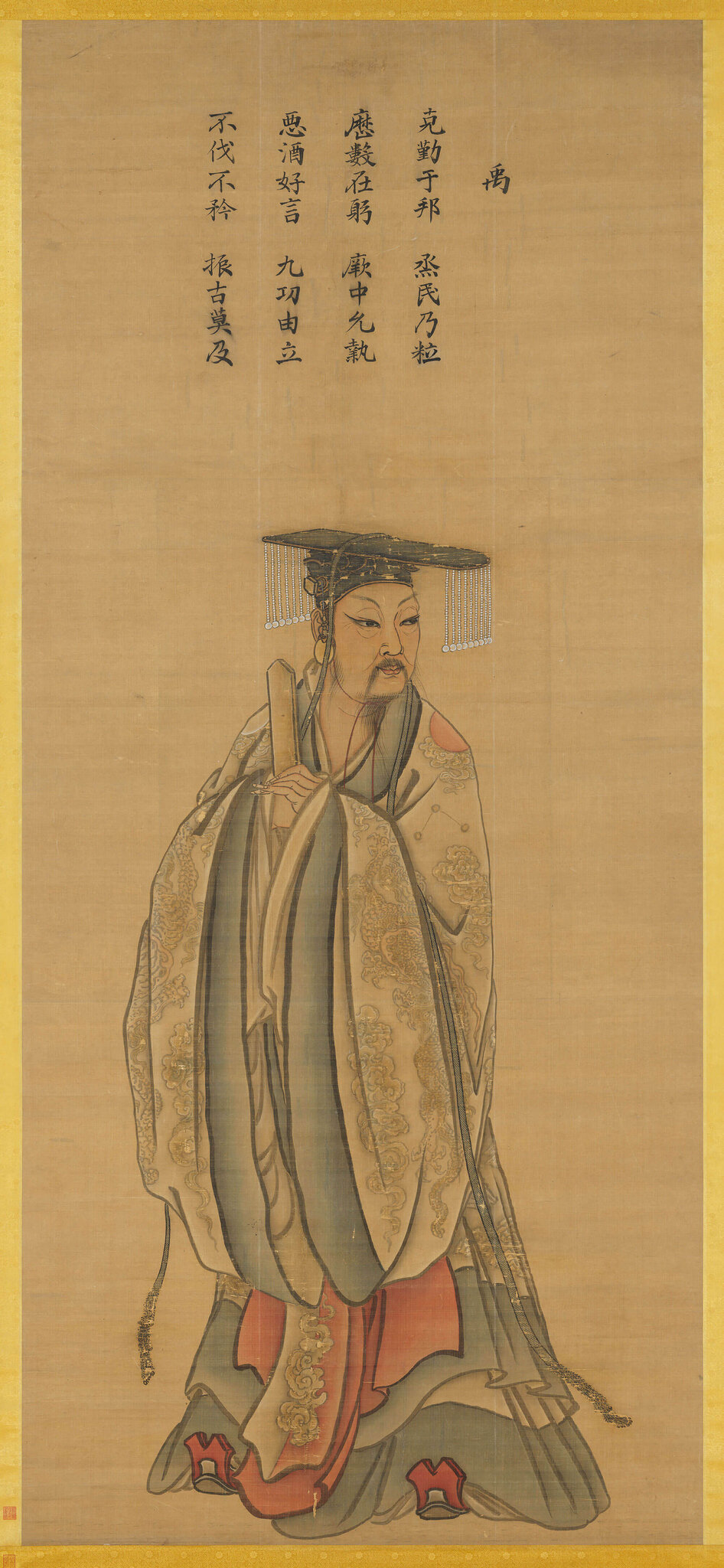
Ma Lin (ca. 1180-after 1256), Song dynasty, Standing Portrait of King Yu of the Xia. Verified and declared by the Ministry of Culture in April 2011 as a National Treasure, National Palace Museum, Taipei. © National Palace Museum.
The legendary ruler King Yu of the Xia dynasty is shown here wearing a "nine-tasseled crown" and robes adorned with symbols for the "sun," "moon," and "three stars" traditionally reserved for the ruler. The robes extend all the way to the ground to make the solemn form of King Yu holding a scepter appear even more elongated.
This portrait from the imagination done by the Song court artist Ma Lin is an image made to illustrate Emperor Lizong's (1205-1264) "Encomium on Thirteen Sages and Rulers of the Orthodox Lineage." It manifests the ideal of integrating orthodox lineage and political authority at the time.
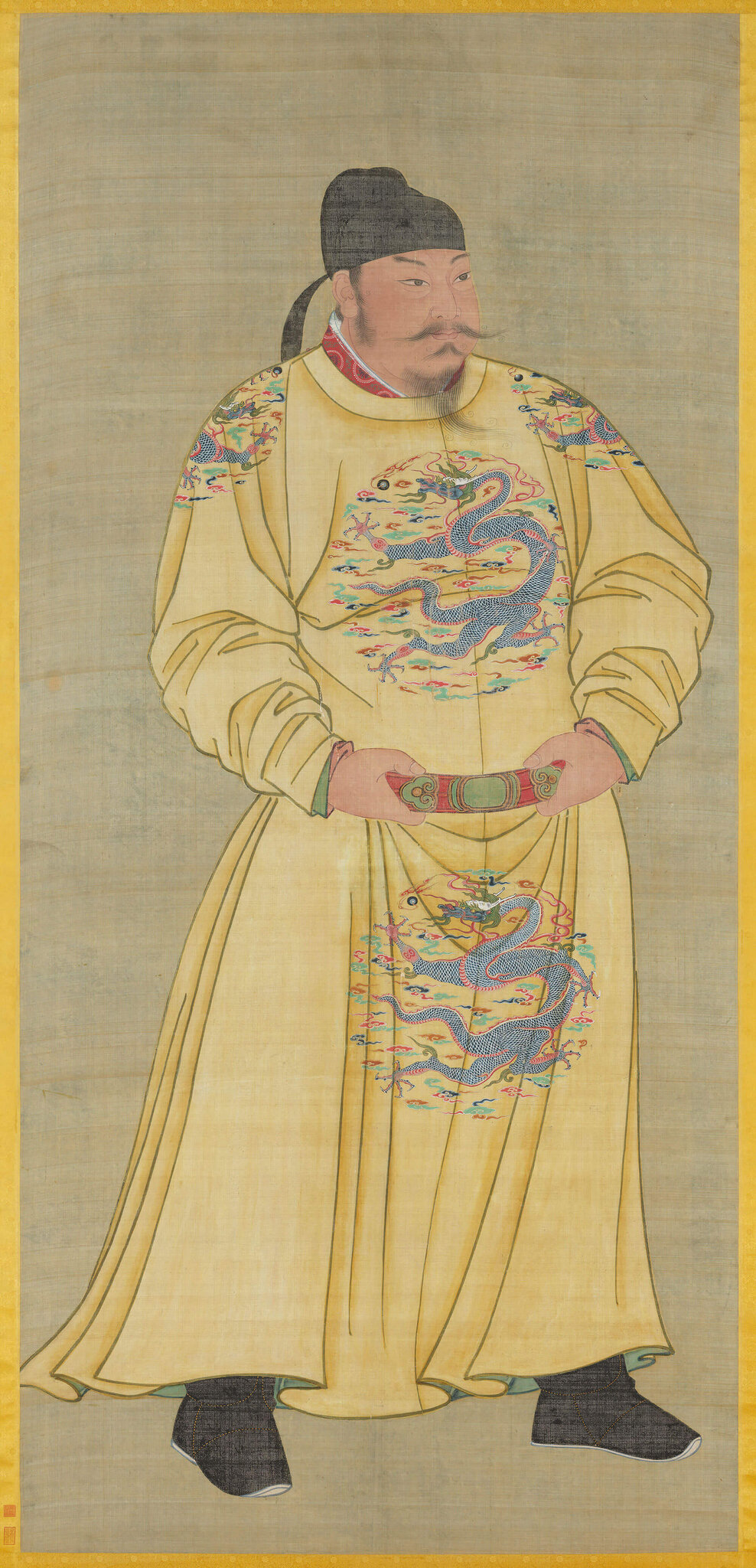
Anonymous, Ming dynasty, Standing Portrait of Emperor Taizong of the Tang (598-649), National Palace Museum, Taipei. © National Palace Museum. © National Palace Museum.
This painting nearly three meters tall shows the proud standing image of the Tang dynasty emperor Taizong (598-649). The enormous figure creates an imposing presence and power that is not easily overlooked. The dragons in the decorative circles on Taizong's robes, however, have flaring nostrils on the snout in a manner that closely resembles those found later in the Ming dynasty (1368-1644). Judging from this and a similarity in terms of the large size of portraits for emperors and meritorious officials, Taizong's portrait here may have once belonged to a series of paintings done in the Ming dynasty to commemorate rulers and officials through the ages that was once displayed for veneration.

Anonymous, Song dynasty, Seated Portrait of Emperor Yingzong of the Song (1032-1067), National Palace Museum, Taipei. © National Palace Museum.
The Song dynasty emperor Yingzong (1032-1067) is shown seated here on a wide red-lacquered imperial daybed. He wears yellow robes of daily repose that appear quite plain at first glance. However, the red robes shown underneath at the cuffs reveal a delicate pattern of dragon circles finely woven with strands of gold. His black shoes are also intricately adorned with many dots. Thus, although reserved at first sight, an air of luxury gradually exudes from within.
Emperor Yingzong was on the throne for only four years before he passed away. This portrait was probably done by a court painter sometime between when he assumed the throne in 1063 and his son and heir, Emperor Shenzong, ordered his image to be installed at the Jingling Palace in 1069 to receive sacrificial offerings.
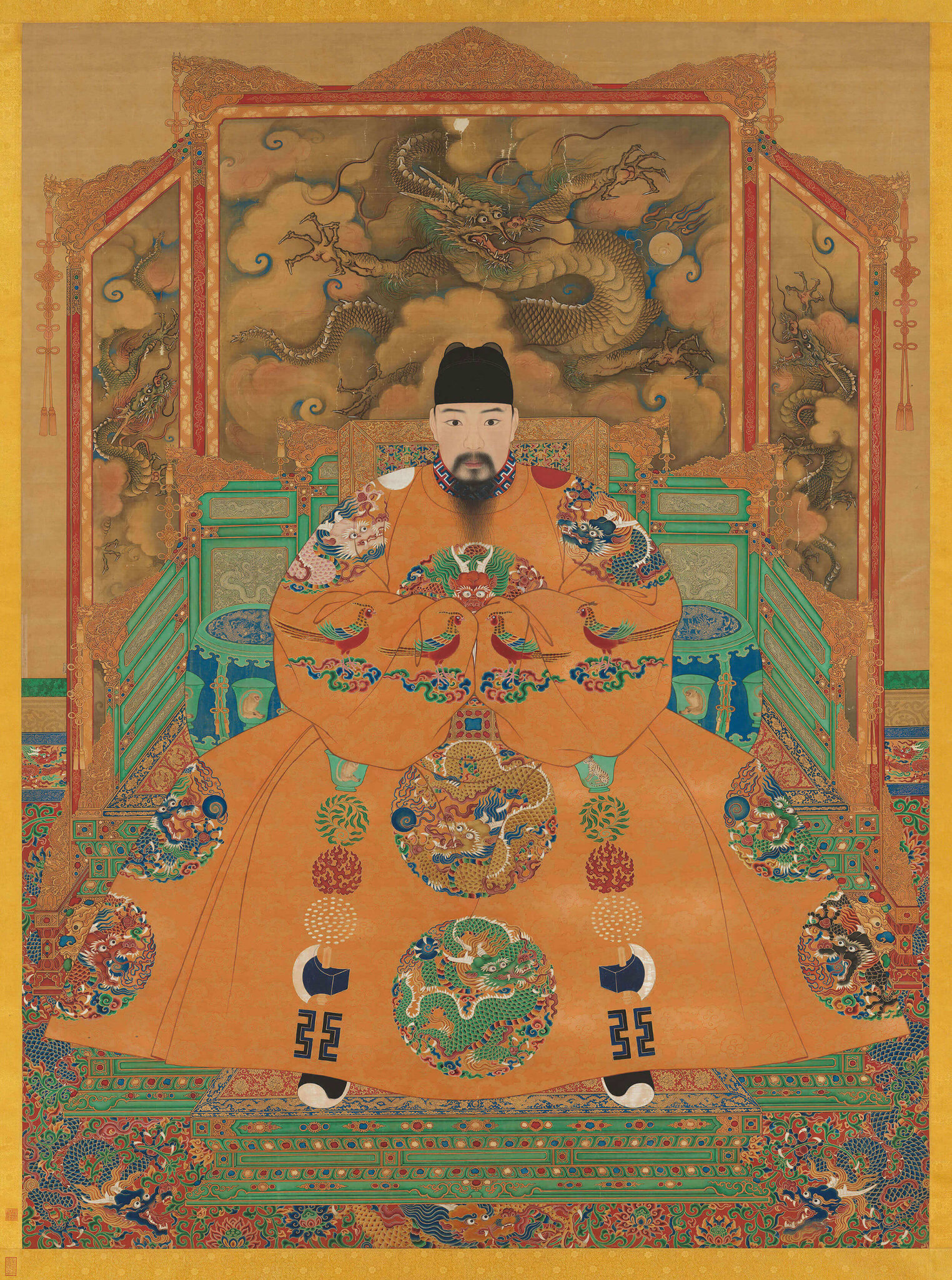
Anonymous, Ming dynasty, Seated Portrait of Emperor Xiaozong of the Ming (1470-1505). Verified and declared by the Ministry of Culture in June 2019 as a Significant Antiquity, National Palace Museum, Taipei. © National Palace Museum.
The Ming dynasty emperor Xiaozong (1470-1505, reign name Hongzhi) is shown frontally as if in audience at court. He wears formal dragon robes with twelve insignia and appears almost overwhelmed by the plethora of riotous dragon patterns that clearly symbolize his imperial status.
This portrait of exceptional quality accurately portrays the complex decoration. The confident brushwork of the dragon-and-cloud decor on the screen also reflects the extraordinary standards of production found in Ming dynasty court painting during the late fifteenth to early sixteenth century.
Subtle Forms of Luxury-Imperial Portraits of the Song Dynasty
Few major differences appear in the clothing of Song dynasty emperors and their officials. However, the textiles woven with gold that appear almost hidden at the collar and cuffs of the imperial figures' clothing in these portraits and the exquisite cushioning for their feet and back clearly reflect an aesthetic of refined yet subdued luxury that is not always obvious at first glance.

Anonymous, Song dynasty, Seated Portrait of Emperor Renzong of the Song (1010-1063), National Palace Museum, Taipei. © National Palace Museum.
The Northern Song emperor Renzong, personal name Zhao Zhen (1010-1063), is shown here wearing a black official's hat with horizontal wing-like flaps and a plain red robe. Although unassuming at first glance as he sits solemnly on a high-backed dragon throne, the emperor's collar and cuffs reveal inner garments that are delicately adorned in gold. The backing and mat that cushion the throne and accompanying footrest are also exquisitely designed. Such luxurious items must have been nothing more than common consumer goods for the emperor, expressing the daily life of his ultimate authority.

Anonymous, Song dynasty, Seated Portrait of Du, Xuanzu's Empress of the Song (902-961), National Palace Museum, Taipei. © National Palace Museum.
Emperor Xuanzu's (902-961) empress was surnamed Du and was the mother of Zhao Kuangyin (927-976), founder of the Song dynasty. In this portrait, she wears clothing that differs from that of other Song dynasty empresses. Over her light yellow outer robes is draped a pearl-hemmed piece of cloth with phoenix patterns that give her a more opulent presence. Underneath them, she wears a semi-translucent gauze skirt that reveals the decoration of her robes beneath it and that extends beyond the border of the painting. This rare portrait of an empress offers us a clearer picture of the material culture among imperial ladies in the Song dynasty.
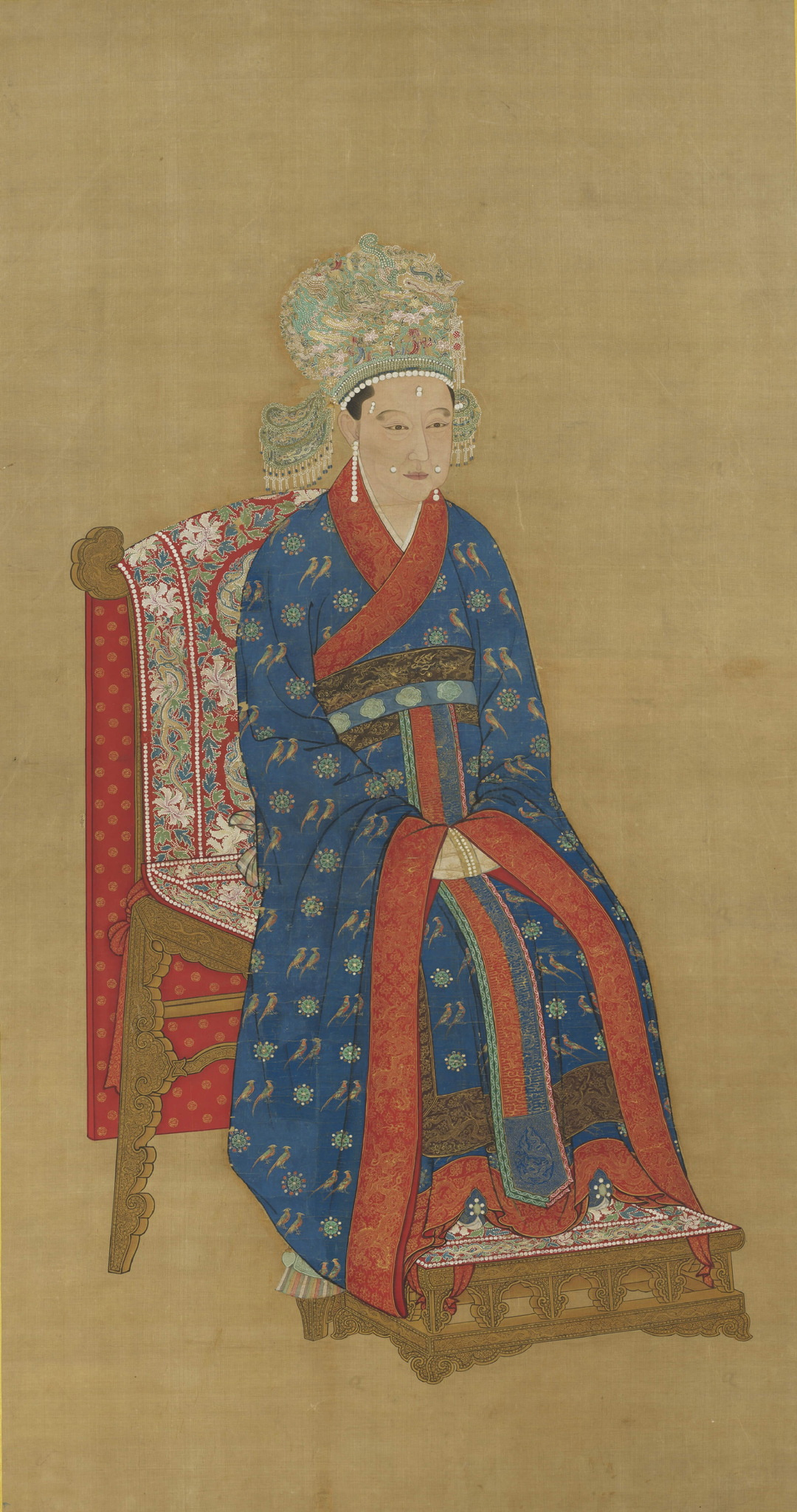
Anonymous, Song dynasty, Seated Portrait of Li Fengniang (1145-1200), Guangzong's Empress of the Song, National Palace Museum, Taipei. © National Palace Museum.
Li Fengniang (1145-1200), empress to Guangzong of the Southern Song, has eyebrows in this portrait similar to the shape of commas, giving this unique feature of the portrait a lifelike and individual quality. She wears an extravagant dragon-and-phoenix hairpin crown made from pearls of different sizes, pearl-inlaid jewelry applied to her face, and a most majestic empress's ceremonial robe that is deep blue in color. Her clothing is decorated with colorful pairs of pheasant, and she wears a large two-color sash hanging from the upper abdomen. She also faces to the right and is seated upright on a high-back chair. This is a standard format of Southern Song empress portraits that continued from the Northern Song period.
Empresses and consorts exerted considerable influence over the ages and often held power behind the scenes, making them holders of power not to be overlooked in Chinese history.
In a Style of Their Own-Imperial Portraits of the Yuan Dynasty
Although formal Yuan dynasty imperial portrait paintings survive only in half-length bust format, they still clearly reveal the traditional clothing and headgear worn by the Mongol rulers. Representing a unique style in the history of Chinese imperial portraiture, they stand out are quite clearly.

Anige, Yuan dynasty, Emperor Shizu of the Yuan (1215-1294). Verified and declared by the Ministry of Culture in June 2013 as a National Treasure, National Palace Museum, Taipei. © National Palace Museum.
The Mongol leader Kublai Khan (1215-1294), who was also Emperor Shizu of the Yuan dynasty in Chinese history, is shown here with his head shaven below the warming cap. Behind his ears are also three looped braids, a typical hairstyle among the Mongols. He wears a white robe devoid of decoration and without any apparent defining features
Despite the lack of patterning, this portrait employs various shades of color to render the three-dimensional features of the face, a technique that had traditionally been used by Nepali painters. This use of a non-Chinese painting method and the retention of clothing associated with nomadic life suggest the enormous authority that transcended borders and ethnic groups at the time.


Anonymous, Yuan dynasty, Portrait of Yingzong's Empress of the Yuan. Verified and declared by the Ministry of Culture in June 2013 as a National Treasure, National Palace Museum, Taipei. © National Palace Museum.
The portrait for each ruler in "Album of Half-length Portraits of Yuan Dynasty Emperors" appears in a single folio. On the right side leaf is the painting in ink and colors on silk, and on the left is a brief biography written on paper. In the corresponding album for Yuan dynasty empresses, though, separate portrait paintings appear on both the left and right sides of each folio. The identity for each figure is indicated only by means of a paper title slip. The two portraits here, for example, feature identical slips for "Yingzong's Empress of the Yuan," meaning their identities are unknown.
Even though the actual appearance for some of these emperors and empresses cannot be verified by later generations, it is not as important as understanding that the key how they were portrayed and that their portraits were preserved for posterity precisely on account of their ultimate power and symbolic status.
Following and Improving--Imperial Portraits of the Ming Dynasty
Following several generations of imperial portraiture in the Ming dynasty, the display, ornamentation, and symbolism increased and tended to become more opulent. In the end, such visual extravagances almost completely filled the painting space in which the imperial figure appears
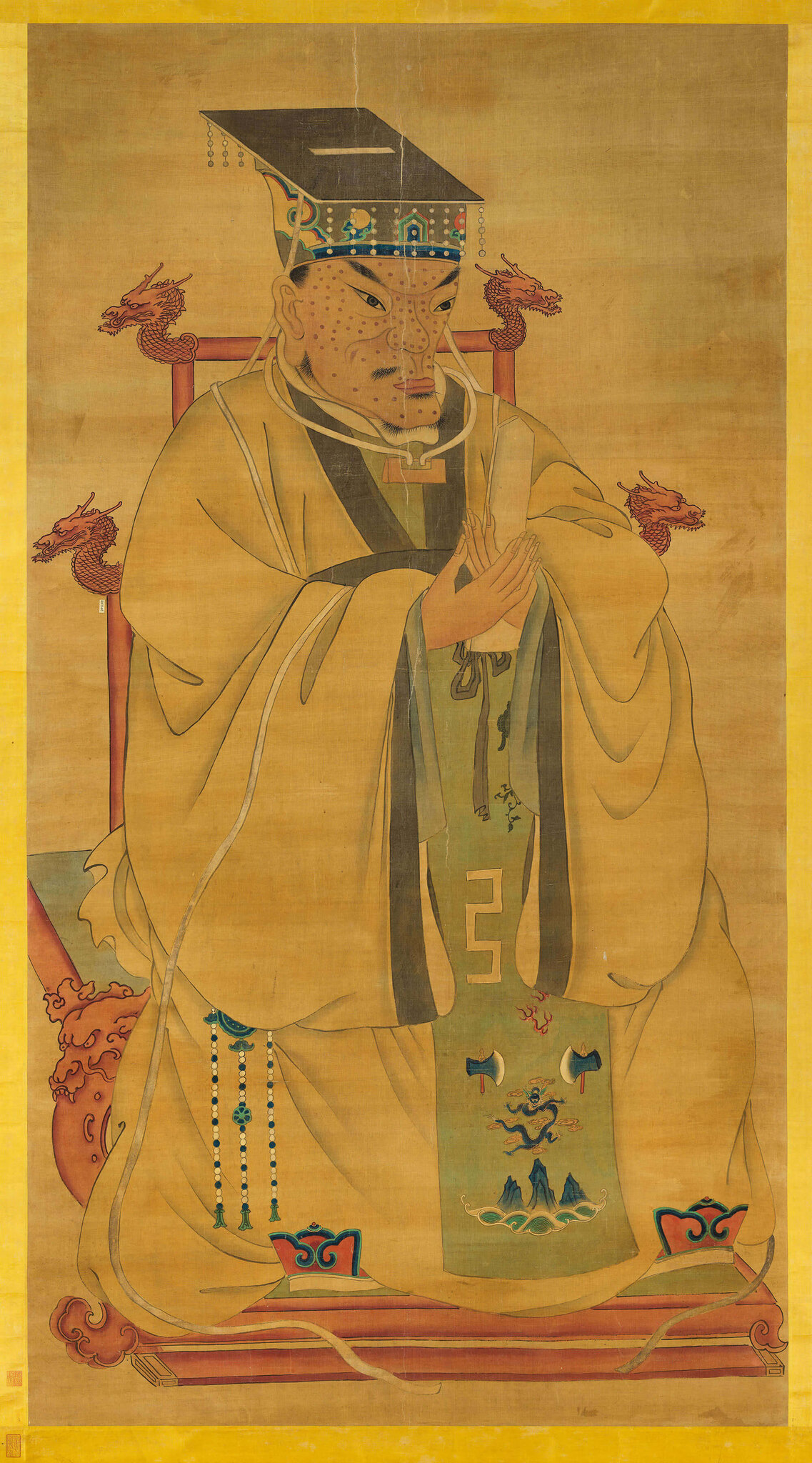
Anonymous, Ming dynasty, Seated Portrait of Emperor Taizu of the Ming (1328-1398), National Palace Museum, Taipei. © National Palace Museum.
This is a portrait of Emperor Taizu (1328-1398), personal name Zhu Yuanzhang and reign name Hongwu, the first ruler of the Ming dynasty. His disfigured face is shown here covered with moles and having protruding cheek and jaw bones that seems to conform to what is known in fortune-telling as the "unusual appearance" of a true Son of Heaven. In other words, the unique facial features reveal this man as destined to become a ruler of enormous power.
The National Palace Museum has a total of ten such "ugly portraits" of Emperor Taizu in its collection. They come in a variety of manners, including crowned, imperially robed, and seated. The quality of these unofficial portraits, however, is not particularly high. It is thought that this type of Zhu Yuanzhang portrait was once popular among the people and so reproduced in large numbers.

Anonymous, Ming dynasty, Emperor Gao, Taizu, of the Ming (1328-1398); Gao's Empress Xiaoci. Verified and declared by the Ministry of Culture in November 2017 as a Significant Antiquity, National Palace Museum, Taipei. © National Palace Museum.
This is a portrait of the Ming dynasty emperor Taizu (posthumous title Gao) at an older age. Although his beard has turned white and the flesh around his eyes and cheeks become looser, the eyebrows and small tufts of beard on his cheeks are quite similar to his appearance in middle age from "Seated Portrait of Emperor Taizu of the Ming." The beard hairs in this painting are rendered with great refinement and combed very carefully and orderly, the perfectly curving shape in this faithful portrait carefully and respectfully done by a court painter at the time.
Compared to the "ugly" unofficial portrait on display here, this has a much more realistic and official appearance, though it paradoxically does not conform to the imagination of a supreme ruler having an "unusual" appearance.

Anonymous, Ming dynasty, Seated Portrait of Emperor Xuanzong of the Ming (1399-1435). Verified and declared by the Ministry of Culture in December 2008 as a National Treasure, National Palace Museum, Taipei. © National Palace Museum.
The Ming dynasty emperor Xuanzong (1399-1435), personal name Zhu Zhanji and reign name Xuande, is shown here with a dark complexion and a luxuriant beard as he wears an "yishan" crown.The yellow robes with dragon-and-clouds pattern were painted in different shades of gold. The emperor grasps an inlaid belt as he sits on a dragon throne meticulously carved that rests on a beautifully brocaded rug decorated with dragon circles.
Compared to portraits of Song dynasty emperors, rulers in the Ming dynasty seem to have spared no effort to show off the opulence of their clothing and objects of use, the extravagance of which was conspicuously displayed. With one hand on his belt and the other resting on his thigh, the open posture of Xuanzong's legs likewise has a special kind of powerful and confident presence, which markedly differs from the more civil and even humble appearance of Song dynasty emperors in their portraits.
"Nanxun Hall" and "Imperial Portraits"
In 1747, Emperor Gaozong (1711-1799, reign name Qianlong) learned that a set of portraits for rulers and officials was stored in the "Tea Storehouse" at court, upon which he ordered that they be repaired and remounted. In the following year, 1748, the project was completed and the imperial portraits among them moved for storage to the Nanxun ("Southern Fragrance") Hall. Currently, more than ninety percent of these portraits are in the collection of the National Palace Museum, while those of meritorious officials remain at the Palace Museum in Beijing.
Nanxun Hall, the construction of which began in the Ming dynasty, is situated in an independent courtyard to the southwest of Wuying Hall. The wood and painting of the building are all original from the Ming dynasty, making it a precious example of architecture from that time. The building itself is five rooms wide and has an inner main hall along with subsidiary rooms that each have a five-story red-lacquered cabinet to hold portraits of rulers through the ages. The room east of the main hall was originally for portraits of empresses through the ages, and stored in the western room were the imperial jade tablets and seals of the Ming dynasty.
"Art Conservation" 270 Years Ago
The repair and remounting for most of the imperial portraits was finished in 1748. Gaozong (the Qianlong emperor) had chosen for these portraits a special silk mounting decorated with eight-petal floral patterns. The labels attached after remounting include not only the posthumous temple name of the figure but also the date of remounting: "Remounted in the 'wuchen' year of Qianlong." Each portrait scroll also has a specially made "bag" made of yellow silk decorated with cloud patterns that were carefully stored at the Nanxun Hall. This demonstrates how much attention Gaozong paid to the repair, remounting, and storage of these imperial portraits from previous dynasties.
'Facets of Authority: A Special Exhibition of Imperial Portraits from the Nanxun Hall' National Palace Museum, Taipei, 2021-01-01~2021-04-06


/http%3A%2F%2Fstorage.canalblog.com%2F03%2F44%2F119589%2F86579713_o.jpg)
/http%3A%2F%2Fstorage.canalblog.com%2F61%2F85%2F119589%2F86579485_o.jpg)
/http%3A%2F%2Fstorage.canalblog.com%2F30%2F64%2F119589%2F86579347_o.jpg)
/http%3A%2F%2Fstorage.canalblog.com%2F86%2F65%2F119589%2F86578375_o.jpg)