

/https%3A%2F%2Fprofilepics.canalblog.com%2Fprofilepics%2F1%2F0%2F100183.jpg)
/https%3A%2F%2Fstorage.canalblog.com%2F03%2F02%2F119589%2F96711876_o.jpg)
/https%3A%2F%2Fstorage.canalblog.com%2F11%2F31%2F119589%2F94773502_o.jpg)
/https%3A%2F%2Fstorage.canalblog.com%2F20%2F83%2F119589%2F94772815_o.jpg)
/https%3A%2F%2Fstorage.canalblog.com%2F26%2F72%2F119589%2F75604929_o.jpg)
/https%3A%2F%2Fstorage.canalblog.com%2F59%2F60%2F119589%2F26458628_o.jpg)
Exhibition examines importance of artistic exchange in medieval Spain
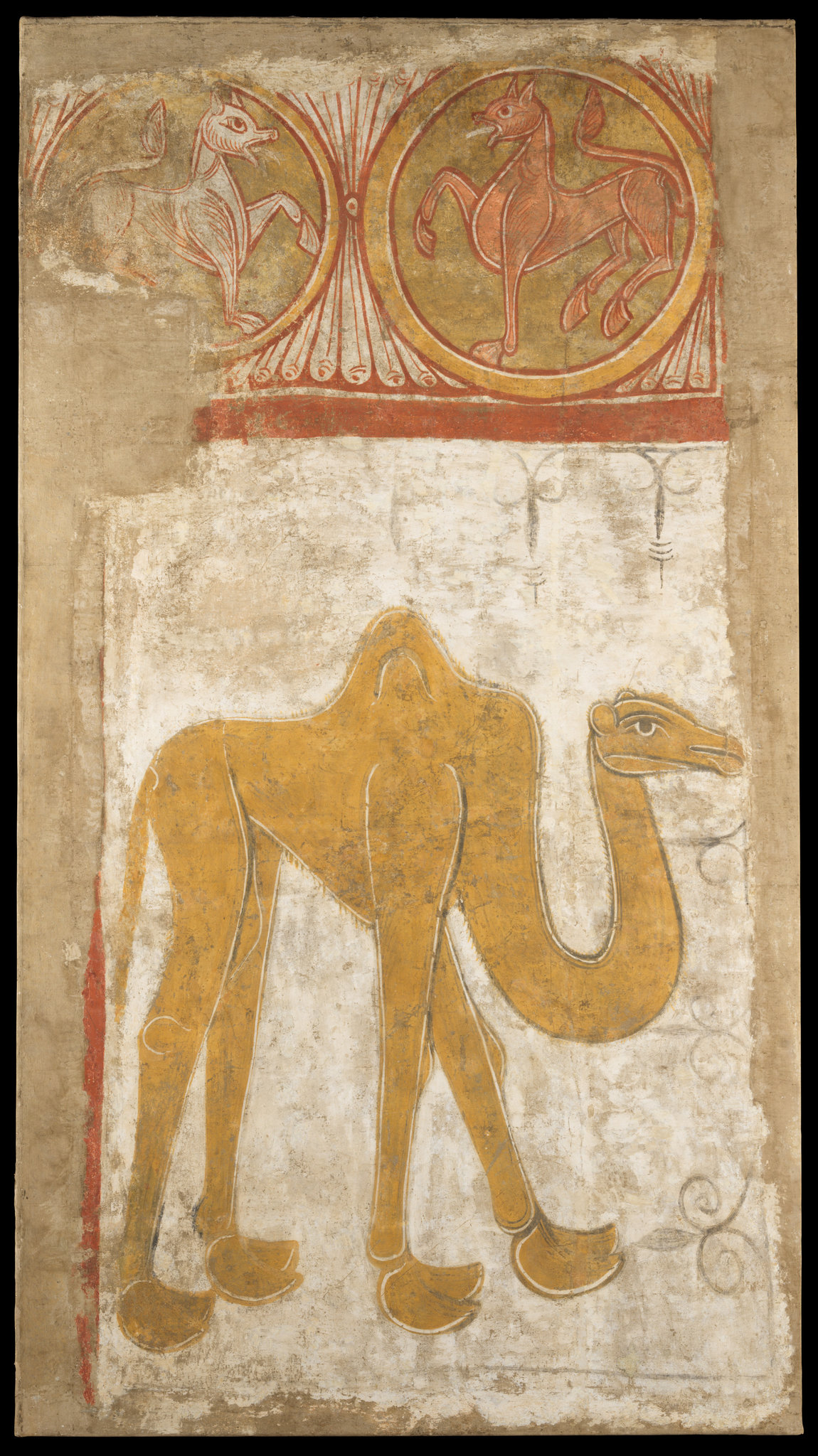
Camel, first half 12th century (possibly 1129–34). Made in Castile-León, Spain. Fresco transferred to canvas, 97 x 53 1/2 in. (246.4 x 135.9 cm) The Cloisters Collection, 1961 (61.219).
NEW YORK, NY.- Communities of Christians, Muslims, and Jews lived and worked side by side in medieval Spain for centuries, and the vibrant artistic traditions they created often intersected in ways that transcended religious differences. On view at The Met Cloisters, Spain, 1000–1200: Art at the Frontiers of Faith brings together a group of works that attest to the diversity of Spanish art during this period. Displayed in the Fuentidueña Chapel gallery, which typically focuses solely on the Christian tradition, this wider ranging exhibition tells a more nuanced story, demonstrating the ease with which objects and artistic ideas crossed religious boundaries. About 40 works—including silk textiles, ivory carvings, illuminated manuscripts, frescoes, and monumental sculptures— have been placed in dialogue with each other, revealing a dynamic, interconnected past that often mirrors the present.
“Finding moments of connection and exchange in our collective cultural heritage is at the heart of The Met’s mission,” said Max Hollein, Marina Kellen French Director of The Met. “By exploring how medieval Spanish artists and patrons found inspiration in the visual traditions of different religions, this sumptuous exhibition will showcase the complex, rich, and often surprising artistic results of interfaith interaction.”

Book Cover (?) with Byzantine Icon of the Crucifixion, 1000 (ivory); late 11th century (setting). Made in Constantinople (ivory); Made in Aragon, Spain (?) (setting), Byzantine (ivory); Spanish (setting). Silver-gilt with pseudo-filigree, glass, crystal, and sapphire cabochons, ivory on wood support, Overall: 10 3/8 x 8 5/8 x 1 in. (26.4 x 21.9 x 2.5 cm) Gift of J. Pierpont Morgan, 1917 (17.190.134)
Julia Perratore, the exhibition’s curator, added: “In medieval Spain, geopolitical frontiers, or borderlands, were understood as places that simultaneously separated and connected different territories. This conception of the frontier is also an apt metaphor for medieval Spanish artistic creation because communities of different faiths, while maintaining their own different beliefs, also developed shared interests and tastes—daily navigating the tension between separation and connection.”
The exhibition’s chronology, 1000 to 1200, corresponds to a pivotal era in the history of the Spanish Middle Ages—one that saw significant shifts in the balance of power between the Christian and Muslim rulers among whom the Iberian Peninsula was divided, destabilizing long-standing social relationships and introducing new tensions among religious communities. Yet the visual arts make it clear that this was not a purely divisive age. Geopolitical frontiers became important places of connection and exchange between sovereignties. Artists and patrons of the Christian-ruled northern peninsula engaged as never before with the cosmopolitan arts of southern, Muslim-ruled Spain (al-Andalus). They emulated, adapted, and appropriated the colorful silks, delicately carved ivories, and fine metalwork they encountered, even as they embraced the Romanesque style of Christian western Europe.

Textile Fragment from the Dalmatic of San Valerius, 13th century. Made in Spain. Silk, gilt animal substrate around a silk core; tapestry weave. Textile: H. 3 1/8 in. (8 cm) W. 8 1/4 in. (21 cm); Mount: H. 7 in. (17.8 cm) W. 12 in. (30.5 cm) D. 1 1/4 in. (3.2 cm) Fletcher Fund, 1946 (46.156.10)
Drawn mainly from The Met collection, with some loans from other institutions, the works of art that visitors encounter throughout the Fuentidueña Chapel gallery illustrate this close connection between the arts of Muslim- and Christian-ruled Spain. Examples include an ornate Hebrew Bible with decorative elements found in both Islamic and Christian manuscripts, demonstrating the tendency for medieval patrons and artists to alternate between visual languages. Fragments of grave markers showcase Arabic inscriptions and architecturally inspired decorations, such as horseshoe arches reminiscent of the Great Mosque of Córdoba. In turn, a Beatus manuscript reveals Christian admiration for the monuments of Córdoba. An overview of the frontier monastery of San Baudelio de Berlanga traces the transfer of motifs and patterns between Islamic textiles and Christian painting and sculpture and also registers aspects of life on the frontier; for example, a camel depicted in one of the monastery’s frescoes shows that the monks of San Baudelio, living in Christian territory, encountered travelers riding on creatures that were brought to Muslim Spain from distant lands. A painted wooden coffret offers a rare depiction of the confrontation of Christian and Muslim armies, while two luxurious votive plaques commissioned by Queen Felicia of Aragon reveal the larger trade and political networks of the day through the incorporation of Byzantine and Islamic objects.

Wood Panel with Calligraphy, 11th century. Attributed to Spain, Toledo. Wood; carved. H. 3 13/16 in. (9.7 cm), W. 8 1/16 in. (20.5 cm), D. 9/16 in. (1.5 cm) The Metropolitan Museum of Art, Gift of Dr. Walter L. Hildburgh, 1951 (51.45.7).
Responding to the dearth of explicitly Jewish art surviving from the period, a rare letter of the 12th-century scholar and poet Judah ha-Levi sheds important light on the Jewish experience in Spain. At the same time, the many secular objects, such as carved ivory boxes and patterned textiles, remind visitors that people of all faiths enjoyed the luxury arts, providing evidence of shared artistic taste that rose above cultural and religious prejudices. Through these objects and more, the exhibition demonstrates the sustained history of multifaith coexistence and interaction in the Iberian Peninsula.
The exhibition is organized by Julia Perratore, Assistant Curator, The Met Cloisters.

Spanish Textile, first half 12th century. Attributed to Spain. Silk, metal wrapped thread; lampas. Textile: H. 17 in. (43.2 cm) W. 13 in. (33 cm); Mount: H. 20 5/8 in. (52.4 cm) W. 16 5/8 in. (42.2 cm) D. 1 1/4 in. (3.2 cm) Funds from various donors, 1958 (58.85.2).

Pyxis, ca. 950–75. Made in Cordoba, Andalusia, Spain. Elephant ivory, Overall: 4 5/8 x 4 1/8 in. (11.7 x 10.5 cm) The Cloisters Collection, 1970 (1970.324.5)

Leaf from a Beatus Manuscript: the Lamb at the Foot of the Cross, Flanked by Two Angels; The Calling of Saint John with the Enthroned Christ flanked by Angels and a Man Holding a Book, ca. 1180, Spanish. Tempera, gold, and ink on parchment, Overall (folio): 17 1/2 x 11 13/16in. (44.4 x 30cm) Mat: 22 x 16 in. (55.9 x 40.6 cm) Purchase, The Cloisters Collection, Rogers and Harris Brisbane Dick Funds, and Joseph Pulitzer Bequest, 1991 (1991.232.1)

Bifolium from the Andalusian Pink Qur'an, ca. 13th century, Spain. Ink, gold, silver, and opaque watercolor on paper, H. 12 1/2 in. (31.8 cm) W. 19 3/4 in. (50.2 cm) Purchase, Friends of Islamic Art Gifts, 2017 (2017.232)

Hebrew Bible, 1300–1350 (before 1366). Made in Castile, Spain. Ink, tempera, and gold on parchment; leather binding, 476 folios: 9 5/16 × 7 15/16 in. (23.7 × 20.1 cm) Binding: 9 15/16 × 8 3/4 × 4 1/4 in. (25.2 × 22.3 × 10.8 cm) The Cloisters Collection, 2018 (2018.59)

Coffret with the Legend of Guilhem, count of Toulouse, ca. 1200–1225. South French Walnut, painted, iron mounts. Overall: 10 11/16 x 17 1/2 x 9 3/4 in. (27.1 x 44.5 x 24.7 cm) The Metropolitan Museum of Art, Promised Gift of Sir Paul Ruddock and Lady Ruddock, in celebration of the Museum's 150th Anniversary (L.2008.58.1a–c).


/image%2F1371349%2F20260916%2Fob_a195f3_36749.jpg)
/image%2F1371349%2F20241106%2Fob_02ec1e_465712537-1792332404870104-12151209347.jpg)
/image%2F1371349%2F20240922%2Fob_a3820c_461006918-1759129201523758-70383139702.jpg)
/image%2F1371349%2F20240706%2Fob_4d5b3f_telechargement-18.jpg)