

/https%3A%2F%2Fprofilepics.canalblog.com%2Fprofilepics%2F1%2F0%2F100183.jpg)
/https%3A%2F%2Fstorage.canalblog.com%2F03%2F02%2F119589%2F96711876_o.jpg)
/https%3A%2F%2Fstorage.canalblog.com%2F11%2F31%2F119589%2F94773502_o.jpg)
/https%3A%2F%2Fstorage.canalblog.com%2F20%2F83%2F119589%2F94772815_o.jpg)
/https%3A%2F%2Fstorage.canalblog.com%2F26%2F72%2F119589%2F75604929_o.jpg)
/https%3A%2F%2Fstorage.canalblog.com%2F59%2F60%2F119589%2F26458628_o.jpg)
Minneapolis Institute of Art, Korean Art, The Ethel Morrison Van Derlip Fund & the Wells Family Foundation Trust

Ewer in the shape of a gourd, Korea, 12th century. Porcelaneous stoneware under celadon glaze, 29.85 x 18.1 x 19.05 cm. Minneapolis Institute of Art, The Ethel Morrison Van Derlip Fund and gift of funds from the Wells Family Foundation Trust, 99.41a,b.
The organic forms they encountered in the natural world inspired Korean potters of the Koryo dynasty (918-1392). They fashioned tea pots and wine vessels in the shape of a pumpkin-squash, a peach, and in this case, a gourd. In fact, dried gourds had long been used as storage containers and decanters. Because of the gourd's natural durability, it was believed that drinking liquid from a gourd would help insure a long life. And because ripe gourds contain hundreds of seeds, they also became symbols of fertility and bountiful offspring.

Flask, Korea, 15th century. Stoneware with iron-black glaze, 22.23 x 19.05 x 13.02 cm. The Ethel Morrison Van Derlip Fund and gift of funds from the Wells Family Foundation Trust, 99.7.
Bottles and flasks with a thick iron-brown or black glaze became popular during the Joseon period. Because shards of such vessels have been found at Buncheong kilns, it is likely that the same kilns produced both wares.

Flask, Korea, 17th century. White porcelain, 21.91 x 19.69 x 9.53 cm. Minneapolis Institute of Art, The Ethel Morrison Van Derlip Fund and gift of funds from the Wells Family Foundation Trust, 99.6.
From the founding of the Joseon dynasty at the end of the 1300s, Korean potters produced finely crafted, undecorated white porcelain wares that reflected the austere tastes associated with Confucianism, the official ideology of the Joseon rulers. King Sejong (1397–1450) is said to have been served only from pure white vessels. This flask, from the 1600s, was used to decant liquor. Potters produced such flasks by throwing two platelike shapes on the wheel, and then joining them together, rim to rim. Afterward, they attached a spout and foot ring. The very thinly applied celadon glaze allows the brightness of the porcelain to show through. Only in areas where the glaze is thicker can we see its cool, greenish-blue hue.
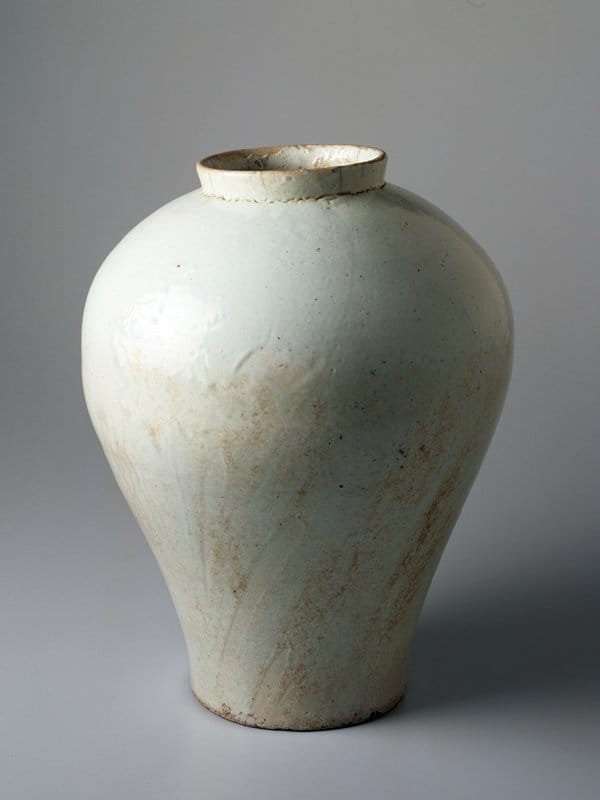
White maebyeong, Korea, 18th century.Porcelain with clear glaze, 38.1 x 29.21 cm. The Ethel Morrison Van Derlip Fund and gift of funds from the Wells Family Foundation Trust, 99.5.


/image%2F1371349%2F20260315%2Fob_fa1080_1000057791.jpg)
/image%2F1371349%2F20260228%2Fob_885667_1000055279.jpg)
/image%2F1371349%2F20260116%2Fob_bd82c2_1000048792.jpg)
/image%2F1371349%2F20240922%2Fob_a3820c_461006918-1759129201523758-70383139702.jpg)