

/https%3A%2F%2Fprofilepics.canalblog.com%2Fprofilepics%2F1%2F0%2F100183.jpg)
/https%3A%2F%2Fstorage.canalblog.com%2F03%2F02%2F119589%2F96711876_o.jpg)
/https%3A%2F%2Fstorage.canalblog.com%2F11%2F31%2F119589%2F94773502_o.jpg)
/https%3A%2F%2Fstorage.canalblog.com%2F20%2F83%2F119589%2F94772815_o.jpg)
/https%3A%2F%2Fstorage.canalblog.com%2F26%2F72%2F119589%2F75604929_o.jpg)
/https%3A%2F%2Fstorage.canalblog.com%2F59%2F60%2F119589%2F26458628_o.jpg)
Chinese textiles to be sold at Sotheby's New York, 19 September 2023
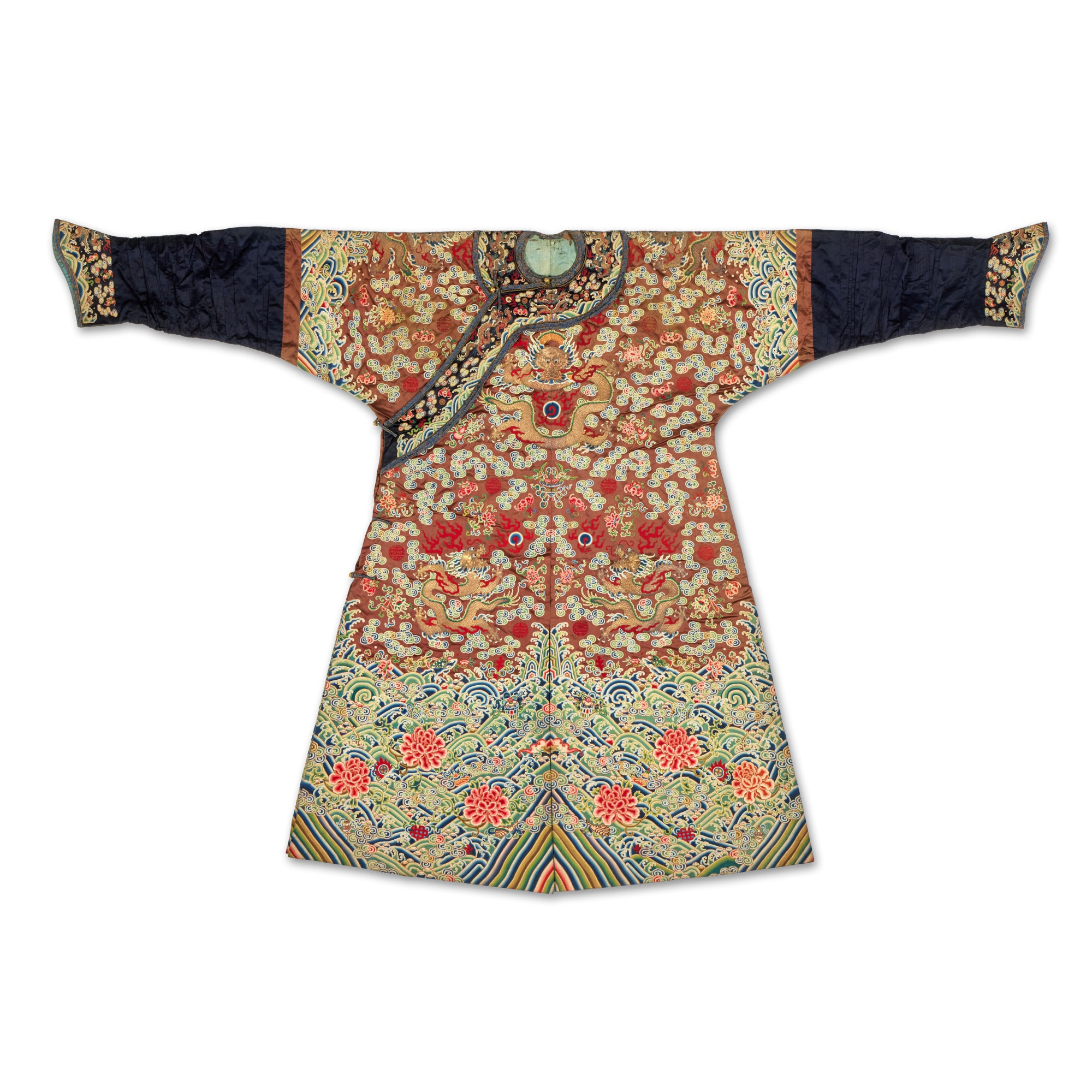


Lot 616. Property from a Hawaii Private Collection. A brown-ground embroidered 'dragon' robe (Jifu), Qing dynasty, Jiaqing period (1796-1820). Height 149.5 cm; Length 228.5 cm. Estimate 50,000 - 70,000 USD. Lot sold 50,800 USD. © Sotheby's 2023
the base with a six-character seal mark in underglaze blue.
Provenance: E&J Frankel, New York, 1981.
Exhibited: The Emperor's Old Clothes, E&J Frankel, New York, 1981.
Note: The décor on this jifu, (吉服, literally, 'auspicious' dress), or longpao, (龙袍, [imperial] dragon robe) follows the standard Qing disposition of five-clawed dragons (long, 龙) amid clouds across the entire surface of the garment. The standing water (lishui, 立水) border at the hem features piled wind-swept waves on which float the Eight Buddhist Symbols ( ba jixiang, 八吉祥), symbols for the Eight Precious Things (ba bao, 八宝), the attributes of the Eight Daoist Immortals (ba xian, 八仙), large peony blossoms, and several motifs that function as rebus. The term 'hurricane waves' was coined by Alan Priest in the 1940s to describe this variation of lishui, which first appeared on some jifu robes during the first quarter of the nineteenth century. The dragons, as is typical, are depicted with couched gold-wrapped threads while the rest of the embroidered decoration uses colored floss silk. However, what is remarkable is the choice of embroidery stitches for executing these colored silk elements.
The embroidery employs a single stitch commonly known in the West as 'pekin', 'peking', or 'pekinese' stitch, (Beijing zhen, 北京針). It is also known as lasuo xiu (拉锁绣, literally 'zipper stitch').1 It is a composite stitch involving two elements: a row of closely spaced back stitches and a second element interlaced in continuous loops moving forward two and back one through the previously laid down back stitches. It is time-consuming and requires consistent, exacting skill to maintain the proper tension and spacing of each parallel row of back stitches and well as rigorous consistency in placing the interlacing elements.
The effect is spectacular. The density of the silk floss and the play of light on the filament of the interlaced elements, which lie in different directions, intensifies the appearance of color and offers crispness to the edges of each design motif. Single rows of pekin stitch worked in red silk back stitches with a fine gold-wrapped yellow silk interlacing thread outline motifs. The skill required to achieve this without snagging the metal thread when it is pulled through the silk back stitches is even more astounding. A single line of these gold-wrapped thread loops marked the lower edge of the embroidered designs at the hem and edges of the cuffs and facings, an attention to detail rarely seen on any other embroidery for the court. It suggests the piece may have been specifically ordered for the imperial household.
There is confusion in literature concerning beijing zhen or lasuo xiu and seed, or knot stitch (dazi xiu, 打籽秀). Both were caught up in the early twentieth century in 'old China hand' accounts of handicrafts, where the term 'forbidden', possibly referencing the residence of the emperor, was attached to types of complex embroidery with the implication such embroidery was used exclusively for the court. A second term 'blind' was applied to such embroidery with the explanation that small scale and complicated manipulation in making this stitch caused needle workers to lose their eyesight.
Dazi xiu embroidery has a long history in China. Schuyler Cammann cites Han dynasty examples recovered from the Noin Ula, the Xiongnu burial site located in Mongolia north of Ulan Bator and notes that the stitch was used sparingly during the Ming and during the Qianlong period of the Qing dynasty.2 However, the wide-spread use of dazi xiu for large areas of design flourished in the nineteenth century. The appearance of beijing zhen or lasuo xiu stitching coincides with development. Both techniques were used largely on dress trimmings and smaller personal accessories and occasionally on late Qing dynasty rank insignia badges.
The exclusive use of beijing zhen or lasuo xiu stitching on a court dragon robe remains a puzzle.
John E. Vollmer, New York City

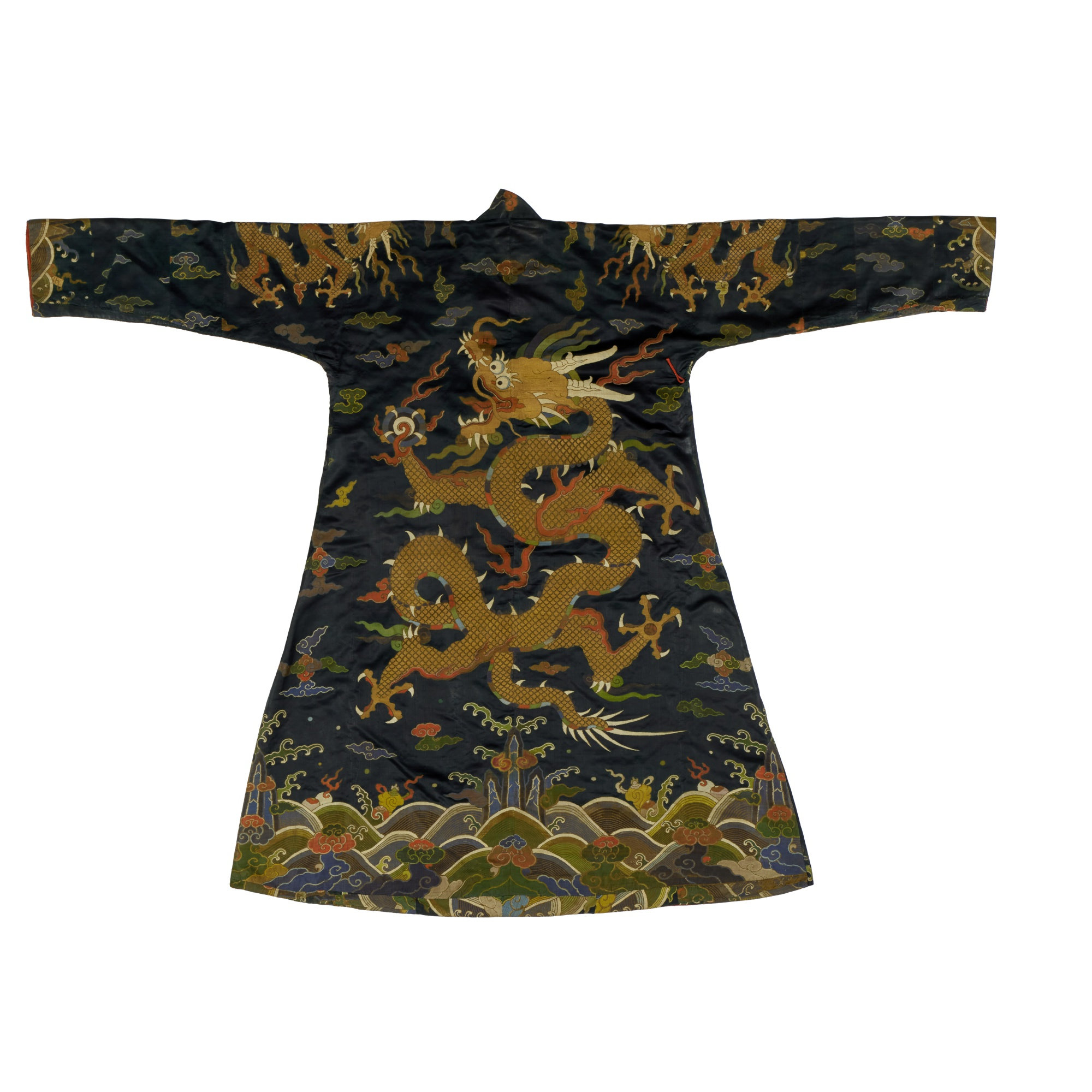
Lot 617. An Important Private Collection of Chinese Textiles. A blue-ground silk embroidered 'dragon' robe, 17th century. Height 134.6 cm; Length 189.2 cm. Estimate 100,000 - 150,000 USD. Unsold. © Sotheby's 2023
Provenance: Geng Zhi Tang Collection.
Exhibited: Chang Foundation Museum, Taipei, 1999.
Foguangyuan Art Gallery, Melbourne, 2001.
Nantian Temple Exhibition Hall, Sydney, 2002.
Note: A rare and unusual example of a late Ming dynasty dragon garment, the present robe is decorated with four-clawed dragons, known as mang. In the Ming dynasty, robes were carefully regulated in terms of design, particularly those with designs of dragons and other animals, to distinguish the status of wearer. According to Ming regulations, the present robe would have been reserved for certain princes and high-ranking noble-men.
This robe is made of 'decorated' satin, known as zhuanghua duan. By using discontinuous wefts, colorful patterns are 'incised' into the satin. In addition, flat gold or gold-wrapped thread is used to make the satin more attractive. The production of such duan required massive labor. According to a modern experiment, weaving a robe based on the dimensions and design of a similar fabric discovered in the Dingling tomb of the Ming Wanli Emperor required experienced weavers approximately 270 working days to complete, see Gao Hanyu, 'Technical and Artistic Development of Chinese Patterned Silk', in Jinxiu luoyi qiao Tiangong / Heavens' Embroidered Cloths. One Thousand Years of Chinese Textiles, Hong Kong, 1995, p. 45.
Only a limited number of Ming dragon robes are found today, likely because they were highly treasured by the owners and therefore buried with them. Many Ming dragon robes that have survived were brought to Tibet as gifts and re-cut into the narrower-sleeved Tibetan chuba style, such as the present lot.
Compare an uncut dark-blue robe material with mang design, attributed to late Ming period, in the China National Silk Museum, Hangzhou, illustrated in Zhao Feng, Zhixiu zhenpin / Treasures in Silk, Hong Kong, 1999, pl. 09.05; another early Qing example, illustrated in Valery M. Garrett, Chinese Clothing. An Illustrated Guide, Oxford, 1994, fig. 3.6, p. 37.

Lot 618. An Important Private Collection of Chinese Textiles. A pair of gold-ground silk kesi 'dragon and phoenix' chair covers, Qing dynasty, late 17th century. Height 148.6 cm; Length 39.4 cm; framed (2). Estimate 40,000 - 60,000 USD. Unsold. © Sotheby's 2023
Provenance: Christie's London, 15th June 1999, lot 197.
Note: Woven and embroidered panels such as the present examples were used to cover chairs when not in use. Each pictorial register conforming to the apron, seat, and the front and back of the back rest. The striding dragon, blossoming peony, phoenix, peaches and shou character would make the present pair of chair covers an appropriate gift for a newly married couple, conveying wishes for a long and harmonious union. A closely related pair of chair covers sold at Christie's New York, 21st March 2014, lot 2353.


Lot 619. An Important Private Collection of Chinese Textiles. An apricot-ground silk embroidered 'phoenix' kang cover, Qing dynasty, late 18th-19th century. Height 104.1 cm; Length 132.1 cm; framed. Estimate 10,000 - 15,000 USD. Lot sold 15,240 USD. © Sotheby's 2023
Provenance: Christie's London, 15th June 1999, lot 201.


Lot 620. An Important Private Collection of Chinese Textiles. A large yellow-ground silk embroidered 'phoenix' panel, Qing dynasty, 18th century. Height 317.5 cm; Length 492.8 cm; framed. Estimate 20,000 - 30,000 USD. Lot sold 60.960 USD. © Sotheby's 2023
Provenance: Offered at Sotheby's New York, 18th April 1989, lot 140.
Note: The impressive dimensions, luxurious quality of the yellow silk, and fine needlework of the present panel indicate that it may have been destined for the imperial household, possibly for use as a bed hanging. The composition of phoenix amid peony flowers, a subject matter associated with idealized femininity, suggests the panel formed a prominent decorative element in the bedroom of an important female member of the imperial court.


Lot 621. An Important Private Collection of Chinese Textiles. A red-ground silk embroidered 'dragon' robe, Ming dynasty, 17th century. Height 119.4 cm; Length 180.3 cm. Estimate 40,000 - 60,000 USD. Lot sold 107.950 USD. © Sotheby's 2023
Provenance: Geng Zhi Tang Collection.
Note: The exuberance of the composition indicates that the present robe was destined not for the imperial court, but perhaps as a relatively contemporaneous costume of a court attendant for theatrical performance.
A related robe, for the Ming court, is in the Shandong Museum, and another in the Chongqing Museum is illustrated in Zhongguo meishu quanji / Complete Volumes on Fine Chinese Art, Beijing, 1987, p. 30.


Lot 622. An Important Private Collection of Chinese Textiles. A red-ground silk woven 'dragon' robe, Qing dynasty, 18th century. Height 137.8 cm; Length 189.9 cm. Estimate 30,000 - 50,000 USD. Lot sold 35,560 USD. © Sotheby's 2023
Provenance: Geng Zhi Tang Collection.
Note: The current kesi robe is a rare example of a jifu (semi-formal robe) for noble ladies within the Qing imperial family. The robe is decorated with eight dragon roundels, three in the front, three at the back and two at each shoulder, all above the mountain and wave patterns at the bottom, a formal design exclusive for imperial ladies in the Qing court. The dragons on this robe each have two claws, indicating that it was made for a concubine of the emperor's grandson or great-grandson. The two-claw dragon was not formally included in the Qing regulations published during the mid-Qianlong period, leaving very few extant examples.
The only example with two-claw dragons found in publications is a green jifu robe from the Qing imperial collection and now in the Palace Museum, Beijing, as illustrated in Qingdai gongting fushi / Costumes and Accessories of the Qing court, Hong Kong, 2005, pl. 111. Compare also a robe with similar pattern, but with four-claw dragon, illustrated in Wang Jinhua, Zhongguo chuantong fushi. Qingdai fuzhuang [Traditional Chinese costumes. Qing costumes], Beijing, 2015, pp 66–67; another example, also on a red ground but decorated with medallions of plum blossoms, orchid, bamboo and chrysanthemum, from the Qing imperial collection, with a yellow note attached and dated to Daoguang period, illustrated in Gugong fushi tudian / Illustrated Dictionary of Qing Dynasty Court Costumes, Beijing, 2018, pl. 65.
Sotheby's. Important Chinese Art, New York, 19 September 2023


/image%2F1371349%2F20260814%2Fob_0c789a_telechargement.jpg)
/image%2F1371349%2F20260814%2Fob_f3fffb_770886458-2320211552082184-81227025763.jpg)
/image%2F1371349%2F20260813%2Fob_88eec5_772929666-2319625142140825-62068689842.jpg)
/image%2F1371349%2F20260813%2Fob_4f3273_772345419-2319091275527545-34726066766.jpg)