

/https%3A%2F%2Fprofilepics.canalblog.com%2Fprofilepics%2F1%2F0%2F100183.jpg)
/https%3A%2F%2Fstorage.canalblog.com%2F03%2F02%2F119589%2F96711876_o.jpg)
/https%3A%2F%2Fstorage.canalblog.com%2F11%2F31%2F119589%2F94773502_o.jpg)
/https%3A%2F%2Fstorage.canalblog.com%2F20%2F83%2F119589%2F94772815_o.jpg)
/https%3A%2F%2Fstorage.canalblog.com%2F26%2F72%2F119589%2F75604929_o.jpg)
/https%3A%2F%2Fstorage.canalblog.com%2F59%2F60%2F119589%2F26458628_o.jpg)
Islamic ceramics from a Private American collection sold at Christie's London, 26.10.2023
The following lots (27-43) come from a Private American collection. They were all excavated with legal licenses in Iran in the 1930s and 40s and were brought to America at a time when Europe was becoming more troubled, and America was considered the marketplace with the greatest potential. The supply of serious works of art, coupled with active promotion by scholars such as Arthur Upham Pope, meant that interest in collecting Persian art rapidly grew, with museums building up representative collections as well as private individuals forming collections of the highest quality.


Lot 27. A Seljuk stucco figure, Iran, 12th century; 25.4cm high. Price realised GBP 10,080 (GBP 10,000 – GBP 15,000). © Christies 2023
Depicting a musician playing an 'ud, remains of dove-grey pigment, with custom-made acrylic stand.
Provenance: American collection, by 1971.


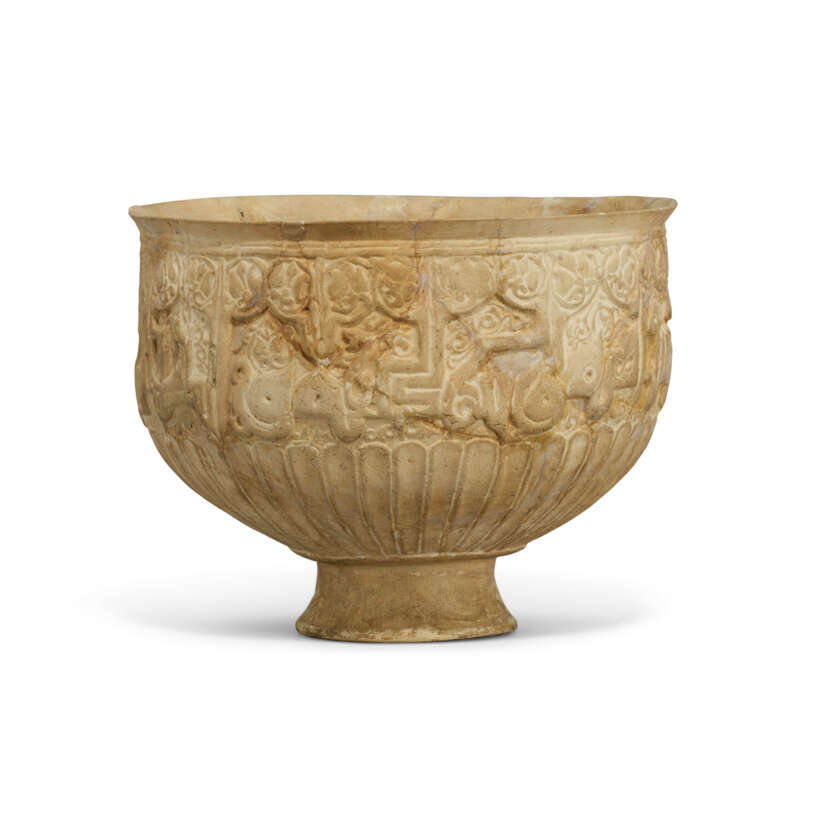


Lot 28. An unglazed pottery bowl, probably Nishapur, Eastern Iran, 12th-13th century; 17.5cm diam. Price realised GBP 1,764 (GBP 2,000 – GBP 3,000). © Christies 2023
Of rounded form with vertical sides, the cavetto moulded with a fluted design, rising to a band of floriated kufic, with a slightly splayed foot, the base pierced with five holes.
Provenance: American collection by 1971.
Inscription: Inscription in kufic, largely undeciphered, suggested reading ...shafaha (shafa'a) wa baraka ... '... intercession (?) and blessing...'
Note: Though there has been comparatively little published on unglazed Iranian pottery, the high-sided form of this bowl resembles a mould in the al-Sabah Collection, Kuwait, which is reported to have been excavated in Ghazni in present-day Afghanistan (Oliver Watson, Ceramics from Islamic Lands, London, 2004, pp.144-5, Cat. Af.6). A fragment of a similarly-shaped mould which was excavated in Nishapur is in the Metropolitan Museum of Art in New York. That has a similar combination of large kufic letters with small birds in an upper band (acc.no.48.101.6a,b).


Lot 29. A Kashan pierced white-glazed conical bowl, Central Iran, 12th century; 24.8cm diam, 11.4cm high. Price realised GBP 10,080 (GBP 4,000 – GBP 6,000). © Christies 2023
Provenance: American collection by 1971.
Note: The introduction of fritware to Iran from Syria and Egypt in the twelfth century has been described as a ‘revolution in ceramic technology’ (Oliver Watson, Ceramics of Iran, London, 2020, p.147). Rather than earthenware, the bodies of ceramic vessels were now made of an artificial mix of quartz, clay, and finely-ground glass powder, which was perfectly white and could be made into walls only a few millimetres thick. This allowed the products of Kashan – the central Iranian town which seems to have had a monopoly on the technology - to rival those of Chinese workshops, which had a translucency which had long been the envy of the world (Oliver Watson, op.cit., p.149). It made possible the creation of vessels like this: with walls so thin that they could be carved with small perforations which would be filled with glaze and create an effect like openwork, while still holding liquids. The decorated band around the rim of our bowl resembles that on another in the Louvre (acc.no. MAO 530), and a beaker in the Sarikhani collection (Oliver Watson, op.cit., p.171, cat.86).


Lot 30. A calligraphic pottery bowl, North East Iran or Transoxiana, 11th century; 19.3cm diam. Price realised GBP 8,190 (GBP 5,000 – GBP 7,000). © Christies 2023
Provenance: American collection by 1971.
Inscription: In the centre, 'Ahmad'; around the wall a saying to Imam 'Ali and part of a word man ayqan bi'l-khalaf jada bi'l-'atiyya bar[aka?], 'He who believes in what follows excels in generosity. Blessing(?)'
Note: Bowls of this type were often painted with aphorisms or exhortations around the cavetto, frequently with the single enigmatic word ‘Ahmad’ in the middle. Abdullah Ghouchani maintains that it was the name of an individual potter (Katabaha-yi sufal-i Nishabur / Inscriptions on Nishapur Pottery, Tehran, 1986). The amount of pottery with the word on it, in all manner of calligraphic styles, may suggest ‘Ahmad’ was a workshop rather than an individual. Others have suggested that it may not be a name at all. Charles K. Wilkinson suggests that it may be an elative form of the Arabic verb hamada, meaning ‘the most laudable’ or ‘may he do that which is laudable’ (Nishapur: Pottery of the Early Islamic Period, New York, 1973).
Other ceramics with ‘Ahmad’ in the middle are in the al-Sabah collection (Oliver Watson, Ceramics from Islamic Lands, London, 2004, p.213, Cat. Ga.9), the British Museum (acc.no.1948,1009.1), and Museum of Applied Arts, Hamburg (acc.no. 1956.96). An example with an inscription which is also in a very similar script, which Ernst Grube describes as ‘particularly elegant and controlled’, is in the Khalili Collection (Ernst J. Grube, “The Pottery of Khurasan”, Cobalt and Lustre: the First Centuries of Islamic Pottery, p.98, cat.no.95).


The pale grey interior with a single line of stylised blue kufic, the exterior plain, repaired breaks.
Provenance: American collection by 1971.
Inscription: The inscriptions reads baraka li-sahibihi, 'blessing to the owner of this [bowl]'.
Note: Pottery of this type is often referred to as ‘Samarra’ ware, a reference to the palace-city which served as the capital of the Abbasid caliphate in the ninth century. Though many examples of pottery of this type were excavated there in the early twentieth century, they are not believed to have been made in Samarra itself, but elsewhere in present-day Iraq - Baghdad, Kufa and – most recently – Basra have been suggested as places of manufacture. The silhouette of these bowls and their smooth white glaze emulates Tang Dynasty porcelain, examples of which were found during the excavations of Samarra, demonstrating the extent of trade connections between the Islamic world and China in the first millennium (Oliver Watson, Ceramics of Iran, London, 2020, p.41).
The sparse decoration on these bowls is rendered in cobalt blue pigment. Although some examples feature geometric or vegetal designs, many - like the present lot - are decorated instead with a single band of inscription. Similar examples, undecorated aside from the inscription, are in the Ashmolean museum in Oxford (acc.nos.EA1956.106 and EA1978.213) and the Museum of Islamic Art in Doha (acc.no.PO.31). Examples sold at auction in recent years include one sold by Sotheby’s London, 24 October 2007, lot 52, and in these Rooms 27 April 2017, lot 6, and 27 April 2007, lot 3. Of those, the latter has an inscription identical in content with that on the present lot.


Lot 32. A figural Kashan lustre pottery dish, Central Iran, late 12th century; 15.8cm diam. Price realised GBP 10,080 (GBP 12,000 – GBP 18,000). © Christies 2023
The white ground decorated in lustre, the central roundel with six figures in cartouches around a central star, a band of kufic around the rim, the exterior with a band of 'dot and dash' design between horizontal bands, '183' written in pen on the base, two stickers on the exterior, intact.
Provenance: American collection by 1971.
Inscription: Around the inside wall in kufic, possibly repetitions of benedictions in Arabic al-'izz, al-daw[la] al-'izz al-iqbal 'Glory, wealth, glory, prosperity'.
Note: Following the introduction of fritware (see lot 29), the arrival of the lustre technique – which also probably found its origins in Egypt – brought about a second revolution in Iranian ceramics. The technique required a potter to apply a thin layer of pigment, made from a mix of silver and copper oxides and earth, to the surface of a fired white-glaze vessel. The vessels would then be fired in a second time in a ‘reducing kiln’, in which carbon monoxide removed the oxygen to leave a deposit of metal. The deposit was thin enough to be practically transparent, but thick enough to have a pearlescent sheen (Oliver Watson, Persian Lustre Ware, London, 1985). In the words of Abu’l-Qasim, a descendent of the Kashani master-potter Abu’l-Tahir writing in the year AH 700⁄1300 AD, a finished vessel ‘reflects like red gold and shines like the light of the sun’ (translated James Allan, “Abu’l-Qasim’s Treatise on Ceramics”, Iran, XI, 1973).
The chain-like motifs between the figures on the interior, which are echoed in a larger scale on the exterior of the dish, are also encountered on other vessels, such as a bottle in the Sarikhani collection (Oliver Watson, Ceramics from Iran, London, 2020, p.223, cat.no.113) and two jugs in the Khalili collection (Ernst J. Grube, “Iranian stone-paste pottery of the Saljuq period”, in Cobalt and Lustre: the First Centuries of Islamic Pottery, London, 1994, pp.232-3, cat.nos. 260 and 262).


Lot 36. A Kashan lustre pottery apothecary jar (albarello), Central Iran, late 12th century; 19.8cm high. Price realised GBP 40,320 (GBP 20,000 – GBP 30,000). © Christies 2023
Provenance: American collection by 1971.
Inscription: Around the neck and body in kufic, possibly repetitions of al-daw[la], 'wealth'.
Note: The decoration on the present lot closely resembles that on lot 32 in the present sale, and like it can be described as an example of the Kashan ‘miniature’ style. Its form however is much more unusual, and far better represented by later blue and white examples from the thirteenth and fourteenth centuries. Of them, Arthur Lane comments that they enjoy the ‘peculiar distinction of being almost the only pre-sixteenth century Islamic pottery that has survived above ground since it was made’. They were made to transport fruits and spices, and were referred to by their Arabic name al-birun. This word became corrupted when they were traded with Europeans, and a pot of this type has since been referred to as an 'albarello'. They were particularly associated with apothecaries and widely imitated, and are commonly seen in the Hispano-Moresque pottery as well as Italian majolica.
Other Kashan lustre albarelli are in London, in the collections of the British Museum (acc.no.G.252) and the Victoria & Albert Museum (acc.no.369-1892). Another example which shares its ascending ‘chain’ motifs with ours is in the Metropolitan Museum of Art, New York (acc.no.2013.255).
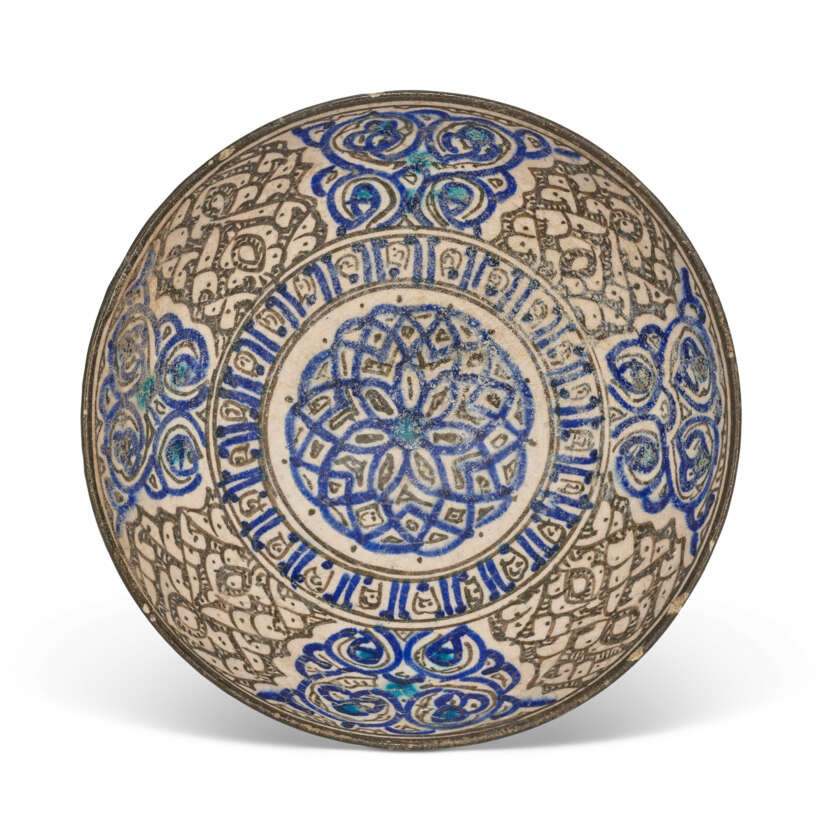


Lot 37. A Sultanabad pottery bowl, Eastern Iran, 14th Century; 21.7cm diam. Price realised GBP 2,520 (GBP 4,000 – GBP 6,000). © Christies 2023
Of rounded form on short foot, painted under the clear glaze in blue and black, the interior decorated with a central rosette surrounded by a band of pseudo-calligraphy and an outer band of alternating floral motifs, the exterior with alternating blue and black vertical lines, inventory numbers in black ink on the base, rim chips, otherwise intact.
Provenance: American collection by 1971.
Note: This bowl was produced after the Mongol invasion although in spite of this there is a certain amount of continuity with early thirteenth century underglaze painted Kashan ware. New departures can be seen, however, in the incorporation of Chinese motifs and the overall shape of this bowl, which resembles Chinese celadon lotus bowls (Oliver Watson, Ceramics of Iran, London, 2020, p.329, cat.no.169). The term ‘Sultanabad’ is a reference to the place where pottery of this type was first discovered by Western archaeologists in the early twentieth century. In all likelihood, these bowls were still made in Kashan, which by the second half of the thirteenth century had recovered from the impact of the Mongol invasion and was once again thriving under the Pax Mongolica.
A Sultanabad bowl with very similar pattern on the exterior is in the al-Sabah collection (Oliver Watson, Ceramics from Islamic Lands, London, 2004, p.390, cat. Q.19). Another, with similar internal decoration in the Los Angeles County Museum of Art (acc.no. 55.26.2). A Sultanabad bowl with a six-pointed stellar motif in the middle was sold in these Rooms, 23 October 2007, lot 71.


Lot 39. A Kashan pottery model house with performing musicians, Central Iran, 12th Century; 11.1 x 16.8 x 6cm. Price realised GBP 2,772 (GBP 3,000 – GBP 4,000). © Christies 2023
Of rectangular form, the central cavity containing eight figures playing a variety of instruments all grouped around forms suggestive of three cypress trees, a line of crenellated arches on all four sides of the central cavity, the four sides of the model carved in relief with coupled columns running along the length in imitation of a hypostyle building, repaired breaks.
Provenance: American collection by 1971.
Note: Covered with a monochrome turquoise glaze, this is an example of an extraordinary group of ‘house models’ attributed to thirteenth century Kashan. When an example was excavated in the Wasit in the early twentieth century, excavators suggested that they had stumbled onto the remains of a toyshop (Margaret S. Graves, Worlds Writ Small: four studies on miniature architectural forms in the medieval middle East, Volume I, PhD thesis, University of Edinburgh, 2010, p.73). Others have suggested that they were intended that they might have been gifts associated with Nowruz, and indeed many examples such as one in the Museum of Islamic Art in Berlin (acc.no. I.3832) show groups sat around a pedestal table with balls of clay on it, which may represent the haft sin. A model in the Metropolitan Museum of Art (acc.no. 67.117), in which two figures stand before a turbanned man on a structure resembling a minbar with eight seated onlookers on either side, has been interpreted as a marriage ceremony.
Exactly what kind of structure is being depicted is also open to question: it may be interpreted variously as a house, a mosque, a madrasa, or a tekke. The rectangular form seems particularly reminiscent of the caravanserai which were constructed under Seljuk auspices across their realm, such as Sultan Han in Aksaray, or the Deyre Gachin near Qom, many of which had arcaded exteriors and enclosed gardens. Perhaps the figures on this model represent a band of travelling musicians, making their living by entertaining weary travellers.

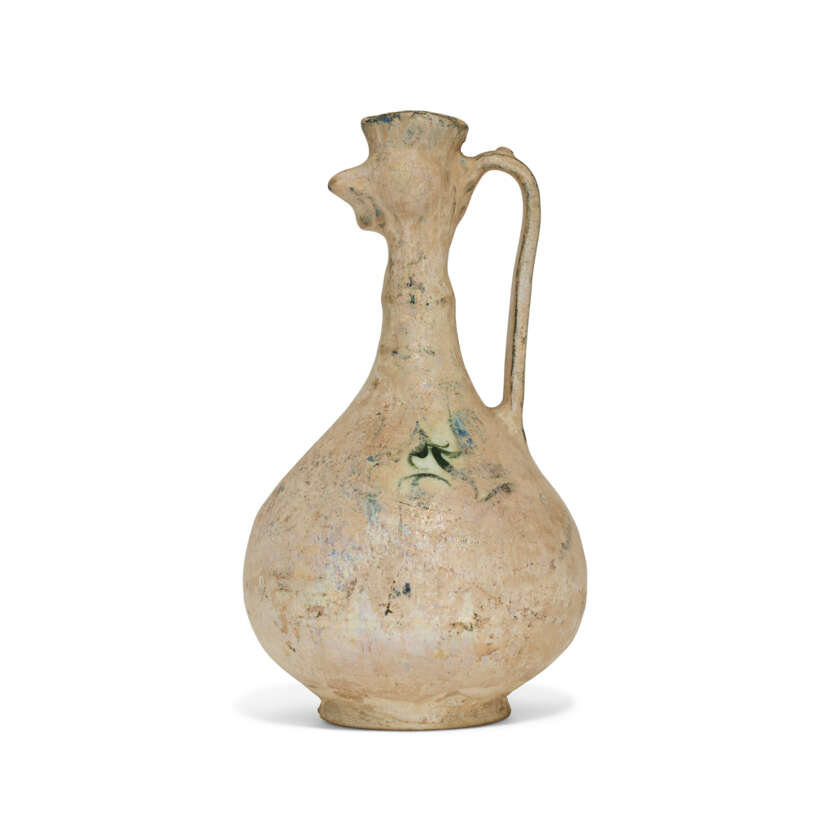
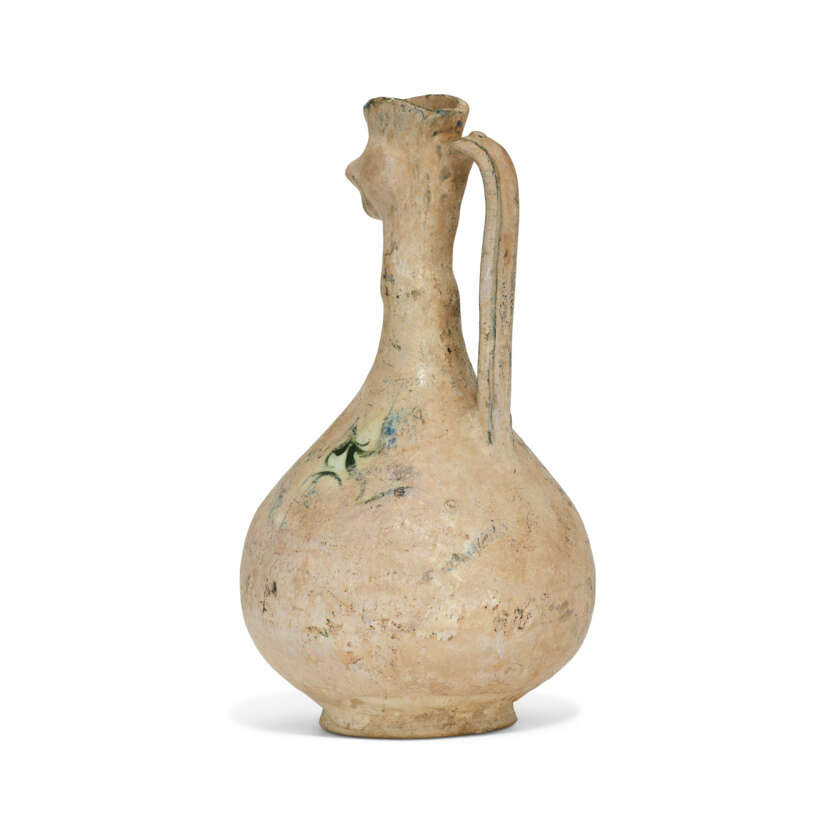


Lot 42. A Kashan cockerel-head pottery ewer, Iran, 13th Century; 25.7cm. Price realised GBP 20,160 (GBP 8,000 – GBP 12,000). © Christies 2023
Of bulbous form, the white ground decorated with cobalt-blue and black scrolls, a band of black calligraphy around the middle, the tapering neck terminating with a sculpted cockerel head and a slightly flared mouth, straight handle, surface iridescence, intact.
Provenance: American collection by 1971.
Note: Underglaze-painted vessels such as the present lot were contemporary with Kashan lustre ware. Often the decoration was done with cobalt-blue and black pigments - the former was quite volatile with a tendency to run, while the latter was thick and viscous enough that it could be incised. There are three examples of bowls decorated with this technique in the Khalili collection, of which one (cat.no. 214) is dated AH 611⁄1214 AD (Ernst J. Grube, “Iranian stone-paste pottery of the Saljuq period”, in Cobalt and Lustre: the First Centuries of Islamic Pottery, London, 1994, pp.197-99, cat.nos.213-15).
The distinctive form of this ewer, with its moulded cockerel’s head, is not uncommon in medieval Iranian pottery. Though they have a variety of different handle designs and body shapes, the heads are broadly homogenous across the group. The model may have been Sassanian metalwork or Tang Dynasty phoenix-head ewers, though an indigenous tradition can also not be ruled out (Oliver Watson, Ceramics of Iran, London, 2020, p.178, cat.no. 91). Other examples of this form with underglaze painting include two examples decorated only with horizontal stripes in the Sarikhani collection (Oliver Watson, op.cit., p.297, cat.no.151) and in the Metropolitan Museum of Art in New York (acc.no. 19.68.2). A further example was sold by Bonhams London, 24 April 2018, lot 172.
Christie’s. Art of the Islamic and Indian Worlds including Rugs and Carpets, London, 26.10.2023


/image%2F1371349%2F20260814%2Fob_f3fffb_770886458-2320211552082184-81227025763.jpg)
/image%2F1371349%2F20260716%2Fob_dde07a_24739.jpg)
/image%2F1371349%2F20260401%2Fob_082a25_1000061016.jpg)
/image%2F1371349%2F20260401%2Fob_6b12a0_1000061018.jpg)