

/https%3A%2F%2Fprofilepics.canalblog.com%2Fprofilepics%2F1%2F0%2F100183.jpg)
/https%3A%2F%2Fstorage.canalblog.com%2F03%2F02%2F119589%2F96711876_o.jpg)
/https%3A%2F%2Fstorage.canalblog.com%2F11%2F31%2F119589%2F94773502_o.jpg)
/https%3A%2F%2Fstorage.canalblog.com%2F20%2F83%2F119589%2F94772815_o.jpg)
/https%3A%2F%2Fstorage.canalblog.com%2F26%2F72%2F119589%2F75604929_o.jpg)
/https%3A%2F%2Fstorage.canalblog.com%2F59%2F60%2F119589%2F26458628_o.jpg)
Longquan Celadon Top Lots To Be Offer At Hong Kong Baopai 2023 Autumn Special Session
HONG KONG - As the end of the year is approaching, Baopai Hong Kong will hold a special auction of Southern Song Dynasty Longquan porcelain and ceramics and porcelain from past dynasties on December 1. The items in this auction date back to the Tang and Song dynasties and go through the Yuan, Ming and Qing dynasties, and are of great variety. Among them, the Longquan porcelain of the Southern Song Dynasty is most eye-catching for its rich variety and shocking appearance. Here, we have carefully selected a series of exquisite collections for you to taste.
Longquan pink celadon series
Pink green glaze (kinuta) is pink green, which is the true color of Longquan in the Southern Song Dynasty. It is an extremely rare and elegant glaze color. It uses iron as the main coloring element, and the glaze is thicker. After entering the kiln, it is fired with a high-temperature reduction flame, making it look like sapphire, with a pinkish-white glaze among the greenish green.


Lot 52. From Okazaki Family Collection, Japan. A Longquan celadon plate mouth bamboo-neck vase, Southern Song Dynasty (1127-1279); 31cm high. Starting price: HKD 500, 000. (c) Hong Kong Baopai
This long-neck bottle is a high-quality Longquan bottle from the peak period of the Southern Song Dynasty, and its shape is also one of the classic bottle styles of the Southern Song Dynasty.
The bottle has a plate mouth, a long neck, an oblate belly, and large round feet. The neck and abdomen are decorated with string patterns, and the whole body is covered with pink green glaze. The glaze is thick and moist, crystal clear and flawless, as warm as jade, and the exposed soles of the feet are flint red. The shape of the whole device is precise, the contour lines are smooth and neat, and full of changes. The neck is slightly convergent, the neck is slender and straight, as strong as bamboo, the belly is full and generous, the legs are high and straight, slightly outward and extravagant, calm and majestic. The decoration of the string pattern is arranged in the number of one, one, two and three. The neck is raised like a bamboo joint, and the abdomen is concentrated in three lines, some are thick and some are thin, some are sparse and some are dense. Although the string pattern is very simple, the use here seems to have a sense of hierarchy and rhythm. In view of this effect, some people call this type of bottle "seven-stringed bottle". This piece has neither exquisite and complicated carvings nor colorful patterns. Instead, it shows its charming artistic charm with its beautiful shape, pure and pretty glaze color, and honest style. This product is 31 centimeters high. The whole vessel is slender and straight, with the style of bamboo cultivation. It stands out among the various small bottles of more than ten centimeters popular in the Southern Song Dynasty. And its glaze color is particularly pure. "The color of the one in Longxi today is pink-green, and the more it is Ai-colored ("Yunlu Manchao" by Zhao Yanwei of the Song Dynasty). Pink-green is the true color of Longquan in the Southern Song Dynasty. This product is pink-green, with a pink and bluish color, and a smooth glaze as clear as the sky blue after rain. It is a model. The same type of vessel is found in the South Korea's Xin'an shipwreck water vessel, which is in the collection of the British Museum. The height is about 31 cm, which can be used as a reference. (As shown below).

British Museum Collection

Lot 160. A Longquan celadon zhadou, Southern Song Dynasty (1127-1279); diameter 14.2cm, height 9.7cm. Starting price: HKD 60, 000. (c) Hong Kong Baopai
The zhadou began in the Jin Dynasty and was a vessel used by the ancients to hold sundries. (Refer to "Chinese Tea Dictionary" author: Chen Zongmao, editor-in-chief Yang Yajun, page 453).
Longquan yellow glaze series
Since archaeological experts and scholars unanimously identified Longquan as having official kiln porcelain in 2014, Longquan celadon has attracted much attention and pursuit from collectors and connoisseurs for its yellow and black-shaped celadon.

Lot 20. A Longquan yellow glaze celadon double fish small plate, Song Dynasty (960-1279); 18cm diameter. Starting price: HKD 10, 000. (c) Hong Kong Baopai


Lot 123. A Longquan yellow glaze celadon imitation official dish, Southern Song Dynasty (1127-1279); 29cm diameter. Starting price: HKD 20, 000. (c) Hong Kong Baopai
Longquan Classic Series
Longquan kiln was a giant in the celadon kiln industry in the south in ancient times. Its thousand-year kiln experience reached its peak in the Song Dynasty, and its craftsmanship was perfect. At this time, Longquan celadon's craftsmanship and technology were very mature, producing exquisite utensils that could be used for banquets and study furnishings, and were highly praised by later generations. Among them, the utensils are meant to carry the Tao, and the literati and officials are the source of elegance, which makes Longquan of the Song Dynasty produce many classic and elegant utensils, which have also become one of the highlights of this auction.


Lot 198. From a Japanese Private Collection. A Longquan celadon plate mouth bamboo-neck vase, Southern Song Dynasty (1127-1279); Height 24.5cm. Starting price: HKD 100, 000. (c) Hong Kong Baopai
This long-necked vase is a display vase, perfect for desk flower arrangements. The bottle is 24.5 centimeters high, which is a bit shorter than the previous long-neck bottle. The biggest difference is the mouth. Although it is also a plate mouth, it has no lip. In addition, the string pattern on the body of the vessel is missing. In addition, the glaze color is different, and the aesthetic style of the whole vessel is different. Judging from the style of the vessel, this product has the charm of imitating glazed vessels. Similar to the long-necked bottles presented previously, the shape of this product is also precise and without deformation. The long neck is neat and the belly is rounded. The glaze color is elegant and moist, making it a fine product.


Lot 197. A Longquan celadon imitation official bottle vase, Southern Song Dynasty (1127-1279); height 15.5cm, diameter 6cm. Starting price: HKD 100, 000. (c) Hong Kong Baopai


Lot 107. A Longquan plum green celadon 'lotus' dish, Song Dynasty (960-1279); 16.5cm diameter. Starting price: HKD 100, 000. (c) Hong Kong Baopai.


Lot 85. Official kiln celadon floral plate, Southern Song Dynasty (1127-1279); 17cm diameter. Starting price: HKD 2,600,000. (c) Hong Kong Baopai.
The official kilns of the Southern Song Dynasty were built based on the legacy of the Northern Song Dynasty and were made for the emperor. Its soil veins are fine and moist, and its production is exquisite. It is said that "the clear mud is the model, extremely refined, and the glaze color is crystal clear, which is treasured in the world." Official kiln vessels were not allowed to be used by the common people, and the firing quantity was limited. From the Yuan Ming Dynasty to the Qing Dynasty, Emperor Qianlong, who was keen on collecting rare treasures from all over the world, once lamented that "the morning stars of the official kilns of Zhao Song Dynasty" were as precious as jade. The surviving Southern Song Dynasty official kiln wares are mainly old items from the Qing Dynasty and are collected in the National Palace Museum in Beijing and Taipei. They are extremely rare in other major museums and private collections. This sunflower-style plate is a rare Southern Song Dynasty official kiln vessel. It has a diameter of 17 centimeters, six sunflower petals, a wide and flat folded rim, a shallow and flat folded belly, a large flat bottom, and a short circle foot. The thick green glaze is thick and blue, with a texture like gelatin. It is natural when opened, and the density and depth are scattered at random. The fetal bones of the whole device are even and thin, and the shape is regular and generous, which can only be obtained by using pure mud as a model. There are two examples of sunflower-petal-style lamps corresponding to this one in the collection of the National Palace Museum in Taipei (Old Porcelain 018034, Ancient Porcelain 018035). Both works were treasures in the Duobao grid of Emperor Qianlong, and were imitated in the Qing palace. (Reference: "Negative Xuan Miscellanies" by Gu Wenjian of the Southern Song Dynasty).


Lot 133. Longquan imitation official octrogonal plate; 18cm diameter. Starting price: HKD 150,000. (c) Hong Kong Baopai.
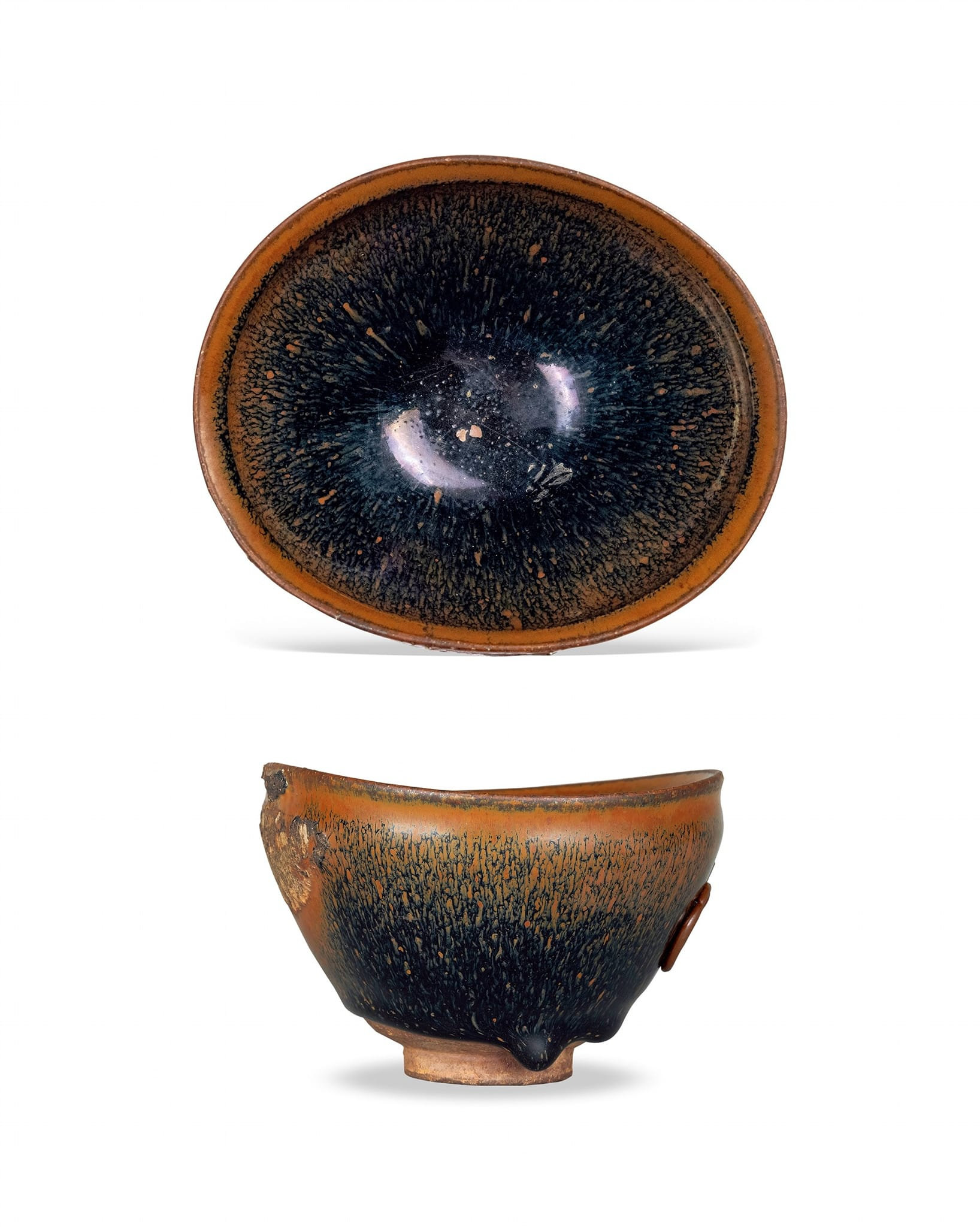

Lot 135. Yaobian Jian ware tea cup; Diameter 13cm, Height 7.5cm. Starting price: HKD 100,000. (c) Hong Kong Baopai.
Yaobian is the supreme glaze color among the "first tea vessels of the Song Dynasty". The porcelain glaze and kiln fire were extremely accidental in the extremely magical atmosphere to produce such a precious lamp. The only three complete Song Dynasty obsidian lamps that still exist in the world are all in Japan and are regarded as national treasures.
The shape of this lamp changed due to the unstable temperature of the kiln. However, the iridescence of the lamp is consistent with the obsidian changes of the three national treasures. It is worthy of being the most special and rare variety among the built-in lamps.

Lot 161. Ding carved lotus basin; Diameter 35cm. Starting price: HKD 150,000. (c) Hong Kong Baopai.
This product is a large basin from Ding kiln in the Northern Song Dynasty. Its diameter is 35 cm, which reflects the unique "large and delicate, large and elegant" style of Ding kiln. The body of the vessel is light and thin, with brass edges and refined carvings. The lotus in the basin emerges from the mud but remains unstained, recreating elegance pursued by the literati of the Song Dynasty. It is similar to the best collection of Shanghai Museum.


/image%2F1371349%2F20260520%2Fob_1d99d0_13608.jpg)
/image%2F1371349%2F20250502%2Fob_2e7960_592abe02-c683-41cc-bbe6-3ee741441556.png)
/image%2F1371349%2F20250426%2Fob_c479cc_image-9.jpg)
/image%2F1371349%2F20240616%2Fob_f792b6_image-3.jpeg)