

/https%3A%2F%2Fprofilepics.canalblog.com%2Fprofilepics%2F1%2F0%2F100183.jpg)
/https%3A%2F%2Fstorage.canalblog.com%2F03%2F02%2F119589%2F96711876_o.jpg)
/https%3A%2F%2Fstorage.canalblog.com%2F11%2F31%2F119589%2F94773502_o.jpg)
/https%3A%2F%2Fstorage.canalblog.com%2F20%2F83%2F119589%2F94772815_o.jpg)
/https%3A%2F%2Fstorage.canalblog.com%2F26%2F72%2F119589%2F75604929_o.jpg)
/https%3A%2F%2Fstorage.canalblog.com%2F59%2F60%2F119589%2F26458628_o.jpg)


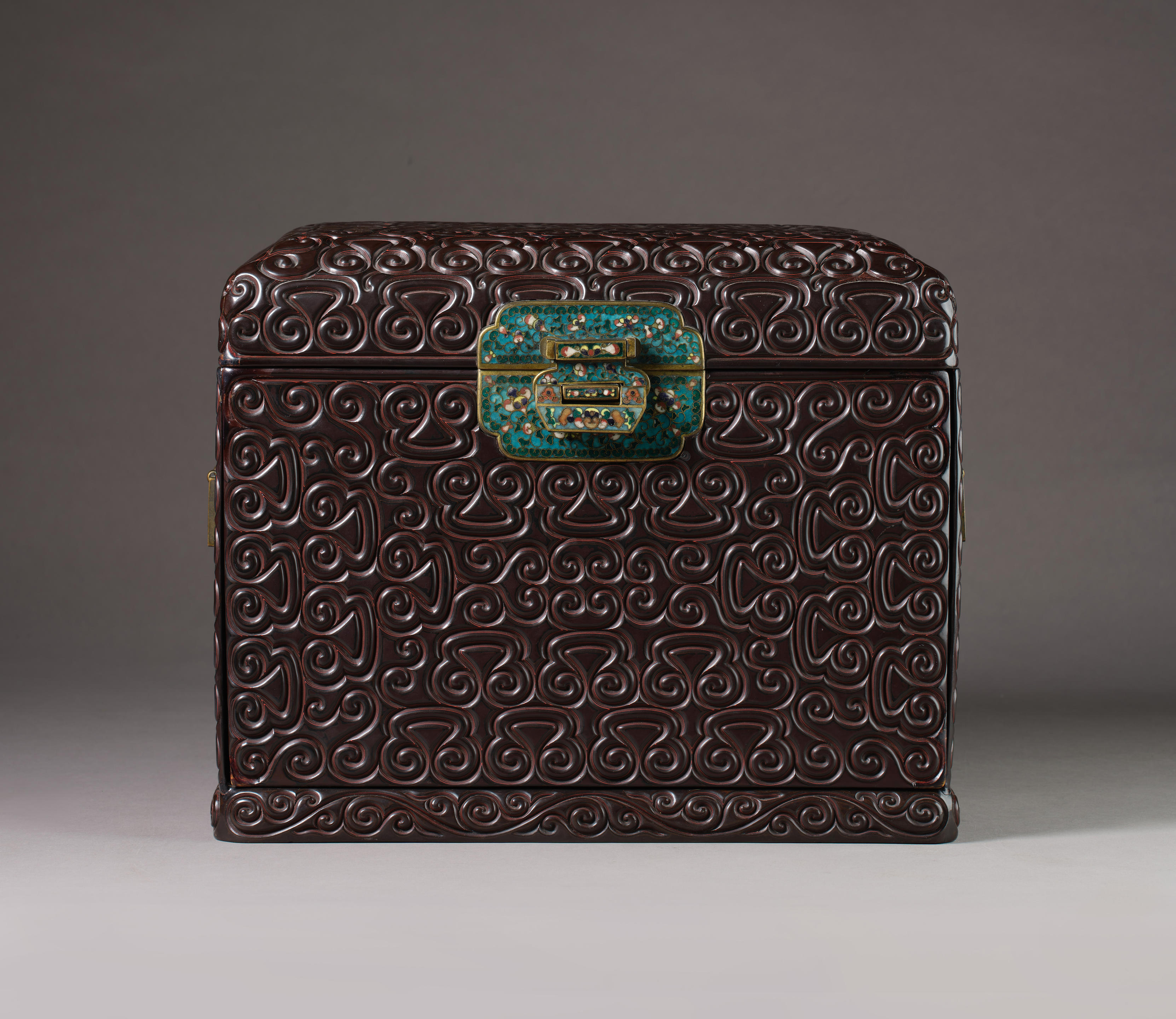

The chest of rectangular form rising from a protruding curved foot to a rounded flat top opening to a single tray, above a single-panel door revealing a pair of drawers of same size, masterfully and densely carved to the exterior through alternating layers of black and thinly layered cinnabar red lacquer with ruyi-shaped pommels, set with cloisonne enamel fittings including a quatrelobed lock-plate, a ruyi-form clasp, two drawer pulls and a pair of handles on both sides, the interior lacquered black. (2)
Provenance: Christie's New York, 19-20 February 2014, lot 260
A distinguished Asian private collection.
Note: It is remarkably rare to encounter a chest of this form in lacquer. Lacquerware with such decoration is more typically seen on smaller tableware such as trays or dishes, perhaps due to the increasing structural challenges. The impressive size and elaborate carving of the lavish tixi pattern in the present lot would have required a significant degree of labour, demonstrating a high level of craftsmanship achieved in lacquer production during the Ming dynasty.
Table cabinets of this type are also referred to as seal chests, which were used as dressing cases by both men and women to store toiletries, or they were used on desks for storage of stationary, writing implements and seals. Called guanpixiang, official boxes, their form and construction with its multiple drawers and sometimes trays resembles a cabinet rather than a box, and they were more often made in huanghuali or zitan set with metal fittings instead of cloisonne enamels, hence further emphasising the rarity of the present lot.
See an example of a carved black and red 'guri' lacquer box and cover of smaller size, Ming dynasty, from the Baoyizhai collection, sold at Sotheby's Hong Kong, 7 April 2014, lot 41. Another smaller example of a cinnabar lacquer 'guri' chest, Ming dynasty, was sold at Sotheby's Hong Kong, 8 October 2008, lot 2588.
Bonhams. FINE CHINESE CERAMICS AND WORKS OF ART, 29 November 2023, Hong Kong, Admiralty


/image%2F1371349%2F20260301%2Fob_13a595_1000055342.jpg)
/image%2F1371349%2F20240409%2Fob_4f7d28_2024-nyr-22642-0904-000-a-small-jichim.jpg)
/image%2F1371349%2F20240409%2Fob_1dca7b_2024-nyr-22642-0901-001-a-small-longya.jpg)
/http%3A%2F%2Fstorage.canalblog.com%2F41%2F83%2F119589%2F133343511_o.jpg)