

/https%3A%2F%2Fprofilepics.canalblog.com%2Fprofilepics%2F1%2F0%2F100183.jpg)
/https%3A%2F%2Fstorage.canalblog.com%2F03%2F02%2F119589%2F96711876_o.jpg)
/https%3A%2F%2Fstorage.canalblog.com%2F11%2F31%2F119589%2F94773502_o.jpg)
/https%3A%2F%2Fstorage.canalblog.com%2F20%2F83%2F119589%2F94772815_o.jpg)
/https%3A%2F%2Fstorage.canalblog.com%2F26%2F72%2F119589%2F75604929_o.jpg)
/https%3A%2F%2Fstorage.canalblog.com%2F59%2F60%2F119589%2F26458628_o.jpg)
Ancient Greek helmets to be sold at Christie’s New York, 30 January 2024


Lot 2. A Greek bronze Corinthian helmet, late Archaic to early Classical period, c. 525-475 BC; 28.7 cm high. Estimate: USD 300,000 – USD 500,000. © Christie's Image Ltd 2023
Provenance: with The Merrin Gallery, New York.
Private Collection, New York, acquired from the above, circa late 1980s-early 1990s.
with Chubb Ltd., New Jersey, 1995.
Private Collection, U.S., acquired from the above at auction, late 1990s.
Antiquities, Christie’s, New York, 11 June 2003, lot 108.
Private Collection, U.S., acquired from the above.
with Christie's Private Sales, New York and London.
Acquired by the current owner from the above, 2010.
Literature: M. Burns, "Graeco-Italic Militaria," in M. Merrony, ed., Mougins Museum of Classical Art, Mougins, 2011, p. 198, fig. 48.
N. Nussbaum, "Á Mougins, les casques gréco-romains racontent les guerres antiques," Nice-Matin, 24 May 2015, p. 35.
V. Torres-Hugon, "Hoplite, le premier guerrier de l'histoire," Antiquité (special edition), Autumn 2017, p. 20.
V. Torres-Hugon, Hoplite: Le premier guerrier de l'histoire, Saint-Martin-des-Entrées, 2018, p. 20.
R. Hixenbaugh, Ancient Greek Helmets: A Complete Guide and Catalog, New York, 2019, pp. 261, 426, 637, no. C669.
V. Torres-Hugon, "Présentation des casques des Hoplites grecs!," (Histoire d'aimer, online video, youtube.com, 2019).
Exhibited: Musée d'Art Classique de Mougins, 2011-2023 (Inv. no. MMoCA495).
Note: With the slender nose-guard, elongated almond-shaped eyes and gracefully-curving cheek-guards, this highly stylized helmet exemplifies the Hermoine type. Named after a helmet excavated in the coastal town of Hermoine on the Argolid peninsula, it is the paragon of the Corinthian helmet type—in aesthetics and protection—and is frequently depicted on Greek vases and Classical sculptures and coins.
Beginning circa 550 B.C., the Hermoine type is categorized by high-quality manufacturing, a product of the Greek mainland as compared to the more austere alternative made in the contemporary South Italian workshops. The helmet was the culmination of three centuries of Greek armour smith experience and provided heightened protection for the warrior. Notable features include a larger dome and a closely-fitting lower half separated by a carinated ridge, meant to provide room at the top to further protect the warrior’s skull from a deadly blow. As Hixenbaugh explains, this specialization required the helmet “to be carefully cast, repeatedly annealed and carefully cold worked to achieve the desired form” (op. cit., p. 199) The type was worn by hoplites and provided maximum protection for him when united in a phalanx, promoting unity rather than individuality. With the entire warrior’s face hidden, he exemplified power and virility (Hixenbaugh, op. cit., pp. 199-200).
For other examples of the type, see nos. C664-C716, pp. 425-432 in Hixenbaugh op. cit.


Lot 8. A Greek bronze Chalcidian helmet, late Archaic to early Classical period, c. 500-400 BC; 27.3 cm high. Estimate: USD USD 30,000 – USD 50,000. © Christie's Image Ltd 2023
Provenance: Axel Guttmann (1944-2001), Berlin, acquired in Munich, 1994 (Inv. no. H322).
Antiken der Sammlung Axel Guttman, Auktion 54, Hermann Historica, Munich, 11 April 2008, lot 321.
Acquired by the current owner from the above.
Literature: M. Burns, "Graeco-Italic Militaria," in M. Merrony, ed., Mougins Museum of Classical Art, Mougins, 2011, p. 202, fig. 65.
V. Torres-Hugon, "Hoplite, le premier guerrier de l'histoire," Antiquité (special edition), Autumn 2017, p. 64.
V. Torres-Hugon, Hoplite: Le premier guerrier de l'histoire, Saint-Martin-des-Entrées, 2018, p. 64.
R. Hixenbaugh, Ancient Greek Helmets: A Complete Guide and Catalog, New York, 2019, pp. 454, 657, no. X58.
Exhibited: Musée d'Art Classique de Mougins, 2011-2023 (Inv. no. MMoCA168).
Note: This helmet is an elegant expression of the early Chalcidian type. Its dynamic form features a carinated ridge around the dome that rises to a peak above the forehead. The rounded check-guards and thin nose-guard permit a broad opening for the eyes. The top of the dome preserves the remains of a crest-holder, and soldering around the perimeter indicates a now-missing decorative band. Notably, the brow features a striking horn-shaped motif.
Helmets of this type have been found across the ancient Mediterranean, including from sites as far afield as Targovishte, Bulgaria, Olympia and Sicily (see Hixenbaugh, op. cit., p. 454). For a nearly identical example from Olympia, see p. 61, no. 17 in P. Connolly, Greece and Rome at War.
Of interest is the horned-shaped repoussé line above the eyes. While traditionally thought to represent stylized eyebrows, more recent scholarship has challenged this notion. As Hixenbaugh notes (op. cit., p. 223), the Greek bronze smith occasionally included recognizable facial hair on helmets, indicating that the realistic reproduction of hair, including eyebrows, was possible. In contrast, Hixenbaugh writes, “these curvilinear lines…do not give one the impression of eyebrows. Rather they look like abstract thin curled horns. It is much more likely they represent ram or bull horns. They also suggest the horns of the god Pan, who was thought to spread panic on the battlefield. Like the charging bull, the tenacious bucking of caprids would have been familiar to anyone close to the land.”


Lot 14. A Greek tinned bronze Chalcidian helmet, late Classical to Helenistic period, c. 350-200 BC; 31.7 cm high. Estimate: USD USD 50,000 – USD 70,000. © Christie's Image Ltd 2023
Provenance: Private Collection, Germany, acquired by the early 1990s.
with Wolfgang Wilhelm, F.A.C. Kunsthandel, Frankfurt.
with Royal-Athena Galleries, New York, acquired from the above, 2005 (Art of the Ancient World, vol. XVIII, 2007, no. 81).
Acquired by the current owner from the above, 2008.
Literature: D. Sim and J. Kaminski, Roman Imperial Armour: The Production of Early Imperial Military Armour, Oxford, 2011, p. 123, pl. 7.
M. Burns, "Graeco-Italic Militaria," in M. Merrony, ed., Mougins Museum of Classical Art, Mougins, 2011, p. 203, fig 67.
R. Hixenbaugh, Ancient Greek Helmets: A Complete Guide and Catalog, New York, 2019, p. 480, no. X271.
Exhibited: Musée d'Art Classique de Mougins, 2011-2023 (Inv. no. MMoCA155).
Note: This exceptional helmet is features a peaked dome, carinated ridge, short nose-guard and hinged scalloped cheek-guards. It is formed from hammered bronze sheet and then tinned, providing it with a beautiful silvery hue. It is rare for a helmet to preserve its original tinned surface, providing us a glimpse to how helmets would have appeared to warriors nearly 2,500 years ago.
This example belongs to Pflug’s Chalcidian Type V (Kunze-Gruppe VII; see “Chalkidische Helme,” in A. Bottini, et al., eds., Antike Helme). Several similar examples of this type have been found in the northern Black Sea area (see pp. 480-481 in Hixenbaugh, op. cit.).


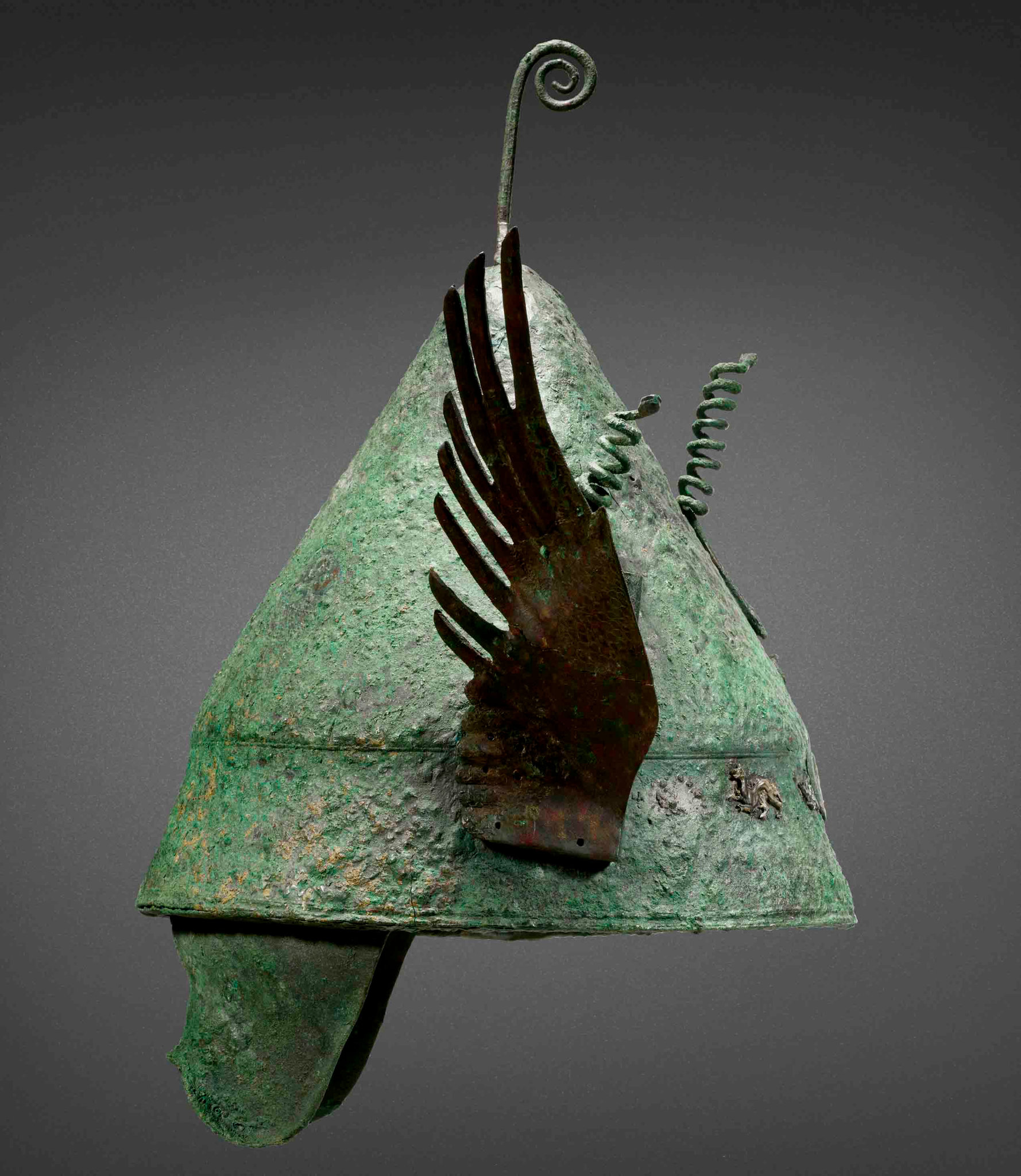


Lot 22. A Greek bronze Pilos helmet with wings, Magna Graecia, Classical to Hellenistic period, c. 400-200 BC; 30.6 cm high. Estimate: USD USD 50,000 – USD 70,000. © Christie's Image Ltd 2023
Provenance: Axel Guttmann (1944-2001), Berlin, acquired in Freiburg, 1988 (Inv. no. AG279/H61).
Antiken der Sammlung Axel Guttman, Auktion 54, Hermann Historica, Munich, 11 April 2008, lot 345.
Acquired by the current owner from the above.
Literature: Sammlung Axel Guttmann, Antike Helme Kalender, 1991 (cover).
H. Born, Restaurierung antiker Bronzewaffen: Sammlung Axel Guttmann, vol. 2, Mainz, 1993, p. 12, fig. 4.
M. Burns, "Graeco-Italic Militaria," in M. Merrony, ed., Mougins Museum of Classical Art, Mougins, 2011, p. 208, fig. 79.
R. Hixenbaugh, Ancient Greek Helmets: A Complete Guide and Catalog, New York, 2019, p. 530, no. H229.
Exhibited: Musée d'Art Classique de Mougins, 2011-2023 (Inv. no. MMoCA171).
Note: This elaborate conical helmet has a separately-made neck-guard soldered to the back of the offset rim. Notable embellishments include a spiral plume-holder at the peak, three snake-headed, coiled plume-holders rivetted on the sloping dome, and two wings with incised overlapping feathers and tubular plume-holders at the join. Below the central coiled plume is a silver rosette plate supporting a suspension ring. Centered on the carinated ridge is a gorgoneion applique, flanked by small silver lion-griffin appliques.
For another helmet with wings and snake-headed coiled plume-holders but of a Chalcidian type, see no. W 24a, pp. 55-56 in D. Cahn, Waffen und Zaumzeug.
Christie’s. Arms and Armour from the Mougins Museum of Classical Art, Part I, New York, 30 January 2023


/https%3A%2F%2Fstorage.canalblog.com%2F30%2F60%2F119589%2F41063150_o.jpg)
/image%2F1371349%2F20260201%2Fob_09ca36_1000050853.jpg)
/image%2F1371349%2F20251231%2Fob_6cc2bc_1000046227.jpg)
/image%2F1371349%2F20250704%2Fob_5805fe_1000022449.jpg)