


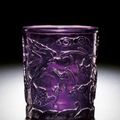
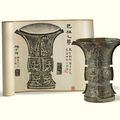


A very rare bronze ritual food four-legged vessel, gui, Early Western Zhou Dynasty


Lot 1051. A very rare bronze ritual food four-legged vessel, gui, Early Western Zhou Dynasty, 11th-10th century BC; 29 cm across handles. Price realised USD 76,800 (Estimate USD 10,000 – USD 15,000) © Christie's Images Ltd 2026
The interior of the vessel is cast with a five-character inscription reading gong bo zuo qi X, which may be translated as "Duke Gong made this vessel for his wife X."
Provenance: The Collection of Mr. (1874-1956) and Mrs. Leo S. Bing (1901-2003), Los Angeles, before 1976.
Christie's New York, 24 March 2004, lot 109.
Exhibited: Los Angeles, Los Angeles County Museum of Art, Ancient Ritual Bronzes from China, 3 February-25 April 1976, no. 28.
Note: The addition of legs to bronze gui vessels appeared in the latter half of the early Western Zhou period and continued into the middle Western Zhou. In such vessels, the legs may descend either from the lower terminals of the handles or from the base of the ring foot. For a discussion of this distinctive stylistic feature, see J. Rawson, Western Zhou Ritual Bronzes from the Arthur M. Sackler Collections, vol. IIB, Arthur M. Sackler Foundation, 1990, pp. 468-69. Two related legged gui, in which the legs similarly extend from the lower ends of the handles, are illustrated ibid., fig. 61.4, the Chen Chen Fu Yi gui in the Harvard University Art Museums, no. 1944.57.8, and fig. 61.6, the Ban gui, after Wenwu, no. 9, 1972, p. 12.
A very similar gui raised on four legs is illustrated in Yenching Journal of Chinese Studies: The Bronzes of Shang and Chou, vol. II, Beijing, 1941, pl. 163, no. 303. In the illustration, the vessel is shown with a domed cover surmounted by a circular handle and encircled by a decorative band similar to that on the body. A further example of this rare type, though different in design, with legs issuing from beneath the four loop handles and formerly in the Qing Court Collection, was sold at Christie’s Hong Kong, 28 April 2003, lot 624.
The character qi 妻 (wife) in the inscription is particularly noteworthy. In bronze inscriptions, references to a female figure or wife more commonly employ the characters mu 母 or nü 女, whereas the use of qi is quite rare. For a ding bearing an inscription that similarly incorporates the character qi 妻, see the Zhe ding, formerly in the collection of the celebrated Qing-dynasty antiquarian Liu Xihai (1793-1852) and now in the Shanghai Museum, documented by Liu Xihai in Chang’an huogu bian (Records of Antiquities Acquired at Chang’an), 1905, vol. 1, no. 3.
The result of Oxford Authentication Ltd. thermoluminescence test no. C103215 is consistent with the dating of this lot.
Christie's. Important Chinese Art Including Ceramics from the Art Institute of Chicago, New York, 17/18 September 2026


