

/https%3A%2F%2Fprofilepics.canalblog.com%2Fprofilepics%2F1%2F0%2F100183.jpg)
/https%3A%2F%2Fstorage.canalblog.com%2F03%2F02%2F119589%2F96711876_o.jpg)
/https%3A%2F%2Fstorage.canalblog.com%2F11%2F31%2F119589%2F94773502_o.jpg)
/https%3A%2F%2Fstorage.canalblog.com%2F20%2F83%2F119589%2F94772815_o.jpg)
/https%3A%2F%2Fstorage.canalblog.com%2F26%2F72%2F119589%2F75604929_o.jpg)
/https%3A%2F%2Fstorage.canalblog.com%2F59%2F60%2F119589%2F26458628_o.jpg)
Jacques Stella (Lyon 1596-1657 Paris) - La Sainte Famille / The Holy Family
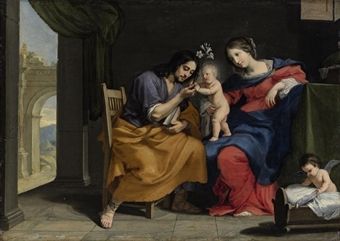
Jacques Stella (Lyon 1596-1657 Paris) - La Sainte Famille / The Holy Family
signed and dated 'J· Stella fecit 1637' (lower left) - oil on copper - 11¾ x 16¾ in. (29.9 x 42.5 cm.) - Estimate: £250,000 - £350,000 ($495,750 - $694,051)
Provenance : - Ranuccio Scotti (1597-1659), Bishop of Borgo San Donnino.
- sale, Paillet Delaroche, Boileau, Paris, 24 June 1799, lot 17, as 'J. Stella, Un sujet de la Saint-Famille dans un beau fond d'architecture, petit Tableau très-précieux de cet habile maître. Les amateurs verront, sans doute, avec intérêt cette composition qui réunit à la noblesse des caractère le coloris le plus brilliant & la plus parfaite conservation, sur cuivre, larg
- Prince Fredrik Adolf of Holstein-Gottorp (1750-1803), Duke of Östergötland, Tullgarn Castle, Sweden; [presumably] (+) sale, Stockholm, 1805.
- Count Fredrik Wilhelm Ridderstolpe (1730-1816).
- Captain Johan Ernst Hagdahl (1836-1906); his sale, Bukowski's, Stockholm, 14 April 1886, lot 601 (to Alfred Brinck (1830-1913); Bukowski's, Stockholm, 14 December 1921 [=1st day], lot 100;
- Swedish private collection until 2007.
Literature : Bouppteckning efter H.K.H. Hertigen af Östergötland Fredrich Adolph [Inventory of Duke Fredrik Adolf's deceased estate], Tullgarn Castle 14 December 1805, under 'I husgeradskammaren', as 'Sainte Famille et un Ange, peint sur cuivre', where valued at 100 Riksdaler (MS. Riksarkivet und Kammarkollegium, Stockholm; published by Wrangel, see infra).
F.U. Wrangel, Svenska Kungsgardar [Swedish Royal Castles] I, Tullgarn, Stockholm, 1888, p. 97.
Nordisk Familjebok Konversationslexikon Realencyclopedi, 26, Stockholm, 1917, p. 1198 (under Stella, Jacques).
O. Granberg, Svenska konstsamlingarnas historia [The History of Swedish Art Collections]. Fran Gustav Vasas tid till vara dagar, III, Gustav III-Karl XIII, Stockholm, 1931, p. 35.
J. Thuillier, Jacques Stella 1596-1657, Paris, 2006, p. 109.
Engraved : Gilles Rousselet (1616-1686), before c. 1641, with a dedication to Ranuccio Scotti (1597-1661) (see V. Meyer, L'Oeuvre gravé de Gilles Rousselet, Paris, 2004, p. 36, no. 34, illustrated) (see fig. 1).
Notes : This recently rediscovered, beautifully preserved Holy Family painted on copper in 1637, is a masterly example of the ability of the Lyon-born artist, Jacques Stella (fig. 2) to combine a delightful sense of intimacy with a strong sense of grace and refinement, communicated through a vivid use of luminous colour and elegance of composition.
In the 17th century, Stella was as highly regarded as his friend Nicolas Poussin, as well as Vouet and Champaigne, and in his lifetime was much in demand as a painter; his compositions were turned into engravings by the greatest printmakers of the day, Mellan, Rousselet and Daret. The son of François Stellaert (1563-1605), a painter and dealer of Flemish origin, Jacques Stella went in 1619 to Florence, where he worked for Cosimo II de' Medici, Grand Duke of Tuscany, and met Poussin. In Florence he came under the influence of artists such as Jacques Callot and Jacopo Ligozzi. By 1623, he was in Rome, where he stayed for 10 years and where his friendship with Poussin was to grow and where he was to come into contact with the art of Raphael, Domenichino and the Carracci, discovering a taste for realistic detail. In 1634 Stella returned to France in the retinue of the French Ambassador in Rome, Charles de Créqui. He was in fact destined for the Spanish Court in Madrid, but was retained in France by Cardinal Richelieu, who housed him in the Louvre and named him peintre ordinaire du roi. Richelieu was at that time organising what was effectively an artistic revolution: paralleling the political goals of the king with one to establish France's cultural supremacy in Europe. To do this, he planned to import Italian artistic heritage to France and recast it in a French mould. In this, Richelieu collaborated with François Sublet de Noyers, surintendant des arts and together they brought back from Rome both Stella and Poussin, among other French artists, to set the standard of this new aesthetic. In 1637, the year that the present work was painted, Poussin executed for Stella his Armida carrying the body of Rinaldo (Gemäldegalerie, Berlin) and a Hercules and Deianeira (now lost).
For much of his career Stella painted on a relatively modest or small scale format, often using different types of precious supports such as marble, lapis, slate or, as here, copper. In this he picked up on the technique of Italian artists whose work he had seen, and in particular Cavaliere d'Arpino, from whom he also developed his characteristic way of depicting his Virgins and Saints in what Sylvain Laveissière describes as 'le type féminin' (catalogue of the exhibition, Jacques Stella (1596-1657), Lyon and Toulouse, 2007, p. 14).
The luminosity that Stella achieves in this Holy Family on copper, consists of a strong light source beaming in from a partly obscured window in the upper right hand corner of the picture that casts a shadow on the stone floor, and leads the eye beyond the draped doorway on the left to the sight of an exquisite classical arch, which in its treatment suggests the architectural paintings of Jean Lemaire, whom Stella would surely have known in Rome. Indeed it is not inconceivable (albeit unlikely) that Lemaire executed this corner of the picture, (the latter had returned to Paris by 1638). The colouring and tonality of the picture makes one think perhaps of Raphael, but more strikingly of the work of his contemporary Philippe de Champaigne and in particular his monumental large scale Marriage of the Virgin now in the Wallace Collection. The dating of the latter is disputed but it is unlikely to have been executed before the present copper panel and it is quite possible that Stella influenced the art of Champaigne in such a work. Indeed, as pointed out by Thuillier (loc. cit.), the Holy Family must have been quite celebrated, as several 17th century copies after it are known, and it was engraved before 1641 by Gilles Rousselet (1616-1686).
If Stella can be considered an artist who looked at and learned closely from the work of other great artists, his work at this stage in his career, is unmistakably his own. This picture represents a wonderful synthesis of all he had learned by 1637, but also marks a new, highly classicizing phase in his oeuvre. Perhaps better than any, Laveissière's comment on Stella in relation to another painting would seem perfectly appropriate to the present one, namely that he is 'maître d'un style d'une rare élégance, éloquent sans emphase, rigoureux sans sécheresse, propre à satisfaire la raison autant qu'à plaire aux yeux' (op. cit., p. 109).
The Rousselet engraving after this picture was dedicated to Ranuccio Scotti (1597-1661), Bishop of Borgo San Donnino, near Parma, and it is thus quite likely that the picture was owned by him (see fig. 3). Scotti was Pope Urban VIII's ambassador to France between 1639 and 1641, and his extensive correspondence of this time is published (Correspondence du nonce en France Ranuccio Scotti 1639-41, Rome, 1965).
The picture appeared in a sale at Bukowski's in Stockholm in 1921. Its Swedish history however dates back to before 1803 when it was recorded in the collection of Prince Fredrik Adolf of Holstein-Gottorp (1750-1803), Duke of Östergötland, King Gustav III's yougest brother. The prince probably acquired the picture in 1799, perhaps through Carl Fredrik Fredenheim (1718-1803), the Director of the Kongl. Museum, (the precursor of the Nationalmuseum) who assisted him with his purchasing. In June that year the picture had come up for sale in Paris. According to a note in the sale catalogue it had been consigned from 'l'étranger', perhaps from Italy by one of the Scotti family?
In the Bukowski's sale catalogue of 1886, when it was also offered, the picture was described as the artist's best work and the jewel of Prince Fredrik Adolf's collection. The latter was housed at Tullgarn Castle, acquired on his behalf in 1772 by the Swedish parliament. The Prince was a keen collector and supporter of the Swedish Royal Academy. Although relatively little is known about his collection, some works remain at Tullgarn and others can be seen in the Nationalmuseum, Stockholm, including Judith Leyster's celebrated Flute Player. A copy after the present picture, which, according to Michael Ahlund, is almost certainly by Anders Hultgren (1763-1838), one of several Swedish artists employed by the Prince at Tullgarn, recently appeared in a sale in Stockholm.
Christie's London. 8 July 2008. OLD MASTER & BRITISH PICTURES (EVENING SALE)


/image%2F1371349%2F20260918%2Fob_d25b31_37267.jpg)
/image%2F1371349%2F20260918%2Fob_09cd50_37268.jpg)
/image%2F1371349%2F20260918%2Fob_d7af4c_37239.jpg)
/image%2F1371349%2F20260918%2Fob_ad6edc_37238.jpg)