

/https%3A%2F%2Fprofilepics.canalblog.com%2Fprofilepics%2F1%2F0%2F100183.jpg)
/https%3A%2F%2Fstorage.canalblog.com%2F03%2F02%2F119589%2F96711876_o.jpg)
/https%3A%2F%2Fstorage.canalblog.com%2F11%2F31%2F119589%2F94773502_o.jpg)
/https%3A%2F%2Fstorage.canalblog.com%2F20%2F83%2F119589%2F94772815_o.jpg)
/https%3A%2F%2Fstorage.canalblog.com%2F26%2F72%2F119589%2F75604929_o.jpg)
/https%3A%2F%2Fstorage.canalblog.com%2F59%2F60%2F119589%2F26458628_o.jpg)
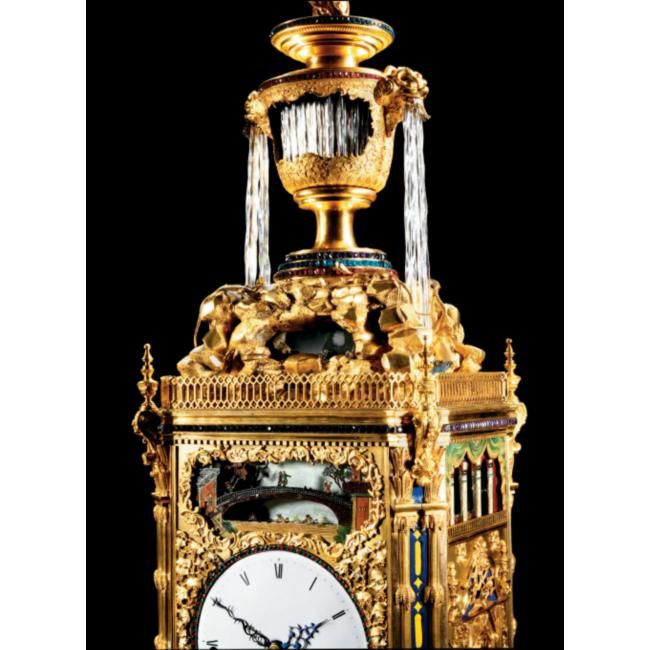
A magnificent and imperial tribute gilt-brass musical and automaton table clock. Qing dynasty, Qianlong period

A magnificent and imperial tribute gilt-brass musical and automaton table clock. Qing dynasty, Qianlong period. Photo Courtesy Sotheby's
6 3/4 inch dial with well pierced gilt-steel hands and paste-set bexel, a painted automaton scene above galleons sailing through choppy water while equestrian figures pass by on a bridge above flanked by trees and chinoiseries figures against a mirrored background, the principal three train fusee movement with six pillars, verge escapement, bell striking and playing one of six tunes on nine bells with twelve hammers, the blackplate engraved with Neo-Classical decoration, a further fusee movement above for driving the automaton work at the sides and on the upper section of the vase, the museum and automaton work released at will or at the conclusion of the hour strike, the richly gilded case surmounted by a gilt tree a cover a chased urn set with bands of coloured pastes and open at the front to reveal waterfall rods, flanked by grotesque mask fountain spouts with further waterfall rods, the whole raised on a rockwork base with lizards on the upper corners and a mirrored aperture at the front with automaton figures passing by, the whole within a formal balustrade, the rectangular central section set with a band of further pastes, overlaid at the front, around the dial, with a fruiting vine mask, angled corners set, at the top, with elaborate corbels and urn finials and inset with blue-painted metal frets, the sides decorated with faux doors with elaborate pediments below mirrored apertures with columns and a painted proscenium arch within which further figures pass by, the rear similarly decorated and with a door giving access to the mechanism, a frieze of chinoiserie fret on a red ground around the base, the whole within a further balustrade with urn corner finials, the plinth decorated with foiled glass roundels within a leaf scroll frieze and raised on elephant feet divided by swags of fruit; with a red painted wood stand with a gilt-brass gadrooned border, raised on paw feet, keys - 103 cm., 40 1/2 in. - Lot Sold: 7,220,000 HKD

NOTE: The Chinese craftsmen who produced this magnificent clock may have been inspired by the fabulous musical and automaton clocks commissioned by the English entrepreneur James Cox which were exported to various Far East destinations during the second half of the 18th century. In China, traders from overseas were not allowed to sell their goods directly but had to go through an agent. James Cox and his son John Henry had a resident agent in Canton, the merchant Thomas Dickinson, and it is possible, in some instances, that clock movements were made in London and exported to China where they were cased to the design of Cox. Although James Cox's fortunes had declined during the 1770s culminating in bankruptcy, he re-established his business with the help of his son and set up business premises at Canton in 1783 which flourished for a number of years. The present clock has a movement that is certainly English in style though the case is undoubtedly Chinese; by the late 18th century the Chinese clockmakers had become expert at making clock movements in the English manner and it can sometimes be difficult to identify the origin of a particular movement. Research is further complicated as, during the Qing Dynasty (1644-1911), it was forbidden for makers to sign their products and this has proved to be a great frustration to researchers attempting to discover the origin of the many rare musical and automaton clocks that have been found in China.
The Emperor Qianlong (1736-95) had a large collection of clocks in his palaces, many presented by visiting dignitaries in the hope of promoting trade with China. The musical and automaton clocks came to be known as 'sing-songs' since they were primarily valued as amusing toys rather than fine timekeepers. Sadly many of the clocks were badly damaged or destroyed during several turbulent periods in the history of China, particularly during the looting of the Forbidden City in the early 1900's. Of the clocks that survived, many were damaged by unskilled clockmakers who found it easier to remove troublesome musical and automaton features rather than attempt to restore them.
The present clock is remarkable in that it has come down through the years in mostly good condition and still retains the original fire gilding. The eye-catching performance of revolving waterfall rods, ships sailing along and figures passing by, on the front and the sides, to the accompaniment of a choice of four musical tunes can still serve to amuse and astonish the present day connoisseur, just as much as it would have done over two hundred years ago, when the clock was made.
This clock does not appear to have been published but similar clocks may be seen: Derek Roberts, Mystery, Novelty & Fantasy Clocks, Schiffer 1999, chapter 15; Arthur Ord-Hume, The Musical Clock, Mayfield 1995, chapter 9; Antiquarian Horology, Summer 1991, pgs 367-387; Simon Harcourt-Smith The Palace Museum, Peiping, 1933.
Perhaps the most similar clock to the present example was in the Ionides Collection at Buxted Park, England; it had a large three-train movement with white enamel dial, many revolving waterfall rods and passing figures, the clock was of a similar height. Illustrated Antiques July 1959, English Clocks for China, an article by John Hayward. The present whereabouts of this clock is not known. The clock chimes the hour on twelve cast bells.
Sotheby's. Legacies of Imperial Power: Treasures from the Imperial Collection. 08 Oct 08. Hong Kong - www.sotheby's.com


/http%3A%2F%2Fstorage.canalblog.com%2F75%2F76%2F119589%2F113126020_o.jpg)
/http%3A%2F%2Fstorage.canalblog.com%2F94%2F11%2F119589%2F109301310_o.jpg)
/http%3A%2F%2Fstorage.canalblog.com%2F41%2F72%2F119589%2F85932048_o.jpg)
/http%3A%2F%2Fstorage.canalblog.com%2F28%2F18%2F119589%2F65640451_o.jpg)