

/https%3A%2F%2Fprofilepics.canalblog.com%2Fprofilepics%2F1%2F0%2F100183.jpg)
/https%3A%2F%2Fstorage.canalblog.com%2F03%2F02%2F119589%2F96711876_o.jpg)
/https%3A%2F%2Fstorage.canalblog.com%2F11%2F31%2F119589%2F94773502_o.jpg)
/https%3A%2F%2Fstorage.canalblog.com%2F20%2F83%2F119589%2F94772815_o.jpg)
/https%3A%2F%2Fstorage.canalblog.com%2F26%2F72%2F119589%2F75604929_o.jpg)
/https%3A%2F%2Fstorage.canalblog.com%2F59%2F60%2F119589%2F26458628_o.jpg)
A superb and exceptionally large bamboo figure of Vijraputra and Buddhist lion cub. Mid Ming dynasty
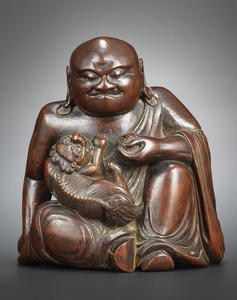


A superb and exceptionally large bamboo figure of Vijraputra and Buddhist lion cub. Mid Ming dynasty. Photo Bonhams
The outstanding figure carved from a large section of bamboo trunk, the luohan of wide stature seated atop a finely carved basket-weaved cushion, his right leg crossed and left leg pendant, the right hand stretched backwards in support and the left hand holding a ball of yarn, the body adorned in loose flowing robes draping downwards in undulating folds, swung over his left shoulders revealing bare chest and exposed right arm, his face set in an expression of deep contemplation, framed by a large round bald head flanked by a pair of pendulous earlobes suspending earrings, a little Buddhist lion depicted playing mischievously on his lap, its head turned right bearing fierce expression and thick bushy eyes with opened jaws revealing sharp teeth, the protruding spine issuing a furry mane ending in a curly trifurcated tail. 19cm high. Estimate: HK$ 5 million - 8 million / US$ 650,000 - 1 million / £400,000 - 640,000
Illustrated 出版: Arts of Asia, July-August 2005, vol.25 no.4, p.83
Notes: Bamboo carving developed into a unique art form during the Ming dynasty, when the literati class learned to appreciate these curios within their studios. Professional bamboo artists no longer confined themselves, but devoted themselves fully to the study of literati art, including poetry, calligraphy, painting and seals, forming the perfect balance of scholarly knowledge and skilful craftsmanship. No matter whether the piece is landscape or figural, each and every piece of bamboo carving no longer shared the same boundaries of other commonly found bamboo pieces. The spirit of bamboo appreciation developed into its highest form, reflecting the individual taste, integrity and inner meanings fused within the artwork.
The current figure is outstanding for its sheer size, and the uttermost care has been taken by the master craftsman in bringing Vijraputra to life.
Bonhams. 24 Nov 2012 15:00 CST Hong Kong. A Private North American Collection of Scholar's Objects


/image%2F1371349%2F20260913%2Fob_a49183_36450.jpg)
/image%2F1371349%2F20260907%2Fob_e595d5_35129.jpg)
/image%2F1371349%2F20260809%2Fob_c7ed2f_telechargement-13.jpg)
/image%2F1371349%2F20260709%2Fob_c303e5_22957.jpg)