

/https%3A%2F%2Fprofilepics.canalblog.com%2Fprofilepics%2F1%2F0%2F100183.jpg)
/https%3A%2F%2Fstorage.canalblog.com%2F03%2F02%2F119589%2F96711876_o.jpg)
/https%3A%2F%2Fstorage.canalblog.com%2F11%2F31%2F119589%2F94773502_o.jpg)
/https%3A%2F%2Fstorage.canalblog.com%2F20%2F83%2F119589%2F94772815_o.jpg)
/https%3A%2F%2Fstorage.canalblog.com%2F26%2F72%2F119589%2F75604929_o.jpg)
/https%3A%2F%2Fstorage.canalblog.com%2F59%2F60%2F119589%2F26458628_o.jpg)
A rare rectangular huanghuali table, Ming Dynasty, 17th century
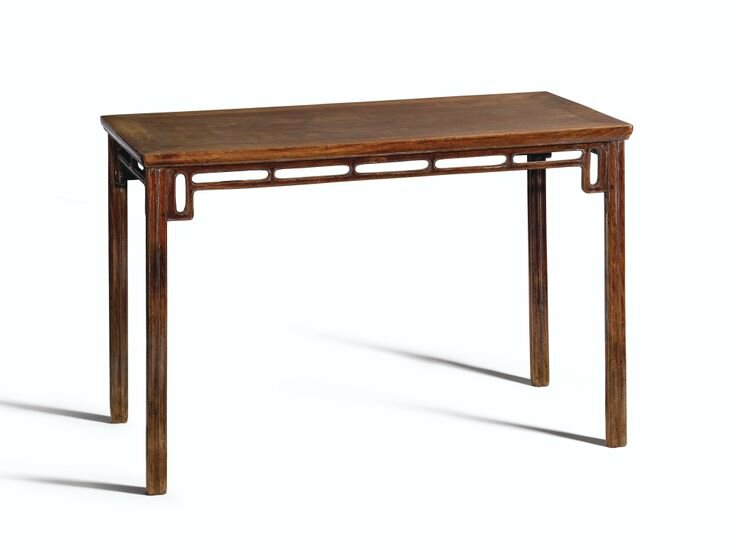


A rare rectangular huanghuali table, Ming Dynasty, 17th century. Photo: Sotheby's.
well proportioned with the framed two-board, flush floating panel supported on the underside by three transverse stretchers, the underside further covered with considerable traces of lacquer, the outer edge of the frame curving down to a concave, thumb-moulded bead on the lower edge, supported on an unusual open fretwork and spandrel with oval openings framed by beaded edges, all resting on four square-section corner legs, each with double-cushion moulding divided by a single, vertical bead, gently splayed in the front and end elevations; 80.6 by 121.3 by 60.9 cm.; 31 3/4 by 47 3/4 by 24 in. Estimation 4,000,000 — 6,000,000 HKD
Litterature: Robert Hatfield Ellsworth, Chinese Furniture: One Hundred Examples from the Mimi and Raymond Hung Collection, New York, 1996, pp. 152-153, no. 55.
Part of the ingenuity of Chinese furniture is the engineering. Chinese cabinetmakers understood the relationship between weight and adequate support and the load bearing capacity of different woods. It was likely through trial and error and experience that cabinetmakers devised solutions to support heavy loads with the use of a minimum of material.
This table exhibits the best features of a cabinetmaker’s solution to maximize load bearing ability while conserving material without sacrificing appearance. The top framework encloses several long, thinly cut boards that are held in place by braces that slide across the panels, locking them together, creating a unit that is stronger than any of the individual boards. The length of the top requires bracing to prevent the centre from sagging, and this is accomplished by a delicate openwork framework incorporating upright struts that extends across the entire lower edge of the table top, anchored into short, matching spandrels at the join of the legs. The upright struts provide additional support to further disperse weight placed on the top, but also brace the legs so the joins will not be compromised. It is an ingenious solution that is elegant, conserves material, and enhances the appearance of the table.
Aside from the striking and unusual openwork apron, this table has double-cushion-molded and beaded legs, a feature found on other finely constructed furniture. Whether this type of molded design is from the same workshop or indicative of a particular region, is unknown. Within the Hung Collection, similar molding can be found on a pair of sloping stile cabinets, a single cabinet, and a rectangular table, ibid. nos. 56, 74 and 75.
Sotheby's. The Hung Collection – A Selection of Important Chinese Furniture. Hong Kong | 08 avr. 2014 - www.sothebys.com


/image%2F1371349%2F20260728%2Fob_fb19da_26960.jpg)
/image%2F1371349%2F20250915%2Fob_def661_telechargement-41.jpg)
/image%2F1371349%2F20250904%2Fob_a8fe96_1000029863.jpg)
/image%2F1371349%2F20250904%2Fob_81a1d3_1000029861.jpg)