

/https%3A%2F%2Fprofilepics.canalblog.com%2Fprofilepics%2F1%2F0%2F100183.jpg)
/https%3A%2F%2Fstorage.canalblog.com%2F03%2F02%2F119589%2F96711876_o.jpg)
/https%3A%2F%2Fstorage.canalblog.com%2F11%2F31%2F119589%2F94773502_o.jpg)
/https%3A%2F%2Fstorage.canalblog.com%2F20%2F83%2F119589%2F94772815_o.jpg)
/https%3A%2F%2Fstorage.canalblog.com%2F26%2F72%2F119589%2F75604929_o.jpg)
/https%3A%2F%2Fstorage.canalblog.com%2F59%2F60%2F119589%2F26458628_o.jpg)
“Murano.Milano. Venezia.Glass” at The Design Museum

Carlo Scarpa for Venini, Vase "Cinese", c. 1940, XXII Biennale di Venezia, 1940, Sammlung Holz, Berlin. Photo: Atelier Martin Adam, Berlin.
The international exhibitions held at the Triennale di Milano and the Biennale di Venezia are barometers of the most significant developments in twentieth century contemporary design and art. It is therefore no coincidence that Murano glass regularly attracts awards at both Milan and Venice. Having resurrected a range of centuries-old techniques, glassmakers such as A.V.E.M, Archimede Seguso, Barovier & Toso, and Venini learned to apply this knowledge in new and ingenious ways. Their work is a synthesis of the master glassmakers’ craftsmanship and the designers’ artistry. The objects they create attest to a successful renaissance of glass design that continues to the present day.

Alfredo Barbini, Objects "Vetro Pesante" (installation view), c. 1962, XXXI. Biennale 1962, Sammlung Holz, Berlin. Photo: Anna Seibel.
"...Murano is the embodiment of Italian glass design. Venice had advanced to being a centre for Middle European glass art as early as the 13th century and when the entire glass production was moved to the neighbouring islands, glass from Murano gained world-wide importance from the 14th century onwards. As the Republic of Venice's power dwindled, glass production on Murano also declined. Yet it was revived during the 19th century and enjoyed another peak in the 1950s and early 1960s."(Angelika Nollert, director of Die Neue Sammlung at preface of published book/catalogue of the exhibition )

Artisti Barovier, Chalice "Calice a spiral", c. 1895, I Biennale di Venezia, 1895, Sammlung Holz, Berlin. Photo: Atelier Martin Adam, Berlin.
“Calice a spirale”, an object from the Artisti Barovier factory, is one of the oldest pieces. The cup on a spiral-shaped base went on display during the very first Venice Biennale in 1895. While the glass objects realized prior to the First World War were typically designed by the factories themselves, from the 1920s on designers and artists were brought in to decide the shape and appearance of objects. Collaborating closely with the glass-makers enabled them to explore the creative and technical scope glass afforded. Indeed, opaque vessels by architect Carlo Scarpa inspired by Chinese vases stand for a new design idiom as championed by the Venini glass factory.
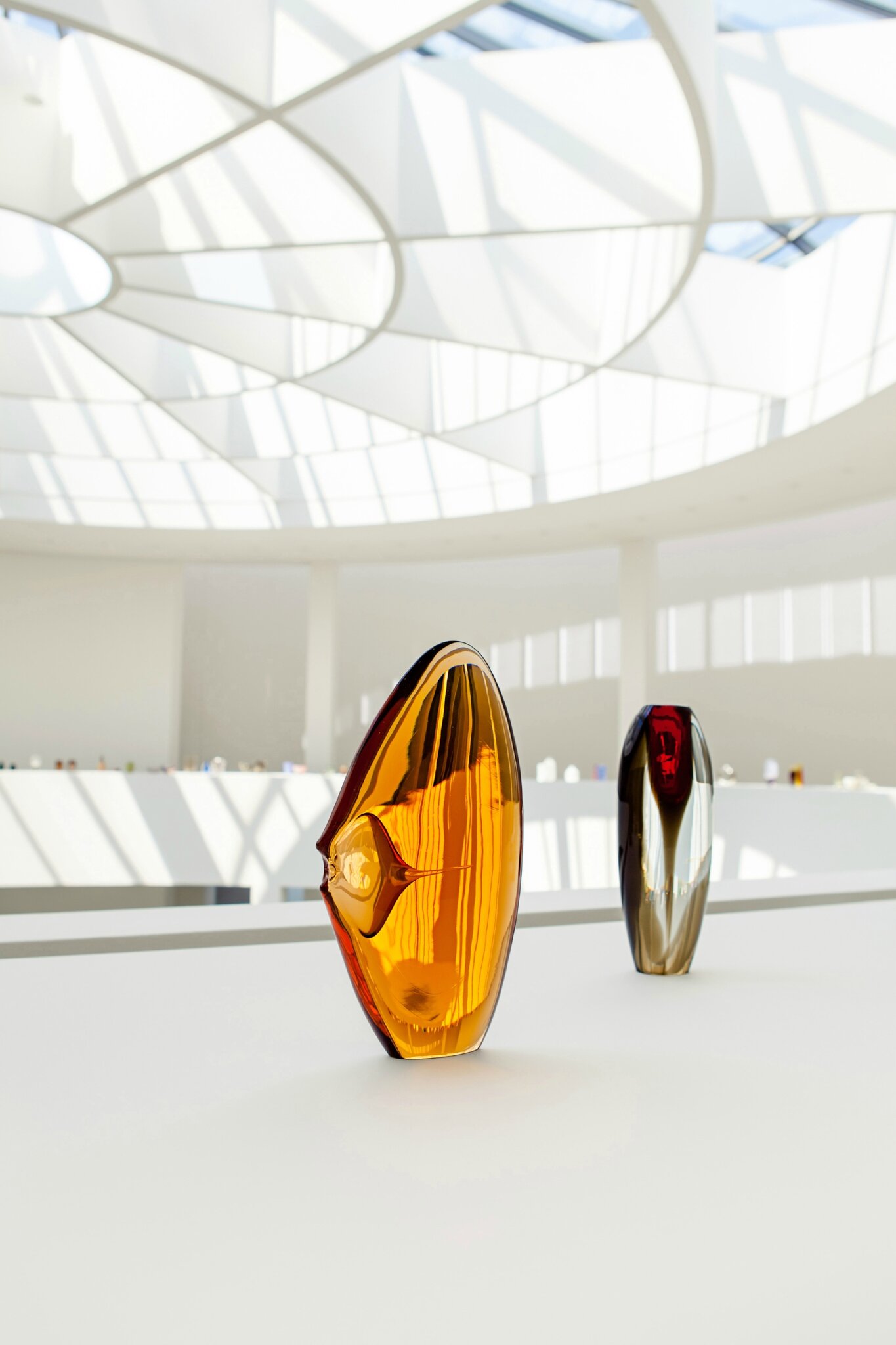
Alfredo Barbini, Vases "Pesce" and "Tulipano" (installation view), c.1960, XXX. Biennale di Venezia, 1960, Sammlung Holz, Berlin. Photo: Anna Seibel.
"...Workshops such as A.Ve.M., Archimede Seguso, Barovier & Toso or Venini managed to develop a contemporary formal language by employing new shapes and decors and in this way assumed a leading role alongside countries such as the Netherlands, the Scandinavian countries, France or the former Czechoslovakia. In the 1950s and 1960s in particular, peak performances were achieved in Murano glass in terms of an autonomous design that certainly possessed analogies to abstract art. "(Angelika Nollert,director of Die Neue Sammlung at preface of published book/catalogue of the exhibition)

Ercole Barovier for Barovier & Toso, Vase "diamantato" (installation view), c. 1968, XXXIV. Biennale di Venezia, 1968, Sammlung Holz, Berlin. Photo: Anna Seibel.

Ercole Barovier for Barovier & Toso, Vase "diamantato", c. 1968, XXXIV. Biennale di Venezia, 1968, Sammlung Holz, Berlin. Photo: Anna Seibel.
"Barovier is one of the oldest Italian glassmakers and family businesses, founded in 1291 on the island of Murano. Murano was where the glaziers had to do their work to prevent the risk of fires in the cities as well as to preserve the secrets of the trade. The first member of the family on record is Jacobello in 1295. Two centuries later, Angelo Barovier became a great name creating precious pieces, one of which; the ‘Barovier wedding cup’ is now in the Murano museum and said to date from 1450." (Barovier & Toso,biography at Rose Uniacke)

Archimede Seguso, Vases "A Piume" (installation view), c. 1956, XXVIII Venice Biennale, 1956, Sammlung Holz, Berlin. Photo: Anna Seibel.

Archimede Seguso, Vases "A Piume", c. 1956, XXVIII Venice Biennale, 1956, Sammlung Holz, Berlin. Photo: The New Collection (A. Laurenzo).
The unusual designs by Ercole Barovier or the polychrome “Oriente” vases by painter Dino Martens attest to a great delight in experimentation during the 1950s. The popular “Pezzati”, masterminded by the versatile Fulvio Bianconi, or the sophisticated “Merletti” by Archimede Seguso, stand for excellent artistry and a complete mastery of technical challenges. Fratelli Toso were especially renowned for black glass designs.

Dino Martens for Aureliano Toso, Vase "Olaf", series "Oriente" (installation view), c. 1952, XXVI. Biennale di Venezia, 1952, Sammlung Holz, Berlin. Photo: Anna Seibel.

Dino Martens for Aureliano Toso, Vase "Olaf", series "Oriente", c. 1952, XXVI. Biennale di Venezia, 1952, Sammlung Holz, Berlin. Photo: Atelier Martin Adam, Berlin.
Influenced by Abstract Expressionism, the works by artist Luigi Scarpa Croce are rarely exhibited. The “Rotellato” pieces by Barovier & Toso demonstrate that in the 1960s glass objects were more colorful and decorative, while the shapes became more classical and plain. Finally, in the early 1970s large vessels and simple interlayer techniques produced spectacular results.

Flavio Poli for Seguso Vetri d'Arte, Vase "Siderale" (installation view), c. 1952, XXVI. Biennale di Venezia, 1952, Sammlung Holz, Berlin. Photo: Anna Seibel.

Flavio Poli for Seguso Vetri d'Arte, Vase "Siderale" (installation view), c. 1952, XXVI. Biennale di Venezia, 1952, Sammlung Holz, Berlin. Photo: Atelier Martin Adam, Berlin.
Among the few international designers represented in shows in Milan and Venice were the Swedish artist Tyra Lundgren, American sculptor Thomas Stearns or the two Swedish designers Birgitta Karlsson and Ove Thorssen. They all worked with Venini, one of the world’s most famous makers of Murano glass.
A very elaborate book/catalogue is published for the exhibition: curatorial team Dr Xenia Reimann and Dr Josef Strasser, who developed the exhibition concept with Steffen John, who maintains the Holz collection.
July 1, 2016 – Oct. 16, 2016 (Die Neue Sammlung, Pinakothek der Moderne,Rotunde, 2nd floor)

Antonio Da Ros for Gino Cenedese, Vase "Contrappunto", c. 1959, XXX Biennale di Venezia, 1960, Sammlung Holz, Berlin. Photo: Atelier Martin Adam, Berlin.

Ercole Barovier for Barovier & Toso, Vase "A spiral", c. 1940, XXII Biennale di Venezia, 1940, Sammlung Holz, Berlin. Photo: Atelier Martin Adam, Berlin.

Ercole Barovier for Barovier & Toso, Vase, c. 1935/36, XX Biennale di Venezia, 1936, Sammlung Holz, Berlin. Photo: Atelier Martin Adam, Berlin.

Luigi Scarpa Croce for Cenedese, Vase "A fili policromi", c. 1952, XXVII Biennale di Venezia, 1954, Sammlung Holz, Berlin. Photo: Atelier Martin Adam, Berlin.

Ercole Barovier for Barovier & Toso, Krug "Eugeneo", c. 1951, XXVI Biennale di Venezia, 1952, Sammlung Holz, Berlin. Photo: Atelier Martin Adam, Berlin.

Ercole Barovier for Barovier & Toso, Vase "Rotellato", ca. 1970, XXXV Biennale di Venezia, 1970, Sammlung Holz, Berlin. Photo: Atelier Martin Adam, Berlin.

Anzolo Fuga for A.Ve.M., Object "Arcobaleno", c. 1956, XXVIII Venice Biennale, 1956, Sammlung Holz, Berlin. Photo: Atelier Martin Adam, Berlin.

Drawing "Arcobaleno", Model No. 13333, A.Ve.M. Archive. Photo Bildarchiv Holz, Berlin.

Archimede Seguso, Vases "A Colori Sovrapposti", c. 1966, XXXIII. Biennale 1966, Sammlung Holz, Berlin. Photo: The New Collection (A. Laurenzo)

Drawing "A Colori Sovrapposti", model no. 11023, 1966, Archives Gino Seguso. Photo: The New Collection (A. Laurenzo)

Alfredo Barbini, Objects "Vetro Pesante", c. 1962, XXXI.Biennale 1962, Sammlung Holz, Berlin. Photo: The New Collection (A. Laurenzo)

Tobia Scarpa for Venini, Vases "Occhi", c. 1959, XII.Triennale 1960, Sammlung Holz, Berlin. Photo: The New Collection (A. Laurenzo)

Ercole Barovier for Barovier & Toso, Vase "Intarsio" (installation view), c. 1961, XXXI. Biennale di Venezia, 1962, Sammlung Holz, Berlin. Photo: Anna Seibel.

Renato Toso for Fratelli Toso, Vases "murrine a spirali" (installation view), c. 1962, XXXI. Biennale di Venezia, 1962, Sammlung Holz, Berlin. Photo: Anna Seibel.

Murrine, Vetreria Artistica Fratelli Toso, Sammlung Holz, Berlin. Photo: The New Collection (A. Laurenzo)


/http%3A%2F%2Fstorage.canalblog.com%2F63%2F45%2F119589%2F110737864_o.jpg)
/http%3A%2F%2Fstorage.canalblog.com%2F97%2F66%2F119589%2F112684582_o.jpg)
/image%2F1371349%2F20260913%2Fob_a49183_36450.jpg)
/image%2F1371349%2F20260913%2Fob_410647_36185.jpg)