

/https%3A%2F%2Fprofilepics.canalblog.com%2Fprofilepics%2F1%2F0%2F100183.jpg)
/https%3A%2F%2Fstorage.canalblog.com%2F03%2F02%2F119589%2F96711876_o.jpg)
/https%3A%2F%2Fstorage.canalblog.com%2F11%2F31%2F119589%2F94773502_o.jpg)
/https%3A%2F%2Fstorage.canalblog.com%2F20%2F83%2F119589%2F94772815_o.jpg)
/https%3A%2F%2Fstorage.canalblog.com%2F26%2F72%2F119589%2F75604929_o.jpg)
/https%3A%2F%2Fstorage.canalblog.com%2F59%2F60%2F119589%2F26458628_o.jpg)
A small Ge-type washer, Ming dynasty (1368-1644)


Lot 717. A small Ge-type washer, Ming dynasty (1368-1644); 3 ½ in. (8.8 cm.) wide. Estimate USD 7,000 - USD 9,000. Price realised USD 21,250. © Christie's Images Ltd 2018
Of shallow square form, the washer is covered in a thick greyish-cream glaze suffused with a network of 'iron' crackle interspersed with light brown crackles.
Note: Ge ware, along with Guan, Ru, Ding and Jun, comprise the ‘Five Great Wares of the Song Dynasty’. The problems of distinguishing the two crackled wares, Guan, and Ge, were discussed at length during a conference held at the Shanghai Museum in 1992, and while no unanimity of opinion was reached, it was generally thought that those wares with a jinsi tiexian (‘gold thread and iron wire’) crackle should be designated Ge. See R. Scott, “Guan or Ge Ware?”, Oriental Art, Summer 1993, pp. 12-23. Recent archaeological researchers suggest that Ge wares may have been made at kilns in Chuzhou, nearer to the center of Longquan production, or just outside the walls of the Southern Song palace at Hangzhou. Scholars agree that Ge wares display the qualities that might be expected of vessels intended for imperial appreciation.
Yuan and Ming dynasty square-form Ge washers are very rare. A Ge cinquefoil brush washer dated to the Yuan-Ming dynasty was sold at Christie’s Hong Kong, 27 November 2013, lot 3279. Another washer, but of circular shape and dated to the Yuan dynasty, 14th century, is in the Qing Court Collection, and is published in the National Palace Museum, Precious as the Morning Star: 12th- 14th Century Celadons in the Qing Court Collection, p. 275, no. IV-34.
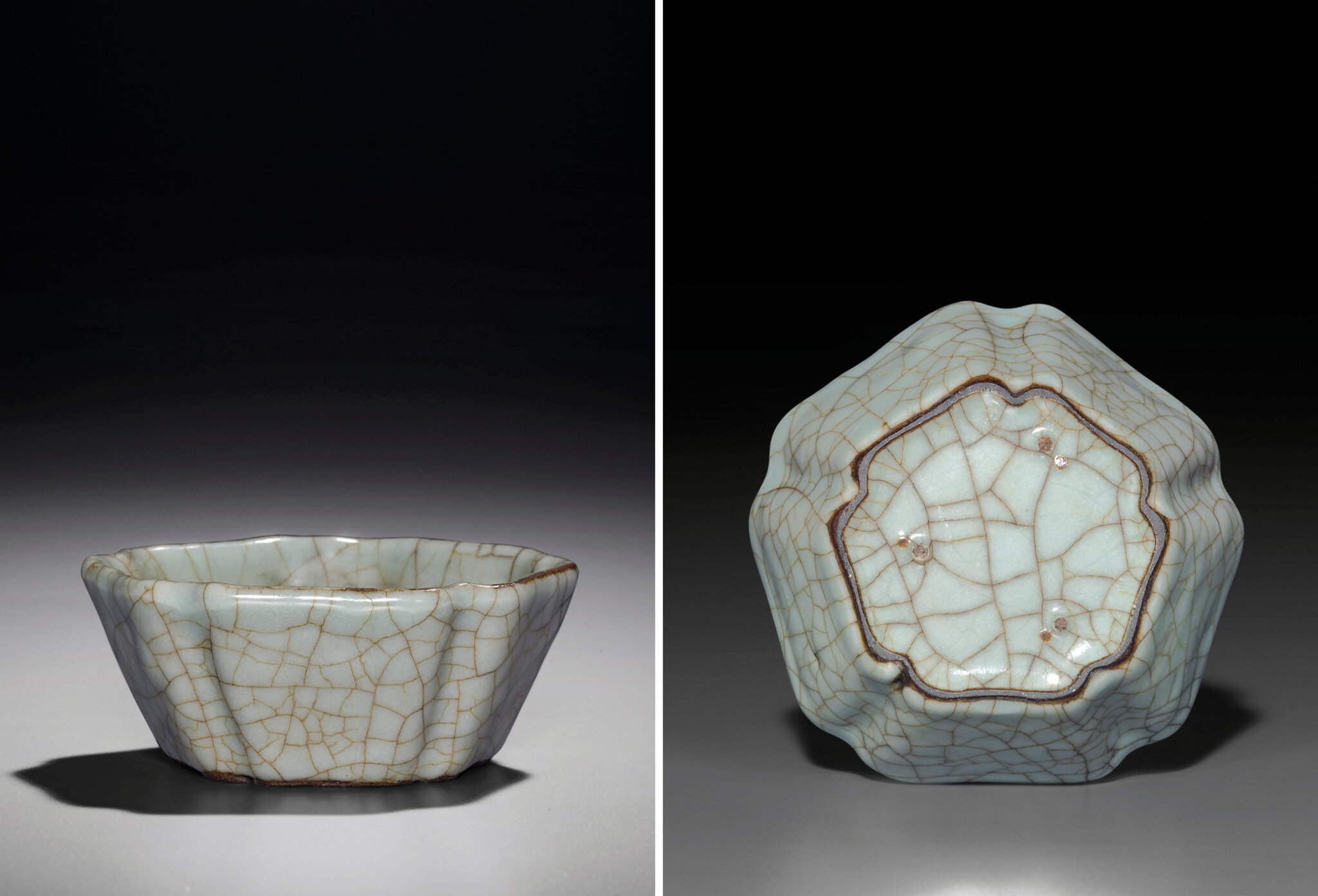
A very rare Ge cinquefoil brush washer, Yuan-Ming dynasty, 13th-15th century; 2 7/8 in. (7.5 cm.) wide. Sold for HKD 3,760,000 at Christie’s Hong Kong, 27 November 2013, lot 3279. © Christie's Images Ltd 2013
The brush washer is finely potted with deep fluted sides rising from a slightly recessed base to a cinquefoil rim, covered with a thick glaze suffused with a matrix of dark grey and russet crackles. The unglazed foot and the three spur marks on the base reveal the dark stoneware body. Estimate HKD 200,000 - HKD 300,000.
Provenance: An Australian private collection, purchased in Shanghai in the 1920s by the grandparents of the current owner.
Note: Compare to a nearly identical Ge-glazed cinquefoil washer dating to the Song dynasty in the National Museum of China. Other similar examples are found in institutions and private collections worldwide, including a Ge-glazed quatrefoil brush washer dating to the Song dynasty exhibited and illustrated in Selected Treasures of Chinese Art: Min Chiu Society Thirtieth Anniversary Exhibition, Hong Kong, 1990, pp. 252-253, no, 111; a Ge-glazed cinquefoil cup in the National Palace Museum, Taipei, illustrated in Ko Ware of the Sung Dynasty, Book II, Hong Kong, 1962, pl. 42, pp. 121-122; and a hexafoil brush washer in the Palace Museum, Beijing, designated as Guan, illustrated in Porcelain of the Song Dynasty (II), The Complete Collection of Treasures of the Palace Museum, Hong Kong, 1996, p. 23, pl. 18.
Christie's. Fine Chinese Ceramics and Works of Art, 22 - 23 March 2018, New York


/image%2F1371349%2F20260917%2Fob_dc9aab_37099.jpg)
/image%2F1371349%2F20260519%2Fob_b2b9d0_13387.jpg)
/image%2F1371349%2F20250724%2Fob_228f6e_image-4.jpg)
/image%2F1371349%2F20250415%2Fob_874cdb_telechargement-28.jpg)