

/https%3A%2F%2Fprofilepics.canalblog.com%2Fprofilepics%2F1%2F0%2F100183.jpg)
/https%3A%2F%2Fstorage.canalblog.com%2F03%2F02%2F119589%2F96711876_o.jpg)
/https%3A%2F%2Fstorage.canalblog.com%2F11%2F31%2F119589%2F94773502_o.jpg)
/https%3A%2F%2Fstorage.canalblog.com%2F20%2F83%2F119589%2F94772815_o.jpg)
/https%3A%2F%2Fstorage.canalblog.com%2F26%2F72%2F119589%2F75604929_o.jpg)
/https%3A%2F%2Fstorage.canalblog.com%2F59%2F60%2F119589%2F26458628_o.jpg)

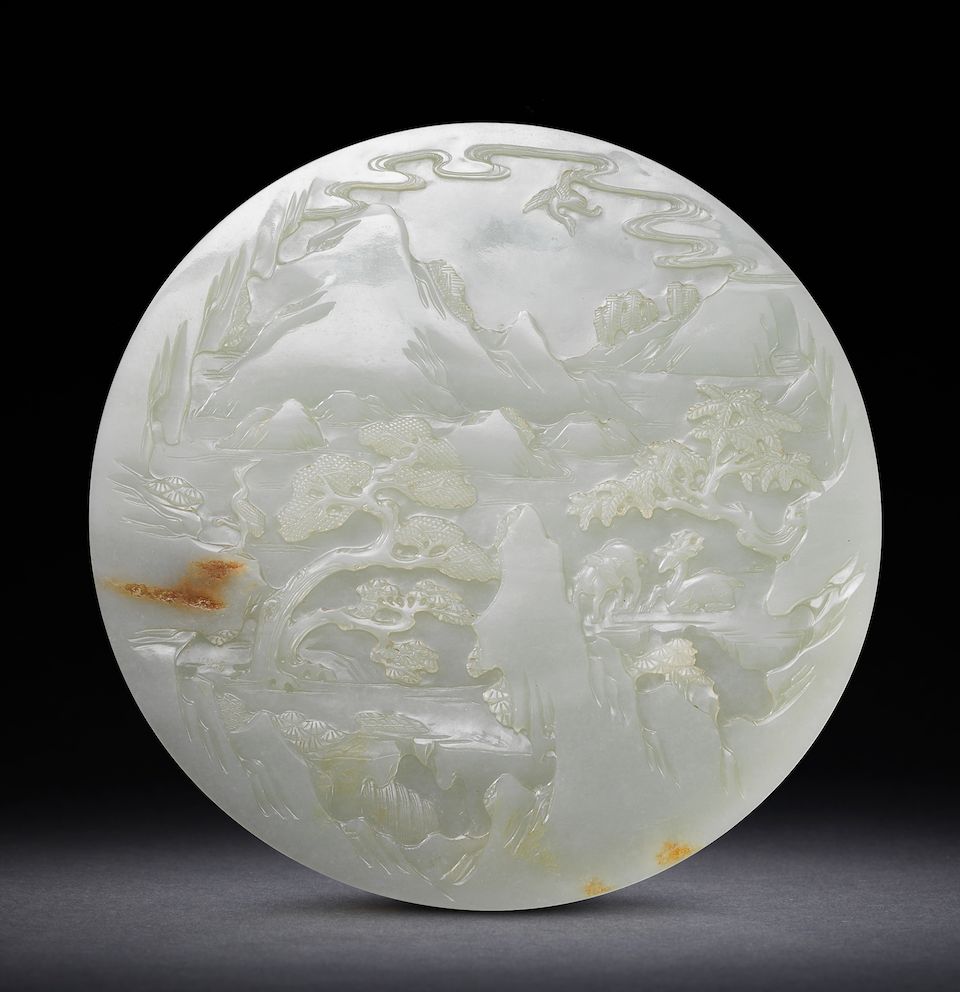
Crisply carved on one side with a mountain landscape, featuring a pavilion with two boys playing a musical stone within the terraced ground, a scholar accompanied by an attendant approaches the steps leading upwards from the side, two further scholars, one with a peony branch and one holding a ruyi sceptre, accompanied by a boy with a peach branch, standing on a rocky landing, all amidst rocks and pine trees, the reverse with a stag and doe in a mountain landscape with a crane perched on one leg and another in flight, the white stone with a small area of attractive russet inclusions, wood stand..
Provenance: An English private collection and thence by descent.
Published and Exhibited: M.Gillingham, Chinese Painted Enamels, Ashmolean Museum, Oxford, 1975, Catalogue no.33A
Note: Circular screens such as the present lot are amongst the most prestigious form of jade carvings, requiring an exceptionally large and nearly flawless raw jade boulder for its production. The thick jade disc, up to 1cm at the edge, allowed the carving on both sides to be unusually deep, with the varying depths allowing the natural translucency of the stone to shine through. The crispness of the details contrasts with the smooth areas of the rocky cliffs, perhaps reflecting both the meticulous order and the expansive imagination of the ideal scholar's mind.
The Qianlong emperor is recorded as having commissioned jade screens to be carved based on paintings from the classical canon. A number of classical paintings from the emperor's own collection were ordered to be reproduced in jades such as the painting entitled Travellers in the Mountain, by Guan Tong of the Five Dynasties period. The Qianlong emperor's appreciation of jade 'landscape' screens is demonstrated in one of his poems, as discussed in an essay by Yang Boda, Arts of Asia, 'Jade: Emperor Ch'ien Lung's Collection in the Palace Museum, Peking', March-April 1992, which may be translated as follows:
'This piece of precious jade slab is from Khotan. It is unsuitable for making vessels such as the dragon hu and animal Lei. In order to fully utilise it, it is carved into a panel with the scene of "A Riverside City on a Spring Morning". Imagination is exerted to turn the natural undulation or ruggedness into an appropriate landscape... It takes ten days to carve with a tiny bit of water and five days to shape a piece of rock. The crafting is indeed very time-consuming'.
Such scenes of scholars and attendants dwarfed by vast mountain landscapes reflect the ideal of a peaceful retirement from public service at the end of a successful career: a dreamlike desire perhaps even more remote from the lifelong service of the emperor. The reverse of the present lot echoes the front in its depiction of remote pines and rocks, whilst the cranes and the stag and doe represent wishes for longevity, and the latter also marital bliss.
Compare a very similarly carved white jade circular screen, Qianlong, illustrated in Christie's 20 Years in Hong Kong, 2006, p.370, sold at Christie's Hong Kong on 1 December 2010, lot 3006. See also a white jade circular screen, Qianlong, from the Fogg Art Museum, Cambridge, Massachusetts, similarly carved with two boys ringing a musical stone, illustrated by R.Kleiner, Chinese Jades from the Collection of Alan and Simone Hartman, Hong Kong, 1996, pp.152-153, no.123 (top image, one of a pair) and later sold at Christie's Hong Kong, 27 November 2007, lot 1511.
See also a pale green jade circular screen, Qianlong mark and of the period, from the Palace Museum, Beijing, illustrated in Noble Virtuosity: Imperial Jades of the Qing Dynasty from the Palace Museum, Macau, 2012, pl.40, similarly carved with a stag and doe. For another white jade circular screen from the Musée National du Château de Fontainenbleau (inv.no. F 1478 C), see M.Crick, Chine Impériale: Splendeurs de la Dynasties Qing (1644-1911), Geneva, 2014, pp.152-153.
BONHAMS. FINE CHINESE CERAMICS AND WORKS OF ART, 4 Jun 2015 10:30 HKT - HONG KONG, ADMIRALTY


/image%2F1371349%2F20260812%2Fob_25ee3c_770688417-2318762078893798-62552963688.jpg)
/image%2F1371349%2F20251215%2Fob_097fc3_telechargement-62.jpg)
/image%2F1371349%2F20250521%2Fob_3f6be9_telechargement-4.jpg)
/image%2F1371349%2F20250408%2Fob_76abc5_1000014289.jpg)