

/https%3A%2F%2Fprofilepics.canalblog.com%2Fprofilepics%2F1%2F0%2F100183.jpg)
/https%3A%2F%2Fstorage.canalblog.com%2F03%2F02%2F119589%2F96711876_o.jpg)
/https%3A%2F%2Fstorage.canalblog.com%2F11%2F31%2F119589%2F94773502_o.jpg)
/https%3A%2F%2Fstorage.canalblog.com%2F20%2F83%2F119589%2F94772815_o.jpg)
/https%3A%2F%2Fstorage.canalblog.com%2F26%2F72%2F119589%2F75604929_o.jpg)
/https%3A%2F%2Fstorage.canalblog.com%2F59%2F60%2F119589%2F26458628_o.jpg)
A large famille rose 'luohan and lotus' punchbowl, Qing dynasty, Qianlong-Jiaqing period (1736-1820)


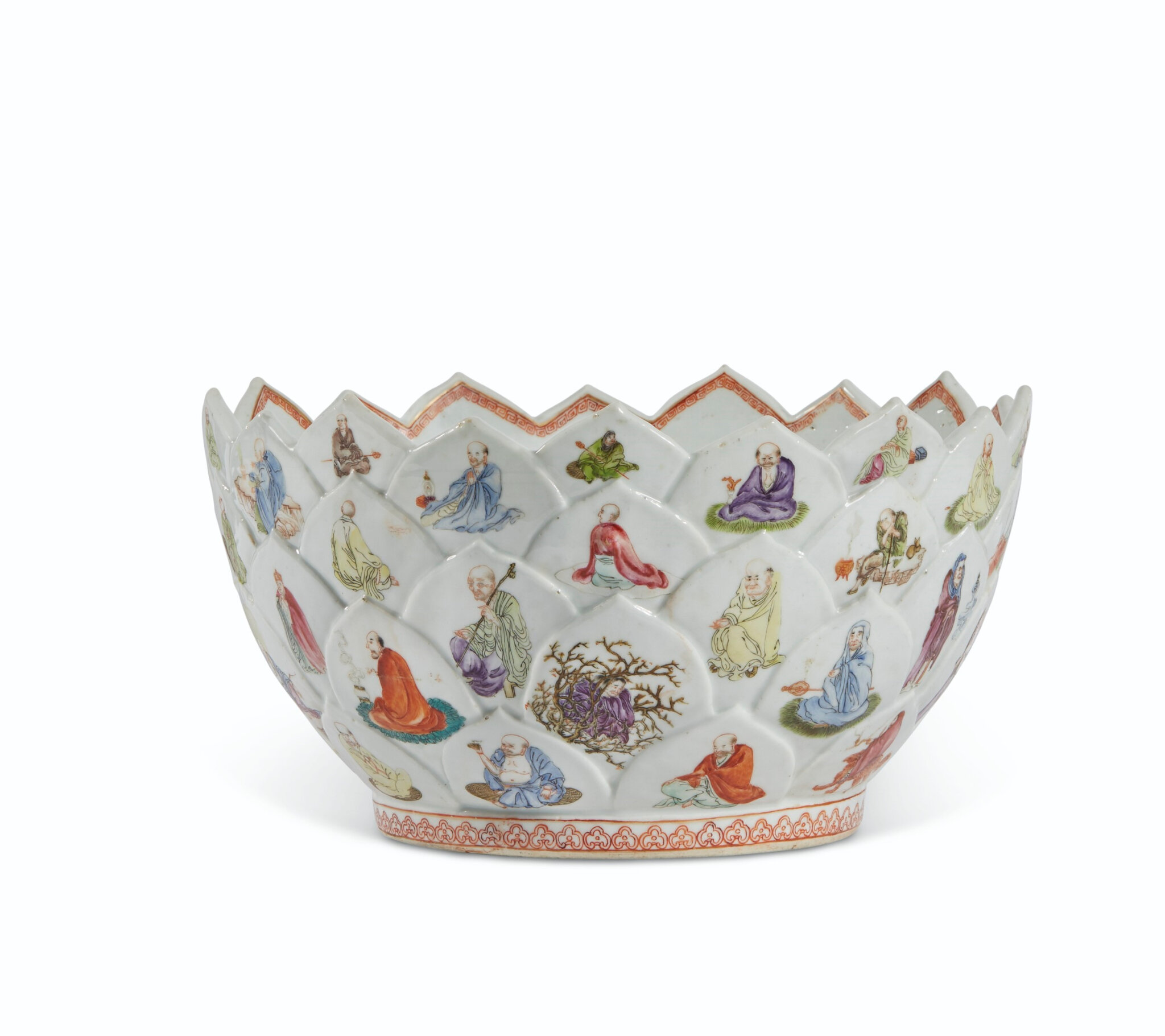


Lot 146. A large famille rose 'luohan and lotus' punchbowl, Qing dynasty, Qianlong-Jiaqing period (1736-1820). Diamètre: 35 cm. (13 ¾ in.). Estimate EUR 5,000 - EUR 7,000. Price realised EUR 10,000. © Christie's Image Ltd 2020.
En forme de lotus et reposant sur un petit pied droit, les cinquante-quatre pétales sont tous ornés d'un luohan différent. Ils sont vêtus de robes souples, les visages souriants, méditatifs ou sereins, chacun tenant son attribut. Le centre de l'intérieur est à décor de Budai assis contre sa bourse, tenant son sceptre dans la main.
Provenance: Previously in a French private collection.
Note: Luohan, also known as Arhat in Sanskrit, were followers of the historical Buddha who have attained enlightenment but remained on earth to manifest their faith. They are usually depicted as middle-aged or elderly monks with shaven heads wearing heavy robes, without Vajrayana ornamentation. In early depictions, they are usually shown with Western features, but by the 11th-12th centuries they are more frequently portrayed as ethnically Chinese such as in this present bowl.
Christie's. Art d'Asie, Paris, 23 June 2020


/image%2F1371349%2F20260726%2Fob_02c135_26715.jpg)
/image%2F1371349%2F20260720%2Fob_01dac8_25371.jpg)
/image%2F1371349%2F20260501%2Fob_aad93c_10088.jpg)
/image%2F1371349%2F20250728%2Fob_689827_1000025080.jpg)