

/https%3A%2F%2Fprofilepics.canalblog.com%2Fprofilepics%2F1%2F0%2F100183.jpg)
/https%3A%2F%2Fstorage.canalblog.com%2F03%2F02%2F119589%2F96711876_o.jpg)
/https%3A%2F%2Fstorage.canalblog.com%2F11%2F31%2F119589%2F94773502_o.jpg)
/https%3A%2F%2Fstorage.canalblog.com%2F20%2F83%2F119589%2F94772815_o.jpg)
/https%3A%2F%2Fstorage.canalblog.com%2F26%2F72%2F119589%2F75604929_o.jpg)
/https%3A%2F%2Fstorage.canalblog.com%2F59%2F60%2F119589%2F26458628_o.jpg)
Marchant: Eight Treasures for the Wanli Emperor at Christie's New York
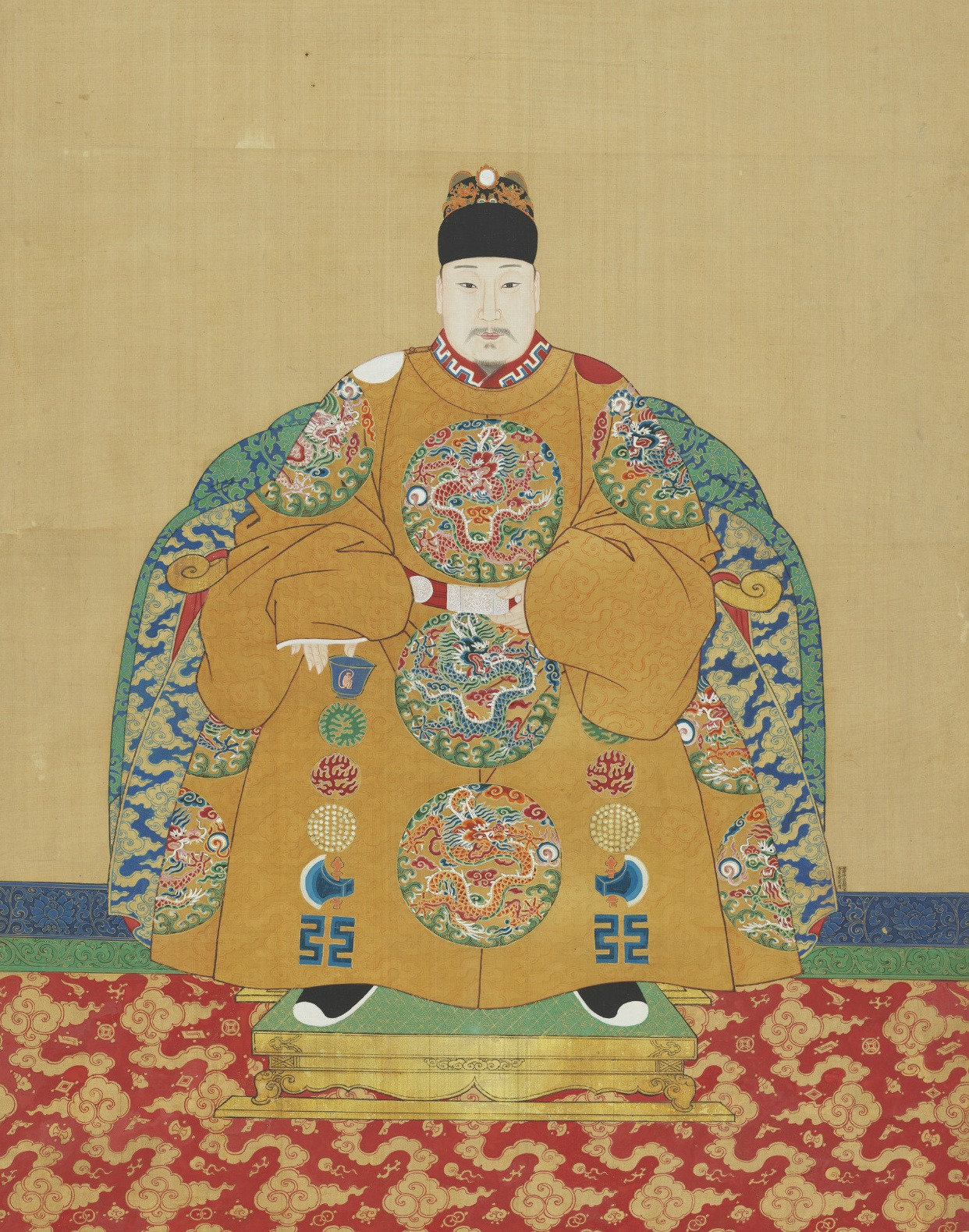
Portrait of Emperor Shenzong (also known as Emperor Wanli), Ming dynasty. National Palace Museum, Taipei, accession number 000297N000000000.
IMPERIAL PORCELAIN REFLECTIONS OF THE WANLI REIGN by Rosemary Scott, Independent Scholar
The group of porcelains contained in this catalogue are not only examples of exceptional ceramics made for the court of the Wanli Emperor, but also reveal specific imperial taste and interests that prompted their commissioning. Zhu Yijun, who was to rule as the Wanli Emperor, was the third son of the Longqing Emperor (1567-72), and came to the throne as a child of eight in June 1572, following his father’s death in May of that year. It was declared that Zhu Yijun’s Wanli reign would officially be considered to have begun at the beginning of the following year, in February 1573 [by the Gregorian calendar]. His was to be the longest ruling of all the Ming dynasty emperors – reigning 48 years from 1573-1620. During the early part of his reign, when he was guided by wise ministers such as Senior Grand Secretary Zhang Juzheng (1525-82), much was accomplished to restore the financial and political stability of the empire. In the middle part of the reign, following Zhang’s death in 1582, when the Wanli Emperor took over complete personal control, he proved himself to be both a diligent and largely competent ruler. However, after 1600, certain events left the emperor disillusioned and he virtually withdrew from government, leaving the country to the mercies of corrupt and venal officials, a succession of scandals, and an increasing threat from the Jurchens in the north. The imperial kilns were amongst the institutions which suffered as a result, and in 1608 production ceased and the eunuch officials were recalled to Beijing. Nevertheless, in the early and middle parts of the reign a wide range of fine porcelains were made for the court, as represented by the pieces in the current catalogue.
It is clear that the Wanli Emperor had a sincere admiration for the porcelains of the 15th century made in the revered reigns of the Xuande (1426-35) and Chenghua (1465-87) Emperors. The very rare blue and white stem cup in the current sale (lot 881) reflects this admiration, having both form and decoration which were inspired by Xuande vessels. The stem cup is decorated with a group of animals known as the sea creatures haishou. This group of creatures, which are usually depicted amongst turbulent waves, comprised winged elephants yixiang (sometimes referred to as flying elephants feixiang), winged ying dragons, celestial horses tianma, qilin, foxes, goats, lions, dogs, deer, antelope, turtles, flying fish, flying shrimps, sea molluscs, and other strange, sometimes unidentifiable, creatures – from which certain creatures, nine in the case of the current stem cup, were selected to decorate particular vessels.
A number of the sea creatures can be identified with those mentioned in the ancient text, Shan hai jing, which was compiled by Liu Xiang and his son Liu Xin in the Han dynasty (206 BC-AD 220), and revised by Guo Pu in the Eastern Jin period (AD 317-420), but includes material from earlier times. In 1983 a symposium was convened in Chengdu, Sichuan province to discuss new research into the Shang hai jing, and the proceedings were published by the Chinese Academy of Sciences, Further Studies on the Shan Hai Jing, Sichuan, 1986, while Chen Ching-kuang of the National Palace Museum, Taipei also undertook research into the use of this motif on Chinese imperial porcelains, and a paper by her on the subject was published in 1993 (Chen Ching-kuang, ‘Sea Creatures on Ming porcelains’, in The Porcelains of Jingdezhen, Rosemary Scott (ed.), Colloquies on Art & Archaeology in Asia No. 16, London, 1993, pp. 101-22). The ying winged dragon, the xuan nine-tailed turtle, the tianlu heavenly deer, and others mentioned in the Shan hai jing can be identified with animals on Ming porcelains. These, and the other sea creatures, are all regarded as auspicious. Significantly, there was a revival of interest in the Shan hai jing during the early Ming period, and this may have encouraged the application of the sea creature motif on early 15th century porcelains. This Wanli example is very closely linked to these 15th century examples and clearly reflects the Wanli Emperor’s admiration for them and his determination that they should provide inspiration for porcelains made during his own reign.
Although the sea creature motif may have initially been of Daoist origin, it is notable that the current Wanli stem cup, and a number of Xuande stem cups bearing this motif, also bear a Sanskrit inscription on the interior. This inscription is comprised of a ninecharacter mantra – clearly linking the vessels to Lamaism (Tibetan Buddhism). It is significant that the winged dragon, the elephant, the winged goat and the lion also appear on the doorways of the Porcelain Pagoda at the Bao’en Temple, built by the Yongle Emperor in honour of his mother near Nanjing, as well as in other Buddhist contexts. It is believed that the theme of sea creatures formed part of the decoration on a wall in the original Tianfeigong Temple in Nanjing, which was built in the early 15th century on the orders of the Yongle Emperor. The building is dedicated to Mazu (also known as Tianfei), the Goddess of the Sea, who was credited by Admiral Zhenghe with protecting his voyages of exploration.
Stem bowls with this type of decoration were made as early as the Yongle reign and a stem bowl decorated with thirteen sea creatures, reserved in white against a ground of underglaze blue turbulent waves was excavated in 1984 from the late Yongle stratum at the imperial kilns at Jingdezhen (illustrated Imperial Porcelain of the Yongle and Xuande periods Excavated from the Site of the Ming Imperial Factory at Jingdezhen, Hong Kong, 1989, pp. 148-49, no. 33). Also, in 1984 a stem bowl decorated with thirteen sea creatures in underglaze copper red against a ground of underglaze blue turbulent waves was unearthed from the late Yongle stratum at Jingdezhen (illustrated ibid., pp. 156-57). On both these Yongle stem bowls ten sea creatures appear on the bowl of the vessel and three on the stem. As noted above, the sea creatures theme continued to be applied to imperial porcelain in the Xuande reign, and in 1984 a stem bowl decorated in underglaze copper red with sea creatures against an incised ground of turbulent waves (illustrated in Chang Foundation, Xuande Imperial Porcelain excavated at Jingdezhen, Taipei, 1998, p. 49, no. 45-2) was excavated from the Xuande stratum at the imperial kilns at Jingdezhen. In 1993 a small stem cup decorated in underglaze blue with a design of sea creatures, against a background of pale blue turbulent waves, was excavated from the Xuande stratum (illustrated Chang Foundation, Xuande Imperial Porcelain excavated at Jingdezhen, op. cit., p. 55, no. 51-1). In 1983 a small cup decorated with nine sea creatures, in underglaze copper red was excavated from the Xuande stratum at Jingdezhen (illustrated Chang Foundation, Xuande Imperial Porcelain excavated at Jingdezhen, op. cit., p. 99, no. 101-3). The National Palace Museum, Taipei has 17 Xuande stem cups with sea creature decoration bearing such inscriptions, indicative of the importance of this theme to the court in this reign. (Fig. 1)

Fig. 1 Stem cup decorated with sea creatures in underglaze blue, Xuande mark and of the period (1426-1435), Ming dynasty. National Palace Museum, Taipei, 故瓷 007771N000000000
A small number of Chenghua porcelains decorated with sea creatures are known, but Wanli examples are even rarer. The National Palace Museum, Taipei has only two stem cups bearing this motif which can be securely dated to the Wanli reign. One, like the current example, has white creatures reserved against blue waves and a Sanskrit inscription (Fig. 2); the other is decorated with iron-red sea creatures depicted against blue waves (see Chen Ching-kuang, op. cit., p. 112). A stem cup with white sea creatures shown against blue waves, which has an apocryphal Xuande mark, but dates to the Wanli reign, is in the collection of Sir Percival David (see Illustrated Catalogue of Underglaze Blue and Copper Red Decorated Porcelains in the Percival David Foundation of Chinese Art, Revised edition, London, 2004, p. 99, no. C601).

Fig. 2 Stem cup decorated with sea creatures and Sanskrit script in underglaze blue, Wanli mark and of the period (1573-1620), Ming dynasty. National Palace Museum, Taipei, 故瓷003631N000000000.
The large rare Wanli doucai bowl in the current sale (lot 883) is an excellent example of an imperial porcelain vessel which has been closely modelled on a Chenghua doucai piece.
While the imperial porcelains of both the Xuande reign and the Chenghua reign have been traditionally admired, it is specifically the blue and white of the Xuande reign and the polychrome wares of the Chenghua reign which have been especially appreciated. Craig Clunas has noted in his analysis of literature on the tastes of the literati in the late 16th and 17th century, that the porcelains of the Xuande and Chenghua reigns became increasingly desirable, and the names of these two reign periods also came to stand for high aesthetic value even at this early date (see Craig Clunas, Superfluous Things - Material Culture and Social Status in Early Modern China, Polity Press, Cambridge, 1991, p. 103). Shen Defu (1578-1642) is the author of one of the most frequently quoted Ming dynasty biji (note-form literature) Wanli ye huo bian (Random Gatherings of the Wanli Era), published in 1606. In his discussion of the antiques market at the Temple of the City God (held each month from the 15th to the 25th day) Shen Defu noted that: ‘In ceramics the dearest are those of the Chenghua reign, then those from the Xuande reign. A cup used to count only several ounces [of silver], when I was a child I did not think of them as valuable treasures. A pair of Chenghua wine cups now fetches 100 ounces [of silver], and a Xuande incense burner almost as much’ (Craig Clunas, Superfluous Things - Material Culture and Social Status in Early Modern China, op. cit., p. 136-7). A list of admired Chenghua porcelains – including doucai wares - can be found in the Rong Cha Li Shuo by Cheng Zhe (active c. 1710). This author also specifically notes that the Wanli Emperor liked to use such vessels, and that a pair of these Chenghua cups was already worth 10,000 cash (see Ts’ai Ho-pi, ‘Chenghua Porcelain in Historical Context’, The Emperor’s broken china - Reconstructing Chenghua porcelain, London, 1995, p. 17).
It is therefore perhaps unsurprising that in the Wanli reign a small group of imperial porcelains took their inspiration from Chenghua doucai. Due to the expense and difficulty of production, the use of the doucai technique to decorate porcelains had been largely abandoned after the end of the Chenghua period. Some doucai-decorated porcelains were made in the Jiajing reign, but these often had rather dull greyish body material, pale cobalt, and weakly drawn lines. A number of doucai porcelains in Chenghua style, but bearing Jiajing marks were included in the Special Exhibition of C’heng-hua Porcelain Ware at the National Palace Museum, Taipei, in 2003, together with the Chenghua originals (National Palace Museum, Catalogue of the Special Exhibition of Ch’eng-hua Porcelain Ware, Taipei, 2003, nos. 187-8, 195, 198-201, 204-7). The Wanli Emperor’s genuine appreciation of Chenghua doucai porcelains led to the technique being applied to good quality wares in his reign. Those Wanli imperial porcelains made in Chenghua doucai style generally exhibit rich blue cobalt, boldly drawn. The Shanghai Museum has in its collection several copies of Chenghua doucai porcelains, which were made in the Wanli reign, and Lu Minghua has discussed in particular bowls, of similar shape to the current example, decorated in doucai style with fruiting branches inside ogival frames (Lu Minghua, Ming dai guanyao ciqi (Ming Dynasty Imperial Ceramics), Studies of the Shanghai Museum Collections, Shanghai, 2007, p. 174), and dishes with fish swimming in water (op. cit., p. 297). A Wanli mark and period doucai bowl of similar form, but slightly larger in diameter, with a design of fruiting branches within ogival panels is in the collection of the Victoria and Albert Museum (see Rosemary Scott and Rose Kerr, Ceramic Evolution in the Middle Ming Period, London, 1994, p. 20, no. 16).
It may be noted that both Jiajing and Wanli copies of Chenghua doucai porcelains are frequently larger than the Chenghua originals, although the designs are often copied with considerable accuracy. However, there is a small group of Chenghua doucai bowls which have a diameter of approximately 16.5 cm., similar to the current Wanli example. A Chenghua bowl bearing the same decoration as the current bowl on its exterior - the Eight Buddhist Emblems on lotus blossoms above a lotus petal band - and of both the same shape and size (d: 16.5 cm.) as the current Wanli vessel, is in the National Palace Museum, Taipei (see Catalogue of the Special Exhibition of Ch’enghua Porcelain Ware, Taipei, 2003, p. 145, no. 131). (Fig. 3) The Taipei Chenghua bowl is unfinished, having only the underglaze blue outlines, and lacking the overglaze enamels. The fragments of a similar (completed) Chenghua doucai bowl were excavated from the late Chenghua stratum at the imperial kilns (see Tsui Museum of Art, A Legacy of Chenghua – Imperial Porcelain of the Chenghua Reign Excavated from Zhushan, Jingdezhen, Hong Kong, 1993, pp. 334-5, no. C123).

Fig. 3 Bowl with the Eight Buddhist Emblems, Chenghua mark and of the period (1465-1487), Ming dynasty. National Palace Museum, Taipei, 故瓷ġ014791N000000000
A Wanli doucai bowl identical to the current example – including having a mark written inside a double circle – is in the collection of the National Palace Museum, Taipei (see Porcelain of the National Palace Museum – Enamelled Ware of the Ming Dynasty, Book III, Hong Kong, 1966, pp. 50-1, colour plates 11, 11a-c). (Fig. 4) A Wanli doucai bowl of the same size, shape and decoration as the current bowl is also in the collection of the Palace Museum, Beijing (see The Complete Collection of Treasures of the Palace Museum, vol. 38, Porcelains in Polychrome and Contrasting Colours, Hong Kong, 1999, p. 205, no. 187), however, this bowl bears a mark written within a double square – an additional reference to Chenghua doucai wares. A further Wanli example with square mark was sold by Sotheby’s Hong Kong in April 2012, lot 44.

Fig. 4 Bowl with Indian lotus and the Eight Treasures decoration in doucai painted enamels, Wanli mark and of the period (1573-1620), Ming dynasty. National Palace Museum, Taipei, 故瓷ġ011972N000000000
The jewel-like, vibrant, cobalt blue applied to fine imperial porcelains in the first half of the Wanli reign can be seen not only on the sea creatures stem cup, discussed above, but also on the ingot-shaped box (lot 884) and the rectangular writing box (lot 882) in the current sale. It is recorded that in the late 16th century blue and white imperial porcelains were decorated using imported cobalt. The Ming shilu (Veritable Records of the Ming) states that in the 24th year of the Wanli reign (AD 1596) imported blue pigment for imperial use was sent as tribute from various Muslim countries in the west, but that, nevertheless, it was proving difficult to obtain and therefore the Vice Governor of Gansu province was commanded to purchase pigment and send it to the court without delay (see Wang Qingzheng, Qinghua youlihong (Underglaze Blue and Red), Hong Kong, 1987, p. 12). The Ming shilu also states that by the 34th year of the reign (AD 1605) it was necessary to use domestic pigment and that only the cobalt from Zhejiang was deemed to be a high enough quality for imperial use (see ibid.). The Tiangong kaiwu (Exploitation of the Works of Nature), written by Song Yingxing and first published in 1637, confirms this and notes the Qu and Xin prefectures in Zhejiang as the source of the best domestic cobalt. This could be refined to give a good blue using advanced techniques described in the ceramics section of the Jiangxi dazhi of 1597, but it was still less vivid than the imported blue.
Both the ingot-shaped box and the rectangular writing box in the current catalogue are rare. The shape of the ingot box references the silver or gold ingot (ding), which is one of the traditional babao ‘Eight Treasures’ or ‘Eight Precious Things’. The shape is known in lacquer ware, but is particularly rare in porcelain because it would have been difficult to make and fire successfully. The combination of incurving and outcurving arcs would have placed great stress on the porcelain while it was being fired. Two boxes of this form dating to the Longqing reign (1567-72) have been published – one of these is in the collection of the National Palace Museum, Taipei (see Porcelain of the National Palace Museum – Blue and White Ware of the Ming Dynasty, Book VI, Hong Kong, 1963, pl. 2), while the other is in the Hallwyl Museum, Stockholm (see the catalogue of the exhibition Utställningen av kinesisk konst och konsthantverk i Stockholm, 1914). Only a small number of Wanli boxes in this form are known in international collections – one in the Musée Guimet, Paris (illustrated by Daisy Lion-Goldschmidt, La Porcelaine Ming, Fribourg, 1978, fig. 213); one in the Asian Art Museum, San Francisco (illustrated by He Li, Chinese Ceramics, A New Comprehensive Survey, New York, 1996, fig. 435); another in the Baur Collection, Geneva (illustrated by John Ayers, The Baur Collection. Chinese Ceramics, vol. 2, Geneva, 1969, pl. A187); while a fourth was included in the exhibition China Institute in America Exhibition of Chinese Art from the Newark Museum, China Institute in America, New York, 1980, cat. no. 26. A further example from the collection of T.Y. Chao was sold by Sotheby’s Hong Kong in 2017, lot 315, and another was sold by Christie’s Hong Kong in May 2007, lot 1458.
The rarity of the rectangular writing box may also, in part, be explained by the difficulty of successfully making and firing such an object. 90-degree angles on slab-made porcelain vessels are wont to split when fired. In addition, the walls of both the base and lid of these writing boxes are, necessarily, relatively thick – making them liable to warping as they shrank during firing. The lid of such boxes also has a top which is made of a quite large section of flat, unsupported, clay. This section had to be skilfully and evenly formed, as well as very carefully fired in order to prevent distortion. It is interesting to note that Jiajing rectangular porcelain boxes, such as that in the Aga Khan Museum in Toronto, Canada (accession no. AKM806), which is decorated with Arabic inscriptions in circular panels, are smaller and have less challenging lids. In the case of the Aga Khan Museum example, it is 21.4 cm. long and 12.6 cm wide (compared to 30.8 cm long and 22.5 cm wide for the current Wanli box). Its lid simply rests on the top of the sides, with a short inside flange to provide stability, instead of having full height sides like the Wanli example. As the lid of the Wanli box has sides which fit over the sides of the base, very precise building and firing were necessary. One other, almost identical, Wanli writing box is known. This was previously in the collection of Charles Russell, and was acquired by Sir Percival David (see Rosemary Scott and Rose Kerr, Ceramic Evolution in the Middle Ming Period, London, 1994, p. 31, no. 56). (Fig. 5) Two wucai decorated boxes of this form, but with different decorative schemes are in the British Museum (see J. Harrison-Hall, Ming Ceramics in the British Museum, London, 2001, p. 334, no. 11:154) and the Tokyo National Museum (see T. Degawa, Imperial Overglaze-Enamelled Wares in the Late Ming Dynasty, Osaka, 1995, cat. no. 34).

Fig. 5 Rectangular porcelain writing box, Wanli mark and of the period (1573-1620), Ming dynasty. The British Museum, PDF,B.611. Courtesy of the Trustees of the Sir Percival David Foundation; ©The Trustees of the British Museum.
The current catalogue includes several important examples of Wanli porcelain decorated in wucai style (lots 885-888). One of these is a rare ‘hundred deer’ jar (lot 888), on which a herd of deer is depicted in a landscape of rocks, streams, trees, and fruiting and flowers plants, encircling the sides of the jar. As is often the case, the word ‘hundred’ is not to be taken literally but in the context of a rebus. The deer – lu – provide a rebus for the word lu, which can mean either good fortune/blessings or an official salary. A hundred deer bai lu thus suggests the wish shoutian bailu, ‘May you receive a hundred blessings from heaven’. It is probable that the deer on the jar were intended to be Sika deer, which naturally have coats or pelage in a range of colours, including white. Some of the deer on the jar are clearly intended to be white, which is significant, since white deer were believed to be especially auspicious. The Jin dynasty scholar Ge Hong (AD 283-343) wrote in his Baopuzi (The Master Who Embraces Simplicity) that a deer can live one thousand years and turns white after five hundred years. A white deer therefore symbolised long life, as well as good fortune and nobility.
The theme of deer in landscape amongst trees inspired Chinese artists from at least the 10th century. A Five Dynasties period (AD 907-960) hanging scroll in ink and colours on silk, entitled Herd of Deer in a Maple Grove is in the collection of the National Palace Museum, Taipei (illustrated in Splendid Treasures: A Hundred Masterpieces of the National Palace Museum on Parade, Taipei, 2012). (Fig. 6) However, the depiction of the deer in a rocky, wooded, landscape on this jar would have been intended as a reference to imperial gardens and hunting parks. As early as the Shang dynasty Chinese rulers appear to have been concerned with the construction of gardens and parks. The first Qin dynasty emperor, Qin Shihuangdi (221-207 BC), is thought to have commissioned the Shanglin Park to the west and south-west of the capital Chang’an (modern Xi’an), and the Upper Grove Park near his palace was used partly for hunting. When the Han dynasty Emperor Wudi (140-87 BC) expanded this park, some additional pools were specially dug for the benefit of deer, which were among the animals brought to the imperial park from all over China (see N. Titley and F. Wood, Oriental Gardens, British Library, London, 1991, p. 72). The second Sui dynasty Emperor Yang (AD 598-618) ordered the construction of a similar park outside his capital at Luoyang, into which he too commanded deer to be brought. The Northern Song, Southern Song, and Yuan dynasty emperors also constructed parks and gardens stocked with deer both for their beauty and for hunting. This passion for imperial hunting continued in the Ming dynasty, and the Xuande Emperor (1426-35) was depicted in several paintings hunting deer – for example The Xuande Emperor on an Outing, by Shang Xi (fl. 1426-35), and the anonymous The Xuande Emperor Hunting, both in the Palace Museum, Beijing (illustrated in the catalogue of the British Museum exhibition Ming – 50 years that changed China, London, 2014, pp. 28-9, fig. 6 and pp. 134-5, fig. 120, respectively), establishing a new genre of imperial hunting pictures.

Fig. 6 Herd of Deer in a Maple Grove (detail), Five Dynasties (AD 907-960). National Palace Museum, Taipei, 故畫ġ000032N000000000.
Imperial famille rose ‘hundred deer’ vases became particularly popular in the Qing Qianlong reign (1736-95), but Ming wucai examples of this design are rare. Amongst international collections, an example is in the Musée Guimet, Paris (illustrated in The World’s Great Collections - Oriental Ceramics Vol. 7 - Musée Guimet, Paris, Kodansha, Tokyo, 1981, no. 26); another is in the National Palace Museum, Taipei (illustrated by Liu Liang-yu in Ming Official Wares: A Survey of Chinese Ceramics, vol.4, Taipei, 1991, p. 258); a third is in the Tokyo National Museum (see Illustrated Catalogues of Tokyo National Museum – Chinese Ceramics, Tokyo, 1965, p. 130, no. 538); and a fourth is in the Matsuoka Museum of Art, Tokyo (see Catalogue of Important Oriental Ceramics, 1991, p. 81, no. 96). The ‘hundred deer’ theme is also seen on a pair of large blue and white Wanli jars given to Queen Christina of Sweden (r. 1632-1654) by the Portuguese Ambassador in 1640 (illustrated in The World’s Great Collections - Oriental Ceramics Vol. 8 - Museum of Far Eastern Antiquities, Stockholm, Kodansha, Tokyo, 1982, fig. 247). (Fig. 7)

Fig. 7 Urns with lids, decorations of animals in a landscape in underglaze blue, Wanli marks and of the period (1573-1620), Ming dynasty. Östasiatiska Museet, CXV-1586 and CXV-1587.
The porcelains in this catalogue provide evidence of the fine imperial porcelains being made for the court of the Wanli Emperor during the first half of his reign.


Lot 881. A very rare blue and white reverse-decorated stem cup, Wanli six-character mark in underglaze blue within a double circle and of the period (1573-1620); 8.2 cm diam, silk pouch, cloth box. Estimate USD 300,000 – USD 500,000. © Christie's Image Ltd 2023
The stem cup is finely decorated on the exterior with nine mythical sea creatures (haishou), including a winged dragon, a turtle, a lion, a qilin and a celestial horse, all reserved in white and incised in anhua against a ground of crested waves painted in deep tones of cobalt blue. The pedestal foot is encircled by a raised ruyi band above further waves crashing against rocks. The interior is inscribed in lança characters with a nine-character mantra.
Provenance: Baronial family, Japan.
Private collection, Japan.
Christie's Hong Kong, 29 May 2013, lot 2247.
Marchant, London.
Literature: Marchant & Son, Chinese Ceramics Tang to Qing, London, 2014, pp. 36-7, no. 18.
Exhibited: London, Marchant & Son, Chinese Ceramics Tang to Qing, 6-30 May 2014.
Note: The present stem cup belongs to a very rare group produced in the Wanli period and is closely based on earlier Xuande-period (1426-35) prototypes. A Xuande mark-and-period example in the National Palace Museum, Taipei, is illustrated by Chiang Fu-tsung in The Special Exhibition of Hsuan-te Porcelain, Taipei, no. 70. (Fig. 1)

Fig. 1 Stem cup decorated with sea creatures in underglaze blue, Xuande mark and of the period (1426-1435), Ming dynasty, National Palace Museum, Taipei, 故瓷007771N000000000.
It appears that the only other known published stem cup of this design, with lança characters on the interior and with a Wanli mark, is in the National Palace Museum, Taipei, and is illustrated in Ming Ci Ming Pin Tu Lu, Jiajing, Longqing, Wanli, The Catalogue of Famous Ming Porcelain from Japan and Taiwan, 1978, no. 82, and again by Liu Liang-yu in Ming Official Wares, Taipei, 1991, p. 281. (Fig. 2) A related Wanli-period example, but bearing a Xuande mark, from the Percival David Foundation, now in the British Museum, London, is illustrated by M. Medley in Illustrated Catalogue of Underglaze Blue and Copper Red Decorated Porcelains, London, 1976, p. 73, no. C601.

Fig. 2 Stem cup decorated with sea creatures and Sanskrit script in underglaze blue, Wanli mark and of the period (1573-1620), Ming dynasty, National Palace Museum, Taipei, 故瓷003631N000000000
The decoration of 'sea creatures' is discussed by Rosemary Scott in the introduction to this catalogue, where their relationship to Tibetan Buddhism is explained. A larger (8.2 cm. diam.) stem bowl, Xuande mark and period, with a related design of the nine ‘sea creatures’ on a blue wave ground in the British Musuem, London, is illustrated by J. Harrison-Hall in Ming Ceramics in the British Museum, London, 2001, p. 128, no. 4:13, where the author also discusses the relationship between these motifs and Tibetan Buddhism.


Lot 882. A very rare blue and white writing box and cover, Wanli six-character mark in underglaze blue in a line and of the period (1573-1620); 30.9 cm wide; 22.6 cm deep. Estimate USD 250,000 – USD 350,000. © Christie's Image Ltd 2023
The top of the cover is decorated in vibrant tones of cobalt blue with a shaped panel enclosing a scene of three scholars and two attendants in a garden beside a floor screen. Each side of the cover is decorated with a further scene of scholars and attendants in a garden setting, and the interior is decorated with a large flowering peony branch enclosed on the sides by further flowering branches. The box is decorated on the interior with a fruiting tree enclosed by branches on each side, with each exterior side decorated with branches of the 'Three Friends of Winter' (pine, bamboo and prunus) above the flat plinth decorated around the sides with cloud motifs.
Provenance: Tournet, Paris, c. 1960.
Private collection of a famous French industrialist.
Marchant, London.
Note: In her introduction to this catalogue, Rosemary Scott discusses this box and the use of the vibrant, imported cobalt blue used for the decoration, as well as the remarkable technical feat of successfully firing such an object created with slab construction. A nearly identical box and cover from the Percival David Foundation, now in the British Museum, London, has been extensively published and appears in the following publications: R. L. Hobson, B. Rackham, W. King, Chinese Ceramics in Private Collections, London, 1931, referenced p. 177, col. pl. 25; International Exhibition of Chinese Art, Royal Academy of Arts, London, 1935-36, p. 186, no. 1983, listed p. 167; M. Medley, Illustrated Catalogue of Underglaze Blue and Copper Red Decorated Porcelains, London, 1976, p. 55, pl. X, no. B611; and R. Scott, Elegant Form and Harmonious Decoration, London, 1992, p. 92, no. 94. (Fig. 1) Another very similar example in the Gemeentemuseum, The Hague, is illustrated by C. J. A. Jörg in Oriental Porcelain in the Netherlands, Four Museum Collections, Groningen, 2003, pp. 20-21, no. 4.


Fig. 1 Rectangular porcelain writing box, Wanli mark and of the period (1573-1620) , Ming dynasty. The British Museum, PDF,B.611. Courtesy of the Trustees of the Sir Percival David Foundation; © The Trustees of the British Museum.


Lot 883. A superb and exceptionally rare doucai 'bajixiang' bowl, Wanli six-character mark in underglaze blue within a double circle and of the period (1573-1620); 16.5 cm diam., cloth box. Estimate USD 600,000 – USD 800,000. © Christie's Image Ltd 2023
The deep bowl with slightly everted rim is finely decorated in underglaze blue, iron-red enamel, and green and yellow glazes, with the bajixiang ('Eight Buddhist Emblems') on the exterior and on the interior with a central lingzhi with scrolling branches within a double blue line circle.
Provenance: Shogado, Tokyo, c. 1990.
Marchant, London, 1994.
Private collection, United States.
Eskenazi, London, no. A-291.
Marchant, London.
Exhibited: Middlebury, Vermont, Middlebury College Museum of Art, 2006-2015.
Note: During the Wanli period, doucai wares from the Chenghua reign were greatly admired and emulated. The present bowl is based on a Chenghua prototype, such as the one illustrated in the exhibition catalogue, A Legacy of Chenghua: Imperial Porcelain of the Chenghua reign excavated from Zhushan, Jingdezhen, Hong Kong, 1993, pp. 334-35, no. C123. Another Chenghua example with the same design as the present bowl, but decorated only in underglaze blue and lacking the polychrome decoration, in the National Palace Museum, Taipei, is illustrated in Catalogue of the Special Exhibition of Ch’eng-hua Porcelain Ware, 1465-1487, Taiwan, 2003, p. 145, no. 131. (Fig. 1) Both Chenghua and Wanli examples of this doucai pattern are extremely rare.

Fig. 1 Bowl with the Eight Buddhist Emblems in underglaze-blue outline, Chenghua mark and of the period (1465-1487), Ming dynasty. National Palace Museum, Taipei, 故瓷014791N000000000.
Only three other Wanli doucai bowls of this design appear to be recorded, two of the bowls, including the current bowl, have the marks written within double circles, and the other two have the marks written within double rectangles. A very similar Wanli doucai bowl is in the National Palace Museum, Taipei, and is illustrated in Enamelled Ware of the Ming Dynasty, Book III, Hong Kong, 1966, plates 11a-d. (Fig. 2)

Fig. 2 Bowl with Indian lotus and the Eight Treasures decoration in doucai painted enamels, Wanli mark and of the period (1573-1620), Ming dynasty. National Palace Museum, Taipei, 故瓷011972N000000000.
The mark on the National Palace Museum bowl is also set within a double circle and written in the same style as that on the present bowl, and quite likely by the same hand. (Fig. 3)


Fig. 3 mark on National Palace Museum bowl (left) - mark on current bowl (right)
Other similarly decorated Wanli doucai bowls, but with the marks within double rectangles, include one in the Palace Museum, Beijing, illustrated in Porcelains in Polychrome and Contrasting Colors, The Complete Treasures of the Palace Museum, Hong Kong, 1999, p. 205, no. 187, and one from the Meiyintang Collection, and formerly in the collections of Sir John Braithwaite, The British Rail Pension Fund, and the Tsui Museum of Art, which was sold at Sotheby’s Hong Kong, 4 April 2012, lot 44.


Lot 884. A rare blue and white ingot-shaped 'dragon' box and cover, Wanli six-character mark in a line and of the period (1573-1620); 22 cm wide, Japanese wood box. Estimate USD 350,000 – USD 450,000. © Christie's Image Ltd 2023
The cover is decorated in rich cobalt-blue tones with a pair of dragons contesting a 'flaming pearl' in a raised panel of conforming ingot-shape. The rounded sides of both the box and the cover are decorated with borders of striding dragons, and the rims are decorated with a thin band of triangular diaper.
Provenance: Mayuyama & Co., Tokyo.
Private collection, Japan.
Kitayama Fine Arts, Tokyo.
Marchant, London.
Note: As discussed by Rosemary Scott in the introduction to this catalogue, while the ingot shape is more commonly found in lacquer ware, it is rare in porcelain, perhaps because of the difficulty in firing the complex curved shape. The shape in porcelain appears in Longqing-period blue and white boxes, such as one in the National Palace Museum, Taipei, illustrated in Porcelain of the National Palace Museum - Blue and White Ware of the Ming Dynasty – VI, Hong Kong, 1963, pl. 2. (Fig. 1)

Fig. 1 Ingot-shaped box with cloud and dragon decoration in underglaze blue, Longqing mark and of the period (1567-1572), Ming dynasty. National Palace Museum, Taipei, 故瓷017844N000000000.
Similarly decorated blue and white ingot-shaped boxes from the Wanli period can be found in several important museum collections. A very similar example to the present box from the Grandidier Collection, G. 5787, now in the Museé Guimet, Paris, is illustrated by A. LeBonheur in The World’s Great Collections, Oriental Ceramcis, vol. 7, Tokyo, 1981, no. 79. Other related examples include one in the Baur Collection, Geneva, illustrated by J. Ayers in The Baur Collection, Chinese Ceramics, Volume II, Geneva, 1969, no. A187; one in the Asian Art Museum, San Francisco, illustrated by He Li in Chinese Ceramics, A New Comprehensive Survey, New York, 1996, fig. 435; and one in the Newark Museum, illustrated by V. Reynolds and Yen Fen Pei in Chinese Art from the Newark Museum, China House Gallery, New York, 1980, p. 48, no. 26.


Lot 885. A rare large wucai beaker vase, Wanli six-character mark in underglaze blue within a double circle and of the period (1573-1620); 40.4 cm high. Estimate USD 300,000 – USD 400,000. © Christie's Image Ltd 2023
The vase is boldly decorated on the central, bulbous section with four quatrefoil panels, each containing a five-clawed dragon amidst flames, reserved on a ground of stylized floral scroll, which is repeated on the neck and on the interior of the mouth rim. The tall foot is decorated with birds amidst fruiting trees. The broad bands of decoration are separated by various narrow decorative borders.
Provenance : Private collection, Britain, and thence by descent within the family.
Marchant, London.
Based on the ancient ritual bronze form known as a gu, Wanli mark-and-period vases of this shape and large size are very rare.
Note: A nearly identical Wanli wucai vase to the present example, and of the same size, is in the Palace Museum, Beijing, and illustrated in Porcelains in Polychrome and Contrasting Colors – 38 - The Complete Treasures of the Palace Museum, Hong Kong, 1999, p. 36, no. 33. (Fig. 1) This same vase is also illustrated in Imperial Porcelains from the Reign of Jiajing, Longqing and Wanli in the Ming Dynasty, Beijing, 2018, pp. 654-5, no. 388. It is interesting to note that on both the Beijing vase and the current vase, the iron-red dragons on the central section are shown descending and pursuing flaming pearls, while the alternating green and blue dragons are shown ascending and writhing amidst cruciform cloud motifs centered by lingzhi heads.

Fig. 1 Polychrome beaker-shaped vase with design of dragon medallions, Ming dynasty, Wanli mark and of the period, (1573-1620), Ming dynasty. Palace Museum, Beijing, 故00145736. © Palace Museum, Beijing.
Two Wanli wucai vases of related form, but with more compressed bulbous midsections decorated with pheasants amidst ornamental rocks between bands of writhing dragons on the neck and flared foot, were sold in Chinese Art from The Art Institute of Chicago; Christie’s New York, 12 September 2019, lots 707 and 708. Formerly in the collection Russell Tyson (1867-1963), both of the Chicago vases are reduced at the neck but would likely have been of approximately the same size as the current vase.


Lot 886. An exceptional pair of large wucai 'garlic-mouth' vases, Wanli six-character marks in underglaze blue in a line and of the period (1573-1620); 47 cm high. Estimate USD 300,000 – USD 400,000. © Christie's Image Ltd 2023
Each vase is heavily potted with a pear-shaped body rising to a cylindrical neck surmounted by a garlic-bulb-form mouth, and is decorated in underglaze blue, iron-red enamel, and yellow and green glazes with dragons in pursuit of flaming pearls on a dense leafy floral ground. The necks are decorated with a wide band of scrolling ruyi-form lingzhi interspersed with 'precious objects' below the garlic mouths decorated with beaded strands suspending ingots and ruyi-heads between large iron-red tassels.
Provenance : Bonta Family Collection, Belgium.
Marchant, London.
Note: This extraordinary pair of vases combine elegant form, monumental size, and vibrant decoration. The form of the vases is known as suantouping in Chinese, and garlic-mouth vase in English, because of the bulb-like section at the top of the extended neck. While the garlic-shaped mouth may trace back to ancient bronzes of the late Eastern Zhou period, it was during the Yuan dynasty that the form became established in porcelain at the Jingdezhen kilns and flourished in the Ming and Qing dynasties.
Five Wanli wucai garlic-mouth vases in the collection of the Palace Museum, Beijing, are illustrated in Porcelains in Polychrome and Contrasting Colours - 38 - The Complete Treasures of the Palace Museum, Hong Kong, 1999, pp. 27-31. One of these, p. 31, no. 28, although smaller (46.6 cm.), features virtually identical decoration to that on the present pair. Other Wanli wucai vases with similar dragon decoration include one in the Matsuoka Museum, illustrated by M. Matsuoka in Catalogue of Masterpieces of Oriental Ceramics, Tokyo, 1991, no. 72, and another in the Victoria & Albert Museum, London, which appears on the museum’s website, accession no. circ.23-1950. A further similar vase is illustrated in Selected Chinese Ceramics from Han to Qing Dynasties, Chang Foundation, Taipei, 1990, p. 256, no. 109, and was subsequently sold at Christie’s Hong Kong, 30 November 2016, lot 3397. (Fig. 1)


Fig. 1 A very rare wucai ‘dragon and phoenix’ garlic-mouth vase, Wanli six-character mark in underglaze blue in a line and of the period (1573-1620), sold for HKD 9,660,000 at Christie’s Hong Kong, 30 November 2016, lot 3397.
See, also, the slightly smaller (45.5 cm.) garlic-mouth vase decorated with similar dragon decoration around the main section of the body, but with decoration of birds amidst two fruiting trees on the neck and floral scroll around the garlic-mouth, in the National Palace Museum, Taipei, illustrated in Enamelled Ware of the Ming Dynasty, Book III, Hong Kong, 1966, Wanli ware, pl. 1.


Lot 887. A rare wucai 'dragon' curved brush rest, Wanli six-character mark in underglaze blue within a double rectangle and of the period (1573-1620); 17.1 cm wide, cloth box. Estimate USD 150,000 – USD 250,000. © Christie's Image Ltd 2023
The three-peak mountain-from brush rest is molded with three five-clawed dragons writhing amidst stylized cloud scrolls above rocks and waves.
Provenance : Blair Charitable Trust, Blair Castle, Blair Atholl, Scotland.
Christie's London, 10 November 2015, lot 194.
Marchant, London.
Note: Blair Castle, Blair Atholl, where this brush rest once resided, is the seat of the earls and dukes of Atholl, an historic Scottish family whose noble title dates back to the mid-15th century when John Stewart (c. 1440-1512) was christened 1st Earl of Atholl circa 1457. (Fig. 1) Queen Anne bestowed the title of Duke of Atholl upon John Murray, 2nd Marquess of Atholl, whom she had appointed to the prestigious role of Keeper of the Privy Seal in Scotland the previous year. Building began on the oldest part of the castle, Comyn’s Tower, in 1259, which still stands to this day.

Fig. 1 Blair Castle, Blair Atholl, Perthshire, Perth and Kinross, Scotland. scottishcreative/Alamy Stock
The dragons depicted on this rare brush rest form three tall peaks, and take the shape of the Chinese character for ‘mountain’ (shan). The slightly curved form of the present brush rest is extremely rare and only three others of this shape appear to have been recorded. A crescent-form example in the British Museum, London, is illustrated by J. Harrison-Hall in Catalogue of Late Yuan and Ming Ceramics in the British Museum, London, 2001, p. 355, no. 11:155. Another in the Tsui Art Foundation was included in the Min Chiu Society of Hong Kong exhibition Joined Colors, Decoration and Meaning in Chinese Porcelain, Special Exhibition at the Arthur M. Sackler Gallery, Smithsonian Institution, Washington, D. C., 31 January-28 November 1993, illustrated in the Catalogue, p. 107, no. 35, and subsequently sold at The Jingguantang Collection, Christie’s Hong Kong, 3 November 1996, lot 574. A third example from the Manno Art Museum was sold at Christie’s Hong Kong, 28 October 2002, lot 536. (Fig. 2)

Fig. 2 A rare late Ming wucai ‘three peak’ ‘dragon’ brushrest, Wanli mark and of the period (1573-1620), sold at The Jingguantang Collection; Christie’s Hong Kong, 3 November 1996, lot 574.


Lot 888. The Keswick ‘Hundred Deer’ Jar. A Very rare and important wucai 'Hundred deer' jar, Wanli six-character mark in underglaze blue within a double circle and of the period (1573-1620); 35.6 cm high. Estimate USD 700,000 – USD 900,000. © Christie's Image Ltd 2023
The jar is boldly decorated in underglaze blue, iron-red enamel, and green, yellow, and aubergine glazes with the auspicious 'hundred deer' design. The deer are depicted resting, grazing and at playful leisure in a continuous landscape, all below a ruyi border on the shoulder beneath the neck decorated with floral sprays.
Provenance : William Keswick (1834-1912), Eastwick Park, Great Bookham, Surrey, England.
Alice Henrietta Keswick Pyke (1874-1966).
Messrs. White and Sons, Capel Leyse House Sale, Surrey, 4 May 1967.
Marchant, London.
Note: The Keswick “Hundred Deer” jar derives its name from its illustrious owner William Keswick (1834-1912), who prominently displayed the jar on the mantle of the drawing room at his luxurious home, Eastwick Park. (Fig. 1) Keswick was a prominent figure in the powerful business dynasty Jardine Matheson. His grandmother, Jean Jardine Johnstone, was an older sister of Dr. William Jardine, co-founder of Jardine Matheson. Keswick worked for the Jardines in China and Hong Kong starting in 1855, and in 1859 he established a branch of the firm in Japan. He became a partner of the firm, based in Hong Kong, in 1862. Keswick also held various posts during his tenure, including director of Hudson’s Bay Company, member of the Legislative and Executive Councils of Hong Kong, Consul-general for the Kingdom of Hawaii, and consul for the Kingdom of Denmark in Hong Kong. His keen business acumen led him to oil interests in Peru, as well as involvement in railway companies and banks.

Fig. 1 Exterior view of Eastwick Park from the west, showing scaffolding erected on the roof and porch, 1910. Historic England Archive, BL20858. © Historic England Archive.
Keswick returned to England and settled into Eastwick Park in 1882. (Fig. 2) After serving as High Sheriff of Surrey in 1897, he was elected Member of Parliament for Epsom in 1899, serving until his resignation on 8 March 1912. He died the following day, leaving his second wife, Alice Henrietta Barrington (b. 1874) personal effects of £500,000 (roughly equivalent to £50 million today). Alice sold Eastwick Park in 1915 and married Cyril Cameron Pyke OBE (c. 1873-1951) of the Colonial Service. The couple resided at Capel Leyse, Surrey, where Alice remained until her death in 1966. The present jar was purchased at the Capel Leyse House sale in 1967, the year after her death.

Fig. 2 The present jar shown on the mantle in the drawing room at Eastwick Park, May 1911 - Jun 1911. Historic England Archive, BL21274. © Historic England Archive.
The present jar is a particularly fine example of its type, featuring vivid cobalt blue and great animation of the interactions of the deer. A similar jar in the National Palace Museum, Taipei (Fig. 3), is illustrated in Ming Ci Ming Pin Tu Lu, Jiajing, Longqing, Wanli, The Catalogue of Famous Ming Porcelain from Japan and Taiwan, Tokyo, 1978, no. 101, and again by Liu Liang-Yu in Ming Official Wares: A Survey of Chinese Ceramics, Vol. 4, Taipei, 1991, p. 258. The Taipei jar has slightly higher shoulders than the present jar, and does not appear to have as fluid painting of the deer.

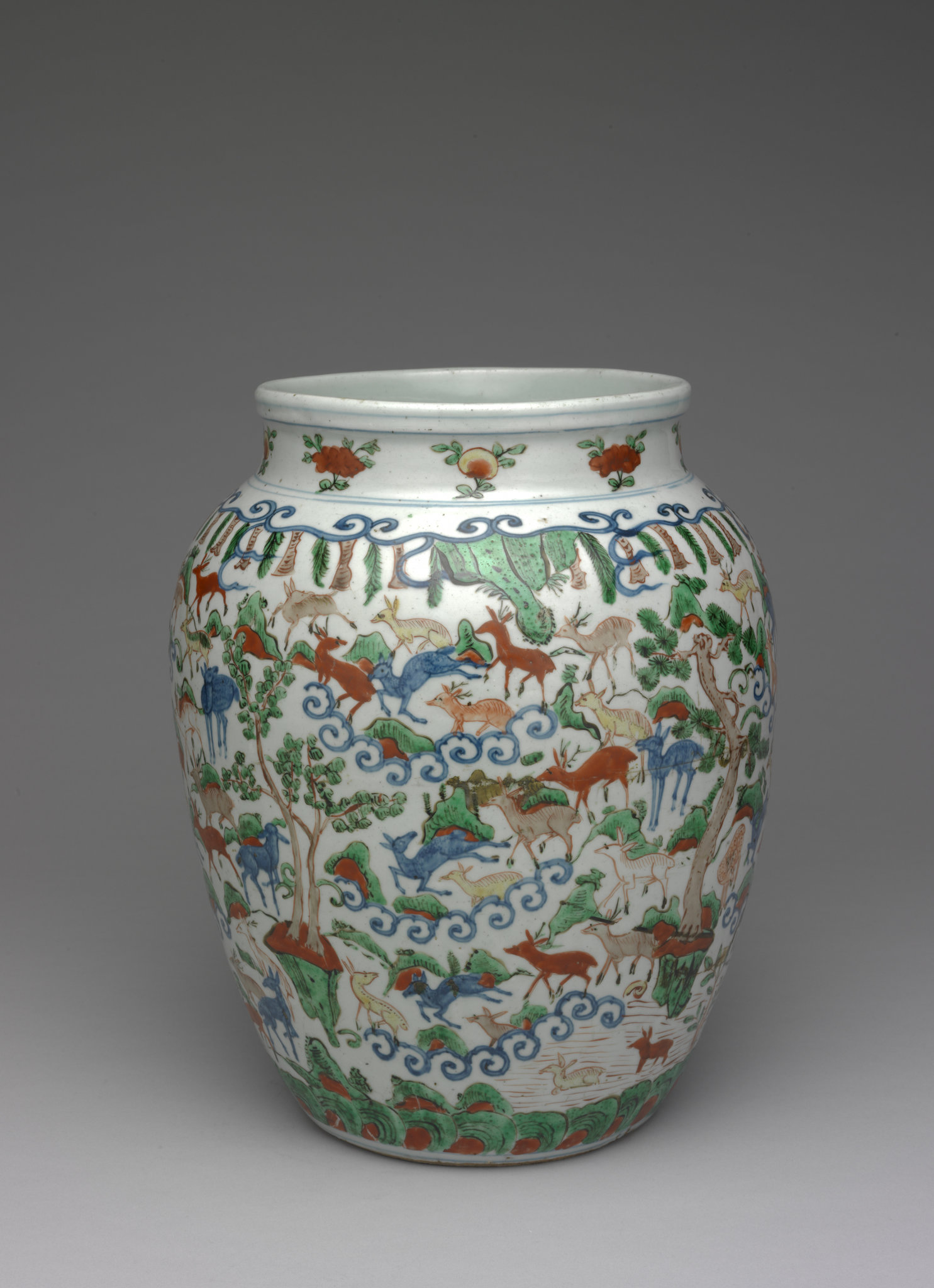


Fig. 3 Vase with “One hundred deer” motif in wucai painted enamels, Wanli mark and of the period (1573-1620), Ming dynasty. National Palace Museum, Taipei, 故瓷012030N000000000.
Other similar jars of the same shape as the present jar include one in the Museé Guimet, Paris, illustrated in The World’s Great Collections, Oriental Ceramics, Vol. 7, Tokyo, 1981, no. 26, one in the Tokyo National Museum, illustrated in Illustrated Catalogues of Tokyo National Museum, Tokyo, 1965, p. 130, no. 538 (Fig. 4), and one in the Matsuoka Museum of Art, illustrated by M. Matsuoka in Catalogue of Masterpieces of Oriental Ceramics, Tokyo, 1991, no. 75. A pair of blue and white jars and covers with the 'hundred deer' theme, given to Queen Christina of Sweden (r. 1632-54) by the Portuguese ambassador in 1640, is illustrated in The World's Great Collections - Oriental Ceramics, Vol. 8 - Museum of Far Eastern Antiquities, Stockholm, Tokyo, 1982, fig. 247. This pair of jars is also illustrated in the introduction to this catalogue.

Fig. 4 Jar with one hundred deer, Wanli mark and of the period (1573–1620), Ming dynasty. Tokyo National Museum, TG-901. Gift of Dr. Yokogawa Tamisuke, ©Tokyo National Museum.


/image%2F1371349%2F20260724%2Fob_99ce0b_26403.jpg)
/image%2F1371349%2F20260724%2Fob_b4a1d4_26397.jpg)
/image%2F1371349%2F20260724%2Fob_58a318_26316.jpg)
/image%2F1371349%2F20251202%2Fob_953b42_telechargement-20.jpg)