

/https%3A%2F%2Fprofilepics.canalblog.com%2Fprofilepics%2F1%2F0%2F100183.jpg)
/https%3A%2F%2Fstorage.canalblog.com%2F03%2F02%2F119589%2F96711876_o.jpg)
/https%3A%2F%2Fstorage.canalblog.com%2F11%2F31%2F119589%2F94773502_o.jpg)
/https%3A%2F%2Fstorage.canalblog.com%2F20%2F83%2F119589%2F94772815_o.jpg)
/https%3A%2F%2Fstorage.canalblog.com%2F26%2F72%2F119589%2F75604929_o.jpg)
/https%3A%2F%2Fstorage.canalblog.com%2F59%2F60%2F119589%2F26458628_o.jpg)
Everything is Transient. An Important White-Glazed Korean Moon Jar at Sotheby's New York, 9 September 2023
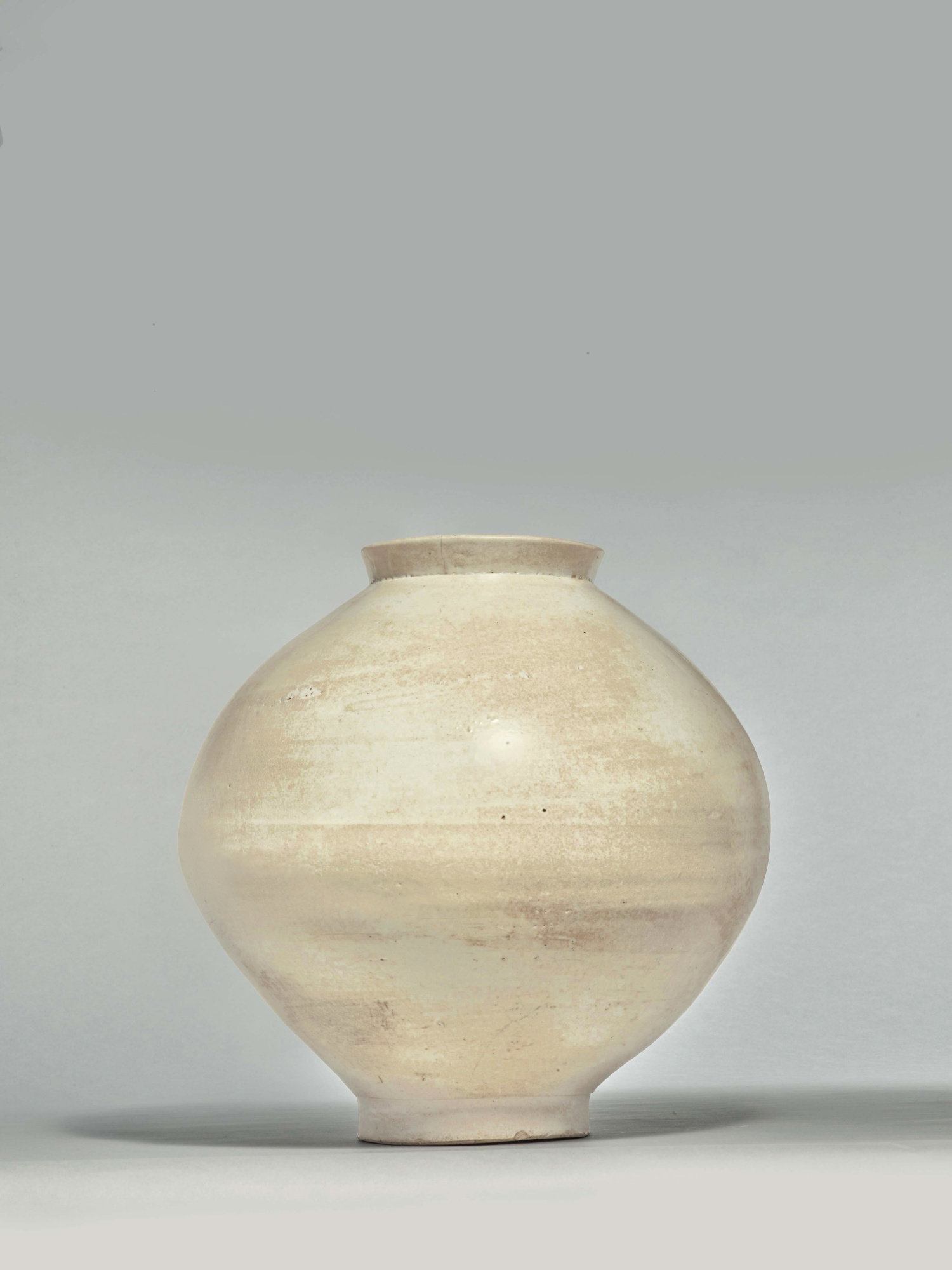


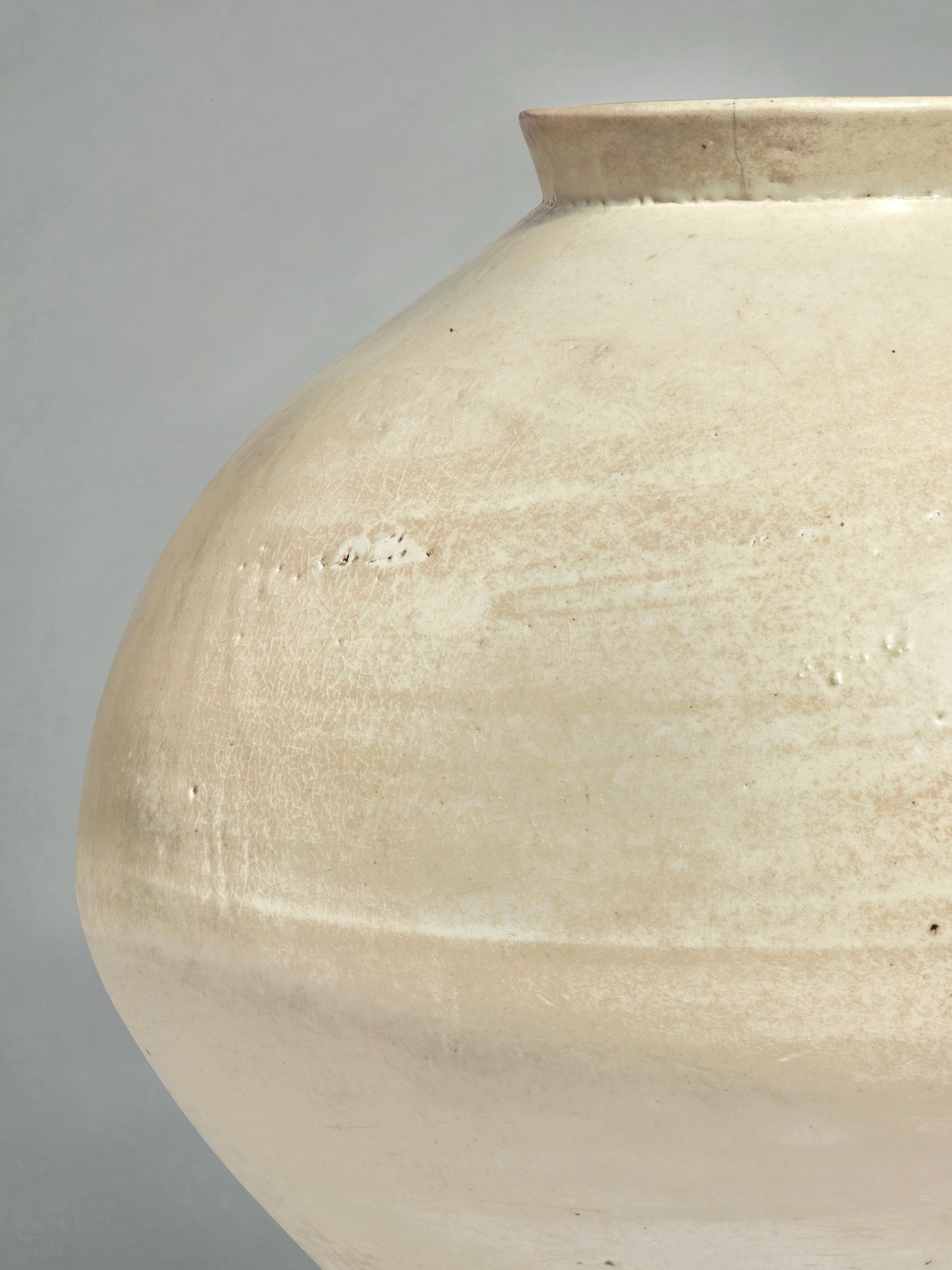

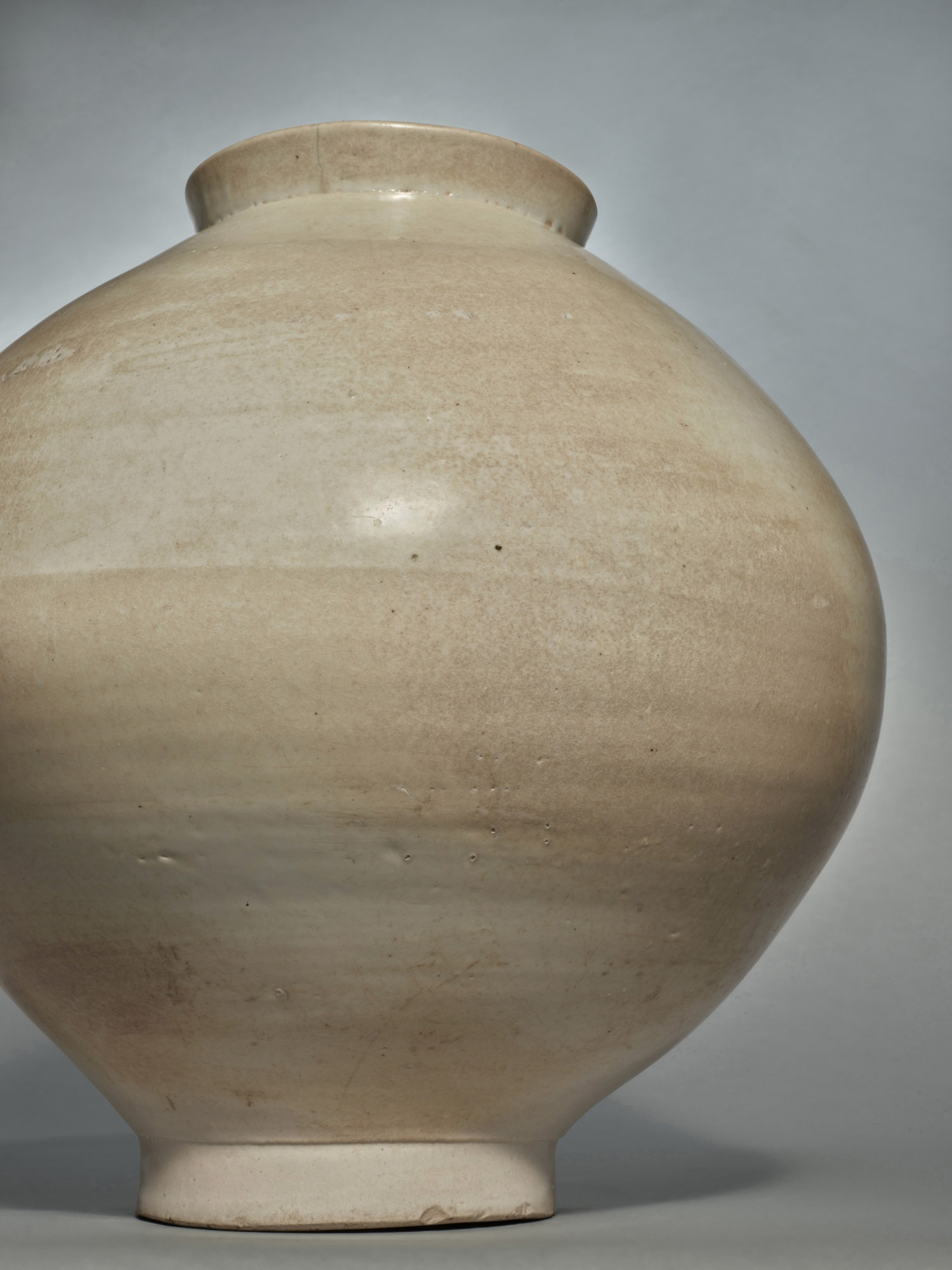

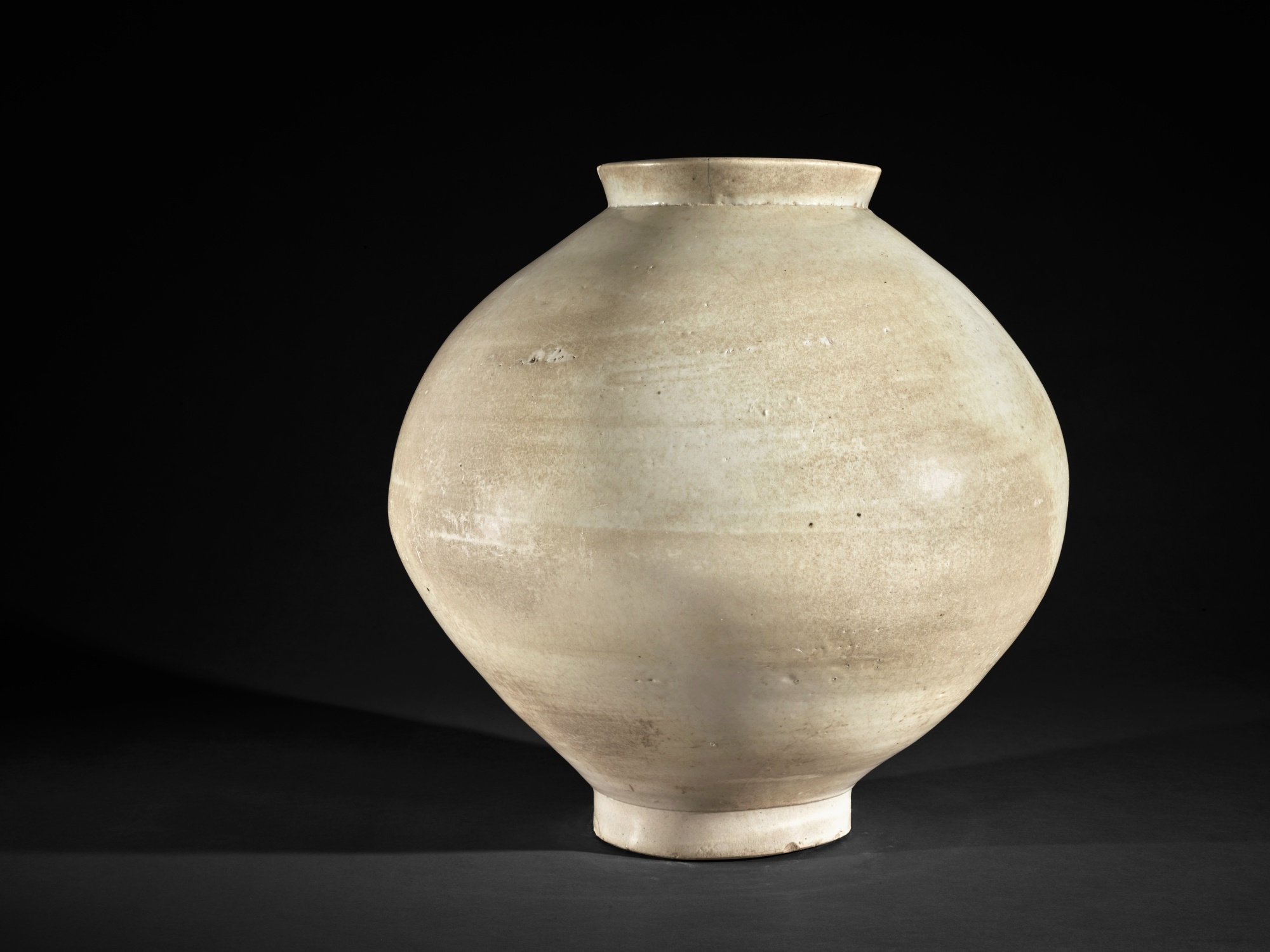

An important white-glazed moon jar, Joseon dynasty, late 17th-early 18th century. Height 45.2 cm; Diameter 45.4 cm. Estimate Upon Request. Lot Sold 3,569,000 USD. © Sotheby's 2023
Provenance: Japanese Private Collection, by 1964.
Important Japanese Private Collection, until circa 1978.
Japanese Private Collection.
Literature: Masterpieces of Korean Art, vol. 3, Tokyo, 1978, pl. 144.
Exhibited: Glory of Korean Pottery and Porcelain of the Yi Dynasty, Museum of Oriental Ceramics, Osaka, 1987, cat . no. 60.
“Like the moon of the 13th or 17th day” A large white-glazed moon jar
niversally admired for its luminous white porcelain surface, elegant, gravity-defying proportions, and charming idiosyncrasies, the evocatively named moon jar (dalhangari) epitomizes the nuanced, natural beauty acclaimed in Korean ceramics. Completely unique to Korea, moon jars were produced for a short amount of time during the Joseon dynasty (1392-1910) in the 17th and 18th centuries, likely for storage of grain or liquid. The jar’s deceptively simple form, plain surface, and striking materiality led to its “rediscovery” in the 20th century by art historians and artists alike. Indeed, the term “moon jar” is a modern moniker attributed to the Korean artist Kim Whan-ki (1913-1974), coined around the 1940s when Kim and other artists wrote lyrically about the vessel. In the Joseon period, it was simply referred to as a “large white ceramic jar” or “round jar” (wonho 圓壺).[1] From its humble beginnings as a utilitarian vessel, the moon jar has transcended geographic and cultural boundaries to become one of the most iconic and influential works of art in modern times, equally significant in the history of Korean ceramics, the development of modern studio pottery, and global art history.
Joseon Porcelain in the 17th and 18th century
Porcelain was introduced to Korea during the Yuan (1279-1368) and early Ming (1368-1644) dynasties in China, exemplified by blue and white vessels decorated with dragons given by the Ming Xuande Emperor (r. 1425-1435) to the Joseon King Sejong (r. 1418-1450). Soon, porcelain was made domestically in official court-sponsored kilns at Bunwon, near the capital city of Hanyang (present-day Seoul). These kilns supplied porcelains to the royal court for use in daily life and state rituals. The production of these vessels was highly regulated, with government-appointed supervisors overseeing the selection of raw materials and ceramic production. From its inception, porcelain was regarded as a material for Joseon elites—sumptuary laws restricted the use of porcelain to the court, and those who violated this rule were punished.[2]
Clouds over the river become rain in the night
Strong winds pass through the trees of the valley
Potters living together at the corner of the mountain
Endure hardship of forced labor
They say they went to Yeongnam
For fine clay to ship by sea
Clay white as snow
Is best for firing royal vessels
Although potters did their best
Many vessels were rejected
Clay as soft as cotton
Wheel moving when touched by foot
A thousand vessels shaped on the wheel
Bowls, plates, bottles, jars, smooth and gentle
As many as 30 names for bowls
As many as 400 vessels from a royal kiln
Cannot express the beauty of shape, color and quality
All are precious beyond measure].
-- YI HA-GON 李夏坤 (1677-1724)
Neo-Confucianism was the official state doctrine of the Joseon court and underpinned all aspects of society. The ideology advocated societal and cosmological harmony through the correct performance of rites, the fulfilment of social hierarchies and responsibilities, dedication to moral cultivation, and the observation of nature. Since the beginnings of the Joseon period, Neo-Confucian values of propriety, purity, humility, and frugality heavily influenced the décor, style, and form of Korean porcelain. Makers and consumers of Joseon porcelains eschewed colorful polychrome=enameled wares, and instead favored restrained, austere white-glazed ceramics with little or no decoration. Even when a vessel was decorated with underglaze pigment, there was a preference for using only one color and leaving an abundance of blank background space around the painted motif. Although Joseon elites certainly coveted and acquired lavish polychrome porcelains from China and Japan, generally, a restraint from ostentatious decoration and the preference for pure white ceramics persisted throughout the dynasty. Indeed, the eventual disappearance of freely decorated buncheong wares in the mid Joseon period can be partly attributed to the penchant for porcelain and all-white ceramics. White porcelain was the physical embodiment of the gunja 君子, or noble gentleman, who represented the pinnacle of Joseon Neo-Confucianist virtues and principles.[3] The Annals of King Sejeong note that in the 7th day of the 12th month in 1491, the king gave a white porcelain cup to the Royal Secretariat, saying,
‘This empty wine cup is clear and spotless, but once it is filled with wine, many specks and particles become apparent. Likewise, people who are utterly fair and upstanding will not tolerate that which is not righteous.’
King Sejeong’s moralizing metaphor of the white porcelain cup suggests the equivalence of the material with the Joseon quest to become a gunja.[4]
If raw substance dominates refinement, you will be coarse. If refinement dominates raw substance, you will be clerical. When refinement and raw qualities are well blended, you will be gunja, a human of virtue.
--CONFUCIUS, ANALECTS
Furthermore, geopolitical circumstances of the 16th and 17th centuries catalyzed the widespread embrace of pure white porcelains in Joseon Korea. Since the 15th century, porcelains painted with cobalt-blue were highly sought after. However, as cobalt had to be imported from China, blue and white porcelains were severely circumscribed and produced in limited quantities, and only became more prevalent from the early 18th century onwards with the availability of more affordable domestic cobalt.[5] The Japanese invasions (Imjin War 1592–98), Manchu invasions (Byeongja War 1636–37), and a long and tumultuous dynastic transition in China from the Ming to the Qing dynasty made it nearly impossible for Korean potters to obtain cobalt during that period.[6] The peninsula recovered from the invasions to usher in a second “golden age” of the Joseon dynasty in the 18th century: one marked by a heightened awareness of native customs, history, and culture, and a rise in distinctly Korean art forms independent of artistic practices in neighboring China and Japan. In terms of ceramic production, the late 17th through 18th century witnessed stylistic developments that were without parallel in East Asia and the rest of the world.[7]
One example of such artistic innovation is the moon jar. Moon jars first appeared in the late 17th century during the reign of King Sukjong (r. 1674-1720) and reached their peak in production in the early 18th century. Earlier examples have a flaring neck, while jars produced from the mid-18th century onwards typically exhibit straight necks. Ideally, the height and diameter of a moon jar should be the same to create its spherical shape, as the present jar demonstrates. Moon jars were produced by forming two roughly hemispherical bowls on a wheel, then joining them together at the rims to form the upper and lower halves of the vessel. This technique of making large jars is believed to have originated in Ming dynasty China.[8] However, in contrast to Chinese potters who aimed for perfect symmetry and smoothed or trimmed the seam to hide the lute line, Joseon craftsmen took care to make the two halves slightly different but compatible, and often left the seam visible, drawing focus to the jar’s charming form, the quality of the clay and its reaction in the kiln. The lute lines on moon jars often warped or cracked during firing, creating an imperfect sphere that evoked a waxing or waning moon. As the former Director of the National Museum of Korea Chung Yang-mo describes, moon jars are “as bright as the full moon, but have the charm of being a bit incomplete, like the moon of the 13th or 17th day.”[9]
With a capacious, gracefully swelling body, the present jar is a superlative example of its type. The jar’s height (44 cm) equals its diameter (44.6 cm) to approximate a perfect sphere, while its sloping, slightly asymmetrical walls imbue a sense of liveliness and naturalness in its form. Nuanced differences between the upper and lower body, the contours of the sides, and the tonality and texture of the surface, reveal the process and materials unique to the creation of this jar. In other words, the potter had to exercise restraint from overly refining the jar to maintain the qualities of the clay, kiln, and human touch that give the vessel its vitality. Its generous proportions are balanced by a narrow foot and flared mouth of similar diameter, creating a strikingly elegant, harmonious form heightened by its plain, white-glazed porcelain surface.
In the global history of ceramics, it is exceptionally rare to find vessels of such large proportions completely undecorated. This chaste aesthetic resonated deeply with Joseon Neo-Confucian values of restraint, austerity, order, simplicity, modesty, and purity. Moreover, the eschewal of expensive, flamboyant cobalt ornamentation, and indeed any decoration whatsoever, demonstrates a prioritization of frugality over excess, pragmatism over whimsy, purity over corruption, and the indigenous over the foreign; values promoted by the Silhak (‘practical learning’) school of Korean Neo-Confucian thought which became influential from the late 17th century onwards. As the Joseon Silhak scholar Yi Gyu-gyeong (1788-1856) observed, “The greatest merit of white porcelain lies in its absolute purity. Any effort to embellish it would only undermine its beauty.”[10] Kim Hyunjung, Associate Curator of the Fine Arts Division at the National Museum of Korea, notes that “The blank space is a perfect manifestation of restraint and anonymity, devoid of greed or selfishness.”[11]
The greatest merit of white porcelain lies in its absolute purity. Any effort to embellish it would only undermine its beauty.[QC4]
-- YI GYU-GYEONG 李圭景 (1788-1856)
To achieve a pure white appearance, moon jars were made from highly refined clay with no iron content, dipped in a clear or translucent white-tinged glaze, and fired at extremely high temperatures of over 1250°C. Unlike many ceramics produced according to standard patterns and forms in kilns across East Asia during this period, no two moon jars are alike. Jars were glazed in a range of white tones, from milky, ivory, and ashen to bluish or snow white. The unadorned surfaces encourage meditation and close looking, revealing subtle changes in texture and tonality—indices of the jar’s journey from its inception on the pottery wheel to its metamorphosis in the fiery furnace. The Korean word yobyeon (‘change in the kiln’) succinctly captures the effect of clay, fire, air, and ash intermingling in the kiln and the natural, unintended consequences of the firing process. A spectrum of hues is found on a single moon jar, from peach-toned flourishes to yellowish spots caused by oxidation, incomplete combustion, or discoloration from the seepage of liquid or food contained inside.[12] These chance features were embraced by Joseon consumers and continue to appeal to viewers today.[13]
Here, the jar’s deceptively monochrome surface belies a range of hues and tonalities. Passages of milky white glaze coalesce into an area of thicker, bluish-tinged glaze covering one half of the vessel and dripping down the neck and shoulder. Smooth swathes of ivory white glaze finely speckled with flecks of iron give way to softly diffused blooms of beige and peach infused with fine networks of crackle. These warm-hued flourishes evoke the sunset in a hazy sky, or the cloud of pigment efflorescing from an inkbrush dipped in water. The glaze thins at the rim and the foot into a pinkish tone, revealing the buff clay body beneath. The jar leans slightly left or right depending on how it is placed, imbuing its outline with a sense of liveliness and movement that is enhanced further by the uneven seam. Yet, there is an overall sense of utmost harmony and balance, achieved in no small part by the narrow lip and foot that anchor its weighty presence. Each subtle change in coloration, texture, and form of the jar reveals its singular story—a perfect amalgamation of human intervention, chance, and natural occurrence.
The scholar does not deem gold and jade precious, but loyalty and good faith. He does not crave broad lands and possessions, but holds the rectification of himself his domain.
--CONFUCIUS
While the exact function of moon jars is unclear, they were likely used to store grain or liquid.[14] There are no known Joseon-era records concerning what these jars were used for, however some surviving examples have inscriptions that refer to the royal kitchen. Scientific analyses have also found remnants of vegetable oil in the interiors.[15] However, some scholars believe that they may be too large for use at the table or for storage and therefore their function is still subject to further research.[16] Given their impressive size, luxurious material, and the Joseon practice of using pure white porcelains in Confucian ceremonial rites, it is also possible that they were displayed as decoration, appreciated for their artistic value, or used as ritual vessels.[17] For example, the painting Gathering of Elderly Gentlemen by Kim Hong-do (1745-1806) depicts a scene of elderly men seated in front of small tables with white porcelain tableware, all surrounding a central table supporting large white porcelain vessels (fig. 1).

Fig. 1 Detail of Gathering of Elderly Gentlemen (italics Gathering of Elderly Gentlemen), Kim Hong-Do, 1804, Illustrated in Portal Jane, 'A Korean Porcelain 'Full-Moon' Jar : Bernard Leach Lucie Rie and The Collecting of Oriental Ceramics.' Apollo (Italics Apollo), 1999, Fig. 5.
Of the things brought about by the rites, harmony is the most valuable.
--CONFUCIUS
“Rediscovering” the Moon Jar
Moon jars were only produced for about two hundred years, and fell to relative obscurity in the 19th century. By the early 20th century, most collectors dismissed Joseon porcelain as inferior to Goryeo celadons. This view was challenged by a small but influential group of Japanese collectors. Philosopher and art critic Yanagi Sōetsu (1889-1961), founder of the Mingei (‘folk craft’) movement that championed the beauty of ordinary utilitarian objects made by traditional craftsmen, admired Joseon porcelain for its “natural,” simplistic beauty. Yanagi championed the “beauty of deformity” found in the asymmetry and firing flaws often seen in Korean ceramics.[18] He exclaims, “How many times have I witnessed immortal Joseon works even though the period is often overlooked as a declining, final phase. Some of its wooden and porcelain works are truly eternal.”[19]
Although Yanagi’s interpretations of Korean art have since been criticized for their essentializing and colonialist undertones, his work had significant influence in bringing attention to Joseon porcelain, both in Korea and abroad. In the wake of World War II, the moon jar caught the attention of an early generation of postcolonial Korean artists and scholars who sought to restore Korean art history and national identity, as the vessel resonated with the visual language of international modernism and minimalism of the mid-20th century while remaining a distinctly Korean work of art.
As I said many times before, our white porcelain jar would be right at home in a Le Corbusier house. As Le Corbusier’s art is new, so is the white porcelain jar.
--KiIM WHAN-KI (LETTER)
One figure who played an influential role in popularizing the moon jar was the pioneering Korean abstract artist Kim Whan-ki (1913-1974). Kim was an avid collector of moon jars, which informed much of his artistic practice and remained a significant motif throughout his oeuvre (fig. 2). Acknowledging that everything he knew about form and aesthetics came from Joseon ceramics, Kim claimed, “They awakened my eyes to beauty.”[20] Kim found his ultimate artistic ideal through the moon jar: to create art that was simultaneously Korean and universal, ancient yet modern.[21] Sharing Kim’s sentiment for the creativity that a moon jar could arouse, the art historian and former Director of the National Museum of Korea Choi Sun-u (1916-1984) wrote in a 1963 article, “Whenever I struggle to find an idea for writing, I caress whichever [moon] jar is closest to me and then I come up with a good idea.”[22]

Fig. 2 Immortal Crane and Vase, Kim Whan-ki, ca. 1950, oil on canvas, sold at Sotheby's Hong Kong, 6th October 2014, lot 762.
The pot is the man: his virtues and his vices are shown therein – no disguise is possible.
--BERNARD LEACH
The moon jar was not only significant in the re-evaluation of Korean art and ceramics in the 20th century, it is also immortalized in the story of modern and contemporary studio pottery in the West. The esteemed British potter Bernard Leach (1887-1979), regarded as the father of British studio pottery, was involved in the Mingei movement in the early 20th century and friends with its leaders, including Yanagi Sōetsu. During a visit to Seoul in 1935 with Yanagi, Leach purchased a large moon jar from an antique store, describing that he left the store “carrying a piece of happiness” (fig. 3).[23] This jar has had its own fascinating history, as it was gifted to the renowned studio potter Lucie Rie (1902-1995) for safekeeping during the war. It remained in her studio for 50 years and is a testament to the impact of Korean ceramics on studio pottery in Britain and around the world in the past century.

Fig. 3 A Moon Jar, Joseon Dynasty, 18th Century © The Trustees of the British Museum
To appreciate a moon jar properly, you should look beyond its simple shape. Although it is a plain porcelain jar with no decorative elements whatsoever, it will seem different every time you look at it, depending on the circumstances. It will look quite different when you feel good and when you feel gloomy, when the weather is sunny, rainy, or cloudy.
--KWON DAE-SUP
Moon jars continue to inspire contemporary Korean artists like Kwon Dae-sup, Park Young-sook, Yeesookyung, Koo Bohnchang, or Choi Young Wook, many of whom spend their entire careers faithfully recreating Joseon moon jars or employ the moon jar as a leitmotif in their work. The moon jar has also become a symbol of Korea and a global icon in popular culture. In 2012 the Unification Minister Yu U-ik chose the moon jar as a symbol for a joint Korean peninsula, and artists like Ik-Jook Kang use the vessel to represent personal and political reunion. At the 2018 Winter Olympics in PyeongChang, the Olympic torch was held in a giant moon jar supported by curved pillars. In November 2019, Kim Nam-joon (also known as RM), leader of the hugely successful K-pop group BTS, posted a picture of himself hugging a contemporary moon jar made by Kwon Dae-sup, with a caption describing the calm he felt around the vessel.[24] Simultaneously historical and reflective of contemporary tastes, local and global, and revered in both fine art and popular culture, the moon jar is one of the very few works of art that has transgressed multiple cultural and disciplinary boundaries in the 20th and 21st centuries.
Moon Jars in Collections Worldwide
Joseon dynasty moon jars were made in a variety of sizes ranging from 29 cm to around 49 cm in height. Although the term is generally used to describe the form of the vessel, according to the Cultural Heritage Administration in South Korea, Joseon white-glazed vessels of this spherical form are only officially considered moon jars when they reach a height of over 40 cm. Measuring 44 cm high, the present jar ranks amongst the larger jars and is comparable to some of the finest examples designated Treasures/National Treasures in Korea or housed in museums and private collections worldwide. It is exemplary for its equally wide diameter and resulting voluminous, spherical form, as most related moon jars exhibit a slightly narrower, taller silhouette.
Closely related moon jars of the similar height include one from the early 18th century formerly in the collection of Charles Bain Hoyt and now in the Museum of Fine Arts, Boston that tapers more towards the base and is more bluish in tone (44 cm) (accession no. 50.1040) (fig. 4); an 18th century example from a private collection designated National Treasure no. 309 and exhibited in Joseon White Porcelain, Paragon of Virtue, Leeum Museum of Art, Seoul, 2023, cat. no. 35, with similar peach flourishes but a short straight neck and more ovoid profile (44.5 cm) (fig. 5); and another 17th / 18th century jar in the National Palace Museum, Seoul, designated National Treasure no. 310, with a shorter lip and milkier white hue (43.8 cm). See also a mid-17th to mid-18th century moon jar from the Avery Brundage Collection now in the Asian Art Museum, San Francisco with similarly generous proportions (45.7 cm) (accession no. B60P110+) (fig. 6); an 18th century jar with a thinner lip in the Museum of Oriental Ceramics, Osaka (45 cm) (accession no. 01404) (fig. 7); and two that sold at auction: one at Seoul Auction, 26th June 2019, lot 179 , that set the record for the most expensive ceramic sold at auction in South Korea (45.5 cm), and another sold recently at Christie’s New York, 21st March 2023, lot 177 (45.1 cm).

Fig. 4 A Moon Jar, Joseon Dynasty, Early 18th Century © Museum of Fine Arts, Boston.

Left Fig. 5 A Moon Jar, Joseon Dynasty, 18th Century © Leeum Museum of Art, Seoul
Right: Fig. 6 Moon Jar, 1650-1750. Joseon Dynasty (1392-1910). Porcelain with clear glaze. Asian Art Museum of San Francisco, |The Avery Brundage Collection, B60p110+. Photograph © Asian Art Museum of San Francisco.

Left: Fig. 7 A Moon Jar, Joseon Dynasty, 18th Century © The Museum of Oriental Ceramics, Osaka (Gift of Mr. Shindo Shinkai), Photography by Muda Tomohiro
Right: Fig. 8 A Moon Jar, Joseon Dynasty, 18th Century © Honolulu Museum of Art, Honolulu
Larger examples include an 18th century jar in the Uhak Foundation of Culture, Seoul, designated National Treasure no. 262, with similarly everted rim but beige-tinged glaze with yellowish spots and a proportionally narrower foot (49 cm); the aforementioned 18th century example in the British Museum, London, with similar lip and slightly more ashen glaze (47 cm) (accession no. 1999,0302.1) (fig. 3); one with creamier glaze designated Treasure in the Amorepacific Museum of Art, Seoul, exhibited in Joseon White Porcelain, Paragon of Virtue, op. cit., cat. no. 36 and one in the Honolulu Museum of Art, Honolulu, exhibiting a very similar profile and pinkish-peach hues to the present jar (47 cm) (accession no. 7733.1), exhibited in Korean Art from the United States, National Museum of Korea, Seoul, 2012, cat. no. 21 (fig. 8). For a slightly shorter example, compare an early 18th century jar in the National Museum of Korea, National Treasure no. 1437, its surface similarly infused with passages of fine brown crackle (41 cm) (accession no. Jeopsu 702).
For moon jars with a closely related silhouette to the present, but under 40 cm tall, compare a late 17th / early 18th century example sold in these rooms, 22nd September 2022, lot 503 (36 cm), one in the Cleveland Museum of Art, Cleveland (34.3 cm) (accession no. 1983.28) (fig. 9); and one in the Birmingham Museum of Art, Birmingham (36.8 cm) (accession no. 2002.4).

Fig. 9 A Moon Jar, Joseon Dynasty, 18th Century © The Cleveland Museum of Art, Purchase from The J. H. Wade Fund 1983.28.
Through its deliberate restraint and harmonious form, the moon jar evokes a sense of sublime elegance and beauty. Arguably one of the most important ceramics in recent memory, the moon jar continues to inspire, astound, and soothe those fortunate enough to stand in its presence.
[1] Charlotte Horlyck, “The Moon Jar: The Making of a Korean Icon,” The Art Bulletin, vol. 104:2 (June 2022), p. 124; Joseon White Porcelain, Paragon of Virtue, Leeum Museum of Art, Seoul, 2023, p. 102.
[2] Soyoung Lee, “Ceramics and Culture in Chosŏn Korea,” in A Companion to Korean Art, eds J.P. Park, Burglind Jungmann and Juhyung Rhi, Hoboken, 2020, p. 322; Jeon Seung-chang, “White Porcelain of Joseon Dynasty for the Royal Court in the Fifteenth and Sixteenth Century,” in Joseon White Porcelain, Paragon of Virtue, Leeum Museum of Art, Seoul, 2023, pp 362-364.
[3] Lee Jun-kwang, Joseon White Porcelain, Paragon of Virtue, Leeum Museum of Art, Seoul, 2023, p. 10.
[4] Ibid., 20.
[5] Soyoung Lee, op. cit., p. 333. For more on the scarcity of cobalt blue in the early to mid-Joseon dynasty, see Jeon, op. cit., 366-368.
[6] Jeon, op. cit., 368.
[7] Soyoung Lee, op. cit., p. 334.
[8] Kim Hyunjung, “The Height of Restraint: Pure White Porcelain Moon Jars of the Joseon Dynasty,” National Museum of Korea Quarterly Magazine, vol. 34, p. 6.
[9] Chung Yang-mo, “White Moon-faced Porcelain Jars,” Koreana, vol. 14:1 (Spring 2000), p. 72.
[10] Jane Portal, “A Korean Porcelain ‘Full-Moon’ Jar,” Apollo, vol. 150 (November 1999), p. 37.
[11] Kim, op. cit., p. 2-4
[12] Ibid., p. 5
[13] Lee, op. cit., p. 334.
[14] Ibid.
[15] Joseon White Porcelain, Paragon of Virtue, op. cit., p. 102.
[16] Bang Byung-sun, “Joseon White Porcelain for the Royal Court in the Seventeenth and Eighteenth Century,” in Joseon White Porcelain, Paragon of Virtue, Leeum Museum of Art, Seoul, 2023, p. 382.
[17] Portal, op. cit., p. 37.
[18] Ibid., p. 37.
[19] Horlyck, op. cit., p. 122.
[20] Ibid., p. 124.
[21] Christine Y. Hahn, “Clay Bodies, Moon Jars, and Materiality: Reconciling Dualisms in the Paintings of Kim Whanki,” positions: asia critique, vol. 24(2), p. 493.
[22] Horlyck, op. cit., p. 125.
[23] Doh Jae-kee, “Potter Pursues Subtle Hues of the White Moon Jar,” Koreana, vol. 23:3 (Autumn 2014), p. 40.
[24] Horlyck, op. cit., p. 137.


/image%2F1371349%2F20260916%2Fob_a195f3_36749.jpg)
/image%2F1371349%2F20260913%2Fob_a49183_36450.jpg)
/image%2F1371349%2F20260813%2Fob_89789c_telechargement-43.jpg)
/image%2F1371349%2F20260811%2Fob_46ce03_telechargement-33.jpg)