

/https%3A%2F%2Fprofilepics.canalblog.com%2Fprofilepics%2F1%2F0%2F100183.jpg)
/https%3A%2F%2Fstorage.canalblog.com%2F03%2F02%2F119589%2F96711876_o.jpg)
/https%3A%2F%2Fstorage.canalblog.com%2F11%2F31%2F119589%2F94773502_o.jpg)
/https%3A%2F%2Fstorage.canalblog.com%2F20%2F83%2F119589%2F94772815_o.jpg)
/https%3A%2F%2Fstorage.canalblog.com%2F26%2F72%2F119589%2F75604929_o.jpg)
/https%3A%2F%2Fstorage.canalblog.com%2F59%2F60%2F119589%2F26458628_o.jpg)
Spring and Dragon: Shanghai Museum Year of the Dragon Spring Exhibition
SHANGHAI - It’s the Year of the Dragon in Jiachen, and the new year is auspicious. The dragon is a creation myth that spans thousands of years and is also a spiritual totem that the Chinese nation is proud of. The oracle bone inscriptions of the dragon (  ) have horns, a huge mouth, a curved body, a hooked tail, and a clear shape. However, there are still many different opinions on its origin, including reptiles, astronomy, totems, insects, etc., which brings together the imagination of ancient and modern times. The images of dragons are correspondingly flexible and changeable. Some are like crocodiles or snakes, crawling and coiling, and some are like beasts, leaping and running. On this basis, there are many complex patterns and variations.
According to literature, the important characteristics of the dragon are "the ability to be dark and bright, to be thin or giant, to be short or long, to ascend to the sky at the spring equinox, and to dive into the abyss at the autumnal equinox." It is an extraordinary existence that goes up to the sky and into the earth, causing clouds and rain. It is of extremely important significance to agricultural society. In addition, the dragon is also an auspicious beast in the hearts of the ancients, indicating the east and the stars, the emperor and power. It was also absorbed into the Buddhist and Taoist systems, developing the belief in the Dragon King that has influenced today.
The Shanghai Museum, together with the Liaoning Provincial Institute of Cultural Relics and Archeology and the Xi'an Museum, will exhibit eight dragon cultural relics from different periods and with different images. They are witnesses of the ancestors' adaptation and transformation of nature, and are also a portrayal of the integration of multicultural arts. We regard the dragon as a symbol of the long history of Chinese civilization and the pioneering spirit of the Chinese nation. The descendants of the dragon continue to write and create history. On the occasion of the New Year in the Year of the Dragon, I wish the audience and friends can feel the warmth of spring and the high vitality of traditional culture from the exhibition.


Jade 'pig dragon', Late Neolithic, Hongshan Culture (about 5500-5000 years ago). Unearthed at the Niuheliang site in Chaoyang City, Liaoning Province in 2003. Collection of Liaoning Provincial Institute of Cultural Relics and Archeology.
The head is large, with erect ears and a ridge between the ears. The muzzle protrudes forward, and the folds between the eyes, mouth and nose are carved with negative lines. The body is curved in a Jie shape, and there are obvious cutting marks at the notch. There is a round hole in the neck for tying. This kind of jue-shaped vessel is considered to be an early image of the dragon. Based on the shape, it is speculated that it may have originated from pigs, bears or silkworms, etc., which reflects the richness of the origin of dragon culture.
The Niuheliang site is a large-scale sacrificial site group in the late Hongshan Culture. A large altar, a goddess temple, a group of stone tombs and a large number of jade ritual vessels were discovered. It is known as one of the cradles of Chinese civilization. The high-level tombs at the site contain jade as important burial objects, which may have been regarded as tools for cultivating the gods.


Bronze Fish and Dragon water vessel, pan, Late Western Zhou Dynasty. Hight 13.9 cm, diameter 33 cm, base diameter 23.5 cm; Weight 3500 grams.  Shanghai Museum.
The fold is along the shallow abdomen, the high-circle feet are turned outwards, and there are two attached handles on the abdomen. One of the attached handles has two short beams connected to the mouth of the vessel. The outer belly is decorated with a deformed dragon pattern, without a concrete dragon head. The inner wall is decorated with twelve fish patterns connected end to end. The center of the inner bottom is a spiral dragon pattern, with the dragon's head in the center, two circles of eye sockets, and prominent round eyes. The shape of the dragon's horns and mouth are quite special. There is a small dragon behind the left dragon horn, and there are two symmetrical curved bodies under the dragon's head. little dragon. The torso is turned to the right, decorated with scales, and has two claws on the side.
The dish is mainly used in the wash ( guàn ) ritual, which is the ritual of washing hands. Water is poured into the basin ( hé ) or 府 ( yí ) to wash hands, and the waste water is collected in the dish. During sacrifices and banquets, people must wash their hands to show their cleanliness and respect for their guests. Dragon patterns are often combined with water vessels such as plates, reflecting the connection between dragons and water.

Gilt bronze dragon head silver chain lock, Tang Dynasty (618-907). Excavated from Xianyang Yaodian, Shaanxi Province in 1980. Collection of Xi'an Museum. Xi'an Museum.
The chain body is braided with silver wire and equipped with a dragon head-shaped lock. The dragon head is made of copper, with a gilt surface, a long mouth with a single horn, huge eyes and fangs, big ears and long beards, a rolled nose, and a ring lock in the mouth. The dragon head and chain are riveted together. The whole device is 102 centimeters long and weighs 647 grams. Judging from similar cultural relics, this necklace may be a necklace worn by monks or laypeople, intended to worship the Buddha and protect the Dharma. It is well-made and made of expensive materials, which reflects the social and economic development level of the Tang Dynasty and the economic development of Buddhist temples at that time.

Gold dragon, Tang Dynasty (618-907). Unearthed in Guojiatan Village, Xi'an City, Shaanxi Province in 1971. Collection of Xi'an Museum. Xi'an Museum.
The dragon has a long head and a single horn, huge eyes and a wide mouth. There are three short beards under the eyes and ears. It looks like it is flying in the air. Its claws are sharp and have three toes. The body is relatively straight, and the lower hollow is inlaid with turquoise. The neck and back are curled into sharp angles, the long tail is straight and curled at the end. horns, three clawsThere are small holes on each end, which are used for rivets. It is speculated that they should be decorations on some utensils. The dragon scales are clear and fine, and the shape is strong and powerful, reflecting the superb craftsmanship and aesthetic taste of the Tang Dynasty.


Ding white glazed 'dragon' dish, Song dynasty (960-1279). Porcelain. Height 4.5 cm, diameter 23.3 cm, bottom diameter 10.8 cm; Weight 405 grams. Shanghai Museum.
Open, curved belly, circled feet. The body and feet of the vessel are covered with glaze, and the glaze color is white with a hint of yellow. The rim of the mouth cannot be glazed due to over-firing, resulting in an exposed rim, so it is decorated with metal buckles. The inner wall is stenciled with cloud and dragon patterns. The dragon has a strong body and fine scales. It looks at each other from head to tail and leaps in the clouds. This dragon-patterned plate has exquisite craftsmanship and is rare in the world. It can be called a masterpiece. It may be one of several cloud-dragon-patterned plates unearthed from the Faxing Temple site in Quyang, Hebei.
Beginning in the Song Dynasty, the shape of the dragon formed a relatively fixed paradigm, which had a profound impact on later generations. Guo Ruoxu of the Northern Song Dynasty summed up the theory of painting dragons by "folding them into three stops and dividing them into nine likenesses".


'Six Dragons' Rhinoceros Horn Cup, "Youkan" mark, Ming dynasty (1368-1644). Height 9.2 cm, mouth length 11.4 cm, mouth width 16.2 cm; Weighs 350 grams. Shanghai Museum.
The cup is surrounded by auspicious clouds, and six dragons and dragons are passing through the clouds. Two dragons rise up to form the handle of the cup, clinging to the rim of the cup. They put their heads in and compete with the dragon inside the cup to play with the orb. One dragon on one side of the cup wall is trying to move up, while the two dragons on the other side are rising and falling, playing with each other. The whole picture is full of rolling clouds and dragons, and the atmosphere is extraordinary. The carving is exquisite and powerful, the dragon tattoo has an elegant posture, scales and claws are strong, and the beard and mane are flying, which is a typical Ming Dynasty style. The body of the cup has the inscription " Youkan " written in Yangwen seal script .
There is no record of Youkan's life, but it may be related to the famous rhinoceros worker Youtong who was enshrined in the palace in the early days of Kangxi. There are several fine rhinoceros horn carvings handed down from generation to generation that are particularly distinguished by their uniqueness, and none of them can be caught off guard by ordinary artists. Considering the style of his works, he was active in the late Ming and early Qing dynasties.


Carmine red blue and white 'dragon' moonflask, bianhu, Qianlong mark and period (1736-1795), Jingdezhen kiln. Porcelain. Diameter 3.5 cm, height 16.7 cm, base width 5.3 cm, base length 3.5 cm. Shanghai Museum.
Small mouth, short neck, double handles, flat and round belly, and circle feet. On the front and back of the bottle, a five-clawed dragon is painted in carmine red, surrounded by auspicious clouds painted in blue and white. The blue and white are deep, and the carmine red is delicate and beautiful. The two colors complement each other. On the neck of the flat bottle, the Chinese character " Shou " is written in rouge red color , which means a hundred years of auspiciousness. At the bottom is a six-character seal script in blue and white with the inscription " Made in the Qianlong Year of the Qing Dynasty " . During the Qianlong reign, there were many copies and imitations of famous porcelain from past dynasties. This type of flat bottle should be based on the moon-holding bottle from the Yongxuan period of the Ming Dynasty. Carmine is an overglaze color that was successfully fired at the Jingdezhen Royal Kiln Factory in the 13th year of Yongzheng's reign. Tang Ying ( 1682-1756 ), the pottery supervisor, called it " new Western purple "
The five-clawed dragon pattern was a royal pattern on official kiln porcelain in the Qing Dynasty. However, as late as the beginning of Qianlong's reign, such patterns were already being used among the people, and were not strictly prohibited by the government. The Zhu Zhu written by Qianlong clearly stated that " five-clawed dragons are often found outside " and instructed Tang Ying to sell the chosen weapon at a local price.


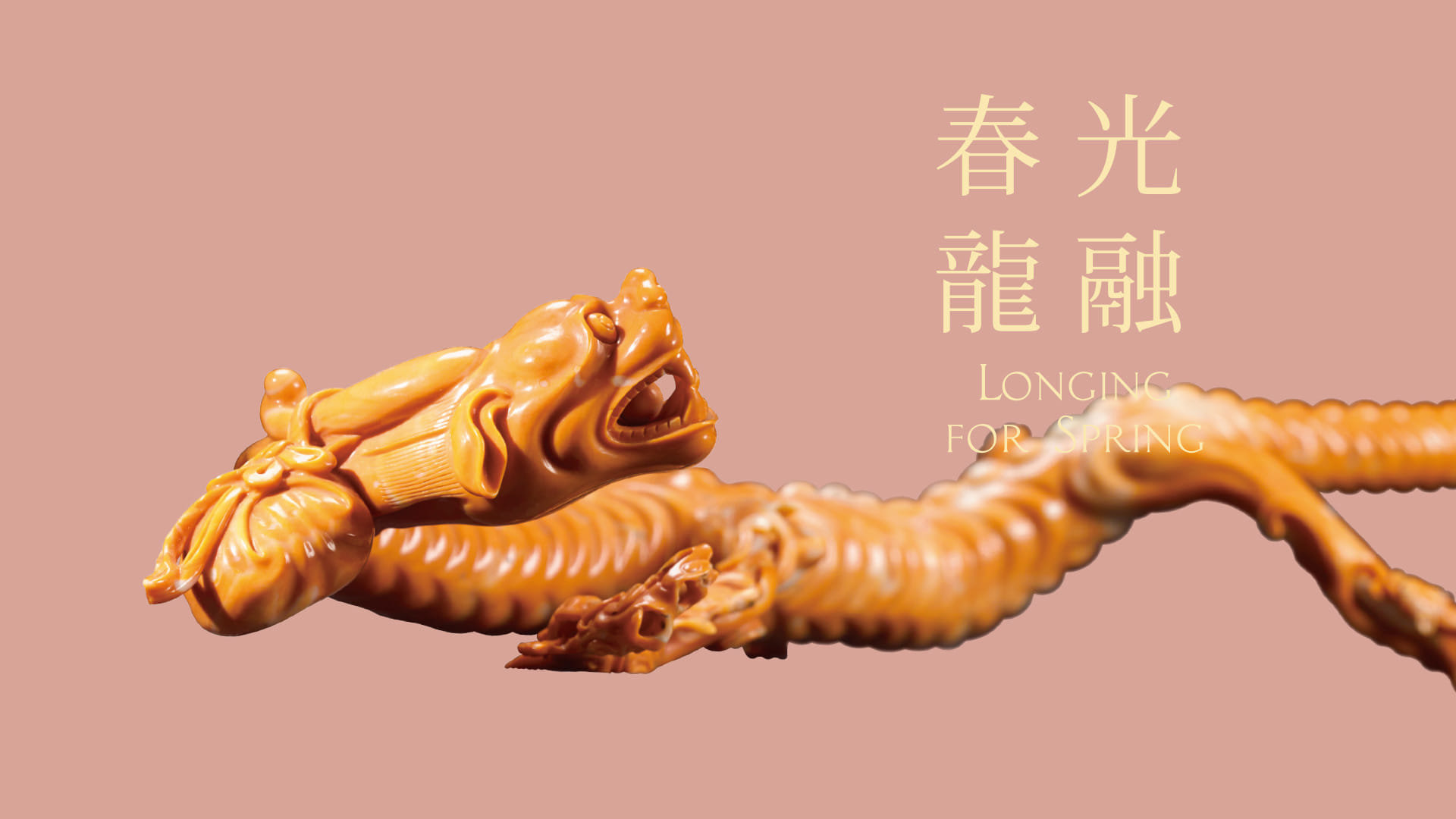
Coral dragon, Modern. Overall length 68 cm, maximum width 20.7 cm: Weight 1070 grams. Shanghai Museum.
This artefact is carved with a whole branch of red coral as a swimming dragon, which is quite rare. The dragon looks back and sways its tail, its eyes are wide open, and its huge mouth is wide open. There is a movable orb in the mouth. The dragon's horns are trailing behind, and there is a bag-like weapon hanging on it. The body of the dragon is skillfully carved in the shape of coral, with clear carvings on the back and dragon scales. The limbs are carved with Ganoderma lucidum and small climbing dragons. The shapes are different and show unique ingenuity.
Coral is an organic gemstone, which is formed by the accumulation of lime secreted by coral polyps in the ocean. It can be seen in red, white, blue, gold, black and other colors, with red coral being the most popular. As early as the ancient Greek and Roman times, coral had been made into amulets and worn everywhere. In the East, coral is also regarded as auspicious and happy things. According to historical records, the royal family of the Qing Dynasty would wear coral beads during grand ceremonies, and auspicious ornaments such as coral trees would be displayed in the palace when celebrating birthdays.


/https%3A%2F%2Fstorage.canalblog.com%2F30%2F60%2F119589%2F41063150_o.jpg)
/image%2F1371349%2F20260201%2Fob_09ca36_1000050853.jpg)
/image%2F1371349%2F20251231%2Fob_6cc2bc_1000046227.jpg)
/image%2F1371349%2F20250704%2Fob_5805fe_1000022449.jpg)