


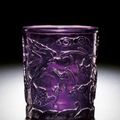
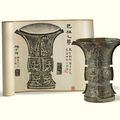


The Sir Percival David pottery jar, Zhou dynasty; imperially inscribed with Qianlong’s poem Yong Tao Zun (“Ode to a Pottery Zun”)


Lot 8024. The Sir Percival David pottery jar, Zhou dynasty; imperially inscribed with Qianlong’s poem Yong Tao Zun (“Ode to a Pottery Zun”), very likely composed for this vessel and dated to the summer of the jichou year (1769); 26 cm. Lot Sold 7,680,000 HKD (Estimate 6,000,000 - 12,000,000 HKD) © Sotheby's 2026
Provenance: Collection of Sir Percival and Lady David.
Sotheby’s London, 5th December 1961, lot 25.
Bluett & Sons, London.
A European private collection.
Sotheby’s London, 7th November 2012, lot 211.
Literature: R.L. Hobson, A Catalogue of Chinese Pottery and Porcelain in the Collection of Sir Percival David, London, 1936, p. 181.
Nicolas Chow, The Literati Aesthetic, Hong Kong, 2018, no. 23 and cover.
Note: A vestige of antiquity reborn through the admiration of an emperor, the present jar is a remarkable survivor. Tracing almost three thousand years of Chinese history in its rich patina, rope-twist surface, and voluptuous form, the jar stands as a testament to the enduring beauty of Chinese ceramics and the power of connoisseurship.
At first glance, the present jar appears understated. Fairly well attested in Zhou dynasty (c. 1046–771 BCE) contexts, used in everyday life and in burial, jars of this form are classic examples of the elegant yet fairly simplistic hand-coiled forms of early dynastic China. On closer inspection, however, one’s perceptions are transformed. Surrounding the interior rim, skillfully carved in a playful yet deliberate hand of kaishu calligraphy, the jar bears a 47-character inscription, which could be translated as follows:
This zun was formed from clay and earth,
No different from a hole cut in the ground.
In ancient times it was flanked by wood and bamboo vessels,
It shares its origins with agriculture itself.
Taking a drink from it, I gaze in contemplation,
But there is no need to expound endlessly on symbolism.
The Zu Ding and Fu Yi vessels,
It’s clear to see are this one’s descendants.
Composed by the Emperor in the jichou year of the Qianlong reign
Followed by a seal reading de chong fu (“The Seal of Complete Virtue”)
This elegant poem, entitled Yong tao zun (Ode to a Pottery Zun Wine Vessel), was composed by Qing Gaozong, the Qianlong Emperor (r. 1736–1795) himself, recorded in the third ji of his Yuzhi shiji [Imperial poetry compendium], juan 79. Pondering the elegant form before him and the antiquity of its patina as he pours himself a drink, the Emperor turns to the antique as a source of inspiration, a piece of history alive in his hands.
Throughout his illustrious sixty-year reign and well into his retirement, the Qianlong Emperor turned to the archaic objects in his vast collection as wells of inspiration from which to draw. Composing around a thousand poems on the subject of ceramics, porcelain, jade and other treasures presented to him as tribute or inherited from his predecessors, the Emperor frequently commissioned his jade-carvers to break from their typical projects and carve his compositions directly into the antiquities that inspired him. Far from an act of vandalism, this application of one layer of imperial meaning atop the preexisting beauty of the antique produced objects far greater than the sum of their parts — unique antiques reborn through the imperial gaze.
The present jar appears to be unique in its form and inscription, with no other comparable jars apparently published from the imperial collection. Indeed, while similar imperially inscribed wares are fairly well attested in the collections of the Beijing Palace Museum and the Taipei Palace Museum, the vast majority of these are ceramic pieces from the Song dynasty, which represent more than one hundred and fifty of the hundred and ninety poems on antiques recorded in the Yuzhu shiji; see Feng Xianming, Annotated Collection of Historical Documents on Ancient Chinese Ceramics, Taipei, 2000, p. 271ff. Two further Han pottery jars of more conventional baluster form are similarly attested in the Taipei Palace Museum (accession nos guci-2638 and guci-2645) bearing lengthy Qianlong poems dated to jimao and dingsi years respectively and illustrated on the Museum’s website; the latter – now broken into shards and possibly of later date – is inscribed like the present around the interior rim. Also compare a pottery vase of garlic-mouth form with a Qianlong poem, apparently never illustrated, sold alongside the present jar in 1961, lot 26.
The illustrious provenance of this jar extends beyond the walls of the Palace and into the twentieth century. By 1936, this magnificent blending of antiquity and imperial grandeur had arrived in the famed collection of Sir Percival and Lady David. Acquiring from sources directly in contact with the imperial collections and the leading British collectors of his day, primarily between 1914 and 1950, Percival David assembled an extraordinary collection of Chinese ceramics, which remains unquestionably one of the most important ever formed outside of the Palace. While the vast majority of the David Collection was preserved in the Percival David Foundation of Chinese Art, gifted in its entirely to the British Museum, London in 2024, a few scattered pieces were sold by Sir Percival, the Foundation and (after his passing) Lady David in the 1960s and 1970s, including the present jar as part of a group of fifteen lots sold in our London rooms, 5th December 1961.
As much a scholar as a collector, David appears to have developed a particular fascination with transhistorical pieces like the present and inscribed wares that ground ceramics in their historical contexts. For examples of David’s passion for the transtemporal, compare other holdings from the collection now preserved in the British Museum — most seemingly acquired directly from the imperial collection following the default of a collateralised loan — including twenty-three included in the illustrated Catalogue of Ru, Huan, Jun, Guangdong and Yixing Wares in the Percival David Foundation of Chinese Art, London, 1999, cat. nos 2, 3, 5, 8-10, 12-14, 16-19, 23, 64, 94, A28, A29, A32, A37, A42, A58 and A86.
Sotheby's. Possessing the Past, Hong Kong, 30 October 2026


