

/https%3A%2F%2Fprofilepics.canalblog.com%2Fprofilepics%2F1%2F0%2F100183.jpg)
/https%3A%2F%2Fstorage.canalblog.com%2F03%2F02%2F119589%2F96711876_o.jpg)
/https%3A%2F%2Fstorage.canalblog.com%2F11%2F31%2F119589%2F94773502_o.jpg)
/https%3A%2F%2Fstorage.canalblog.com%2F20%2F83%2F119589%2F94772815_o.jpg)
/https%3A%2F%2Fstorage.canalblog.com%2F26%2F72%2F119589%2F75604929_o.jpg)
/https%3A%2F%2Fstorage.canalblog.com%2F59%2F60%2F119589%2F26458628_o.jpg)
Gerhard Richter (B.1932), Abstraktes Bild (704-2)
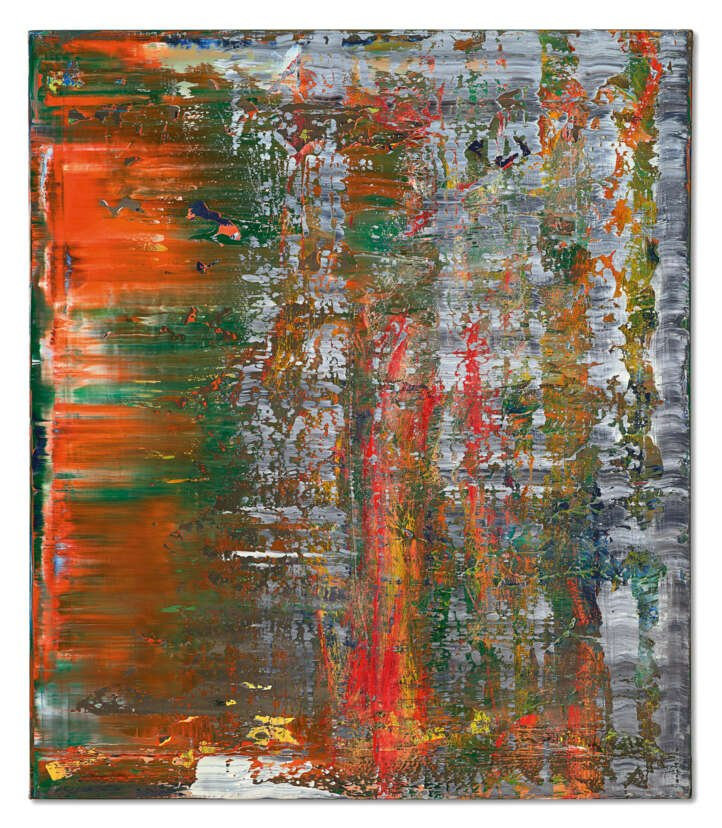
Lot 18. Gerhard Richter (B.1932), Abstraktes Bild (704-2), signed, numbered and dated ‘704-2 Richter 1989’ (on the reverse), oil on canvas, 28 3/8 x 24 1/2in. (72 x 62.2cm.). Painted in 1989. Estimate GBP 2,500,000 – GBP 3,500,000. © Christie's 2023 © Gerhard Richter 2023
Provenance: Galerie Fred Jahn, Munich.
Private Collection, Munich.
Barbara Mathes Gallery, New York.
Acquired from the above by the present owner in 2002.
Literature: Kunst- und Ausstellungshalle der Bundesrepublik Deutschland (ed.), Gerhard Richter, Werkübersicht/Catalogue Raisonné: 1962-1993, volume III, Ostfildern 1993, p. 187, no. 704-2 (illustrated in colour, unpaged).
D. Elger (ed.), Gerhard Richter Catalogue Raisonné, Nos. 652-1-805-6, 1988-1994, Vol. IV, Ostfildern 2015, no. 704-2 (illustrated in colour, p. 259).
Exhibited: Munich, Galerie Jahn und Fusban, Gerhard Richter. Fotoeditionen, Aquarelle und Bilder, 1991.
New York, Barbara Mathes Gallery, Gerhard Richter: Paintings from the 1980s, 2002.
Note: 'In nature everything is always right: the structure is right, the proportions are good, the colours fit the forms. If you imitate that in painting, it becomes false.' Gerhard Richter
With its fiery reds and yellows blazing amid smeared, fractured layers of viridian and silver-grey, the present work is a richly atmospheric example of Gerhard Richter’s Abstrakte Bilder or abstract pictures. Painted in 1989—the same year as such celebrated abstract works as the Eis (Ice) quartet, today held in the collection of the Art Institute of Chicago, USA—it stands at a key moment in the artist’s practice. Where other years had seen him explore the abstract and photo-based poles of his painting in tandem, Richter made only a handful of figurative canvases in 1989, focusing intensely on his Abstrakte Bilder. Refining the distinctive squeegee technique which he had started using at the start of the decade, he dragged and marbled veils of still-wet pigment over one another, taking the works’ colours and textures to complex, variegated and volatile new heights. He also began to welcome echoes of the natural world into these outwardly non-representational paintings. Alongside the Ice group, other allusive titles from this year include Frost, Karst, Split (Rubble), Fels (Rock), and Grat (Ridge), all exhibiting telluric surfaces and earthy, elemental palettes. The present painting’s shimmer of solar reds, hazy silvers and boreal greens likewise evokes hints of forest, sunset and glinting water. Its organic character speaks to the dialogue with nature itself that defines Richter’s abstract works: in the surrender of his process partly to chance, the artist interfaces with the vast, mysterious forces that shape our world.

Gerhard Richter, Eis (2), 1989. The Art Institute of Chicago. © Gerhard Richter 2023 (0023).
Richter had been playing with abstraction since 1960, but it was not until the 1980s that his Abstrakte Bilder truly took shape. In 1982, he debuted five monumental abstractions at documenta VII in Kassel—sometimes referred to as his ‘Wild Abstracts’—which featured clashing brushwork, garish colours and the distinctive, staticky texture of the squeegee. He had first used this innovative tool on relatively small-scale works in 1980: handmade to various sizes from lengths of supple Plexiglas attached to a wooden handle, it allowed him to drag deposits of wet paint across the entire surface of a canvas, merging, stuttering and obscuring the colours in unpredictable ways. The squeegee introduced a tension between chance and intent that would play a crucial role in his work across the following decades. As he developed the technique throughout the 1980s, building ever-more intricate hues and textures into the abstract pictures, he also refined his thoughts on what these paintings could achieve. In notes written in 1985, he described his process as ‘Letting a thing come, rather than creating it—no assertions, constructions, formulations, inventions, ideologies—in order to gain access to all that is genuine, richer, more alive: to what is beyond my understanding.’ The involvement of chance, he said, freed the work from his own ‘constructions and inventions’ into an open field of boundless, proliferating potential. ‘Using chance is like painting nature—but which chance event, out of all the countless possibilities?’ (G. Richter, ‘Notes, 1985’, in D. Elger and H. U. Obrist (eds.), Gerhard Richter: Text: Writings, Interviews and Letters 1961-2007, London 2009, pp. 140-141).
Where the Abstract Expressionists conceived of the canvas as an arena for gestural action, or a receptacle for the painter’s emotions, Richter understood his Abstrakte Bilder in more impersonal terms. He worked slowly and deliberately, dragging the squeegee horizontally or vertically in a smooth, purposeful motion. He acknowledged that his own ‘inner state’ had an impact on his works, but not in the sense of subjective content or mental imagery. Rather, he saw his disposition as just one of the myriad natural inputs that would lead to the painting’s final form, which—like the shape of a tree in a forest—was ultimately the product of chains of causation too complex to comprehend, predict or analyse. This was ‘painting like nature, painting as change, becoming, emerging, being-there, thusness; without an aim, and just as right, logical, perfect and incomprehensible’ (G. Richter, ‘Notes, 1985’, in ibid, p. 142).
In 1989, the shifting political landscape of Germany was certainly on Richter’s mind as he painted. His series October 18, 1977, a group of paintings of the Baader-Meinhof group completed the previous year, had caused heated controversy on its February debut at the Museum Haus Esters in Krefeld. Richter later reflected that their sensitive subject matter, relating to a radical left-wing organisation that had waged a campaign of violence against the West German government since the late 1960s, appeared too raw for viewers to understand the paintings in an art-historical context. If the debate around this series led Richter to concentrate his efforts on abstract work, it is tempting—particularly in the rupture and thaw of titles such as Split, Frost and Ice—to see his art’s ever-present political undercurrents subsumed into the Abstrakte Bilder of this year. Created during the period of change known as Die Wende (‘the turning point’) that would lead to German reunification, their cascading, collapsing surfaces, with vivid breakthroughs of light and colour, seem to foreshadow the fall of the Berlin Wall on 9 November 1989.
While he painted without an image in mind, Richter was open to suggestive atmospherics in his abstract works. He titled a group of four 1990 paintings Forest after their completion, noting that ‘There seemed to me a romantic mood in these four paintings that reminded me of a forest. In the blue, there is the sensation of a diffuse light, which is why I came upon this title’ (G. Richter, ‘Comments on some works, 1991’, in ibid., p. 270). While he gave the present painting no such telling title, it captures the same Romantic strain that runs throughout Richter’s abstract work, as if reconfiguring the grand, sublime clarity of Caspar David Friedrich’s German landscapes for a new era of slippage, uncertainty and change. Like those paintings, it points to a universe of forces, depths and scales beyond our control or understanding, and the endless mystery of our place and time within it.
Christie's. 20th/21st Century: London Evening Sale


/http%3A%2F%2Fstorage.canalblog.com%2F80%2F56%2F119589%2F114714968_o.jpg)
/image%2F1371349%2F20261002%2Fob_29bf30_h0792-l441348574-original.jpg)
/image%2F1371349%2F20261007%2Fob_635e38_40322.jpg)
/image%2F1371349%2F20261007%2Fob_50971a_40276.jpg)