


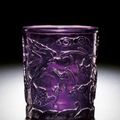


An important and exceptional Junyao flowerpot, Early Ming dynasty


Lot 6015. Property from the Beixuan Shuzhai Collection. An important and exceptional Junyao flowerpot, Early Ming dynasty; w. 24.7 cm, the base inscribed with a numeral wu (five), with a Qing dynasty, 18th century white jade stand. Lot Sold 10,880,000 HKD (Estimate 6,000,000 - 18,000,000 HKD) © Sotheby's 2026
Provenance: T.Y. Chao Family Trust Collection, no. 98.
Sotheby’s London, 17th November 1999, lot 719.
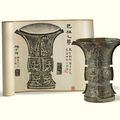
Note: Unlike many other ceramics of the time, Jun ware pots like these were never exported or buried in tombs. Instead, they were actively used in the Ming and Qing court environments. This is evident in a scroll painting that depicts the Ming emperor Zhu Zhanji (1399-1435) enjoying the four seasons within the imperial palaces, where a pair of pots of almost identical colour and form is represented on the ground in front of the Emperor (Craig Clunas and Harrison-Hall, Ming: 50 Years that Changed China, London, 2014, pl. 85, pp. 97-99). The appreciation continued in the Qing Dynasty, as examples from the former Qing imperial collection were inscribed and assigned to palaces within the Forbidden City, the private residences of the famed imperial palace in Beijing. For example, a Jun pot inscribed Jianfugong (Palace of Established Happiness) horizontally and zhu shi jiashan yong (to be used for bamboo, rocks and fake mountains) vertically (Junci yaji / Selection of Jun ware, Beijing, 2013, pl. 68). In comparison, the base of this pot was grinded, leaving ‘T’ shaped marks, suggesting the pot had also been displayed in the Qing imperial palaces (Qin Dashu ed., Beixuan Shuzhai Junyao / Jun Yao Ceramics from the Beixuan Shuzhai Collection, Hong Kong, 2017, pl. 29).
The Jun ware pot inscribed with the numeral wu (five) is extremely rare. Surveying the public and private collections known today, only one similar example in the Palace Museum, Taipei (accession no. guci-16537) has been published in Penping fenghua, Ming Qing huaqi tezhan / The Enchanting Splendor of Vases and Planters: A Special Exhibition of Flower Vessels from the Ming and Qing Dynasties, Taipei, 2014, cat. no. I-11.
The dating of Jun ware like this remains controversial. Some scholars believe that it was commissioned during the Northern Song period (960-1127), while others suggest that pots like these were commissioned by the Yongle (1403-24) and Xuande emperors (1426-35) of the Ming Dynasty (1368-1644). On the bases of these pots and on related basins, numbers from 1 to 10 are incised before glazing and firing, so they are often called "numbered Jun". The numbers seem to reflect their size, with 1 being the largest and 10 the smallest.
Sotheby's. Chinese Art, Hong Kong, 30 October 2026


