

/https%3A%2F%2Fprofilepics.canalblog.com%2Fprofilepics%2F1%2F0%2F100183.jpg)
/https%3A%2F%2Fstorage.canalblog.com%2F03%2F02%2F119589%2F96711876_o.jpg)
/https%3A%2F%2Fstorage.canalblog.com%2F11%2F31%2F119589%2F94773502_o.jpg)
/https%3A%2F%2Fstorage.canalblog.com%2F20%2F83%2F119589%2F94772815_o.jpg)
/https%3A%2F%2Fstorage.canalblog.com%2F26%2F72%2F119589%2F75604929_o.jpg)
/https%3A%2F%2Fstorage.canalblog.com%2F59%2F60%2F119589%2F26458628_o.jpg)
Christie's to offer miniature engraved gems formerly in the G. Sangiorgi Collection
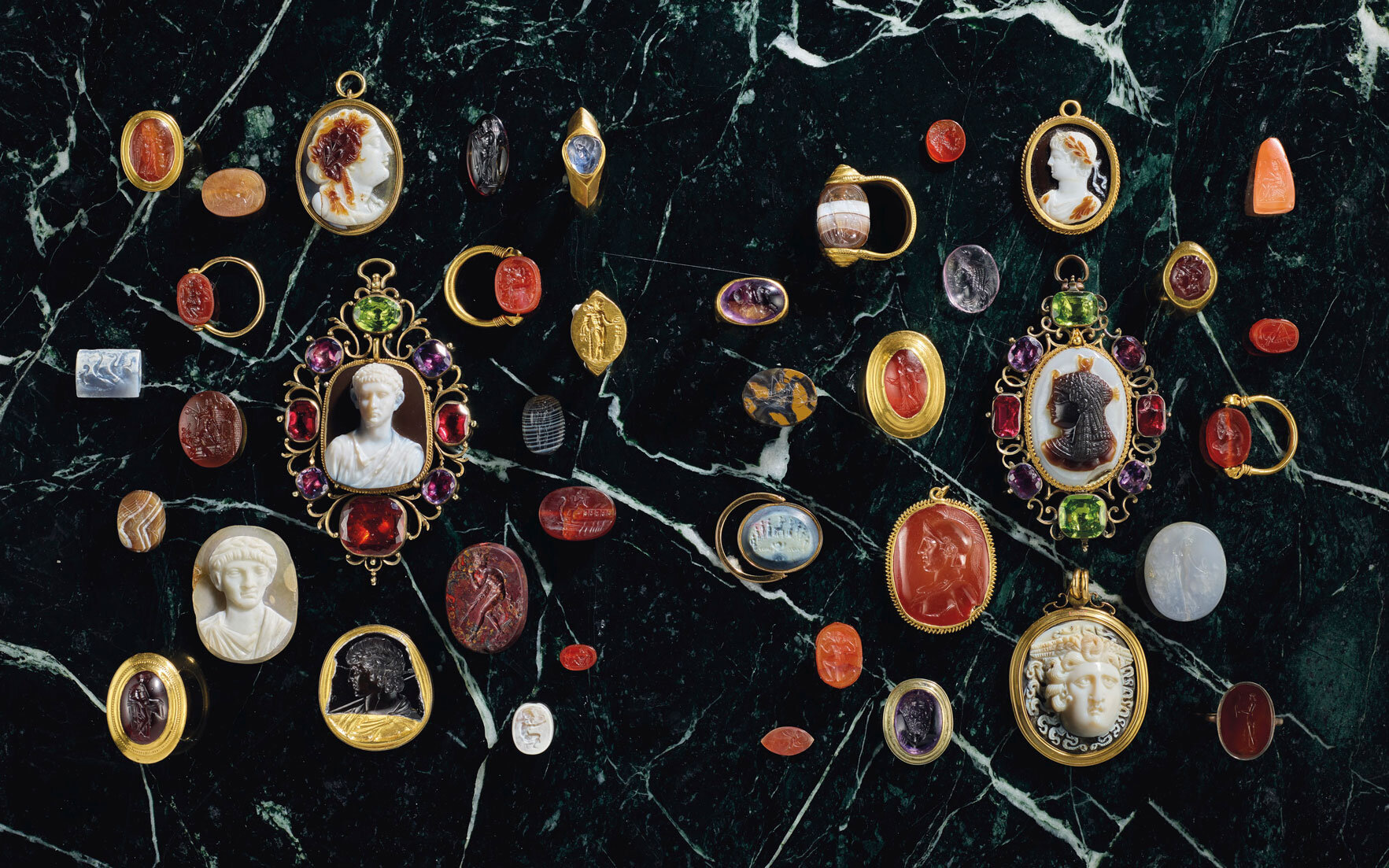
NEW YORK, NY.- Christie’s announced Masterpieces in Miniature: Ancient Engraved Gems Formerly in the G. Sangiorgi Collection on April 29, 2019, during the Classic Week series of sales. Spanning the Classical world from the 16th century B.C. to the 4th century A.D., the sale comprises 40 lots of the most sought-after and captivating gems still in a private collection. Enchanting collectors and connoisseurs alike, this is one of the most important of private collections in history, this sale offers timeless artifacts that unlock a window into the early 20th century.
Giorgio Sangiorgi (1887-1965) was a renowned collector, dealer, and scholar in ancient, medieval, and Renaissance Art. He amassed most of his collection in early to middle years of the 20th century. The entire collection was recently published by the renowned gem scholar Sir John Boardman and Claudia Wagner. The sale features arguably the 40 best gems from the collection. In addition to their superb quality and rarity, many gems boast important provenance, with many originating from the renowned collection of nobleman and politician, George Spencer, the 4th Duke of Marlborough.
G. Max Bernheimer, International Department Head of Antiquities, remarked: “Many are without question true masterpieces of the gem engraver’s art, some world-renowned, rivaling the best works of the major arts of every other medium, and are assuredly the most important group to appear at auction in over a generation.”
Highlights from the Masterpieces in Miniature sale to include:
The Roman black chalcedony intaglio portrait of Antinous is a gem that carries an old and prestigious provenance. Previously in the Marlborough collection (1765-1875) and sold at Christie’s in London in 1875, this gem is one of the finest in existence. The 4th Duke of Marlborough wrote that it was “of incredible beauty,” making it the highlight of the most extraordinary collection of ancient gems ever assembled still in a private collection. The exceptional quality of the engraving has led many to proclaim this gem to be the finest surviving portrait of Antinous in existence in any medium. Superbly engraved on this sizeable black chalcedony gem is a portrait of the bust of Antinous, who drowned in the Nile in 130 A.D. while traveling in Egypt. It is said that Antinous, who was the young favorite of Emperor Hadrian (76-138 A.D.), perhaps even intentionally drowning to counter a prophecy in order to save the Emperor’s life. In his honor, Emperor Hadrian founded a new city on the east bank of the Nile, Antinoopolis, and esteemed Antinous as a hero and a God, throughout the Empire. His memory was honored in festivals, poems, hymns, and temples, including the Imperial Villa at Tivoli.

Lot 37. Roman black chalcedony intaglio portrait of Antinous, circa 130-138 A.D. Estimate: $300,000-500,000. © Christie's Images Ltd 2019.
Provenance: Count Antonio Maria Zanetti (1679-1767), Venice, acquired by 1740.
George Spencer, 4th Duke of Marlborough (1739-1817), Blenheim Palace, Oxfordshire, acquired from the above by 1767; thence by descent to his son, George Spencer-Churchill, 5th Duke of Marlborough (1766-1840), Blenheim Palace, Oxfordshire; thence by descent to his son, George Spencer-Churchill, 6th Duke of Marlborough (1793–1857), Blenheim Palace, Oxfordshire; thence by descent to his son, John Winston Spencer-Churchill, 7th Duke of Marlborough (1822-1883), Blenheim Palace, Oxfordshire.
The Marlborough Gems: Being a Collection of Works in Cameo and Intaglio Formed by George, Third Duke of Marlborough, Christie's, London, 28 June-1 July 1875, 1875, lot 500.
David Bromilow (1809-1898), Bitteswell Hall, Leicestershire, acquired from the above; thence by descent to his daughter, Julia Harriet Mary Jary, Bitteswell Hall, Leicestershire, 1898.
The Marlborough Gems: A Collection of Works in Cameo and Intaglio Formed by George, Third Duke of Marlborough, Purchased by the Late David Bromilow, Esq., of Bitteswell Hall, Lutterworth, the Property of Mrs. Jary, Christie's, London, 26-29 June 1899, lot 500.
with Francis E. Whelan (1848-1907), London, acquired from the above (according to auctioneer's book).
Charles Newton-Robinson (1853-1913), London.
Catalogue of the Valuable and Important Collection of Engraved Gems Formed by Charles Newton-Robinson Esq., Christie's, London, 22 June 1909, lot 66.
Antiquities, Sotheby's, London, 15 January 1952, lot 136.
Forrer, acquired from the above (according to auctioneer’s book).
Giorgio Sangiorgi (1886-1965), Rome, acquired and brought to Switzerland by 1952; thence by continuous descent to the current owners.
Literature: A.M. and G.F. Zanetti, Delle antiche statue greche e romane, che nell'antisala della libreria di San Marco, e in altri luoghi pubblici di Venezia si trovano, vol. I, Venice, 1740, pl. 23.
A.F. Gori, Gemmae antiqae Antonii Mariae Zanetti, Venice, 1750, pp. 43-44, pl. 22.
P. Cle´ment, Les Cinq anne´es litte´raires, ou Lettres sur les ouvrages de litte´rature qui ont paru dans les anne´es 1748, 1749, 1750, 1751 et 1752, Berlin, 1755, pp. 124-125 and 476.
P.D. Lippert, Dactyliothec, Leipzig, 1767, vol. 2, p. 206, no. 729.
T. Worlidge, A Select Collection of Drawings from Curious Antique Gems; most of them in the possession of the Nobility and Gentry of this Kingdom; etched after the Manner of Rembrandt, London, 1768, pl. 55.
P.D. Lippert, Supplement zu Phillip Daniel Lipperts Dactyliothec, Leipzig, 1776, p. 148, no. 304.
J. Bryant, Gemmarum antiquarum delectus ex præstantioribus desumptus, quæ in dactyliothecus ducis Marlburiensis conservantur, Choix de pierres antiques grave´es du cabinet du Duc de Marlborough, vol. 1, London, 1780, no. 21.
D. A. Bracci, Memorie degli antichi incisori che scolpirono i loro nomi in gemme e cammei con molti monumenti inediti di antichità statue bassirilievi gemme, vol. 1, Florence, 1784, pp. 108-113, pl. 20.
R.E. Raspe, A Descriptive Catalogue of a General Collection of Ancient and Modern Engraved Gems, Cameos as well as Intaglios, taken from the most Celebrated Cabinets in Europe, and cast in Coloured Pastes, white Enamel, and Sulphur, London, 1791, vol. 2, p. 649, no. 11701.
K. Levezow, Uber den Antinous dargestellt in den Kunstdenkmaelern des Alterthums, Berlin, 1808, pp. 77-79.
T. Cades, Descrizione di una Collezione di 8121 impronte in Stucca posseduta in Roma da Tommaso Cades, Incisore in gemme, cavate accuratamente dalle più celebre gemme incise conosciute che esistino nei principali Musei e Collezioni particolari di Europa, divisa in due parti…, Rome, 1836, p. 256, vol. 4, no. C 482.
C.W. King, "Notices of Collections of Glyptic Art Exhibited by the Archaeological Institute in June, 1861," Archaeological Journal 19, vol. 1, p. 106, no. 389.
M.H. Story-Maskelyne, The Marlborough Gems: Being a Collection of Works in Cameo and Intaglio Formed by George, Third Duke of Marlborough, 1870, pp. 84-85, no. 500.
C.W. King, Antique Gems and Rings, vol. 1, London, 1872, pp. xii, 18.
L. Dietrichson, Antinoos: Eine kunstarchäologische Untersuchung, Christiania, 1884, pp. 280-281, no. 95.
C.W. King, Handbook of Engraved Gems, London, 1885, p. 243, pl. 84, no. 1.
S. Reinach, Pierres gravées des collections Marlborough et d'Orléans, Paris, 1895, p. 114, no. 21, pl. 110.
F. Bartolozzi and G.B. Cipriani, One Hundred and Eight Plates of Antique Gems Engraved by Francesco Bartolozzi, London, 19th century, Series 1, no. 21.
A. Furtwängler, Die antiken Gemmen, Leipzig, 1900, vol. 1, pl. 65, no. 50; vol. 2, p. 362, no. 50.
Burlington Fine Arts Club Exhibition of Ancient Greek Art, London, 1904, pp. 253-254, no. 87, pl. CX.
G. Lippold, Gemmen und Kameen des Altertums und der Neuzeit, Stuttgart, 1922, p. 180, pl. 74, no. 2.
C. Seltman, "Greek Sculpture and Some Festival Coins" Hesperia 17, 1948, p. 83, pl. 27, no. 6; pl. 28, no. 20.
M. Yourcenar, “Carnets de notes des ‘Mémoires d’Hadrien,’” Mercure de France 316, December 1952, p. 427.
M. Yourcenar, Me´moires d'Hadrien: suivis des Carnets de notes des Me´moires d'Hadrien, Paris, 1953, pp. 448 and 450.
C. Seltman, Approach to Greek Art, London, 1960, pp. 112 and 130, pl. 96a.
C. Clairmont, Die Bildnisse des Antinous, Rome, 1966, pp. 30-32, pl. 1e,f.
F. de la Maza, Antinoo: el último dios del mundo clásico, Mexico City, 1966, pp. 285-288, pls. 32b-e.
M.L. Vollenweider, Die Steinschneidekunst und ihre Künstler in spätrepublikanischer und augusteischer Zeit, Baden-Baden, 1966, p. 79.
G. Richter, Engraved Gems of the Romans, London, 1971, no. 550.
P. Zazoff, Die antiken Gemmen, Munich, 1983, p. 321, pl. 95.5.
R. Lambert, Beloved and God: The Story of Hadrian and Antinous, London, 1984, pp. 242-243, fig. 7.
E. Zwierlein-Diehl, Glaspasten im Martin-von-Wagner-Museu der Universität Würzburg, Munich, 1986, pp. 253-254, no. 764.
H. Meyer, Antinoos, Munich, 1991, pp. 157-158, IC7.
J. Charles-Gaffiot and H. Lavagne, eds., Hadrien, Trésors d'Une Villa Impériale, Milan, 1991, pp. 261-262, no. 101.
G. Seidmann, "The Grand Tourist's favourite souvenirs: cameos and intaglios," RSA Journal 144, no. 5475, December 1996, p. 63.
G. Seidmann, "An Eighteeneth-Century Collector as Patron: The 4th Duke of Marlborough and the London Engravers," in Engraved Gems: Survivals and Revivals, Washington, 1997, pp. 263-264, 267-268, 275 and 277.
M. Goslar, "Antinou¨s, de la pierre a' l'e´criture de Me´moires d'Hadrien," Revue litte´raire en ligne, 1 February 2006, no. 40.
E. Zwierlein-Diehl, Antike Gemmen und ihr Nachleben, Berlin, 2007, p. 444, pl. 148, fig. 662.
J. Boardman, et al., The Marlborough Gems, Formerly at Blenheim Palace, Oxfordshire, London, 2009, cover, pp. 21-22, 206 and 304-305, no. 753.
M. Henig, "Review: The Marlborough Gems," The Classical Review, vol. 61, April 2011, pp. 278-279.
H.J. Rambach, "The Antinous Braschi on Engraved Gems: an Intaglio by Giovanni Beltrami," LANX 15, 2013, p. 112.
M. Chehan, "Muses en abyme: Marguerite Yourcenar et les arts," in Quand les e´crivains font leur muse´e…, Bruxelles, 2017, p. 208.
J. Boardman and C. Wagner, Masterpieces in Miniature: Engraved Gems from Prehistory to the Present, London, 2018, p. 165, no. 151.
R.R.R. Smith and M. Melfi, Antinous: Boy Made God, Oxford, 2018, pp. 9 and 108, no. 14.
M. Magrini, ed., Lettere artistiche del Settecento veneziano: Anton Maria Zanetti, Venice, 2019, ns. 40-43.
Beazley Archive Gem Database no. 753.
Exhibited: Burlington Fine Arts Club, London, Exhibition of Ancient Greek Art, 1904.
Note: Superbly engraved on this unusually large black chalcedony gem is a portrait bust of Antinous, the young favorite of the Emperor Hadrian (76-138 A.D.), who drowned in the Nile in 130 A.D. Traditionally identified as depicting him in the guise of a hunter, Antinous wears a chlamys over his shoulders pinned in place by a circular fibula and carries a spear. His idealized facial features display a rounded chin, full lips and thick hair arranged in luscious curls that cover his ears and fall along his neck. Stylistically, this gem is exactly that of his main portrait types in marble. The extraordinary quality of the engraving has led many to proclaim this the finest surviving portrait of Antinous in existence in any medium. Some of the missing portions of his bust were restored during the Renaissance in gold. Behind his shoulders three letters are preserved, ANT […], plus a portion of a fourth letter and possibly parts of the others, the inscription either identifying the subject or perhaps an artist’s signature.
The Marlborough Antinous is one of the most famous gems to survive from antiquity and has a long list of owners since its rediscovery in the Renaissance. So great was the mania inspired by this gem that its first documented modern owner, Anton Maria Zanetti (1679-1767), who had pursued the gem for some time before acquiring it, supposedly saying that he would have sold his house to buy it. From him the gem was purchased by George Spencer (1739-1817), the 4th Duke of Marlborough, who wrote that it was “of an incredible beauty,” making it the highlight of perhaps the most extraordinary collection of antique gems ever assembled. The entire Marlborough Collection of gems was first sold at Christie’s en masse to David Bromilow in 1875. The collection remained intact until his daughter sold the gems, again at Christie’s, in 1899. The Antinous was acquired in that sale by Charles Newton Robinson, whose collection was in turn dispersed at Christie’s ten years later. Its owner for the first half of the 20th century is unknown. The gem would reappear at auction at Sotheby’s in 1952, and then it was acquired by Giorgio Sangiorgi, who considered it “excellent work of courtly art comparable with the most celebrated portraits of Antinous…”
About Antinous, ancient sources record that he was born near the provincial city of Bithynion (northwest Turkey) sometime after 110 A.D. He was a member of Hadrian’s large entourage on an inspection tour of the Empire. While travelling in Egypt in 130 A.D., Antinous drowned in the Nile, either the result of an accident, intrigue or suicide said to have been committed to counter a prophecy in order to save the Emperor’s life. In his honor, Hadrian founded Antinopolis, a new city on the east bank of the Nile. In addition, Antinous was posthumously venerated, in some places as a god, in others as a hero, throughout the Empire, including at the Imperial Villa at Tivoli. His memory was honored in temples, festivals, games, poems and hymns. The large number of surviving statues, busts, reliefs, coins and gems depicting Antinous indicate the popularity of his cult as promoted by Hadrian (see pp. 11-16 in R.R.R. Smith and M. Melfi, Antinous, Boy Made God).
As in the case of this gem, most of the surviving portraits of Antinous must date to the eight years between his own death in 130 A.D. and that of Hadrian in 138 A.D. Often Antinous was depicted in the guise of a pre-existing Greco-Roman or Egyptian god, depending on where the image was created. He can be shown as Osiris, as in the example from the Antinoeion at Hadrian’s Villa, now in the Vatican Museums (fig. 156 in T. Opper, Hadrian, Empire and Conflict), as Dionysus, also in the Vatican (fig. 166 in Opper, op. cit.) and as the hunting and agricultural god Aristaios, now in the Louvre (fig. 168 in Opper, op. cit.). In this last example, he holds a hoe over his shoulder, in a position that recalls that of the spear seen on the gem, and while it has always been called a spear in the vast literature, its identification as a hoe is equally plausible.
The use of black chalcedony for the gem may mean that this portrait was connected to mourning, as suggested by Furtwängler (op. cit.), and indeed the color was already emblematic of mourning for the Romans, who considered a dark toga pulla the appropriate garb for burial ceremonies (see p. 141 in J.L. Sebesta and L. Bonfante, eds., The World of Roman Costume).
Since it was first published by Zanetti in 1740, the gem has unceasingly been the subject of scholarly interest, particularly concerning its incomplete inscription. The first three letters ANT are clearly visible, and the beginnings of a fourth letter can just be made out. Lippert thought it was for Gnaeus, the name of an ancient gem engraver; Bracci regarded the gem a work by another ancient artist Anterote; Raspe believed the inscription could be completed as “ANTI[nous].” Levezow postulated an abbreviated “ANT[inous] H[eros],” a creative solution that drew few supporters. The discovery in 1907 at Lanuvium, south of Rome, of a relief depicting Antinous as the agrarian god Silvanus (now in the National Museum of Rome, fig. 30 in Smith and Melfi, op. cit.) lead to further speculation. The Silvanus relief is signed by the Greek sculptor Antonianos of Aphrodisias. Some years after its discovery, Seltman suggested that the Antonianos who created the Sylvanus relief had also engraved and signed the gem, believing the fourth letter in the gem’s inscription to be a “rather angular” omega. While the identification of the inscription may never be decided, what is clear is that the Antinous portrait presented here is one of the finest gems to have survived since antiquity.
Roman and Greek artists mastered the art of engraving to extraordinary levels, with each carved gemstone telling a unique story. In ancient society, the primary objective of engraved gems and ring stones was to serve as a personal signature or a seal of identification. Elite members of society possessed multiple gems for the various roles they held in society. A Roman amethyst intaglio with a portrait of Demosthenes is another masterpiece in the collection and is one of the most important gems to survive from antiquity. To the right of the bust, in small neat letters is the inscription “of Dioskourides,” the artists signature. Dioskourides was named the chief gem engraver for Emperor Augustus (63 B.C.-14 A.D.). According to ancient literature, Dioskourides sculpted the Emperor’s signet ring, a portrait of Augustus himself, and his successors used it for signing personal and imperial documents. Recognized through the Renaissance and into the modern era as the greatest gem engraver of the Roman world, Dutch Renaissance painter Peter Paul Rubens (1577-1640) saw the gem between 1600 and 1608 while visiting Rome, recording the inscription in his itinerary. The gem was deeply admired for the quality of craftsmanship, exceptionally deep engraving, and identifying signature.


Lot 32. Roman amethyst portrait cameo, signed Dioskourides, circa late 1st century BC; ¾ in. (1.9 cm.) long. Estimate: $200,000-300,000. © Christie's Images Ltd 2019.
Provenance: Lelio Pasqualini (1549-1611), Rome, acquired by 1602; thence by descent to his nephew, Pompeo Pasqualini (d. 1624), Rome.
Francesco Boncompagni (1596-1641), Frosinone, acquired from the above, 1624; thence by descent to his nephew, Gerolamo Boncompagni (1622-1684), Frosinone; thence by descent to Antonio Boncompagni-Ludovisi, Prince of Piombino (1658-1721), Frosinone; thence by descent to his son, Gaetano Boncompagni-Ludovisi, Prince of Piombino (1706-1777), Frosinone; thence by descent to his son, Antonio II Boncompagni-Ludovisi, Prince of Piombino (1735-1805), Rome; thence by descent to his son, Luigi Maria Boncompagni-Ludovisi, Prince of Piombino (1767-1841), Rome; thence by descent to his son, Antonio III Boncompagni-Ludovisi, Prince of Piombino (1808-1883), Rome.
with Tommaso Martinetti, Rome (1832-1895) and possibly Count Michel Tyszkiewicz (1828-1897), Rome, acquired from the above, by 1883.
Sir Arthur Evans (1851-1941), England, acquired by 1890.
Giorgio Sangiorgi (1886-1965), Rome, acquired from the above and brought to Switzerland, by 1941; thence by continuous descent to the current owners.
Literature: P. Gassendi, Viri illustris Nicolai Claudii Fabricii de Peiresc, senatoris Aquisextiensis vita, per Petrum Gassendum…, Paris, 1641, pp. 85-86.
J.J. Winckelmann, Monumenti antichi inediti spiegati ed illustrati da Giovanni Winckelmann prefetto delle antichità di Roma, Rome, 1767, pp. xiii, 91 and 108.
J.J. Winckelmann, Storia delle arti del disegno presso gli antichi di Giovanni Winckelmann, vol. 2, Rome, 1783, pp. 331-332.
D.A. Bracci, Memorie degli antichi incisori che scolpirono i loro nomi in gemme e cammei con molti monumenti inediti di antichità statue bassirilievi gemme, vol. 2, Florence, 1786, fig. 69.
E.Q. Visconti, Il Museo Pio Clementino, vol. 3, Rome, 1790, p. 15, n. C.
A. L. Millin, Introduzione allo studio delle pietre intagliate... dal francese nell’idioma italiano ridotta, Palermo, 1807, pp. 55, 82 and 97-98.
E.Q. Visconti, Iconographie grecque, vol. 1 and plates, Paris, 1811, pp. 256-257, pl. 30, fig. 1.
"Classe quarta. Letteratura e belle arti," Giornale Bibliografico Universale, no. 30, vol. viii, Milan, 1811, p. 160.
E.Q. Visconti, Iconographie grecque; ou recueil des portraits authentiques des empereurs, rois, et hommes illustres de l'antiquite´, vol. 1, Milan, 1824, pp. 357-358, pl. 29,1.
G. Ferrario, Il costume antico e moderno, o storia del governo, della milizia, della religione, delle arti, scienze ed usanze di tutti i popoli antichi e moderni, vol. 3, Florence, 1827, p. 215, pl. 134, 6.
E.Q. Visconti, Opere varie italiane e francesi di Ennio Quirino Visconti, vol. 2, Milan, 1829, pp. 123-124, 127-128, 131, and 359.
T. Cades, Descrizione di una Collezione di 8121 impronte in Stucca posseduta in Roma da Tommaso Cades, Incisore in gemme, cavate accuratamente dalle più celebre gemme incise conosciute che esistino nei principali Musei e Collezioni particolari di Europa, divisa in due parti…, Rome, 1836, p. 235, nr. 32.
H. Schröder, Über die Abbildungen des Demosthenes mit Beziehungen auf eine antike Bronzebu¨ste im Herzoglichen Museum zu Braunschweig, Braunschweig, 1842, pp. 13-14, pl. 2, fig. 4.
C. Cantù, Documenti alla storia universale: cronologia, geografia, archeologia, vol. 1, Turin, 1848, pp. 832-833.
H. Köhler, Gesammelte Schriften: Abhandlung über die geschnittenen Steine mit den Namen der Künstler, vol. 3, St. Petersburg, 1851, pp. 147 and 309
C.O. Mueller, Ancient Art and its Remains; or a Manual of the Archeology of Art, London, 1852, p. 188.
T. Combe, E. Hawkins, C.R. Cockerell and S. Birch, eds., A Description of the Collection of Ancient Marbles in the British Museum, London, 1861, p. 36.
C. W. King, Antique Gems: Their Origin, Uses, and Value as Interpreters of Ancient History and as Illustrative of Ancient Art with Hints to Gem Collectors, London, 1866, pp. 217, 236 and 261.
H. M. Westropp, Handbook of Archaeology: Egyptian, Greek, Etruscan, Roman, London, 1867, pp. 208, 257 and 277.
"Cammeo o Cameo," Nuova enciclopedia italiana, ovvero dizionario generale di scienze, lettere, industrie, ecc., edition 6, vol. iv, Turin, 1877, p. 790.
A. Bo¨ckh, E. Curtius, A. Kirchhoff, J. Franz, and H. Ro¨hl, eds., Corpus inscriptionum graecarum, vol. IV, 1877, p. 69.
W. Lu¨bke, History of Sculpture, from the Earliest Ages to the Present Time, vol. 1, London, 1878, p. 323.
V. Poggi, La gemma di Eutiche, Genoa, 1884, pp. 34-35, 43, and 46-47.
C. W. King, Handbook of Engraved Gems, London, 1885, pp. 169 and 248.
A. Michaelis, “Die Bildnisse des Demosthenes,” in A. Schäfer, ed., Demosthenes und seine Zeit, vol. 3, Leipzig, 1887, pp. 411, 414, 418-419 and 427.
A. Furtwängler, Jahrbuch des Kaiserlich Deutschen Archäologischen Instituts, Berlin, 1888, p. 222, pls. 8-24.
H. Brunn, Geschichte der grieschischen Künstler, vol. 2, Stuttgart, 1889, p. 486.
C. Daremberg and E. Saglio, “Gemmae (Dioscoride),” in Dictionnaire des antiquités grecques et romaines, Paris, 1896, p. 1478.
E. Babelon, La gravure en pierres fines: camées et intailles, Paris, 1894, p. 160, fig. 117.
Spink & Sons, The Numismatic Circular, vol. 8, London, 1900, p. 4006.
A. Furtwängler, "Gemmen mit kunstlerinschrigten," Die antiken Gemmen: Geschichte der Steinschneidekunst im klassischen Altertum, vols. 1-3, Leipzig, 1900, pp. 233-234, 306 and 355, pl. 49-7.
J.J. Bernoulli, Griechische Ikonographie mit Ausschluß Alexanders und der Diadochen, vol. 2, Munich, 1901, p. 76, cat. no. b.
A. F. von Pauly and G. Wissowa, “Dioskurides,” in Paulys Realencyclopa¨die der classischen Altertumswissenschaft, Stuttgart, 1903, p. 1143.
L. Forrer, “Dioscorides,” in Biographical Dictionary of Medalists, Coin, Gem, and Seal-Engravers, Mint-Masters, Ancient and Modern, with References to their Works B.C. 500-A.D. 1900, vol. 1, London, 1904, p. 592, no. 5.
U. Thieme and F. Becker, “Dioskurides,” in Allgemeines Lexikon der bildenden Künstler von der Antike bis zur Gegenwart, Leipzig, 1913, pp. 319-320.
D. Osborne, Engraved gems, signets, talismans and ornamental intaglios, ancient and modern, New York, 1912, p.121.
A. Furtwängler, Kleine Schriften, Munich, 1913, pp. 214-215, table 26, fig. 24.
J.D. Beazley, The Lewes House Collection of Ancient Gems, Oxford, 1920, p. 114.
G.M.A. Richter, Catalogue of Engraved Gems of the Classical Style, New York, 1920, pp. xl, 90-93
G. Lippold, Gemmen und Kameen des Altertums und der Neuzeit, Stuttgart, 1922, p. 179, pl. 67, no. 3.
L. Forrer, “Dioscorides,” in Biographical Dictionary of Medalists, Coin, Gem, and Seal-Engravers, Mint-Masters, Ancient and Modern, with References to their Works B.C. 500-A.D. 1900, vol. 7, London, 1923, p. 225.
H. Gebhart, Gemmen und Kameen, Berlin, 1925, pp. 106-107, 109 and 196-197, fig. 162.
S. Casson, "A New Copy of a Portrait of Demosthenes," The Journal of Hellenic Studies, vol. 46, part 1, 1926, pp. 74-75, fig. 3.
D. Levi, “Dioscuride,” in Enciclopedia italiana di scienze, lettere ed arti, vol. 12, Rome, 1931, p. 952.
P. Ducati, “Grecia,” in Enciclopedia italiana di scienze, lettere ed arti, vol. 17, Rome, 1933, p. 885.
G. Sangiorgi, “Der Demosthenes des Dioskurides,” Pantheon 19, May 1937, pp. 144-145.
C. Seltman, Approach to Greek Art, London, 1948, p. 105, table 92c.
G.M.A. Richter, Three Critical Periods in Greek Sculpture, Oxford, 1951, pp. 55-56, 58-59 and 78, fig. 125.
G.M.A. Richter, Ancient Italy: A Study of the Interrelations of its Peoples as Shown in Their Arts, Ann Arbor, 1955, pp. 70-71, fig. 220.
G.M.A. Richter, Catalogue of Engraved Gems: Greek, Etruscan, and Roman, Rome, 1956, pp. xxxiii and xxxviii.
M. Vollenweider, “Glittica,” in Enciclopedia Universale dell’Arte, vol. 6, Rome, 1958, p. 283.
G. M.A. Richter, Greek Portraits II: to What Extent were They Faithful Likenesses?, Brussels, 1959, pp. 17, 45, 47, pl. 3, fig. 11.
G.M.A. Richter, A Handbook of Greek Art, London, 1959, p. 241, fig. 352.
P. E. Arias, "Demostene," Enciclopedia dell'arte antica, classica e orientale, vol. 3, Rome, 1960, p. 77.
L. Vlad Borrelli, "Dioskourides," Enciclopedia dell'arte antica, classica e orientale, vol. 3, Rome, 1960, p. 133.
G.M.A. Richter, The Portraits of the Greeks, vol. 7, London, 1965, p. 222, figs. 1504 and 1506.
M. Vollenweider, Die Steinschneidekunst und ihre Künstler in spätrepublikanischer und augusteischer Zeit, Baden-Baden, 1966, pp. 57, 88 and 112, pl. 57, figs. 1-3 and 5.
G.M.A. Richter, Engraved Gems of the Romans, London, 1971, p. 143, fig. 672.
M. van der Meulen, Petrus Paulus Rubens antiquarius: collector and copyist of antique gems, Alphen aan den Rijn, 1975, p. 205.
M. Vollenweider, Catalogue raisonne´ des sceaux, cylindres, intailles et came´es, Mainz, 1979, pp. 7, 18 and 32-33, no. 3, 18 and 31.
C. Gasparri, "Gemme antiche in età neoclassica. Egmagmata, Gazofilaci, Dactyliothecae," Prospettiva 8, 1977, fig. 14.
G.M.A. Richter, A Handbook of Greek Art, New York, 1980, p. 253, fig. 359.
M. Greenhalgh, Donatello and his Sources, New York, 1982, p. 37.
P. Zazoff, Die antiken Gemmen, Munich, 1983, p. 317, table 91, fig. 6.
A. Michaelis, "Die Bildnisse des Demosthenes," in K. Fittschen, ed., Griechische Porträts, 1988, pp. 87-88 and 90-91.
L.P.B. Stefanelli, "Una raccolta per collezionisti," Il tesoro di Via Alessandrina, Rome, 1990, p. 34.
P. Baldassarri, "Di Demosthene oratore atheniese," Prospettiva 64, October 1991, pp. 8, 11 and 13, ns. 90 and 95, fig. 17.
J. Spier, Ancient Gems and Finger Rings, Malibu, 1992, pp. 93-94.
D. Jaffé, “Aspects of Gem Collecting in the Early Seventeenth century, Nicolas-Claude Peiresc and Lelio Pasqualini,” Burlington Magazine 135, 1993, pp. 109-110, 115-116 and 118.
L.P.B. Stefanelli, "Una raccolta di 'solfi' del museo Boncompagni per il Medagliere Capitolino," Bolletino dei musei comunali di Roma / Associazione Amici dei Musei di Roma VII, Rome, 1993, p. 129, fig. 1.
L.P.B. Stefanelli, "Collezionisti e incisori in pietre dure a Roma nel XVIII e XIX secolo, Alcune considerazioni,” Zeitschrift für Kunstgeschichte 59, no. 2, 1996, pp. 195-196.
D. Jaffé, “Reproducing and Reading Gems in Rubens' Circle,” in Engraved Gems: Survivals and Revivals, 1997, pp. 182, 184 and 191.
J.M. Moret, Les pierres grave´es antiques repre´sentant le rapt du Palladion, Mainz, 1997, p. 148.
W.-R. Megow, “Dioskurides (IV),” in Künstlerlexikon der Antike, Munich, 2001, p. 182.
D. La Monica, "Progresso verso la 'Dactyliotheca Ludovisiana,'" Annali della Scuola Normale Superiore di Pisa. Classe di Lettere e Filosofia IV, vol. 7, no. 1, 2002, pp. 64-65 and 76, figs. 59-60.
E. Zwierlein-Diehl, Antike Gemmen und ihr Nachleben, New York, 2007, p. 414, pl. 101, fig. 466.
L.P.B. Stefanelli, La collezione Paoletti: stampi in vetro per impronte di intagli e cammei, vols. 1-2, Rome, 2007, pp. 144, 209 and 392, fig. 359, nos. 98 and 217.
L.P.B. Stefanelli and G. Curiale, "Una raccolta di 'impronte' Cades nel museo di Roma," Bolletino dei musei communali di Roma / Associazione Amici dei Musei di Roma, XXI, Rome, 2007, pp. 107-109, fig, 1.
J. Lang, Mit Wissen geschmückt? Zur bildlichen Rezeption griechischer Dichter und Denker in der römischen Lebenswelt, Wiesbaden, 2012, pp. 44, 52, 69-71, 77-78, 103, 107-108 and 150, color pl. 1, fig. 2; pl. 1, fig. 8.
J. Boardman and C. Wagner, Masterpieces in Miniature: Engraved Gems from Prehistory to the Present, London, 2018, p. 120, no. 137.
Beazley Archive Gem Database: "Impronte gemmarie della collezione Boncompagni."
Note: One of the most important gems in the Sangiorgi collection is this extraordinary amethyst intaglio engraved with a portrait bust of Demosthenes, the 4th century B.C. Greek orator, and signed by the gem engraver Dioskourides. It is so deeply cut that in the impression, the bust stands out in such high relief that it nearly reads like a statue in the round. Demosthenes wears a mantle over one shoulder and turns his head slightly to one side. The orator is bearded, with a full mustache framing his lips. His brows are knitted and his forehead creased, giving him a serious expression. To the right, in small neat letters, is the inscription, “of Dioskourides,” the artist’s signature. The gem is mounted in an antique gilt silver frame.
Dioskourides' portrait of Demosthenes is without question a masterpiece and one of the most important gems to survive from antiquity. “The Ludovisi gems, belonging to the Prince of Piombino, include many of great value,” wrote English gem collector C.W. King in 1866, “but its chief glory is the Demosthenes of Dioscorides.” In the time before, when it was in the collection of Lelio Pasqualini (1549-1611), and ever since, the gem has piqued the interest of every antiquarian, Grand Tour traveler, and glyptic scholar with a passion for ancient gems. Dutch Renaissance painter Peter Paul Rubens (1577-1640) saw the gem sometime between 1600 and 1608 when visiting Rome, recording the inscription in his itinerary; Johann Joachim Winckelmann (1717-1768), the father of modern art history and longtime resident of the Eternal City, included an engraving of it in his Monumenti antichi inediti (1767); and Johann Wolfgang von Goethe (1749-1832), during his famous journey through Italy, saw the gem collection of the Boncompagni-Ludovisi in 1787. The gem was admired as much for the high quality of its craftsmanship and its exceptionally deep engraving, rare for an ancient intaglio, as for its identifying signature, since Dioskourides was recognized throughout the Renaissance and into the modern era as the greatest gem engraver of the Roman world.
Born in Aegea, part of modern-day Turkey, in the 1st century B.C., Dioskourides moved to Rome, by then the cultural and artistic capital of the Mediterranean, where he was named chief gem engraver for the Emperor Augustus (63 B.C.-14 A.D.). Pliny the Elder (Natural History, XXXVII, 8) and Suetonius (Augustus, 50) mention that Dioskourides sculpted the Emperor’s signet ring, supposedly a portrait of Augustus himself (now lost), and that it was used by his successors for signing personal and imperial documents. An active patron of the arts, Augustus promoted the emulation of earlier Greek art, a style today called Augustan Classicism. Dioskourides participated in this zeitgeist, basing many of his gems on famous Greek statues, as was the case with his portrait of Demosthenes. Dioskourides is the only gem-engraver of the Roman period who is not only mentioned by ancient writers but also known from surviving works (p. 130 in G.M.A. Richter, Engraved Gems of the Romans). At present, in addition to his Demosthenes portrait, six other intaglio gems and one cameo survive that bear Dioskourides’ signature, while several others are assigned to him on account of quality and style (see p. 317 in P. Zazoff, Die antiken Gemmen).
It was not until around 280 B.C., nearly forty years after Demosthenes’ death in 322 B.C., that the orator was commemorated on the Athenian Agora by a bronze statue by the sculptor Polyeuktos. For hundreds of years after his death, Demosthenes enjoyed a posthumous fame, particularly among the Romans, who prized his oratory and found in him a ready symbol of republicanism and liberty. Marble copies of Polyeuktos’ bronze were exceedingly popular with wealthy Romans, who adorned their villas with portraits of famous Greek thinkers. Such was the extent of his fame that more than fifty marble copies survive (see nos. 1-47 in G.M.A. Richter, The Portraits of the Greeks). After the fall of the Empire, as knowledge of the ancient world faded, the identity of the surviving marble portraits and that of Dioskourides’ gem was lost. Regarding the gem, some thought it depicted the playwright Terence while others thought it was the philosopher Arius, teacher of Augustus. It was not until 1753 when a bronze portrait bust with Demosthenes’ name inscribed on the breast was found at Herculaneum that the likenesses were once again positively identified.
Nothing is known about the ancient owner of Dioskourides’ Demosthenes, and in fact the first mention of it does not occur until towards the end of the Renaissance in a letter dated 1602 from the French scholar and gem enthusiast Nicholas-Claude Fabri de Peiresc (1580-1637), when the gem was in the collection of Pasqualini. Through Pasqualini's nephew, it passed to the Boncompagni family, who for hundreds of years boasted one of Italy’s most prized gem collections, the highlight of which was undoubtedly Dioskourides’ portrait. By the late 1800s however, many of Rome’s storied aristocratic families were facing economic and political setbacks, and the Boncompagni-Ludovisi were no exception. They were forced to sell off much of their property, including the collection of engraved gems, which was sold via Francesco Martinetti (1833-1895) and Baron Michel Tyskiewicz (1828-1897). In an article published years later (Revue Archéologique, III, vol. 28, 1896, pp. 292-293), Tyskiewicz recalled how the two split the collection, most of the more modern gems going to Martinetti, and the ancient ones to Tyskiewicz. Dioskourides’ gem does not appear in the book cataloguing the most celebrated pieces of Tyskiewicz’s collection, nor was it offered in his estate auction, suggesting that he sold it during his lifetime.
The gem was next acquired by Sir Arthur Evans (1851-1941), the famed excavator of Knossos and Keeper of the Ashmolean Museum. Towards the end of his life and in need of funds to publish the final volumes of his Palace of Minos, Evans sold what he described as “my treasure” to Sangiorgi. Sangiorgi had followed the fate of the gem for some time, eventually publishing an article in 1937, “Der Demosthenes des Dioskurides,” solely dedicated to the piece, calling it the “most personal and strongest” of the gem cutter’s works. He would later write: “Like all endowed collectors, I too had in my heart my determined aim, the non plus ultra, the definitive object, the absolute rarity, what could be such an object if not a work by Dioskourides?”
A Roman Sardonyx Cameo with a draped bust of Julio-Claudian Prince is another exceptional piece, which was once part of the Marlborough collection (1765-1875). This impressive two-layer sardonyx, white on brown, is sculpted with a frontal bust in extremely and unusually high relief. The cameo is mounted as a pendant in a gold frame, the ensemble further set into an elaborate openwork gold mount embellished with gems, including peridot, garnets, and amethysts.

A Roman Onyx Cameo with a Draped Bust of a Julio-Claudian Prince, circa early 1st Century A.D. Estimate: USD 150,000 – USD 250,000. © Christie's Images Ltd 2019.
The Greek gold ring with Herakles is made with the finest 24-karat Greek gold. The scene of Herakles on the bezel is expertly chased as the hero stands tall in triumph. The pose was likely derived from a sculptural prototype and is similar to another gold ring currently in the Getty Museum (No. 76, Boardman, Intaglios and Rings).

A Greek Gold Finger Ring with Herakles Classical Period, late 5th – early 4th century B.C. Estimate: USD 30,000 – USD 50,000. © Christie's Images Ltd 2019.
The Roman Sardonyx Cameo of Medusa set as a pendant in an antique gold mount is another gem from the Marlborough collection (1765-1875). According to art historians, Martin Henig and Helen Molesworth, the head of Medusa was perhaps “the most ubiquitous subjects employed for cameos” during the Roman period. When used in jewelry it was thought to have protective properties to the wearer.

A Roman onyx cameo, circa 1st century AD. Estimate: $30,000-50,000. © Christie's Images Ltd 2019.
Another highlights includes:

A Greek blue chalcedony scaraboid with a nude woman, circa 4th century BC. Estimate: $30,000-50,000. © Christie's Images Ltd 2019.

A Minoan blue chalcedony tabloid seal with three swans, circa 16th century BC. Estimate: $50,000-70,000. © Christie's Images Ltd 2019.

A Greek carnelian scarab with a nude archer, circa early 5th century BC. Estimate: $25,000-35,000. © Christie's Images Ltd 2019.

A Greek mottled yellow jasper scaraboid with a grasshopper, circa late 5th century BC. Estimate: $30,000-50,000. © Christie's Images Ltd 2019.


/image%2F1371349%2F20260925%2Fob_aeecf2_38556.jpg)
/image%2F1371349%2F20260925%2Fob_e8b711_38551.jpg)
/image%2F1371349%2F20260925%2Fob_f64f72_38550.jpg)
/image%2F1371349%2F20260925%2Fob_597eb0_38549.jpg)