

/https%3A%2F%2Fprofilepics.canalblog.com%2Fprofilepics%2F1%2F0%2F100183.jpg)
/https%3A%2F%2Fstorage.canalblog.com%2F03%2F02%2F119589%2F96711876_o.jpg)
/https%3A%2F%2Fstorage.canalblog.com%2F11%2F31%2F119589%2F94773502_o.jpg)
/https%3A%2F%2Fstorage.canalblog.com%2F20%2F83%2F119589%2F94772815_o.jpg)
/https%3A%2F%2Fstorage.canalblog.com%2F26%2F72%2F119589%2F75604929_o.jpg)
/https%3A%2F%2Fstorage.canalblog.com%2F59%2F60%2F119589%2F26458628_o.jpg)
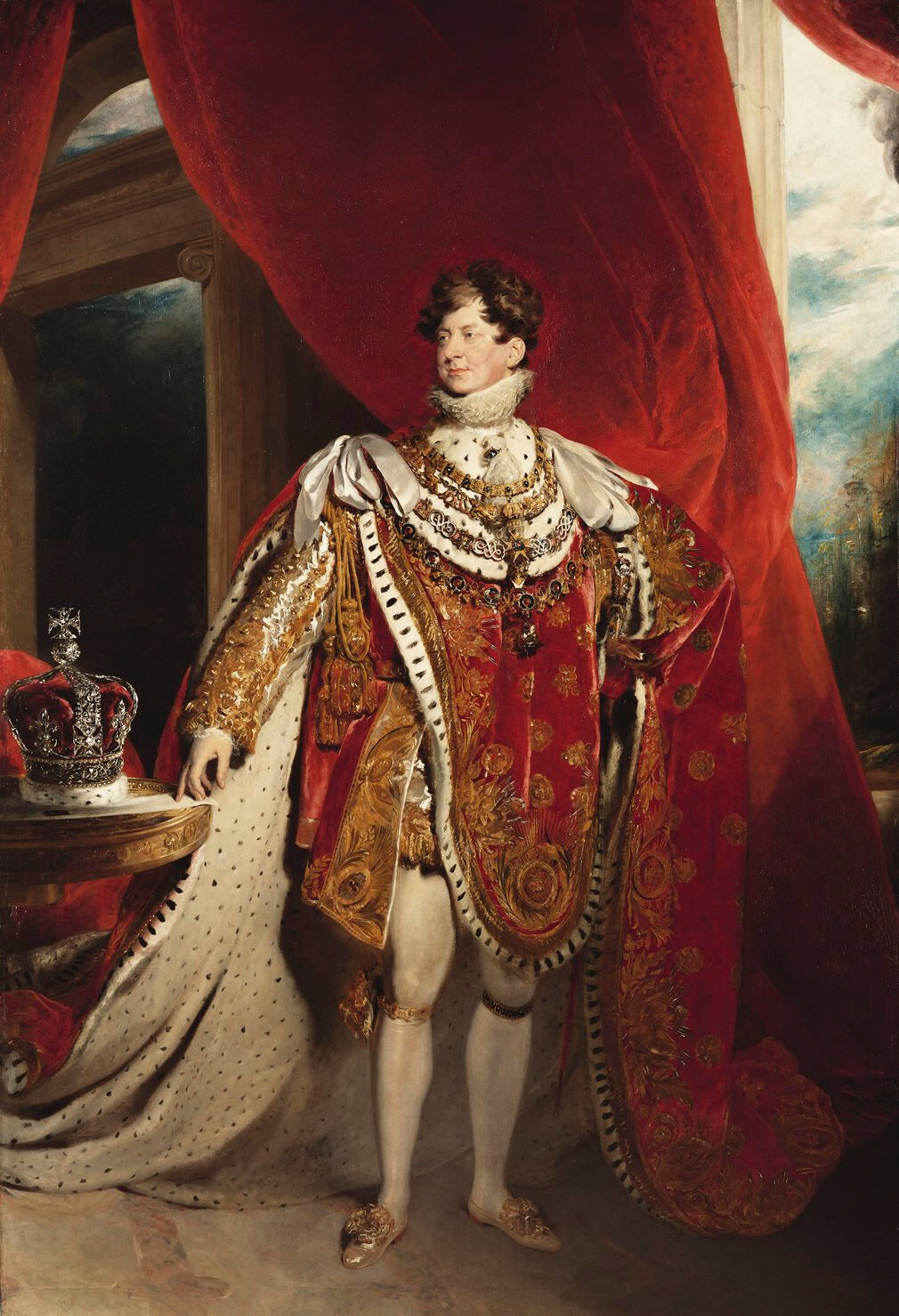


Upheavals on the Continent following the French Revolution flooded the market with works of art that had belonged to the French aristocracy. With the help of agents and friends, George acquired the finest examples of 18th-century French decorative arts, including bronzes and furniture mounted with pietra dura panels by André-Charles Boulle. He had a particular passion for Sèvres porcelain. His most important acquisition of works by the French factory was the Louis XVI service, 1783–92, the most costly service ever created by Sèvres and so extensive that it was delivered to George in batches over 23 years.

Sèvres porcelain factory. The Louis XVI Service, 1783-92, dinner plate. Photo: Royal Collection Trust/© HM Queen Elizabeth II 2019
George IV’s coronation at Westminster Abbey was the greatest theatrical production of his life and came at a cost of £240,000. He personally oversaw the designs for his elaborate coronation robes and the Diamond Diadem, made for the occasion by the goldsmiths Rundell, Bridge & Rundell. At the coronation banquet in Westminster Hall, the great Shield of Achilles, 1821, designed by John Flaxman, was among many pieces of spectacular dining and buffet silver-gilt on display from the Grand Service.
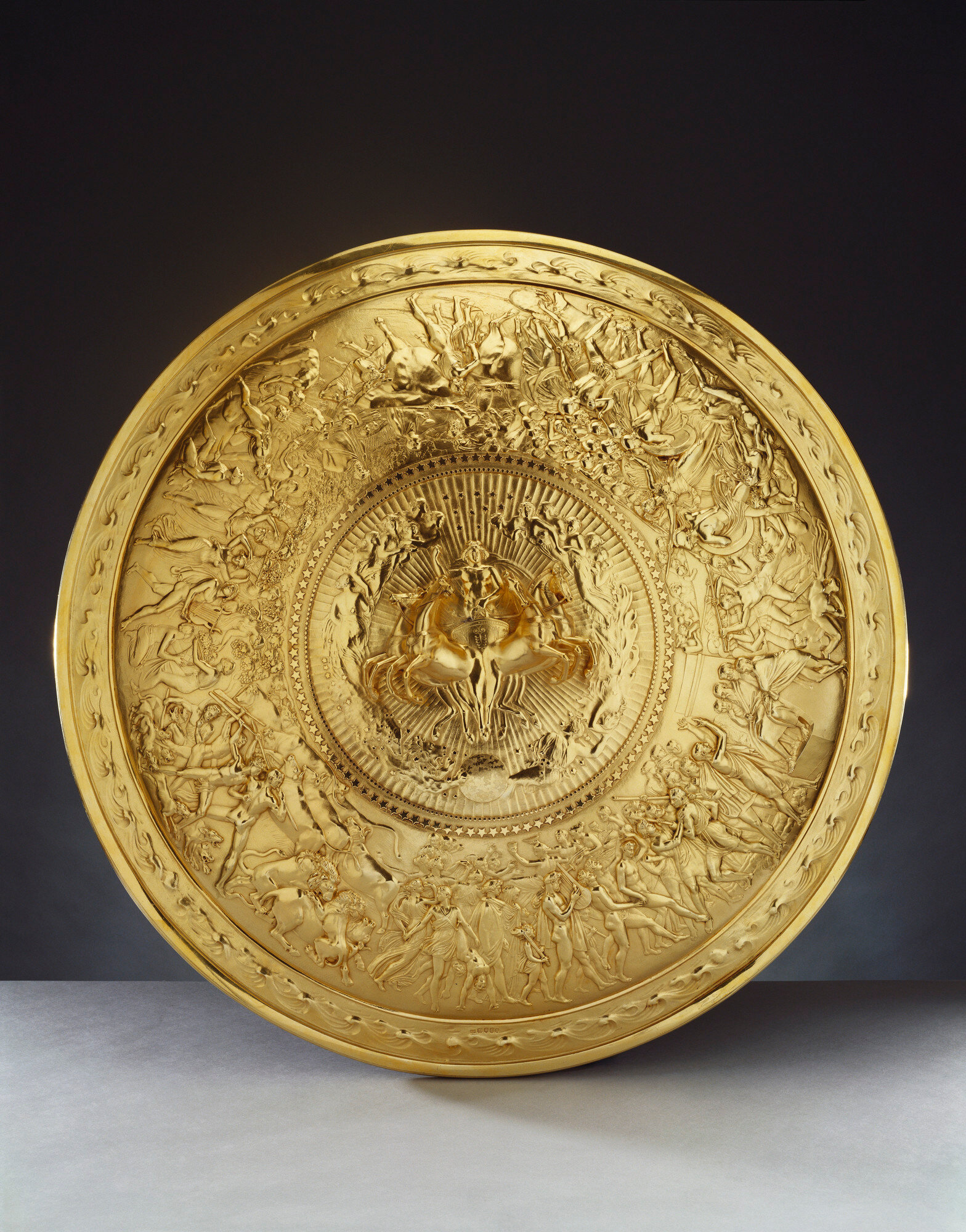
Philip Rundell, Shield of Achilles, 1821. Photo: Royal Collection Trust/© HM Queen Elizabeth II 2019
The King was among the leading patrons of British artists of the day, favouring the work of Sir Thomas Lawrence, Sir Joshua Reynolds and Richard Cosway. In 1784, he commissioned Sir Thomas Gainsborough to paint his three eldest sisters, the Princesses Charlotte, Augusta and Elizabeth, and after the artist’s death purchased Gainsborough’s only surviving mythological painting, Diana and Actaeon, c.1785–8. George’s favourite pastimes were equestrian, as captured in George IV, when Prince of Wales, 1791, an elegant portrait by George Stubbs. The everyday subject matter of the painter David Wilkie appealed to the King as modern-day versions of the 17th-century Dutch genre paintings he so admired. In a vibrant sketch, Wilkie recorded the King’s arrival at the Palace of Holyroodhouse in 1822, the first visit to Scotland by a reigning monarch since Charles I.

Thomas Gainsborough, Diana and Actaeon, c. 1785–88. Photo: Royal Collection Trust/© HM Queen Elizabeth II 2019

George Stubbs, George IV (1762-1830) when Prince of Wales, 1791. Photo: Royal Collection Trust/© HM Queen Elizabeth II 2019
George IV positioned himself at the forefront of the European political stage, in direct competition with Napoleon Bonaparte. Following the French Emperor’s abdication in April 1814, George invited several of the allied leaders and commanders to London, and commissioned Britain's pre-eminent portraitist, Sir Thomas Lawrence, to paint them. After Napoleon's final defeat at Waterloo, Lawrence travelled to the Congress of Peace at Aix-la-Chapelle, then to Vienna and Rome to complete the series. The paintings were later installed in the purpose-built Waterloo Chamber at Windsor Castle. In George’s mind he was one of this cast of heroes, as responsible for the victory over Napoleon as the Duke of Wellington.
As Prince Regent or Monarch, George never travelled beyond Europe, but amassed a large collection of artefacts from the wider world. Between 1800 and 1830, he assembled the most important group of Asian porcelain in Britain. To harmonise with the gilded interiors of his residences, these pieces were augmented by elaborate gilt-bronze mounts – converting a simple jar into an incense burner, candelabrum or even a clock. His taste for the oriental found its greatest expression in the Royal Pavilion at Brighton, designed by John Nash in 1815–33.

Jar and cover mounted as a pot-pourri, jar and cover: 1720-40, mounts: mid-18th century. Porcelain with celadon glaze painted in white slip and underglaze blue and gilt bronze, 34.6 x 31.7 x 21.6 cm (whole object). Photo: Royal Collection Trust/© HM Queen Elizabeth II 2019
Many of the finest non-Western pieces in George’s collection were received as diplomatic gifts, among them a red and yellow feather cape (‘ahu’ula) from King Kamehameha II and Queen Kamamalu of the Sandwich Islands (now Hawaii), and a First Nations coat of caribou skin. His collection of arms and armour covered almost every part of the world, from a Maori club brought from Hawaii by Captain Cook’s ship Resolution, to a Persian sabre and a samurai sword.

Hawaiian Cape ('ahu'ula) 1824. Photo: Royal Collection Trust/© HM Queen Elizabeth II 2019
George’s IV’s print and book collection reveals a more measured side to the Monarch in the variety of his intellectual pursuits. The books that he acquired for his Carlton House library, including a copy of Emma sent to him by Jane Austen’s publisher following the writer’s visit to the royal residence, highlight his interest in literature, geography, theology, European history and the antique.
Despite the King’s efforts to control his image, satirical artists of the day mocked him mercilessly in widely circulated prints. The caricatures of Thomas Rowlandson, John Doyle and Robert Seymour share the recurring themes of George’s excesses in food, fashion and sex. Although George collected some satirical prints of himself when Prince of Wales and King, these were of the gently comic kind. At the same time, he tried to suppress the more hostile images, threatening legal action and, through his agents, bribing publishers not to criticise him or his mistresses, with little success.
George IV: Art & Spectacle is at The Queen’s Gallery, Buckingham Palace, 15 November 2019 – 3 May 2020.


/image%2F1371349%2F20260407%2Fob_5e1a54_1000062087.jpg)
/image%2F1371349%2F20250327%2Fob_114f5c_1000013386.jpg)
/http%3A%2F%2Fstorage.canalblog.com%2F73%2F03%2F119589%2F133015613_o.jpg)
/http%3A%2F%2Fstorage.canalblog.com%2F94%2F13%2F119589%2F132735003_o.jpg)