

/https%3A%2F%2Fprofilepics.canalblog.com%2Fprofilepics%2F1%2F0%2F100183.jpg)
/https%3A%2F%2Fstorage.canalblog.com%2F03%2F02%2F119589%2F96711876_o.jpg)
/https%3A%2F%2Fstorage.canalblog.com%2F11%2F31%2F119589%2F94773502_o.jpg)
/https%3A%2F%2Fstorage.canalblog.com%2F20%2F83%2F119589%2F94772815_o.jpg)
/https%3A%2F%2Fstorage.canalblog.com%2F26%2F72%2F119589%2F75604929_o.jpg)
/https%3A%2F%2Fstorage.canalblog.com%2F59%2F60%2F119589%2F26458628_o.jpg)
'Chinese Silk Textiles of the Ming and Qing Dynasties' at Saint Louis Art Museum, July 1–December 18, 2022

Manchu Imperial Consort's Semiformal Court Robe with Design of Nine Five-Clawed Dragons Chasing Pearls and Five Symbols of Imperial Authority, detail, late 18th–early 19th century; Chinese, Qing dynasty, Jiaqing period; silk in tapestry weave (kesi) with metallic threads, sleeve extensions in silk faille; 56 1/2 x 93 inches; Saint Louis Art Museum, Museum Purchase 30:1918.
ST. LOUIS—The Saint Louis Art Museum will present “Chinese Silk Textiles of the Ming and Qing Dynasties,” an exhibition showcasing rare examples of clothing, embroideries, hangings and banners from the museum’s collection. The free exhibition opens July 1.
Chinese silk textiles were used for many different purposes and settings, mostly for the luxury and beauty they imparted. These include clothing and accessories, as well as furnishing fabrics and decorative pieces.
The exhibition will explore the diversity of Chinese silks, which varied in the numerous types of weaves employed and the many colors and patterns used. The show will also highlight common motifs on Chinese textiles, including animals and mythical creatures, floral and plant imagery, geometric forms, Buddhist and Daoist symbols and various auspicious emblems.
The museum started purchasing fine examples of Chinese textiles more than a century ago and it continues to acquire rare pieces of high quality. Numerous generous gifts from local patrons and donors have also greatly augmented the collection over many decades.
“Chinese Silk Textiles of the Ming and Qing Dynasties” is curated by Philip Hu, curator of Asian art. The installation will be on view in the Carolyn C. and William A. McDonnell Gallery 100 through December 18. The exhibition will complement “Global Threads: The Art and Fashion of Indian Chintz,” a ticketed textile exhibition that opens in October.
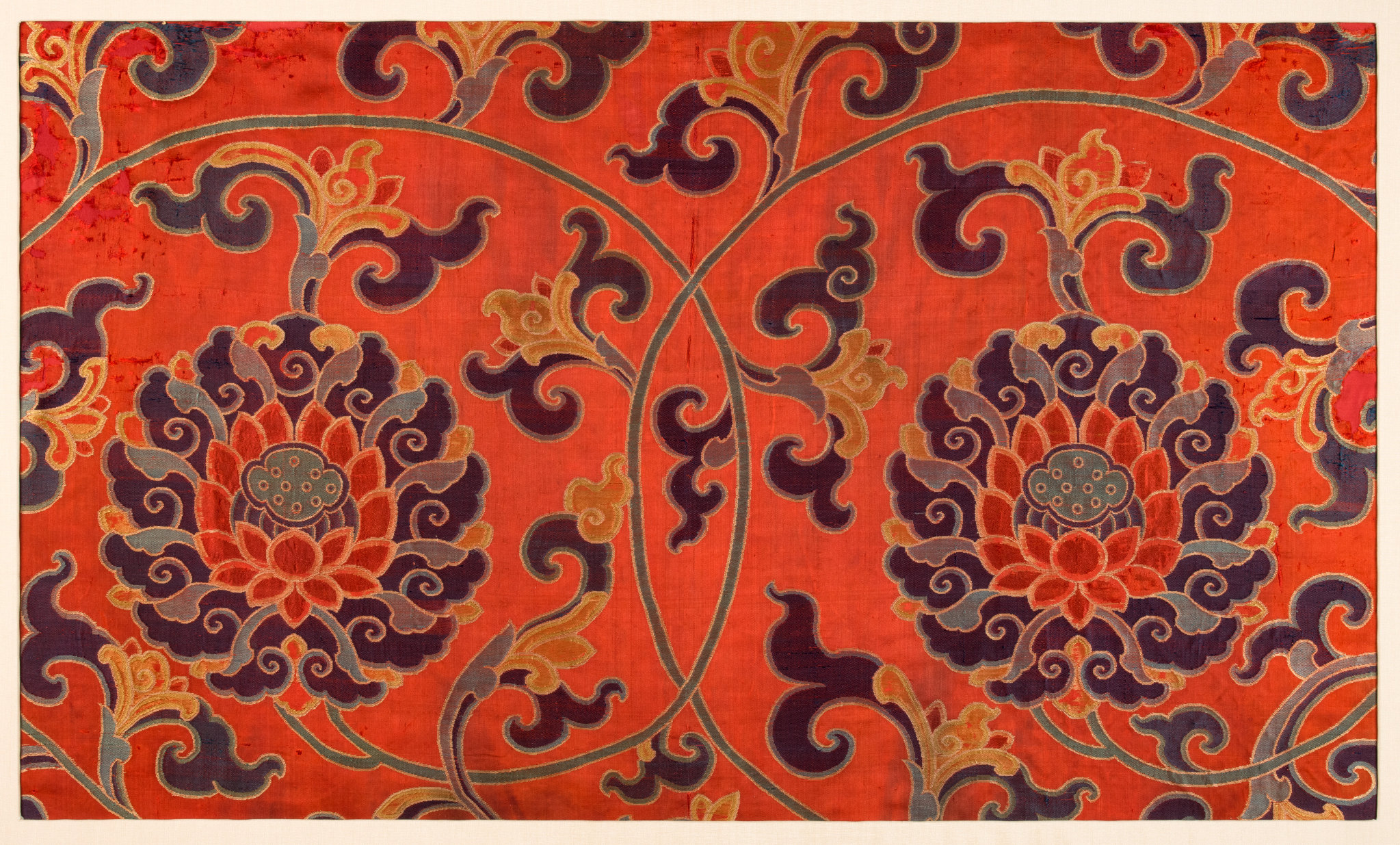
Chinese; Fragment of Textile with Design of Scrolling Lotus Flowers, Stems, and Leaves, late 16th–early 17th century, Ming dynasty, Wanli period, 1573–1619. Swivel-weave satin (zhuang hua duan); 21 1/4 x 35 1/16 in. (54 x 89 cm); Saint Louis Art Museum, Bequest of William Corman, 9:1958.
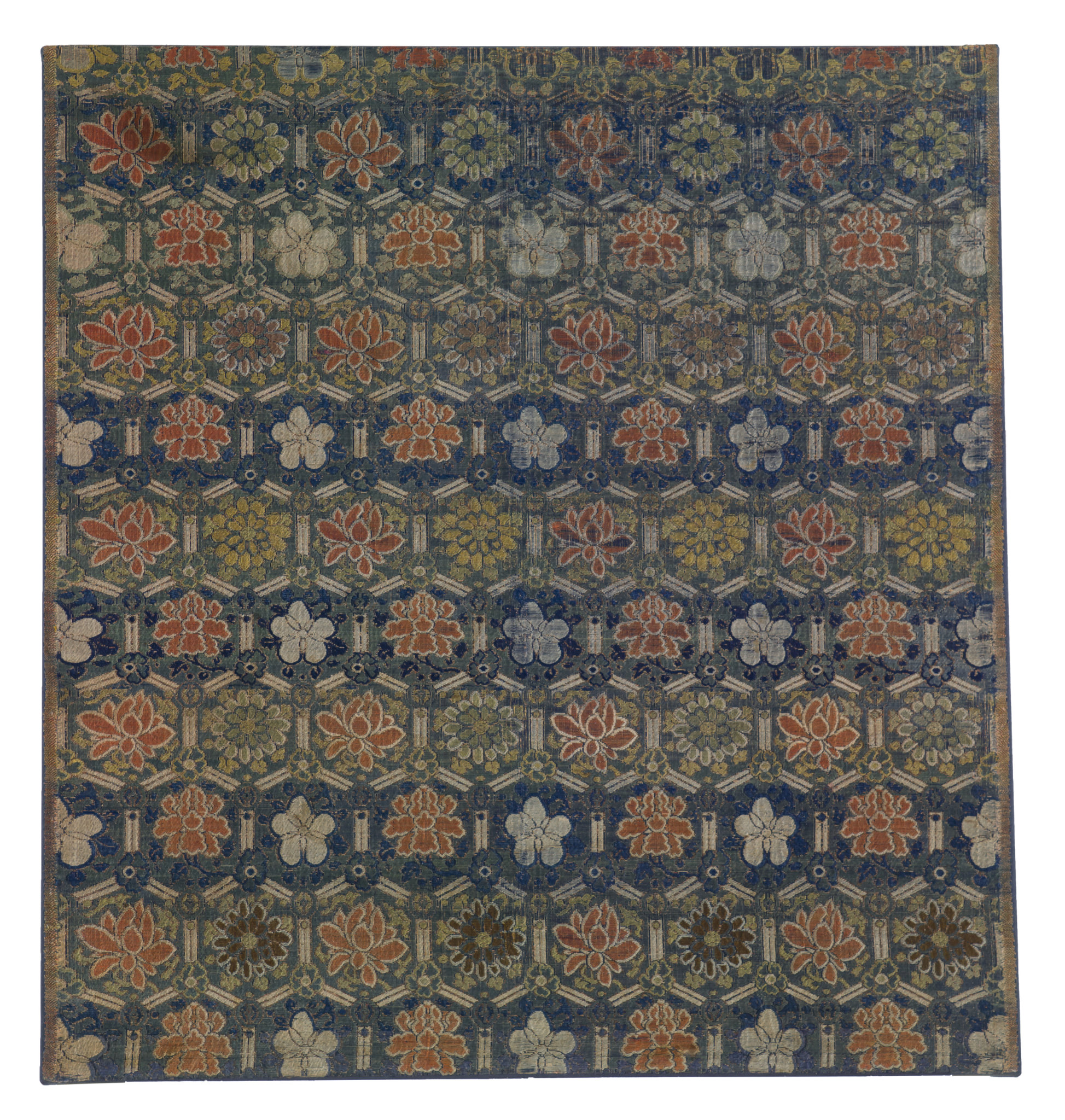
Chinese; Panel with Design of Seasonal Flowers Set within Hexagons, late 16th–early 17th century, Ming dynasty, Wanli period, 1573–1619. Silk brocade; 29 1/2 × 27 1/4 in. (74.9 × 69.2 cm); Saint Louis Art Museum, Gift of J. Lionberger Davis, by exchange, 32:2017.

Chinese; Hanging Made from Pieced Fragments of a Priest’s Robe (kāṣāya) with Design of the “Thousand Buddhas” Motif, 15th–17th century, Ming dynasty or Qing dynasty. Silk gauze embroidered with silk satin, 86 1/4 × 43 1/4 in. (219.1 × 109.9 cm); ; Saint Louis Art Museum, Museum Purchase, 115:1919.
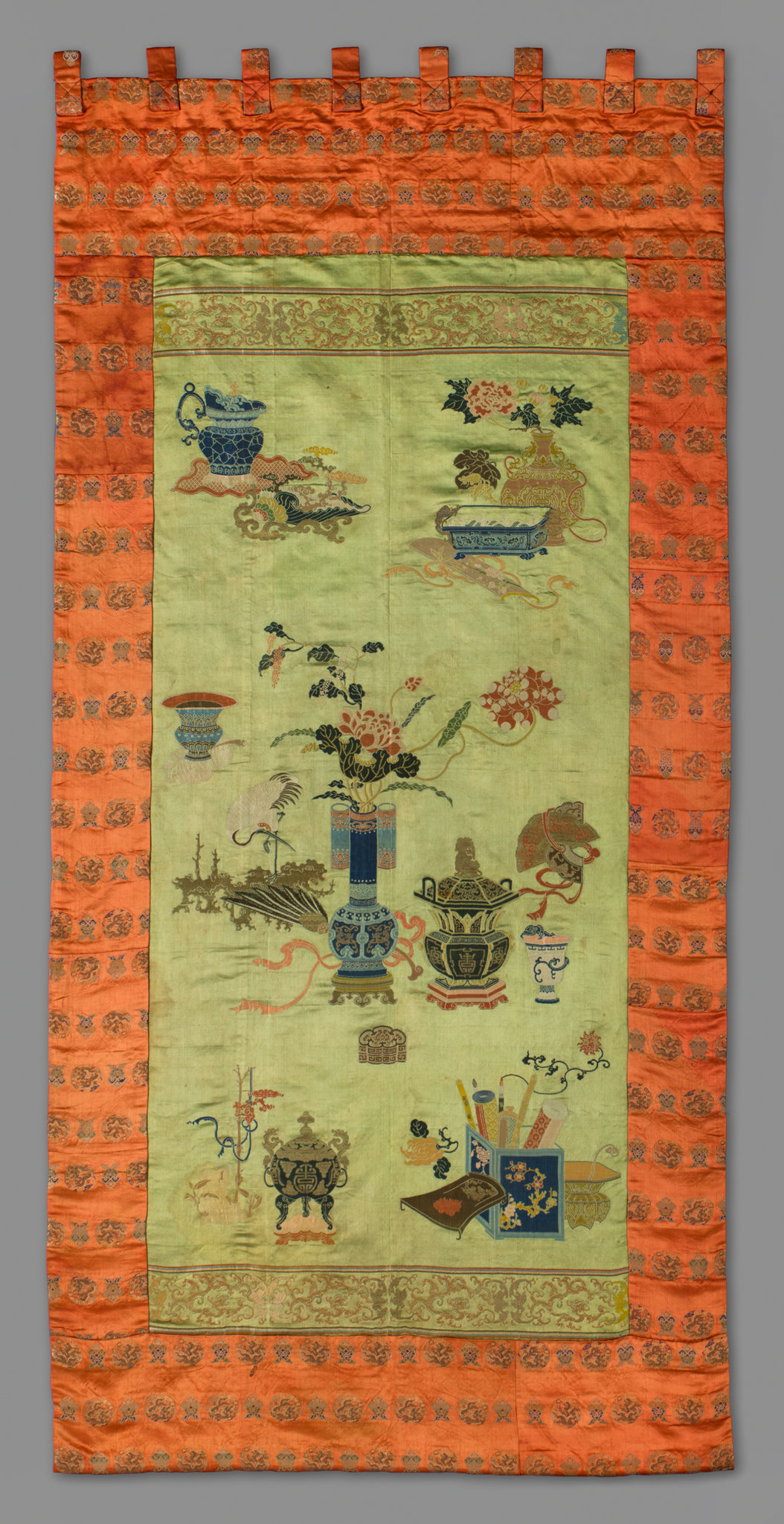
Chinese; Hanging with Design of the “Hundred Antiques”, early 18th century, Qing dynasty, Kangxi period, 1662–1722 or Yongzheng period, 1722–1735. Silk satin brocaded with polychrome silk; 84 1/2 × 40 1/2 in. (214.6 × 102.9 cm), dimensions of area within orange silk borders: 64 in. × 28 1/2 in. (162.6 × 72.4 cm); Saint Louis Art Museum, Gift of Mrs. Samuel C. Davis, 84:1941.
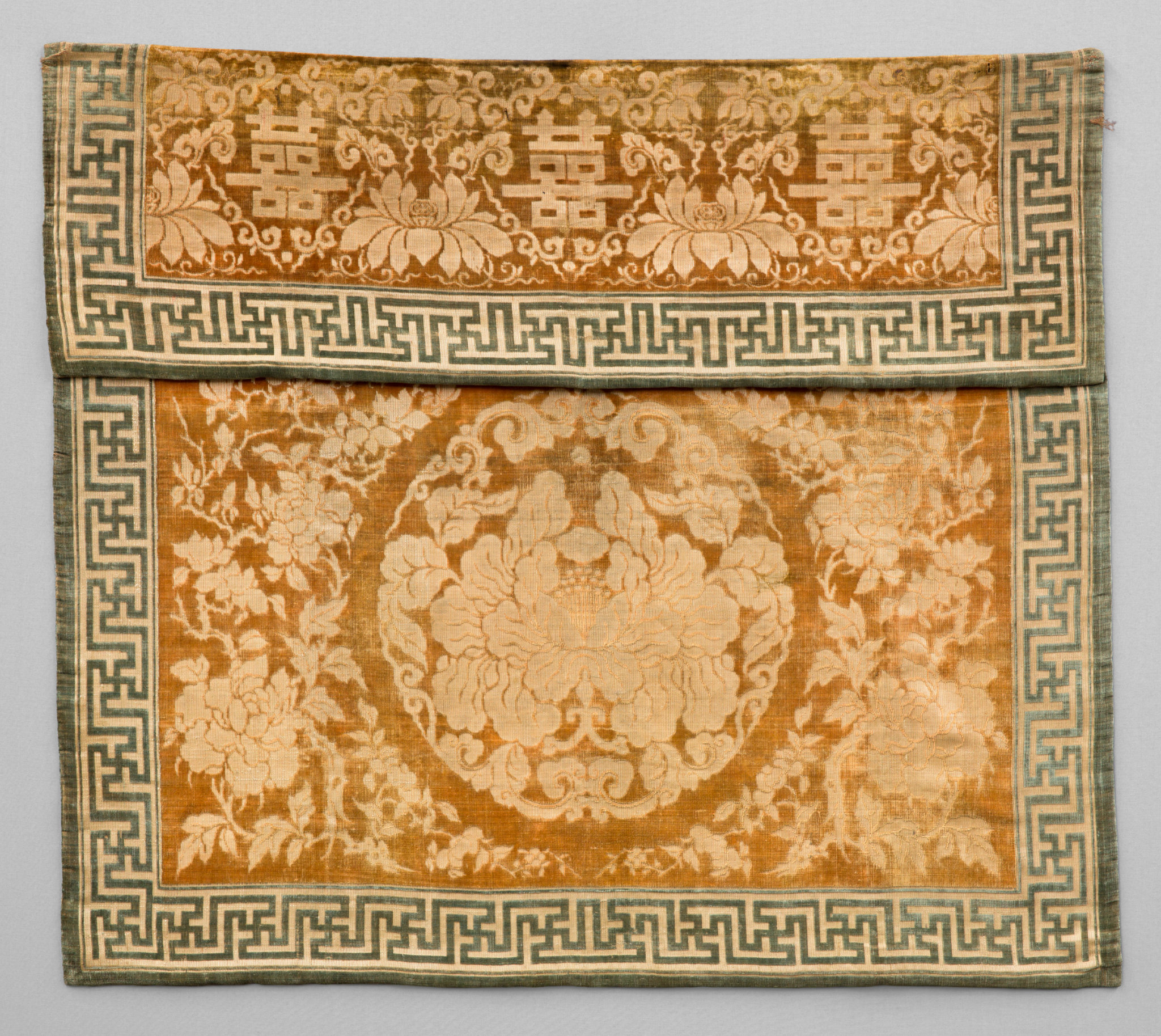
Chinese; Wedding Altar Frontal with Design of Peony and Lotus Scrolls, Symbols for Double Happiness, and Meandering Swastika Fret Border, mid- to late 18th century, Qing dynasty, Qianlong period, 1736–1795. Cut silk velvet; 32 3/8 x 36 1/2 in. (82.2 x 92.7 cm); Saint Louis Art Museum, Museum Purchase, 38:1917.

Chinese; Altar Frontal with Design of Dragons amidst Multicolored Clouds and Waves with Kui-Dragon Roundels, mid- to late 18th century, Qing dynasty, Qianlong period, 1736–1795. Silk floss embroidery in counted stitch on silk gauze; when stretched flat on one plane: 31 × 95 7/8 in. (78.7 × 243.5 cm), when folded on left and right to cover three sides of a table: 31 in. × 39 5/8 in. × 28 1/4 in. (78.7 × 100.6 × 71.8 cm); Saint Louis Art Museum, Museum Purchase, 38:1917.

Chinese; Cushion Cover for an Imperial Dais (kang) with Design of Floral Scrolls and the Eight Auspicious, Symbols of Buddhism, late 18th century, Qing dynasty, Qianlong period, 1736–1795. Silk in tapestry weave (kesi) and couched gold thread; 39 5/8 × 53 3/4 in. (100.6 × 136.5 cm); Saint Louis Art Museum, Museum Purchase, 158:1916.

Chinese; Imperial Chair Cover with Design of Five-Clawed Dragons and Bats amidst Peony Scrolls and Border with the Eight Daoist Emblems and Multicolored Clouds, mid- to late 18th century, Qianlong period, 1736–1795. Silk in tapestry weave (kesi) and gold thread; 51 1/4 × 51 3/4 in. (130.2 × 131.4 cm); Saint Louis Art Museum, Museum Purchase, 33:1917.

Chinese; "Manchu Imperial Consort's Semiformal Court Robe with Design of Nine Five-Clawed Dragons Chasing Pearls and Five Symbols of Imperial Authority", late 18th–early 19th century; Qing dynasty, Jiaqing period, 1796–1820. Silk in tapestry weave (kesi) with metallic threads, sleeve extensions in silk faille; 56 1/2 in. x 93 inches; Saint Louis Art Museum, Museum Purchase 30:1918.

Chinese; "Manchu Man's Informal Summer Court Robe with Design of Four-Clawed Dragons Chasing Flaming Pearls", late 18th–early 19th century, Qing dynasty, Jiaqing period, 1796–1820. Silk and metallic yarns couched and embroidered on silk gauze; 54 x 84 inches; Saint Louis Art Museum, Museum Purchase 52:1934.

Chinese; "Han Chinese Woman's Informal Three-Quarter-Length Coat (ao) with Design of Flowers and Butterflies", late 19th century, Qing dynasty; silk damask, applied embroidered satin borders, satin stitch, French knot, gold foil wrapped thread embroidery; length: 40 inches; Saint Louis Art Museum, Gift of Jane K. Pelton 79:1979.

Chinese; Han Chinese Woman’s Skirt (qun) with Design of Floral Sprays, Bats, Auspicious Emblems, and Waves with Stylized Dragon Borders late 19th century, Qing dynasty, Tongzhi period, 1861–1875 or Guangxu period, 1875–1908. Silk satin embroidered with silk and couched gold threads, cotton waistband; length: 32 in. (81.3 cm); Saint Louis Art Museum, William K. Bixby Trust for Asian Art, 977:1920.

Chinese; Han Chinese Woman’s Skirt (qun) with Design of Flowers and Butterflies with Stylized Floral Scroll Borders on a Yellow Ground, late 19th century, Qing dynasty, Tongzhi period, 1861–1875 or Guangxu period, 1875–1908. Silk damask with satin stitch embroidery, gold-wrapped threads, and cotton waistband; length: 37 1/2 in. (95.3 cm); Saint Louis Art Museum, Gift of Mrs. Ralph F. Bixby, 98:1978.

Chinese; Manchu Woman’s Informal Robe (changyi) with Design of Roundels Containing Orchid, Chrysanthemum, and Begonia Sprays, late 19th–early 20th century, Qing dynasty, Guangxu period, 1875–1908. Silk satin damask with polychrome silk embroidery; 53 7/8 × 47 1/2 in. (136.8 × 120.7 cm); Saint Louis Art Museum, Gift of Mr. and Mrs. F. Russell Fetté in memory of Helen Campbell Fetté, 263:1986.

Chinese; Birthday Hanging with Design of Auspicious Motifs, late 19th century, Qing dynasty, Guangxu period, 1875–1908. Silk satin embroidered with silk and metallic threads; 67 1/2 x 47 11/16 in. (171.5 x 121.2 cm); Saint Louis Art Museum, Gift of Mr. and Mrs. F. Russell Fetté in memory of Helen Campbell Fetté, 268:1986.

Chinese; Banner with Design of Five-Clawed Dragon, Flaming Pearl, and Multicolored Clouds, late 19th century, Qing dynasty, Guangxu period, 1875–1908. Floss silk embroidery on silk satin; 37 5/8 x 14 3/16 in. (95.5 x 36 cm); Saint Louis Art Museum, Gift of Mr. and Mrs. F. Russell Fetté in memory of Helen Campbell Fetté, 118:1994.

Chinese; High Lama’s Summer Hat, late 19th–early 20th century, Qing dynasty, Guangxu period, 1875–1908
or Xuantong period, 1909–1911. Silk satin damask with metallic silk braid and silk brocade over woven bamboo frame, 3 11/16 x 15 3/16 in. (9.4 x 38.5 cm); Saint Louis Art Museum, Gift of Mr. and Mrs. F. Russell Fetté in memory of Helen Campbell Fetté, 271:1986.


/image%2F1371349%2F20250121%2Fob_051371_1000008303.jpg)
/image%2F1371349%2F20250121%2Fob_b9e5a3_1000008285.jpg)
/http%3A%2F%2Fstorage.canalblog.com%2F63%2F82%2F119589%2F134347381_o.jpg)
/http%3A%2F%2Fstorage.canalblog.com%2F62%2F32%2F119589%2F133552231_o.jpg)