

/https%3A%2F%2Fprofilepics.canalblog.com%2Fprofilepics%2F1%2F0%2F100183.jpg)
/https%3A%2F%2Fstorage.canalblog.com%2F03%2F02%2F119589%2F96711876_o.jpg)
/https%3A%2F%2Fstorage.canalblog.com%2F11%2F31%2F119589%2F94773502_o.jpg)
/https%3A%2F%2Fstorage.canalblog.com%2F20%2F83%2F119589%2F94772815_o.jpg)
/https%3A%2F%2Fstorage.canalblog.com%2F26%2F72%2F119589%2F75604929_o.jpg)
/https%3A%2F%2Fstorage.canalblog.com%2F59%2F60%2F119589%2F26458628_o.jpg)
Getty to acquire ancient portrait bust of Roman Emperor Antoninus Pius
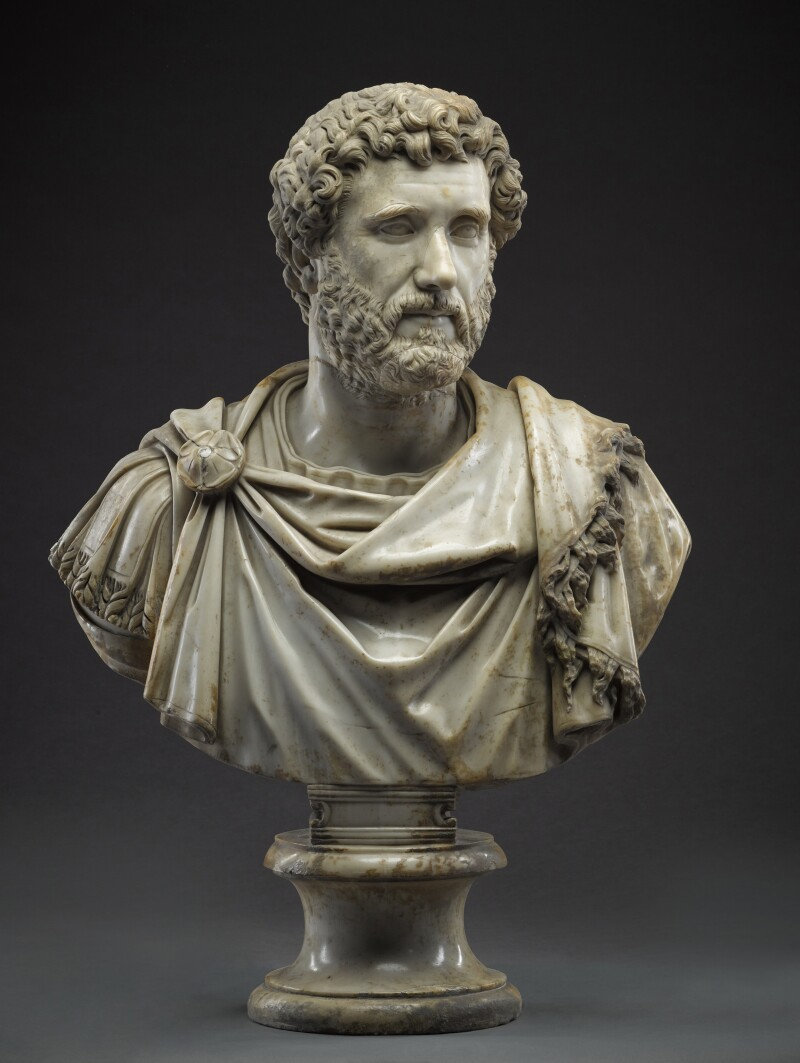
LOS ANGELES, CA.- The J. Paul Getty Museum is set to acquire an over-life-size ancient Roman marble bust of the emperor Antoninus Pius (ruled AD 138–161).
The work was purchased at auction in December; its final acquisition is subject to an export license being granted by the Arts Council England.
A prime example of Antoninus Pius’s main portrait type, the bust was created sometime after he ascended the throne in AD 138. With minor variations, this portrait type remained the emperor’s official image throughout his reign until AD 161. Carved from a single block of fine-grained white marble, the bust shows the emperor as a mature man with distinct facial features, a full, neatly trimmed beard, and thick curly hair. He wears a tunic, a cuirass (body armor), and a fringed paludamentum (a general’s cloak) folded in half and pinned at his right shoulder.
“This exquisitely sculpted and remarkably preserved portrait ranks among the finest of more than 100 versions of Antoninus’s image that have survived from antiquity,” says Timothy Potts, Maria Hummer-Tuttle and Robert Tuttle Director of the Getty Museum. “The bust adds a new highlight to the series of high-quality imperial portraits at the Getty Villa, including the full-length statue of Antoninus’ wife Faustina the Elder, and the busts of Augustus, Germanicus, Caligula, and Commodus.”
Born in Lanuvium to a family that had migrated to Italy from Nemausus in southern Gaul (today’s Nîmes in France), Antoninus was not groomed to become emperor. At the advanced age of 51, following a career as governor of the province of Asia and as Roman senator, he was adopted by Emperor Hadrian to be his successor. Antoninus’ long and exceptionally peaceful reign brought great prosperity to the Roman Empire, and the economy, culture, and artistic production flourished. The emperor started the dynasty of the Antonines, which lasted for more than two generations and ended with the death of Commodus in AD 192.
“Many objects in our collection were made in the Antonine period, as it is known today, including portraits, mythological sculptures, sarcophagi, and numerous other works,” says Jens Daehner, associate curator of antiquities at the Getty Museum. “The bust of Antoninus provides a firmly dated visual reference for what characterized Roman aesthetics during that period. On display in our galleries, the bust will convey to visitors how, for example, Antonine sculptors carved drapery folds, used drills to give texture to hair, or incised the eyes of their sitters.”
The marble bust was acquired in 1851 in Naples, Italy, by Robert Martin Berkeley (1823–1897), who brought it to his estate at Spetchley Park, Worcestershire, in England. It remained there with his heirs until it was offered at auction late last year at Sotheby’s, London. Although documented in the estate’s archive, the bust was previously unknown to the public or scholars.
Once acquired, the bust of Antoninus Pius will go on display in the Getty Villa’s Later Roman Sculpture gallery with its selection of other Antonine period portraits.


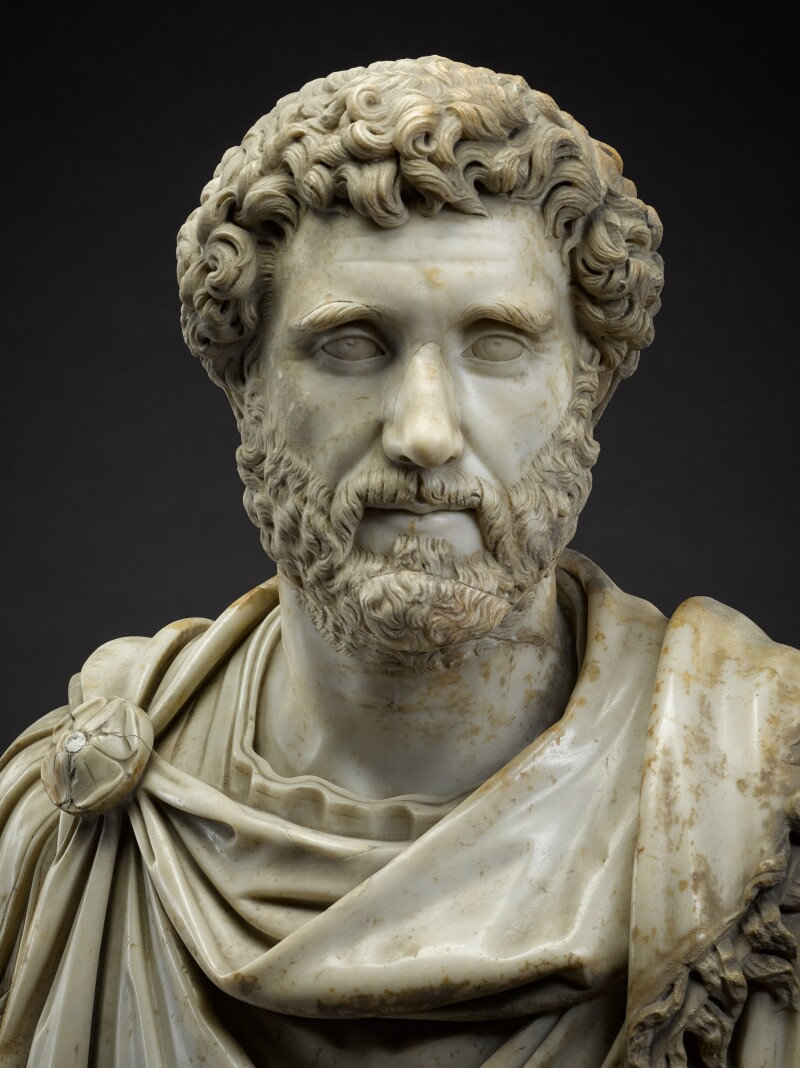
Property from the Berkeley Collection at Spetchley Park. A Roman Marble Portrait Bust of Emperor Antoninus Pius, circa A.D. 140. Height 97 cm. Lot sold: 7,717,000 GBP at Sotheby's London, 6 December 2022, lot 29. (Estimate: 600,000 - 900,000 GBP). (C) 2023 Sotheby's
monumental in size, the emperor with his head turned to his left, his mature face with thoughtful countenance, full beard and moustache, deep-set eyes with incised irises and dotted pupils, and incised eyebrows, his thick hair radiating from the crown in long wavy locks and massed in rich deeply drilled and unruly voluted curls around the forehead and temples, and wearing a tunic, cuirass, and paludamentum fastened with a circular brooch on the right shoulder, the fringed hem of the cloak falling in zigzag folds from the left shoulder, the entire bust and its socle carved in one piece; head repaired at the neck, the nose, chin, and right eyebrow restored.
Provenance: said to have been found at Pozzuoli
Raffaelle Barone, Naples
Robert Martin Berkeley (1823-1897) and Lady Mary Catherine Berkeley (1829-1924), Spetchley Park, Worcestershire, acquired from the above on June 11th, 1851, while on their honeymoon
by descent to the present owner.
Documented: Robert Martin Berkeley's honeymoon diary 1851 [manuscript]:'Wednesday June 11 - Bought of Raffaello Baroni dealer in antiquities in the Strada Constantinopoli an antique marble bust of Antoninus Pius, etc.' (Berkeley Family Archive at Spetchley Park)
Busts bought in Italy 1851 [manuscript]: 'Naples... Bust of Antoninus Pius 240 Ducats £44-2 (Raff Baroni) found at Pozzuoli' (Berkeley Family Archive at Spetchley Park)
Inventory of Furniture, Plates, Glass, China, Plated Articles on the Premises of Spetchley Park, Worcester, 1893 [manuscript]: '10 marble busts on pedestals as follows... 1 antique 37'' Antoninus Pius on ditto [scagliola pedestal]', in the Inner Hall (Berkeley Family Archive at Spetchley Park).
Note: For an extensive and richly illustrated overview of Antoninus’ portraiture see K. Fittschen and P. Zanker, Katalog der römischen Porträts in den Capitolinischen Museen, vol. 1, 1985, pls. 67-69 and Beilage 39-49.
The present bust is closely related to another example in Castle Howard (Fittschen and Zanker cit., Beilage 41; B. Borg et al., Die antiken Skulpturen in Castle Howard, 2005, p. 85f., no. 41, pl. 40f.; https://arachne.dainst.org/entity/1064014), in the way the folds of the paludamentum are carved, suggesting that they were both produced in the same workshop.
Antoninus Pius’ portrait type, which remained almost unchanged during his 23-year reign, is likely to have been created by his court sculptors on the occasion of his accession to the throne at age fifty-two in A.D. 138. Another high-quality portrait of Antoninus Pius, now in the Yale University Art Gallery, was sold at Sotheby’s, New York, June 12th, 2003, no. 54.
Antoninus Pius (reigned AD 138-161), like his adoptive father Hadrian, is wearing the philosopher’s beard, a sign that he wanted to show himself not only as a man of action, but also as a thinker steeped in Greek philosophy and culture. Unlike Hadrian he rarely traveled outside of Rome and Italy, preferring to administer the Empire from the capital. According to an ancient writer, “In personal appearance he was strikingly handsome, in natural talent brilliant, in temperament kindly; he was aristocratic in countenance and calm in nature, a singularly gifted speaker and an elegant scholar, conspicuously thrifty, a conscientious land-holder, gentle, generous, and mindful of others’ rights“ (Historia Augusta, III,2).
According to S. Sarti, Giovanni Pietro Campana (1808-1880). The Man and his Collection, 2001, p. 33: "A renowned dealer working in Naples was Raffaele Barone, whose shop was well known to most archaeologists, since he allowed them to study the antiquities he acquired." Several vases from his collection were published by G. Minervini, Monumenti antichi inediti posseduti da Raffaele Barone, 1850.


/image%2F1371349%2F20260925%2Fob_aeecf2_38556.jpg)
/image%2F1371349%2F20260925%2Fob_e8b711_38551.jpg)
/image%2F1371349%2F20260925%2Fob_f64f72_38550.jpg)
/image%2F1371349%2F20260925%2Fob_597eb0_38549.jpg)