

/https%3A%2F%2Fprofilepics.canalblog.com%2Fprofilepics%2F1%2F0%2F100183.jpg)
/https%3A%2F%2Fstorage.canalblog.com%2F03%2F02%2F119589%2F96711876_o.jpg)
/https%3A%2F%2Fstorage.canalblog.com%2F11%2F31%2F119589%2F94773502_o.jpg)
/https%3A%2F%2Fstorage.canalblog.com%2F20%2F83%2F119589%2F94772815_o.jpg)
/https%3A%2F%2Fstorage.canalblog.com%2F26%2F72%2F119589%2F75604929_o.jpg)
/https%3A%2F%2Fstorage.canalblog.com%2F59%2F60%2F119589%2F26458628_o.jpg)


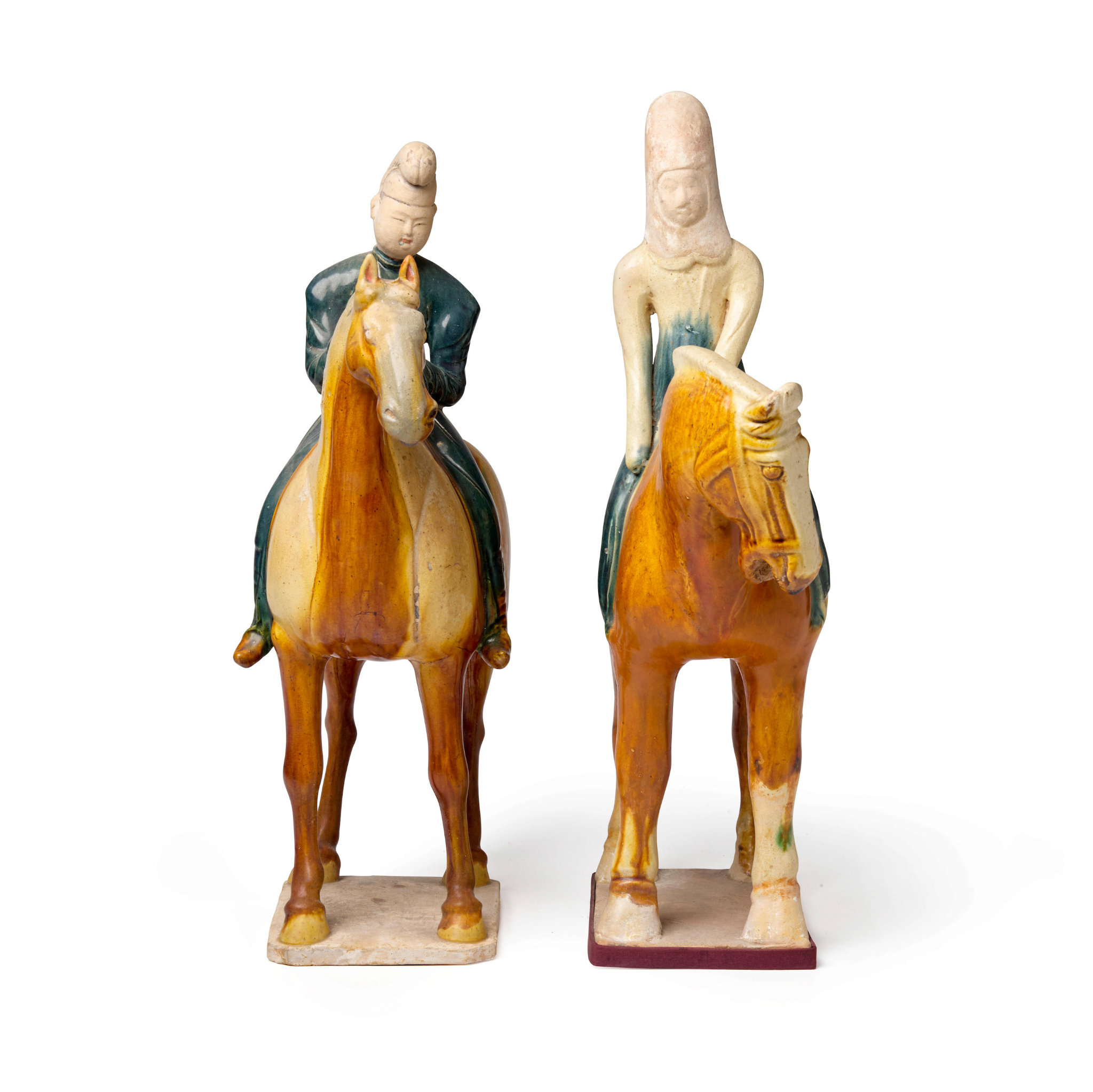
Depicting male and female riders, the first wearing wide-shouldered blue riding coat and trousers and ochre-glazed boots and stirrups, the rider's hands covered by voluminous sleeves and held forward, the front flap neatly outlined off-center and with a simple crew neck below the unglazed head, the hair tied in a forward-facing bun under a tied cap, the sancai-glazed horse standing four-square on an unglazed rectangular base, with head held forward and turning slightly to it's (real) left, the female rider wearing a blue and straw-glazed riding coat and trousers with lightly molded stirrups, her ochre and straw-glazed horse standing four-square on an unglazed rectangular base with head looking downward and to it's (real) left.
Note: Compare the similarly modeled painted pottery equestrian figures unearthed from the Tang cemetery in Xingyuan village, Yanshi city, Henan province, illustrated in the excavation report The Tang Tombs in Yanshi Xingyuan, Beijing, 2001, pl. 7-1-4.
For a pair riding straw-glazed horses, see Christie's New York, 25 March 2022, from the Collection of Mr. And Mrs. McLendon, lot 1066; see also a larger, blue-glazed rider on an amber horse sold at Christie's New York, 13 September 2019, lot 1069.
For another larger blue-glazed rider on a straw-glazed horse, see Sotheby's New York, Important Chinese Art, 13 September 2016, lot 151 and previously sold at Sotheby's New York, 3rd December 1986, lot 110 from the Collection of Earl and Irene Morse and also illustrated in the exhibition catalog A Thousand Years of Chinese Tomb Sculpture at the Epcot Center, Orlando, 1983, no. 28.


Lot 48. From the Alan and Simone Hartman collection. A large sancai-glazed tripod dish with impressed flowerhead center, Tang Dynasty (618-907); 65 x 84 x 19.2cm. Sold for US$57,600. © Bonhams 2001-2024
The center of the dish impressed with a large six-petaled composite flowerhead of lotus outline, with a smaller flowerhead at it's center, all surrounded by twelve detached cloud-form leafy sprays, reserved on a resist-spotted ochre ground that runs to a molded or incised line at the base of the well, and continues with a resist-spotted green ground to the rounded everted rim, the sides of the exterior under an apple-green glaze that pools attractively around the flat buff pottery base that is supported on three simple loop-form green-glazed feet.
Provenance: Christie's New York, 16 September 1999, lot 292
Sotheby's New York, 30 March 2006, Lot 12
Note: Sancai dishes of this size and rich design are very rare. A similar dish of larger size (38.1 cm) from the Victoria and Albert Museum is illustrated by Margaret Medley, T'ang Pottery and Porcelain, London, 1981, pp. 40-41, where the author notes that motifs like wax-resist dots (the backdrop to the rim, well and center of our dish), are developed out of Central Asian textile techniques such as tie-and-dye silks and fabrics with wax-stenciled resist designs, while the impressed flowerhead designs at the center were inspired by chased silver.
Compare the Sancai and blue-glazed dish with three loop-form feet illustrated in the catalog of the exhibition organized by the Nezu Institute of Arts, Tang Pottery and Porcelain, Tokyo, 1988, p. 46, no. 42, with description on p. 91, where the author cited a white glazed dish with three loop-form feet.
For another rare large sized dish very similarly decorated to this example, See Christie's Hong Kong, 6 October 2015, lot 90. Compare also to another similar dish, also covered with a green glaze on the exterior, in the Eisei Bunko Collection, Tokyo, illustrated in Sekai toji zenshu, Tokyo, 1976, pl. 55.
See also Sotheby's Hong Kong, 8 April 2023, lot 3685 for a slightly smaller dish (24cm diam); and another illustrated in Spirit and Ritual: The Morse Collection of Ancient Chinese Art, The Metropolitan Museum of Art, New York, 1982, cat. no. 54.
The results of the thermoluminescence testing are consistent with the suggested dating of this piece, Oxford Authentication sample No. C123p14.


Lot 57. From the Alan and Simone Hartman collection. A group of three sancai glazed ceramics, Tang Dynasty (618-907); pillow: 10.5cm across; jar and cover: 8.5cm across; box and cover: 10cm diam (3). Sold for US$16,640. © Bonhams 2001-2024
Comprising an impressed small rectangular model of a pillow; a small globular jar and cover; and a shallow cylindrical box and cover, the first with four rows of five impressed four-petaled flowerheads to the top and to the underside and divided on the shallow sides with a spotted sancai glaze; the second with an incurving mouth and shallow domed cover with bud finial under a most attractive spotted glaze; the third with a shallowly domed cover with green and brown spotted glaze above vertical bands of color to the short sides.
Note: Small sancai-glazed pottery artifacts were used as personal accessories. Their prototypes may have came from silver wares, but the vibrant glaze colors have made them appealing to a wide audience. The rectangular pillow may be used as wrist rest when writing calligraphy. The covered jar may be used to store medicine or tea. The circular box may be used as container for incense, medicine, perfume paste, or cosmetic powder.
Compare the blue- and sancai-glazed rectangular pillow in the Beijing Palace Museum, illustrated in The Complete Collection of Treasures of the Palace Museum: Porcelain of the Jin and Tang Dynasties, Hong Kong, 1996, p. 232-233, no. 212.
Compare the green-glazed white spotted circular box in the Beijing Palace Museum, illustrated in The Complete Collection of Treasures of the Palace Museum: Porcelain of the Jin and Tang Dynasties, Hong Kong, 1996, p. 197, no. 182; together with another blue- and sancai-glazed circular box, op. cit., on p. 229.


Lot 58. From the Alan and Simone Hartman collection. A sancai glazed amphora, Tang Dynasty (618-907); 23.8cm high. Sold for US$8,320. © Bonhams 2001-2024
Of elegant slender oviform shape and supported on a short slightly flaring circular foot, the shoulder with a single molded bow-string band below the tall waisted neck and flaring rim, under a most attractive sancai glaze of ochre, green and straw tones that pool slightly unevenly at the foot and over the base edge revealing the pink pottery beneath.
Note: For a similar example see Mayuyama, Seventy Years, Vol. 1, Tokyo, 1976, p. 91, no. 242 and another is illustrated by R.L. Hobson, The George Eumorfopoulos Collection. Catalogue of the Chinese, Corean and Persian Pottery and Porcelain, Vol. 1, London, 1925-2, Vol. 1, pl. xlix, no. 328, both bear the same idiosyncratic wax-resist technique of three-colors that dribble attractively from the tall neck to the slightly spreading foot.
Another example of this decoration is illustrated in the catalog organized by the Nezu Institute of Arts, Tang Pottery and Porcelain, Tokyo, 1988, p. 45, no. 41.
The result of the thermoluminescence testing is consistent with the suggested dating of this piece, Oxford Authentication sample No. C123p16.


Lot 59. From the Alan and Simone Hartman collection. Two similar sancai and blue-glazed globular jars and covers, Tang Dynasty (618-907); 18.4cm high; 23.5cm with cover approx. (2). Sold for US$10,880. © Bonhams 2001-2024
Both with waisted everted rims, one rim ochre-glazed, the other green, and each with five triangular lappets that descend just below the mid-body that are outlined in blue, ochre and straw dots and centered by dabs of color forming flowerheads, all set against a green ground with further wax-resist dots of stylized flowerheads, the glaze stopping about two-thirds of the way down the vessels and revealing the buff pottery body beneath, the bases flat, the lightly domed covers with simple bud finials.
Note: The globular jar and cover is a classic Tang dynasty shape, called wan nian guan (ten-thousand-year jar), usually covered with a monochrome glaze of green, yellow, white, or blue, and occasionally with the white-spotted sancai glaze. It is very rare to see the cross-hatch pattern such as the present example.
A very similar jar and cover is in the collection of the Beijing Palace Museum, illustrated in The Complete Collection of Treasures of the Palace Museum: Porcelain of the Jin and Tang Dynasties, Hong Kong, 1996, p. 221, no. 204, where the author describes using wax-resist method for the glazing and noted that the design may have been inspired by Tang dynasty textiles.
See another example sold at Sotheby's Hong Kong, 3 December 2021, lot 835.


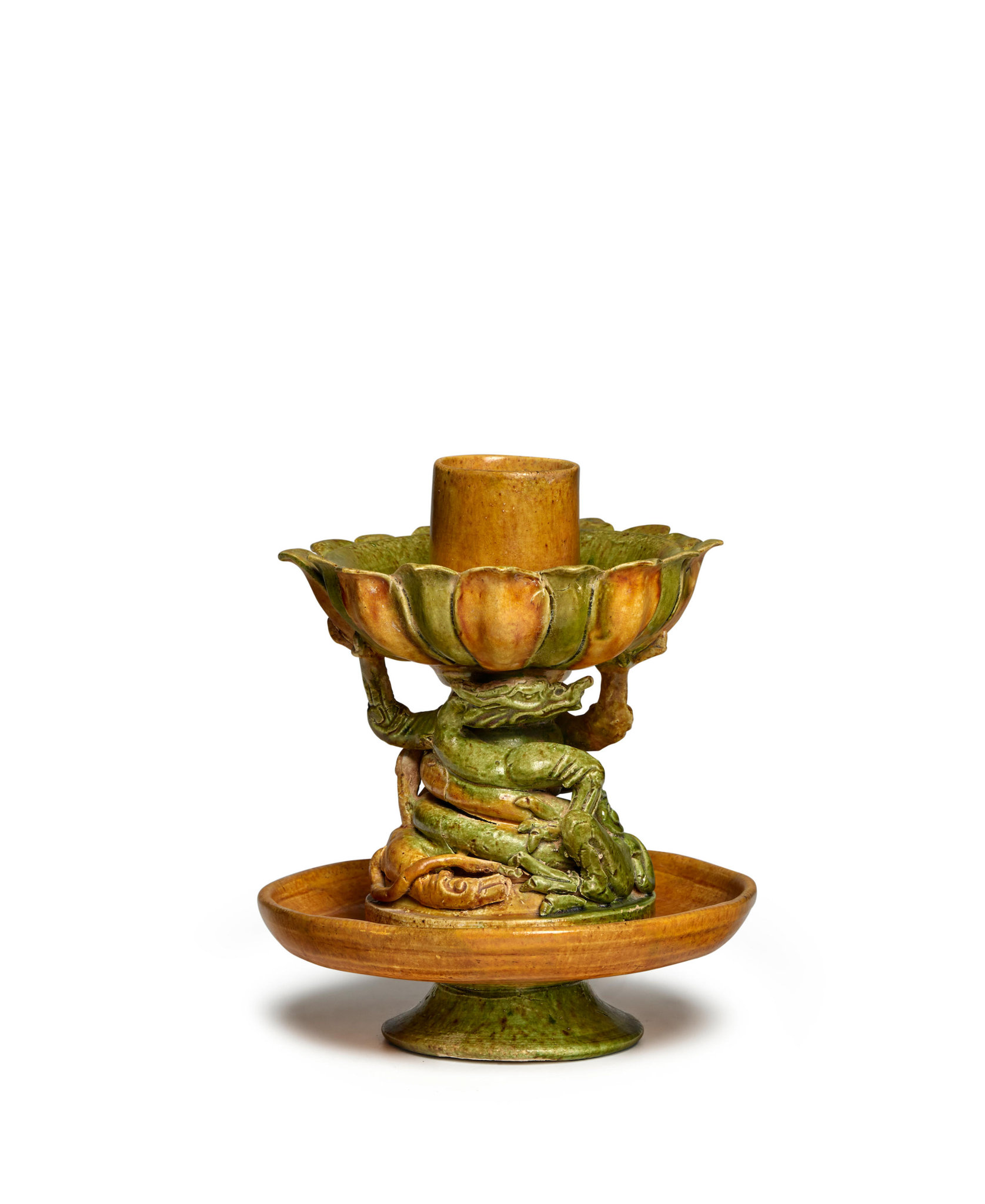
Lot 61. From the Alan and Simone Hartman collection. A rare green and ochre-glazed dragon lotus-form candleholder, Tang Dynasty (618-907); 20.3cm high. Sold for US$61,440. © Bonhams 2001-2024
The central stem applied with two entwined and coiling slender-bodied dragons, one glazed ochre, the other green, and each with one foreleg raised to dually support a lotus-petal-shaped upper drip pan with similar alternate glazed petals to the exterior and a green glaze to the interior that is centered by an ochre-glazed cylindrical candleholder, the larger lower drip pan with an ochre glaze and supported on a green-glazed short spreading foot, the foot interior un-glazed and revealing the pale buff pottery.
Provenance: Christie's Los Angeles, 4 December 1998, lot 51 and attributed to late Sui-early Tang dynasty (late 6th-early 7th century).
Note: For a very similar example see Kaikodo Journal V, Hong Kong, 1997, p. 206, no. 62, where the authors discuss the use of candles among the Tang nobility. Compare also with a very similar, green-glazed example illustrated in the Tsui Museum of Art, Chinese Ceramics I, Hong Kong 1993, no. 84, which bears a cover suggesting its possible use as a censer.
Compare the similarly modeled candleholder in the collection of the Museum of Fine Arts, Boston, illustrated by Tseng and Dart, The Charles B. Hoyt Collection in the Museum of Fine Arts: Boston, Volume I, Boston, 1964, no. 63, and another illustrated by William Watson, Tang and Liao Ceramics, Friborg, 1984, p. 46, pl. 26 and dated to the 7th century from the Cleveland Museum of Art, with lotus petals to the lower part rather than the pan of this example. See also the Tang dynasty candleholder with coiled dragons in the collection of the Beijing Palace Museum, illustrated in The Complete Collection of Treasures of the Palace Museum: Porcelain of the Jin and Tang Dynasties, Hong Kong, 1996, p. 185, no. 171.
Candleholder of this type exists as early as Sui dynasty. Compare, for several Sui dynasty examples, the straw-glazed white boshanlu with coiled dragon support in the collection of the Yamato Bunkakan, Nara, illustrated in the catalog of the exhibition organized by the Nezu Institute of Arts, Tang Pottery and Porcelain, Tokyo, 1988, p. 24, no. 9, together with a green-glazed boshanlu with coiled dragon support, in the collection of the Idemitsu Museum of Art, Tokyo, on p. 25, no. 10, and a straw-glazed white candleholder with coiled dragon support in the collection of the Osaka Municipal Museum of Art on p. 25, no. 11.
Bonhams. THE ALAN AND SIMONE HARTMAN COLLECTION THE INAUGURAL SALE, New York, 14 December 2023


/image%2F1371349%2F20250919%2Fob_eab298_image.jpg)
/image%2F1371349%2F20250322%2Fob_d69766_image.jpg)
/image%2F1371349%2F20240815%2Fob_0c89f6_image-9.jpg)
/http%3A%2F%2Fstorage.canalblog.com%2F69%2F06%2F119589%2F129930077_o.jpg)