

/https%3A%2F%2Fprofilepics.canalblog.com%2Fprofilepics%2F1%2F0%2F100183.jpg)
/https%3A%2F%2Fstorage.canalblog.com%2F03%2F02%2F119589%2F96711876_o.jpg)
/https%3A%2F%2Fstorage.canalblog.com%2F11%2F31%2F119589%2F94773502_o.jpg)
/https%3A%2F%2Fstorage.canalblog.com%2F20%2F83%2F119589%2F94772815_o.jpg)
/https%3A%2F%2Fstorage.canalblog.com%2F26%2F72%2F119589%2F75604929_o.jpg)
/https%3A%2F%2Fstorage.canalblog.com%2F59%2F60%2F119589%2F26458628_o.jpg)
The Emperor Maximilian Diamond
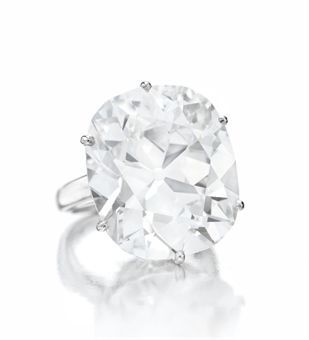
The Emperor Maximilian Diamond. photo: Christie's Images Ltd 2010
Set with a cushion-cut diamond, weighing approximately 39.55 carats, mounted in platinum
With report 2115547389 dated 8 January 2010 from the Gemological Institute of America stating that the diamond is I color, VS1 clarity, with very strong blue fluorescence
Accompanied by a supplemental letter dated 23 February 2010 from the Gemological Institute of America attesting to the re-cutting of the Emperor Maximilian Diamond from 41.94 carats to its present weight of 39.55 carats
Estimate: $1,000,000 - $1,500,000 - Price Realized $1,762,500 to an US ptivate.
Christie's. Jewels: The New York Sale, with The Catherine the Great Emerald Brooch and The Emperor Maximilian Diamond. 22 April 2010. New York, Rockefeller Plaza www.christies.com
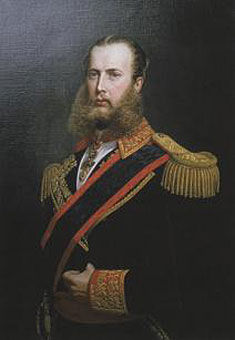 Maximilian was a member of the Imperial House of Hapsburg, the second son of Archduke Franz Charles of Austria and the younger brother of the Austrian Emperor Franz Joseph. Maximilian, a young man of decent liberal instincts, with the high Hapsburg forehead and the pouting Hapsburg lip, had all the prudishness of youth, combined with the snobbishness inevitable in a Hapsburg. As the second son without much of a formal role at the Austrian court and after a distinguished naval career, Maximilian retired to an idle life at Miramar, his idyllic medieval-style retreat overlooking the Adriatic near Trieste, with his young bride, Princess Charlotte of Belgium.
At an early age, Maximilian developed a keen interest in the sciences, particularly botany and he was fascinated by the New World. In 1860, he journeyed to the tropical forests of Brazil on a botanical expedition. While there, he acquired two exceptionally large diamonds which have been named after him: The Emperor Maximilian Diamond and The Maximilian Diamond. The Emperor Maximilian was a 41.94 carat antique cushion-cut diamond with a strong blue fluorescence which gives the diamond a soft luminosity in daylight. The second diamond was of a greenish-yellow tint and weighed 33 carats. After his return to Europe, Maximilian presented this smaller diamond to Charlotte, who wore it as a pendant. It is not known where either diamond was cut but it is possible that they were cut in Brazil, which has long possessed a diamond cutting industry, albeit on the smaller scale than in some other countries.
Maximilian and Mexico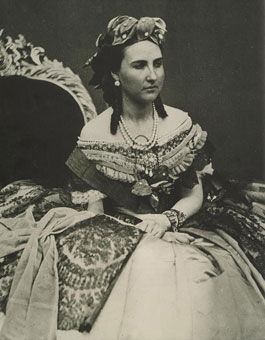 As a far-reaching foreign policy initiative, Emperor Napoleon III of France set out to create a satellite catholic monarchy in Latin America with the aim of curbing the burgeoning power of the United States while promoting French economic and geopolitical interests in the New World. He thought this would be best monitored under a European prince and so in 1863, Napoleon extended the invitation to Maximilian to become Emperor of Mexico. Urged on by his ambitious wife Charlotte, Maximilian would only accept on condition that he had the active backing of France and a firm invitation from the Mexican people.
Empire, emperor, empress, throne, crown…the words resounded like triumphant fanfare in Maximilian and Charlotte’s ears. Charlotte was particularly eager to establish European rule in Mexico after her own father had rejected the Mexican crown in his youth. Additionally, it would simply give her something meaningful to do. She preferred a full and active life with duties and responsibilities and even difficulties as opposed to a frustrating existence contemplating the sea from the top of a rock at Miramar castle. Charlotte was so excited that she changed her name to Carlota, the Mexican equivalent of Charlotte.
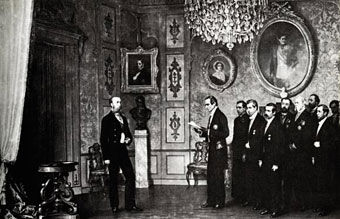 On April 14, 1864, Maximilian and Charlotte set sail for Mexico aboard the Austrian battleship Novara. From the very beginning of the enterprise, the auguries had not been good. Maximilian and Charlotte arrived in Vera Cruz on May 31, 1864, to find that no arrangements had been made to give them a reception in any way worthy of their station. An overnight storm had blown down all the decorations which had been put up to welcome them, adding to the overall impression of muddle and indifference. What was worse, the people of the town, a strong-hold for republican sentiment, seemed far from overjoyed at the arrival of their new emperor and empress.
Neither Maximilian nor Charlotte were acquainted with the country and its problems, but it soon became clear that they had inherited a bankrupt and embattled kingdom. Maximilian, who was not only a natural scientist but an enlightened leader and a great humanist, planned to rule his domain with great benevolence, and to protect and uplift the position of native peasants in the country. But the reigning government lacked popular appeal and civil unrest was rampant. Although Napoleon sent troops to quell Mexican resistance, Maximilian soon realized that the French government had been misled by the conservatives. Mexicans did not want a foreign ruler at all. In addition, Benito Juarez, a native Mexican and the republican leader, constantly opposed Maximilian and the French.
Maximilian and the End
In 1866, under pressure from the United States, Napoleon backed away from his earlier promise and withdrew French troops from Mexico and ceased his financial aid to the mission. Maximilian had been abandoned. Though he considered abdication, Charlotte was against it and decided instead to travel to Europe and seek aid for her husband. But this desperate journey only resulted in her spiral into paranoia and insanity.
After the last French soldier left Mexico, the republicans quickly overwhelmed Maximilian’s army. They took the emperor captive and staged a show trial where Maximilian was sentenced to death. Some foreign governments petitioned to have the Emperor sent back to Europe, but it was in vain. At dawn on June 19, 1867, Maximilian, who was only 35 years old, and two of his generals were taken out to face a firing squad. It was a beautiful morning and on the way to the place of execution Maximilian reputedly said to his companions: "What a wonderful day! I have always wanted to die on a morning like this."
The Emperor Maximilian Diamond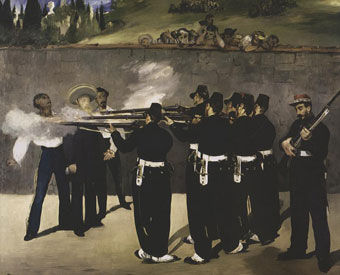 Legend holds that Maximilian was wearing the Emperor Maximilian Diamond in a small satchel tied around his neck when he faced the firing squad. Following the execution, his remains were sent to Vienna and the Emperor Maximilian Diamond returned to Charlotte. Upon news of his death, Charlotte’s condition worsened and she shut herself off from the outside world. The diamond was subsequently sold to help pay for expenses during Charlotte’s illness and it disappeared until 1919 when it returned to America. Maximilian’s widow lived on for another sixty years, hopelessly insane, dying in January 1927 in Brussels at the age of 86. Even in her final days, some say she still believed herself to be the Empress of Mexico.
In 1919, the Emperor Maximilian Diamond was purchased by a Chicago gem dealer, Ferdinand Holtz and was displayed in the 1934 Chicago World’s Fair as the highlight of the 'Century of Progress' exhibition. Despite several offers to buy it, Mr. Holtz refused to sell the diamond and it remained in his possession until his death in 1946. It was subsequently sold to a private collector in New York.
The name of the new owner has never been revealed and the diamond remained in her possession, mounted in a ring by Cartier, until Christie’s auctioned it in New York in 1982. It was expected that diamond would fetch $330,000 but it eventually sold for $726,000 to Laurence Graff, the London jeweler, who has a vast collection of notable and historic diamonds. In January 1983, Graff sold The Emperor Maximilian, together with two other important diamonds, in a single transaction to the same buyer, Madame Imelda Marcos, wife of the President of the Philippines. Subsequently, it was sold and re-cut in the 1990’s, to its current weight of 39.55 carats, and finally it was acquired by the present owner.


/http%3A%2F%2Fstorage.canalblog.com%2F87%2F99%2F119589%2F113679995_o.jpg)
/http%3A%2F%2Fstorage.canalblog.com%2F18%2F67%2F119589%2F111600434_o.jpg)
/http%3A%2F%2Fstorage.canalblog.com%2F10%2F00%2F119589%2F106571552_o.jpg)
/http%3A%2F%2Fstorage.canalblog.com%2F43%2F02%2F119589%2F103466691_o.png)