

/https%3A%2F%2Fprofilepics.canalblog.com%2Fprofilepics%2F1%2F0%2F100183.jpg)
/https%3A%2F%2Fstorage.canalblog.com%2F03%2F02%2F119589%2F96711876_o.jpg)
/https%3A%2F%2Fstorage.canalblog.com%2F11%2F31%2F119589%2F94773502_o.jpg)
/https%3A%2F%2Fstorage.canalblog.com%2F20%2F83%2F119589%2F94772815_o.jpg)
/https%3A%2F%2Fstorage.canalblog.com%2F26%2F72%2F119589%2F75604929_o.jpg)
/https%3A%2F%2Fstorage.canalblog.com%2F59%2F60%2F119589%2F26458628_o.jpg)
Ming dynasty Porcelains from a Japanese Private Collection at Sotheby's New York, 11 September 2019
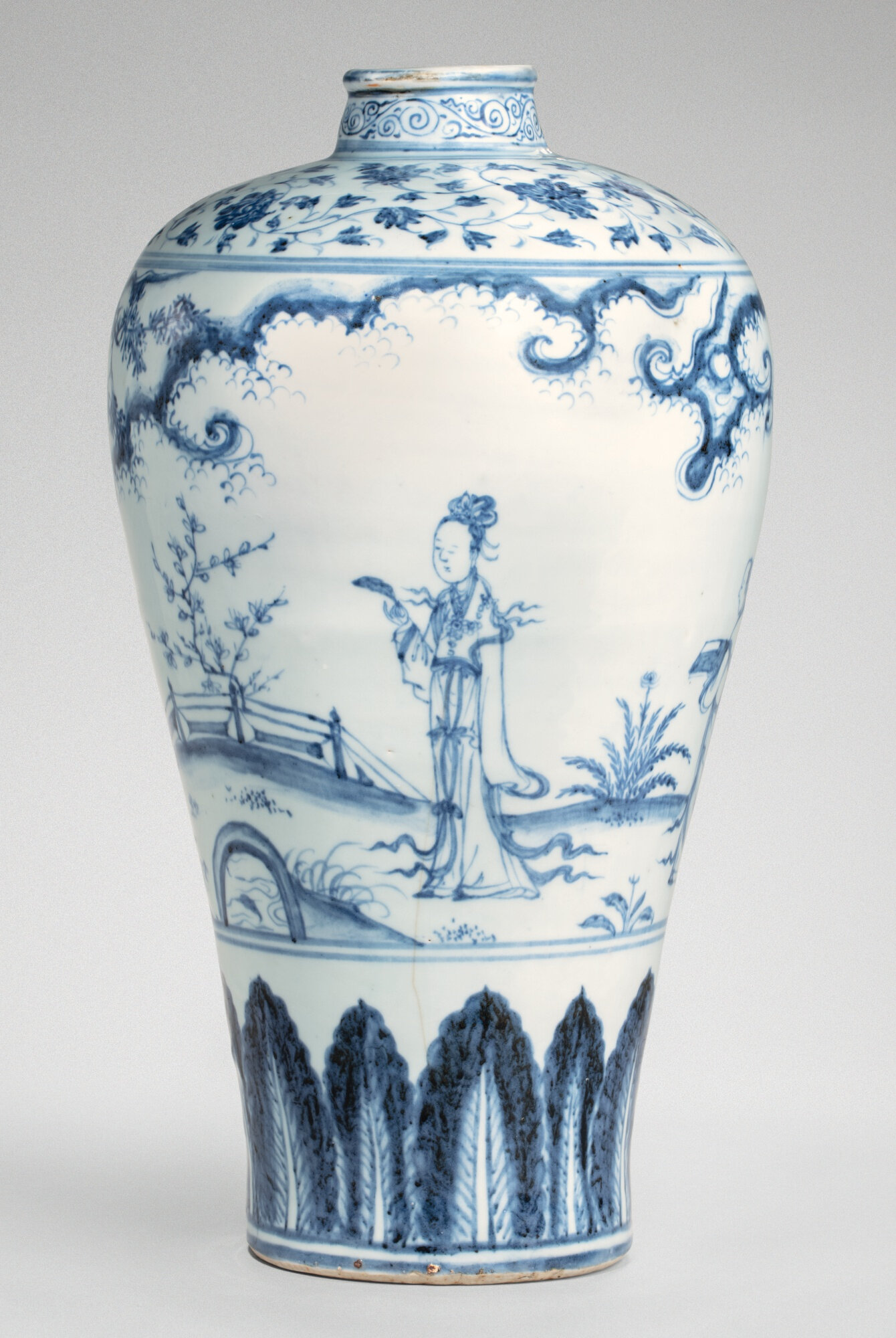


Lot 514. A large and superbly painted blue and white 'Windswept' meiping, Ming dynasty, mid-15th century.Height 14 3/8 in., 36.5 cm. Estimate USD 80,000 — 120,000. Lot Sold 200,000 USD. Courtesy Sotheby's.
finely potted with high swelling shoulders rising to a tapering neck and lipped rim, superbly painted around the sides in the 'windswept' style with a continuous landscape with a lady and her attendant a garden with trees, rockwork and a fence, the lady adorned in beaded jewelry and long flowing robes tied with billowing sashes, holding a feather in the raised right hand, the attendant following and carrying a book, all below boldly stylized clouds with mountain peaks and further cloud wisps in the sky above, the foot encircled by a wide band of upright banana leaves, the shoulder painted with a meandering scroll of camellia below a cloud scroll at the neck, all divided by double line borders, the base unglazed, Japanese wood box (3).
Provenance: Collection of R.H.R. Palmer (1898-1970).
Sotheby's London, 27th November 1962, lot 5.
J.T. Tai, New York.
Sotheby's London, 10th December 1968, lot 59.
Robert Hatfield Ellsworth, New York.
Literature: Ryōichi Fujioka, Tōji Taikei 42 Min no Sometsuke [Outlines of Ceramics: Blue and White Ceramics of the Ming Dynasty], vol. 42, Tokyo, 1975, pl. 59.
In histories of Chinese ceramics, the three short early Ming reigns of Zhengtong, Jingtai, and Tianshun, from 1436 to 1464, had long been omitted. Since the period was politically tumultuous and unstable, and no verifiable pieces with imperial marks from these reigns are known, ceramic specialists in China call it the ‘blank’ or ‘dark period’ (kongbaiqi, heianqi) and in the West, the ‘Interregnum’. Although several literary references attest to the contrary, it has generally been thought that for these nearly three decades in the mid-fifteenth century the imperial kilns were not in use; and even pieces considered as minyao, such as porcelains from dated tombs or pagoda foundations, did not lead to a proper recognition of Jingdezhen’s activity during that period.
Excavations at the imperial kiln site of Zhushan in Jingdezhen have now provided tangible evidence of an imperial production of porcelains during these reigns, which has suddenly focused unprecedented scholarly attention on this period. After a first exhibition devoted to this subject at the Chinese University of Hong Kong in 2012, further exhibitions have more recently been organized in Shenzhen, at the Palace Museum, Beijing, once more in Hong Kong, in Jingdezhen and at the Shanghai Museum (the latter continuing until 1st September 2019).
Although the stratigraphy of the site at Zhushan in Jingdezhen appears to be less clear than one would wish and does not allow for differentiation of pieces from the three reigns, it seems that the kilns were quite active in the Zhengtong (1436-1449) and Tianshun (1457-1464) periods and perhaps less so in the Jingtai reign (1450-1456), when cloisonné enamels may have been preferred. The excavations have, however, given most welcome insights into the kind of wares produced in the imperial workshops. Although no reign marks have been discovered and the imperial kilns seem to have been far less productive than before, in the Xuande period (1426-1435), and afterwards, in the Chenghua reign (1465-1487), the variety of wares they created is remarkable and many styles are highly original. Pieces from this period, which had entered the Qing Court Collection and are still in the Palace Museum, Beijing, had already been published (The Complete Collection of Treasures of the Palace Museum. Blue and White Porcelain with Underglazed Red, Shanghai, 2000, vol. 1, pls 180 and 186); and a symposium held by the Shanghai Museum to coincide with the exhibition there has shown that Interregnum pieces from the imperial collection, so far unpublished, are also held in the National Palace Museum, Taipei.
Fragments of very similar figure-decorated vases and jars recovered from the Ming imperial kiln site at Zhushan, Jingdezhen, have been included in the exhibition Lustre Revealed. Jingdezhen Porcelain Wares in Mid Fifteenth Century China, Shanghai Museum, Shanghai, 2019, cat. no. 200 (fig. 1). The relationship between such pieces from the imperial kilns, guanyao, and those from civilian kilns, minyao, are, however still somewhat obscure. Two related meiping with figure designs in the same catalogue, one excavated from a princely tomb in Guilin, the other also in the Guilin Museum, nos 202 and 203, are presented as perhaps representing gifts from the court, while others are classified as pieces in literati style from civilian kilns, namely nos 235-8, from the Seikado Bunko Art Museum, Tokyo, the Shanghai Museum, the Tianjin Museum and the Shaoxing Museum.

Blue and white shards with figures, Ming dynasty, Zhengtong-Tianshun Reign, Collected from the southern slope of Zhushan in 1996, Jingdezhen Ceramic Archaeological Research Institute.
These meiping as well as several figure-decorated guan jars in the exhibition, cat. nos 227-234, all share the same distinct painting style: the outdoor settings are characterized by freely sketched vegetation and dramatic ‘draperies’ of convoluted clouds encompassing the figures, and often, agitated movement of hair and clothing, with fluttering ribbons, hems and sleeves, suggests a wind-blown location – an idiosyncratic style that is peculiar to this period and not found earlier or later.
The present meiping is a very characteristic piece of the mid-fifteenth century, when a deep cobalt blue was often used, seemingly applied in a fairly liquid state with a thick brush, as is particularly apparent at the banana-leaf border around the base. The free painting manner seen on many interregnum pieces, as well as many shapes and designs, obviously revive styles popular during the Yuan dynasty (1279-1368). In that period, Jingdezhen produced many spectacular figure-decorated meiping and guan jars painted with scenes from Yuan drama. In the Yuan, such scenes can mostly be identified, and illustrations featuring a lady and her maid often depict the heroine of the Xixiangji (‘Romance of the Western Chamber’), Cui Yingying and her maid Hongniang. Although the lady depicted on our meiping, with her attendant bringing a book, cannot definitely be interpreted in this way, the scene clearly refers to this or similar stories that became popular as plays.
The present meiping comes from a Japanese collection. Seemingly the first – and for a long time the only – specialist to interest himself in porcelains such as this was the Japanese scholar Kushi Takushin. As early as 1943 he published and discussed a series of related figure-decorated guan jars (Shina Minsho tōji zukan [Illustrated catalogue of Chinese porcelain of the early Ming], Tokyo, 1943, pls 30-42). He not only remarked on their similarity to Yuan porcelains, but even argued that the customary dating in the West to the Hongzhi reign (1488-1505) is far too late and a date closer to Xuande should be more appropriate.
In the West, the three reigns were first properly acknowledged by John Alexander Pope, who coined the term ‘ceramic Interregnum’ for this period and discussed it at some length in print (Chinese Porcelains from the Ardebil Shrine, Washington D. C., 1956, pp. 101-105). The term was probably adapted from its usage for the historical Interregnum (‘between the reigns’) of the Jingtai Emperor, whose reign intervened in that of his brother, who ruled under two mottos, Zhengtong and Tianshun. Pope, however, did not dare to attribute a flower-decorated meiping painted in a similar style as the present piece to the Interregnum, although he illustrates it together with two pieces painted in a loose Xuande style, which he offers as candidates (pl. 56).
Geng Baochang (Ming Qing ciqi jianding [Appraisal of Ming and Qing porcelain], Hong Kong, 1993) attributes a figure-decorated guan jar with very similar borders around neck, shoulder and foot to the Zhengtong period (pl. 126), other related jars to the Jingtai reign (pls 131 and 132), and further meiping and guan jars to Tianshun (pls 139, 141-144, 146), all being similarly painted in this ‘wind-swept’ style and featuring the same voluminous curly clouds.
The present vase comes from the fabled collection of Chinese ceramics and other works of art assembled by R.H.R. Palmer (1898-1970) and his wife, who started collecting in 1924. As esteemed members of the Oriental Ceramic Society, they lent to many of the Society’s exhibitions. The collection was particularly strong in Ming blue-and-white porcelains, many of which were sold at Sotheby’s over the years. In 1962, the present vase was sold, together with a companion piece of very similar shape and decoration, but with a key-fret border at the neck, as ‘early 15th century’; in 1968, the dating was changed to ‘late 15th century’ (fig. 2).

The present lot illustrated in the auction catalogue, Sotheby’s London, 27th November 1962, lot 5.


Lot 519. A fine and rare green-enameled 'Dragon' dish, Hongzhi mark and period (1488-1505). Diameter 7 in., 18 cm. Estimate USD 60,000 — 80,000. Lot Sold 275,000 USD. Courtesy Sotheby's.
the deep rounded sides rising from a tapered foot to a flared rim, finely carved in the biscuit and enameled in bright translucent green enamel, the interior with a sinuous five-clawed dragon writhing amid scrolling clouds within a line border repeated at the rim, the exterior decorated with two further dragons striding on a ground of finely incised foaming waves between line borders, the base with a six-character reign mark in underglaze blue within a double circle, two Japanese wood boxes (5).
Provenance: Christie's London, 14th June 1982, lot 95.
Hirano Koto-ken, Tokyo, May 1986.
Exhibited: Chūgoku Bijutsu Ten [Chinese Art Exhibition], Hirano Koto-ken, Tokoyo, 1986.
Note: Dishes decorated with sinuous dragons enameled in green against a white ground originated in the Chenghua period (1465-1487), but increased in popularity in the succeeding Hongzhi (1488-1505) and Zhengde (1506-1521) reigns. While Chenghua prototypes are also known with the dragons enameled over the glaze, later examples, such as this dish, were almost all enameled over the biscuit. The dishes were first incised and the dragon silhouettes reserved in the biscuit during firing and then filled with green enamel for a second firing.
Four Hongzhi mark and period dishes of this design and size, in the Palace Museum, Beijing, are illustrated in Imperial Porcelains from the Reign of Hongzhi and Zhengde in the Ming Dynasty, Beijing, 2017, pls 53 and 56-58, together with two slightly larger dishes, pls 54 and 55; a dish from the collection of Sir John Addis, now in the British Museum, London, is illustrated in Jessica Harrison-Hall, Ming Ceramics in the British Museum, London, 2001, pl. 7:17; and another in the Meiyintang Collection is illustrated in Regina Krahl, Chinese Ceramics from the Meiyintang Collection, vol. 2, London, 1994, pl. 693. Further examples were sold at auction, for example, a dish from the collections of Mr and Mrs R.H.R. Palmer and Roger Pilkington, sold in our London rooms in 1962, and again in our Hong Kong rooms, 6th April 2016, lot 30.


Lot 515. A fine underglaze-blue and yellow-enameled 'Gardenia' dish, Zhengde mark and period (1506-1521). Diameter 7 3/4 in., 19.8 cm. Estimate USD 60,000 — 80,000. Lot Sold 212,500 USD. Courtesy Sotheby's.
the shallow rounded sides rising from a slightly tapered foot, the interior painted in shades of cobalt blue with a leafy branch bearing two five-petaled gardenia blooms and a tightly closed bud, encircled on the cavetto by fruiting branches of pomegranate, grape, peach and a ribbon-tied lotus bouquet, all between double-line borders, the underside with a continuous floral scroll of large blooming roses borne on a foliate stem, between double-line borders at the rim and foot, all reserved on a deep yellow enamel ground, the base with a six-character mark within a double ring in underglaze blue beneath a clear glaze, Japanese wood box (3).
Provenance: Sotheby's Hong Kong, 20th May 1981, lot 715.
Christie's London, 10th December 1984, lot 886.
The Jarras Collection.
Christie's Hong Kong, 8th October 1990, lot 301.
Hirano Koto-ken, Tokyo.
Note: This piece is a fine example of a well-known type of dish painted in underglaze blue with spays of gardenia against a brilliant yellow ground. Dishes of this design were made from the Xuande (1426-35) to the Jiajing (1522-66) reigns and are known also in other color schemes, such as blue and white, and brown and white. During the Zhengde period, a distinctive stylistic change occurred in the rendering of this motif which is displayed on the present dish. The central design was tightened, the arrangement of the floral and fruit sprays on the well altered, with the lotus painted directly above the gardenia and the crab apple replaced by the peach, and the mark generally reduced from a six- to a four-character version.
The gardenia flower on dishes of this type, zhizi in Chinese, is not immediately associated with any auspicious meaning, but its distinctive fragrance was popular among ladies who wore branches of gardenia in their hair. It was also used for flavoring tea and for preparing cosmetics, and the small fruits of the plant were coveted for dyeing–producing a fine yellow or orange color–as well as for their medicinal benefits.
A closely related dish in the British Museum, London, is illustrated in Jessica Harrison-Hall, Ming Ceramics, London, 2001, pl. 8:24, together with a slightly larger one with a six-character reign mark, pl. 8:23; another of slightly larger size, in the Palace Museum, Beijing, is illustrated in Imperial Porcelains from the Reign of Hongzhi and Zhengde in the Ming Dynasty, Beijing, 2017, pl. 235; a third from the Percival David Foundation, now also in the British Museum, London, is published in Soame Jenyns, Ming Pottery and Porcelain, London, 1988, col. pl. H; and a further example from the collections of Mr and Mrs R.H.R. Palmer and Roger Pilkington, was sold in our London rooms in 1962, and in our Hong Kong rooms, 5th April 2016, lot 4.
For a Xuande prototype of this design, see a dish in the British Museum, London, illustrated in Harrison-Hall, op.cit., pl. 4.43.

Lot 516. A rare and finely painted blue and white meiping, Ming dynasty, 16th century. Height 12 3/4 in., 32.3 cm. Estimate USD 60,000 — 80,000. Unsold. Courtesy Sotheby's.
elegantly proportioned, the generously rounded baluster body tapering towards a splayed foot, the broad principal register painted with a large fruiting and flowering pomegranate tree, its branches supporting a pair of long-tailed birds, with butterflies and other insects hovering in the air above ornamental rockwork and other vegetation below, all above a border of lotus, arrowhead and aquatic plants emerging from turbulent waves encircling the foot, the shoulder with a collar of ruyi-shaped pendant lappets enclosing lotus reserved on a diaper ground, interspersed with strings of beads suspending jewels and precious objects, and a trefoil border below scattered floral sprays at the neck, the base unglazed, Japanese wood box (3)
Provenance: Hirano Koto-ken, Tokyo.
Exhibited: Chūgokutoji Gen Ming Meihinten [Chinese Ceramics from the Yuan - Ming Dynasties], The Japan Ceramic Society, Nihonbashi Takashimaya, Tokyo, 1956, cat. no. 82.
Chūgoku bijutsu ten series: Min Shin no bijutsu [Chinese Art exhibition series. The Art of the Ming and Qing dynasties], Osaka Art Museum, Osaka, 1980, cat. no. 1-57.
Note: This vase is exquisitely painted with a scene of long-tailed birds chirping on flowering branches. Sensitively rendered with their heads turned towards each other, the painter has successfully conveyed the fleeting nature of the subject. The linear rendering of the design, with delicate details executed with a fine brush and filled with broad washes of cobalt in subtle hues, continues the painterly style developed in the Chenghua reign (1465-1487).
Vases painted with such exquisite designs and lacking a reign mark are unusual, although a similar meiping, with the painting somewhat less refined, was included in the Southeast Asian Ceramic Society exhibition Chinese Blue and White Ceramics, National Museum, Singapore, 1978, cat. no. 126. See also a jar painted in a similar style with birds on a flowering pomegranate tree, sold in our Hong Kong rooms, 5th November 1997, lot 1406; and another in the Museum für Kunsthandwerk, Frankfurt am Main, illustrated in Gunhild Gabbert, Chinesisches Porzellan, Frankfurt am Main, 1977, cat. no. 14.


Lot 502. A rare blue and white square-form 'Floral' jar, Jiajing mark abd period (1522-1566). Height 8 in., 20.2 cm. Estimate USD 60,000 — 80,000. Lot Sold 75,000 USD. Courtesy Sotheby's.
the squat baluster form surmounted by a straight neck and lipped rim, the exterior painted on each of the four sides with chrysanthemum, rose and peony blossoms potted alongside ornamental rocks in jardinières supported on rectangular stands within a garden, with butterflies in flight on either side, all above a lappet band at the foot and below a border of ruyi at the shoulder, the neck collared by a keyfret band, the base with a six-character reign mark within a double-square in underglaze blue, two Japanese wood boxes (5).
Provenance: Hirano Koto-ken, Tokyo, 1982.
Exhibited: Chūgoku bijutsu ten series: Min Shin no bijutsu [Chinese Art exhibition series. The Art of the Ming and Qing dynasties], Osaka Art Museum, Osaka, 1980, cat. no. 1-60.
Literature: Sekai tōji zenshū/Catalogue of World's Ceramics, vol. 11, Tokyo, 1955, pl. 119.
Sekai tōji zenshū [Ceramic Art of the World], vol. 14, Tokyo, 1976, pl. 189.
While jars of this form are known painted with numerous designs, those with this auspicious motif of flowers in vases are unusual. A round jar painted with this motif from the H. Lauritzen Collection, in the Museum of Far Eastern Antiquities, Stockholm, is illustrated in L. Reidemeister, Ming-Porzellane in Schwedischen Sammlungen, Berlin, 1935, pl. 19c.
Compare also a smaller square jar painted with floral sprays and insects, sold in our London rooms, 7th December 1993, lot 227; and one with flowers issuing from rockwork painted in wucai enamels, illustrated in Sekai tōij zenshū/Catalogue of World’s Ceramics, vol. 11, Tokyo, 1955, fig. 123.


Lot 520. A rare iron-red-ground 'Kinrande' double-gourd vase, Ming dynasty, Jiajing period (1522-1566). Height 15 1/8 in., 38.4 cm. Estimate USD 40,000 — 60,000. Lot Sold 81,250 USD. Courtesy Sotheby's.
of slender octagonal section, rising from a countersunk base to an elegantly clinched waist and tapering mouth, the lower bulb painted on each side with a quatrefoil cartouche enclosing gilt lotus sprays, framed within green-enameled and gilt borders and reserved on a Y-patterned diaper ground, all within rectangular green enameled borders with yellow scroll-bracketed corners, the shoulder similarly decorated with roundels inscribed with gilt characters against a diaper ground, and the upper lobe with vertical shaped cartouches enclosing floral sprays against a cash diaper ground, below keyfret and lotus borders in reserve and a gilt scroll at the mouth, with further reserve-decorated scrolls above the waist and foot, and a band of upright lappets encircling the foot, all reserved on a rich iron-red enameled ground, the base with a clear glaze, two Japanese wood boxes (5).
Provenance: Collection of the Bernasconi Family.
Christie's London, 6th June 1988, lot 131.
Hirano Koto-ken, Tokyo, February 1989.
Note: Similar kinrande vases are known with slight variations in design and size. A very similar vase from the Ataka Collection was included in the Exhibition of Oriental Ceramics, Museum of Oriental Ceramics, Osaka, cat. no. 43, and another with different geometric designs is illustrated in Mayuyama, Seventy Years, Tokyo, 1976, pl. 884. Further examples include one formerly in the Norton Collection, sold in our London rooms, 26th March 1963, lot. 65; another from the collection of Louis van der Heyden was sold in our Tokyo rooms, 1st-3rd October 1969, lot 226; and a third example sold in these rooms, 18th September 2007, lot 245.

Iron-Red-Ground ‘Kinrande’ double gourd vase, collection of the Museum of Oriental Ceramics, Osaka. Photo: Muda Tomohiro.


Lot 501. A blue and white 'Mythical beasts' dish, Wanli mark and period (1573-1620). Diameter 6 3/8 in., 16.3 cm. Estimate USD 20,000 — 30,000. Lot sold 40,000 USD. Courtesy Sotheby's.
the shallow rounded sides supported on a straight foot, painted to the central medallion with a spirited scene of three scaled mythical beasts and a tiger within a landscape, a dragon emerging from the clouds above, all encircled at the well by a lotus pond border with mandarin ducks and cranes, the underside painted with six detached fruiting and flowering branches, the base with a six-character mark in underglaze-blue within a double circle, Japanese wood box (3).
Provenance: Hirano Koto-ken, Tokyo, 1994.
Compare a dish of this same design, formerly in the Riesco Collection and included in the exhibition Chinese Blue and White Porcelain, 14th to 19th Centuries, Oriental Ceramic Society, London, 1953, cat. no. 173, later sold in our London rooms, 11th December 1984, lot 327. Another, included in the Exhibition of Chinese Blue and White Porcelain, Hong Kong Oriental Ceramic Society, Hong Kong, 1975, cat. no. 43, previously sold in the same rooms, 1st April 1974, lot 214. A further example was sold in the same rooms, 18th June 1985, lot 114.


Lot 517. An extremely rare wucai sectioned circular box and cover, Wanli mark and period (1573-1620). Diameter 6 in., 15.2 Estimate USD 50,000 — 70,000. Lot Sold 62,500 USD. Courtesy Sotheby's.
the domed cover painted to the top with a circular panel enclosing a pair of mandarin ducks swimming in a lotus pond flourishing with lotus, reed and other aquatic plants, with an egret and magpie perched on the nearby banks, and a pair of magpies in flight above, encircled by a border of scrolling lotus, with each of the principal flowers supporting a Daoist emblem, the box similarly decorated, with the interior divided into a central circular compartment within four radiating sections, the base with a six-character mark in underglaze blue within a double circle, three Japanese boxes (8).
Provenance: Hirano Koto-ken, Tokyo, 1988.
Exhibited: Chūgoku no Kotōuji [Classical Chinese Ceramics], Seibu Department Store, Tokyo, 1988, cat. no. 2.
Note: This box is remarkable for its lively and highly auspicious design of birds by a lotus pond, rendered in brilliant polychrome enamels and underglaze blue. It is particularly notable on account of its use of iron red, applied in different layers to give texture to birds and flowers. This motif brims with auspicious symbolism; pairs of magpies and mandarin ducks express the wish for happiness and a harmonious marriage, while the egrets and the magpie on the lotus pod represent the wish for the successful completion of the civil service examinations and a successful career.
Boxes painted with this motif are unusual, although very similar example from the Lauritzen Collection, now in the Museum of Far Eastern Antiquities, Stockholm, is illustrated in Jan Wirgin, ‘Ming Wares in the Lauritzen Collection’, BMFEA, no. 37, 1965, pl. 33; and another, from the collection of Sir A. Aykroyd, was sold in our London rooms, 17th May 1966, lot 21. A similar sectioned box of the same size and painted with a variation of the same design in the Palace Museum, Beijing is illustrated in The Complete Collection of Treasures of the Palace Museum. Porcelains in Polychrome and Contrasting Colours, Hong Kong, 1999, pl. 40.
This motif is also known on boxes painted in underglaze blue only, such as an example from the Huaihaitang Collection, included in the exhibition Enlightening Elegance. Imperial Porcelain of the Ming to Late Ming, Art Museum, Institute of Chinese Studies, The Chinese University of Hong Kong, Hong Kong, 2012, cat. no. 104; and another sold in our Hong Kong rooms, 8th November 1982, lot 106.


Lot 518. A large blue and white 'Dragon' garlic-mouth bottle vase, Wanli mark and period (1573-1620). Height 19 1/2 in., 49.8 cm Estimate USD 80,000 — 120,000. Unsold. Courtesy Sotheby's.
sturdily potted, the pear-shaped body supported on a short foot, tapering to a tall neck with a garlic-head mouth and upright rim, the body painted with two pairs of sinuous five-clawed dragons alternately descending and ascending in pursuit of 'Flaming Pearls' amidst a composite floral scroll, all above a band of upright lappets and keyfret at the foot and below a trefoil chevron border at the shoulder, the slightly waisted neck painted with birds perched on tall flowering branches, with a broad border of lotus scroll encircling the mouth, the six-character reign mark inscribed in a horizontal line within a rectangular cartouche at the rim, two Japanese boxes (5).
Note: Vividly painted in brilliant cobalt blue with sinuous dragons amongst a dense floral scroll, this vase is representative of the larger porcelain wares created in the late Ming dynasty. While the Wanli Emperor has not gone down in history as a major statesman or a devoted art lover, imperial ceramic production flourished during his reign. A great love of luxury at court and in the upper echelons of society, and the Emperor’s liberal spending of government resources on personal luxury items, resulted in an increased demand for expensive and impressive porcelains. Innovative shapes and unorthodox designs mark this period, epitomized by this vase through its magnificent size, unusual garlic-mouth shape and in the spirited rendering of its dragon motif.
Vases of this form painted with dragons, and with birds on flowering and fruiting branches at the neck, are rare, and only two closely related examples appear to have been published: the first in the Idemitsu Museum of Arts, Tokyo, is illustrated in Chinese Ceramics in the Idemitsu Collection, Tokyo, 1987, pl. 745; and the second was sold at Christie’s London, 16th November 1998, lot 78. See also a slightly larger Wanli mark and period vase of this type, but painted with a floral scroll on the neck, in the Shanghai Museum, illustrated in Lu Minghua, Mingdai guanyao ciqi [Ming imperial porcelain], Shanghai, 2007, pl. 1-74; another from the Meiyintang Collection, illustrated in Regina Krahl, Chinese Ceramics from the Meiyintang Collection, vol. 4, London, 2014, pl. 1697, and sold at Christie’s New York, 28th March 1996, lot 343; and a third from the collection of Dr Hsi Hai Chang, Minister Plenipotentiary of the Chinese Republic, sold in these rooms, 23rd-24th May 1974, lot 352.

A large blue and white 'Dragon' garlic-headed vase, suantouping, Wanli six-character mark and of the period (1573-1620); 19 in. (49.5 cm.) high. Estimate GBP 30,000 - GBP 45,000. Price realised GBP 36,700 at Christie’s London, 16th November 1998, lot 78. © Christie’s Images Limited 1998
This design is also known on vases painted in wucai, such as a piece in the National Palace Museum, Taipei, illustrated in Minji meihin zuroku [Illustrated catalogue of Ming dynasty porcelain], Tokyo, 1978, pl. 99; another from the Avery Brundage Collection, in the Asian Art Museum of San Francisco, illustrated in Soame Jenyns, Ming Pottery and Porcelain, London, 1988, pl. 187, and sold in our London rooms, 4th July 1945, lot 80; and a third sold in our Hong Kong rooms, 8th April 2010, lot 1865.

A fine and rare wucai 'garlic-mouth' vase, Mark and period of Wanli (1573-1620); 43.5 cm., 17 1/4 in. Est. 2,000,000—3,000,000 HKD. Lot Sold 9,380,000 HKD at Sotheby's Hong Kong, 8th April 2010, lot 1865. photo Sotheby's
Cf. my post: A fine and rare wucai 'garlic-mouth' vase, Mark and period of Wanli
Sotheby's. A Noble Pursuit: Important Chinese and Korean Art from a Japanese Private Collection, New York, 11 September 2019.


/image%2F1371349%2F20260327%2Fob_ea80a1_1000060128.jpg)
/image%2F1371349%2F20251215%2Fob_58f5d1_telechargement-61.jpg)
/image%2F1371349%2F20251215%2Fob_e86cf1_telechargement-24.jpg)
/image%2F1371349%2F20250316%2Fob_a520eb_telechargement-10.jpg)