

/https%3A%2F%2Fprofilepics.canalblog.com%2Fprofilepics%2F1%2F0%2F100183.jpg)
/https%3A%2F%2Fstorage.canalblog.com%2F03%2F02%2F119589%2F96711876_o.jpg)
/https%3A%2F%2Fstorage.canalblog.com%2F11%2F31%2F119589%2F94773502_o.jpg)
/https%3A%2F%2Fstorage.canalblog.com%2F20%2F83%2F119589%2F94772815_o.jpg)
/https%3A%2F%2Fstorage.canalblog.com%2F26%2F72%2F119589%2F75604929_o.jpg)
/https%3A%2F%2Fstorage.canalblog.com%2F59%2F60%2F119589%2F26458628_o.jpg)
Christie's Hong Kong Chinese Ceramics and Works of Art Department announces The Tianminlou Collection

© Christie's Images Ltd 2023

© Christie's Images Ltd 2023

© Christie's Images Ltd 2023
HONG KONG.- On 30 November, Christie’s Hong Kong Chinese Ceramics and Works of Art Department will present The Tianminlou Collection – a dedicated single-owner sale featuring 15 exceptional pieces from one of the world’s most esteemed collections of Chinese porcelain, with a pre-sale low estimate of over HK$120 million. This exceptional group comprises 15 iconic examples of Ming and Qing porcelain, all widely published and exhibited, and for the first time, Yuan Dynasty pieces from this globally famous collection will be brought to the market.
The Tianminlou Collection was scrupulously amassed over several decades starting from the 1970s. Particularly renowned for its blue and white as well as imperial porcelain from the Yuan, Ming and Qing dynasties, the collection has been showcased at numerous prestigious museums and art institutions, including the Shanghai Museum, the Hong Kong Museum of Art, and the Chang Foundation in Taipei.
Marco Almeida, Head of Department, Chinese Ceramics and Works of Art, Christie’s Asia Pacific commented: “It is a great honour for Christie’s to be entrusted with these magnificent and significant pieces, from The Tianminlou Collection, one the most prestigious collections of Chinese porcelain ever assembled and arguably the finest in private hands. Encompassing the highest echelons of rarity, quality, and historical importance, The Tianminlou Collection is a true treasure trove for connoisseurs and appreciators of Chinese ceramics. Each and every exquisite example in this sale is of museum-quality, representing the epitome of craftsmanship from its respective period. This is an extraordinary and rare opportunity for collectors and connoisseurs to acquire a masterpiece of Chinese history.”
AUCTION HIGHLIGHTS - YUAN DYNASTY
Yuan blue and white vases have always been highly treasured by collectors, with vases of the elegant meiping form being especially desired. This exceptional and superb example stands out further due to the retention of its original cover, a feature that is often lost in other examples. During its time, it would have served as a wine container. The intricate designs are brilliantly painted in cobalt of vibrant sapphire-blue tones, using the expensive cobalt pigment imported from the Persian regions, which is characteristic of this period.


Lot 2701. Property from The Tianminlou Collection. A Magnificent and Superbly Painted Blue and White ‘Peony Scroll’ Meiping and Cover, Yuan Dynasty (1279-1368), 44.7 cm overall height, Estimate: HK$20,000,000 – 30,000,000. Price realised HKD 67,775,000. © Christie's Images Ltd 2023.
Provenance: Sold at Sotheby’s London, 10 December 1985, lot 191.
Literature: - Chinese Porcelain in the S.C. Ko Tianminlou Collection, Hong Kong, 1987, no. 4
- Selected Treasures of Chinese Art: Min Chiu Society Thirtieth Anniversary Exhibition, Hong Kong, 1990, p. 268-269, no. 119
- Blue and White Porcelain from the Tianminlou Collection, Taipei, 1992, p.48-49, no. 7
- Chugoku meito ten: Chugoku toji 2000-nen no seika [Exhibition of Chinese Pottery: Two Thousand Years of Chinese Ceramics], Tokyo, 1992, p.73, no. 64
- Blue and White Porcelain from the Collection of Tianminlou Foundation, Shanghai, 1996, p. 42-43, no. 8
- The Grandeur of Chinese Art Treasures: Min Chiu Society Golden Jubilee Exhibition, Hong Kong, 2010, p. 256, no. 114
- Treasures of Hong Kong: The 20th Anniversary of Hong Kong’s Handover, Beijing, 2018, p. 140, no. 111
Exhibited: - Hong Kong Museum of Art, Chinese Porcelain in the S.C. Ko Tianminlou Collection, Hong Kong, 1987, no.4
- Hong Kong Museum of Art, Selected Treasures of Chinese Art: Min Chiu Society Thirtieth Anniversary Exhibition, Hong Kong, 30 November 1900 – 10 February 1991, no. 119
- Chang Foundation, Blue and White Porcelain from the Tianminlou Collection, Taipei, 1992, no. 7
- Chugoku meito ten: Chugoku toji 2000-nen no seika [Exhibition of Chinese Pottery: Two Thousand Years of Chinese Ceramics], Japan, 9 April – 23 November 1992, no. 64
- Shanghai Museum, Blue and White Porcelain from the Collection of Tianminlou Foundation, Shanghai, 1996, p. 42-43, no. 8
- Hong Kong Museum of Art, The Grandeur of Chinese Art Treasures: Min Chiu Society Golden Jubilee Exhibition, Hong Kong, 25 September 2010 – 2 January 2011, no. 114
- China Capital Museum, Treasures of Hong Kong: The 20th Anniversary of Hong Kong’s Handover, Beijing, 30 September -3 December 2017, p. 104, no. 111.
Note: Tianminlou is renowned for its distinguished Yuan blue and white porcelain collection, notable for its breadth and depth. The collector recalls when in preparation for their first large-scale exhibition to be held at the Hong Kong Museum of Art in 1987, they learned about an important Yuan blue and white meiping with the original cover on offer at an auction in London. They decided they must secure this major piece for the exhibition, and were determined to win it at auction regardless of price. They were indeed the successful bidder, winning the lot at £286,000, a considerable sum at the time. This meiping, which is the current lot, became the cover piece for the 1987 Tianminlou exhibition, featuring prominently in posters and banners lining the exhibition.
Yuan blue and white vases have always been highly treasured by collectors, with vases of the elegant meiping form being especially desired. This exceptional and superb example stands out further due to the retention of its original cover, a feature that is often lost in other examples.
During the Yuan dynasty, the meiping would have served as a wine container. The intricate designs are brilliantly painted in cobalt of vibrant sapphire-blue tones, using expensive cobalt pigments imported from the Persian regions, contributing to the characteristic 'heaping and piling' effect and dark iron spots on the underglaze-blue decorations.
While vases of similar design and shape are known, there are often variations in the decorations, especially within the cloud collar, ranging from ducks in lotus pond, horse against waves, to phoenix motifs. There are only two examples that compare closely to the current lot, also with a cloud collar containing floral scrolls.
Two closely comparable examples (but without original covers) include:
1) The first example from the Ernst Schaefer of Krefeld Collection was sold without a cover at Sotheby’s London, 2 April 1974, lot 188; and was later sold with a matched cover from the Su Lin An Collection sold at Sotheby's Hong Kong, 31 October 1995, lot 308; and sold again at Christie’s Hong Kong, 7 July 2003, lot 640 for HK$8,799,750. 2) The second example, without a cover, is in the collection of the Museum of Fine Arts, Boston, illustrated in The World's Great Collections, Oriental Ceramics, vol. 11, Kodansha series, Tokyo, 1980, col. pl. 74.
Magnificent in size, exceeding 42cm in diameter, this extremely rare ‘plantain tree’ barbed-rim charger showcases a combination of several decorative techniques. It features 'blue-on-white' motifs in the center, reverse 'white-on-blue' motifs on the well, and additional molded decorations. Chargers with such intricate designs would have required significant cost and time to produce, resulting in only small quantities being made for the upper echelon of society. The inclusion of the barbed-rim shape further adds complexity to the design, enhancing its appeal to collectors.


Lot 2702. Property from The Tianminlou Collection. An Important and Exceedingly Rare Blue and White 'Plaintain Tree' Barbed-rim Charger, Yuan Dynasty (1279-1368), 42.5 cm diam. Estimate: HK$20,000,000 – 30,000,000. Price realised HKD 25,785,000. © Christie's Images Ltd 2023.
Provenance: Sold at Sotheby’s London, 9 December 1986, lot 188.
Literature: - Chinese Porcelain in the S.C. Ko Tianminlou Collection, Hong Kong, 1987, no. 2
- Selected Treasures of Chinese Art: Min Chiu Society Thirtieth Anniversary Exhibition, Hong Kong, 1990, p. 260-261, no. 115
- Blue and White Porcelain from the Tianminlou Collection, Taipei, 1992, p. 38-39, no. 2
- Blue and White Porcelain from the Collection of Tianminlou Foundation, Shanghai, 1996, p. 30-31, no. 2
- The Grandeur of Chinese Art Treasures: Min Chiu Society Golden Jubilee Exhibition, Hong Kong, 2010, p. 256, no. 113
Exhibited: - Hong Kong Museum of Art, Chinese Porcelain in the S.C. Ko Tianminlou Collection, Hong Kong, 1987, no. 2
- Hong Kong Museum of Art, Selected Treasures of Chinese Art: Min Chiu Society Thirtieth Anniversary Exhibition, Hong Kong, 30 November 1900 – 10 February 1991, no. 115
- Chang Foundation, Blue and White Porcelain from the Tianminlou Collection, Taipei, 1992, no. 2
- Shanghai Museum, Blue and White Porcelain from the Collection of Tianminlou Foundation, Shanghai, 1996, p. 30-31, no. 2
- Hong Kong Museum of Art, The Grandeur of Chinese Art Treasures: Min Chiu Society Golden Jubilee Exhibition, Hong Kong, 25 September 2010 – 2 January 2011, no. 113.
Note: This magnificent charger is impressive not only for its size exceeding 42 cm. in diameter, it also combines multiple decorative techniques, seen on the ‘blue-on-white’ motifs in the centre; reverse ‘white-on-blue’ motifs on the well; and additional moulded decorations in relief. The barbed-rim shape adds further complexity to the design. Chargers of such complicated design would have been very costly and time-consuming to produce, and only small quantities were made for the upper echelon of society.
The most distinct feature on this charger is the moulded decorations of various fruits including grapes, lychee, pomegranate, peach and plum on the well. Most comparable examples are moulded with floral scrolls on the well. Another highly unusual feature is the florettes amidst waves decorated on the rim. No other example of this pattern is recorded, presumably this dish is unique.
Chargers of similar design and decorations but with moulded peony or lotus scrolls on the well include:
1) one in the Topkapi Saray Museum, illustrated in Regina Krahl, Chinese Ceramics in the Topkapi Saray Museum, Istanbul, ed. John Ayers, London, 1986, vol. 2, no. 56;
2) one in the Shanghai Museum, illustrated in Splendors in Smalt. Art of Yuan Blue-and-white Porcelain, Shanghai Museum, Shanghai, 2012, cat. no. 27;
3) one in the Ardabil Shrine in Iran, is illustrated in John Alexander Pope, Chinese Porcelains from the Ardebil Shrine, Washington, D.C., 1956, pl. 22;
4) one in the British Museum, illustrated in Jessica Harrison-Hall, Catalogue of Late Yuan and Ming Ceramics in the British Museum, London, 2001, cat. no. 1: 39; and
5) one formerly in the collection of Michel Ney (1769-1815), Field Marshal under Napoleon I, sold at Sotheby’s Hong Kong, 5 October 2016, lot 3636, for HK$29,880,000.
All these previously mentioned comparable examples are moulded with floral scrolls on the well, unlike the current lot moulded with a variety of fruits and leaves.
AUCTION HIGHLIGHTS - MING DYNASTY
China's rich ceramic-making history reached a new height during the Ming dynasty when exclusive imperial kilns were established to serve the Emperor and his family. The imperial kilns in Jingdezhen, particularly during the Yongle (r. 1403-1425) and Xuande (r. 1426-1435) reigns, upheld rigorous standards, discarding any piece with even minor flaws. This meticulous process ensured that only the finest works graced the palace, resulting in the scarcity of surviving imperial porcelain from these periods. The two highlights below epitomise the most coveted and exquisite imperial blue and white porcelain from the esteemed Yongle and Xuande eras, cherished by connoisseurs for centuries since the late Ming dynasty.


Lot 2704. Property from The Tianminlou Collection. An Exceedingly Rare and Outstanding Blue and White ‘Ladies in Garden’ Bowl, Xuande Six-Character Mark in Underglaze Blue Within A Double Circle and of the Period (1426-1435), 19.7 cm diam. Estimate: HK$15,000,000 – 18,000,000. Price realised HKD 18,525,000. © Christie's Images Ltd 2023
Provenance: Acquired from Tai Sing Fine Antiques Ltd., Hong Kong, prior to 1985.
Literature: - Anthology of Chinese Art: Min Chiu Society Silver Jubilee Exhibition, Hong Kong, 1985, p. 354, no. 149
- Chinese Porcelain in the S.C. Ko Tianminlou Collection, Hong Kong, 1987, no. 20
- Liu Liang-yu, A Survey of Chinese Ceramics, vol. 4: Ming Official Wares, Taipei, 1991, p. 102
- Chugoku meito ten: Chugoku toji 2000-nen no seika [Exhibition of Chinese Pottery: Two Thousand Years of Chinese Ceramics], Tokyo, 1992, p. 84, no. 76
- Blue and White Porcelain from the Tianminlou Collection, Taipei, 1992, p.106-107, pl. 36
- Blue and White Porcelain from the Collection of Tianminlou Foundation, Shanghai, 1996, p. 102-103, no. 37
- The Radiant Ming, 1368-1644 Through the Min Chiu Society Collection, Hong Kong, 2015, p. 166, no. 116.
Exhibited: - Hong Kong Museum of Art, Anthology of Chinese Art: Min Chiu Society Silver Jubilee Exhibition, Hong Kong, 25 October 1985 – 15 January 1986, no. 149
- Hong Kong Museum of Art, Chinese Porcelain in the S.C. Ko Tianminlou Collection, Hong Kong, 1987, no. 20
- Chang Foundation, Blue and White Porcelain from the Tianminlou Collection, 1992, Taipei, no. 20
- Chugoku meito ten: Chugoku toji 2000-nen no seika [Exhibition of Chinese Pottery: Two Thousand Years of Chinese Ceramics], Japan, 9 April – 23 November 1992, no. 76
- Shanghai Museum, Blue and White Porcelain from the Collection of Tianminlou Foundation, Shanghai, 1996, p. 102-103, no. 37
- Hong Kong Museum of History, The Radiant Ming, 1368-1644 Through the Min Chiu Society Collection, Hong Kong, 2015, no. 116.
Note: The exterior of the bowl is delicately decorated around the exterior with a continuous scene depicting four ladies in a garden scene; two of whom relaxing and conversing inside a pavilion, the other two are depicted strolling on a terrace. The continuous decoration to the exterior resembles a painting scroll when the bowl is rotated.
‘Ladies in garden’ is a theme frequently seen on paintings by Ming court painters. The scene on the current bowl is very likely a portrayal of noble ladies and their leisurely inner court life.
An identical bowl with the same composition and shape, and of comparable size (19.2 cm.), is in the National Palace Museum Collection, possibly originally a pair with the current bowl (acquisition number guci 003132N000000000. Another Xuande-marked bowl of slightly smaller size (18.9 cm.) from the same collection, is painted with the same composition on the exterior, but with an additional decoration of ‘Three Friends of Winter’ on the interior. According to the National Palace Museum catalogue, this bowl is also characterised by distinctly thin potting, similar to our current lot (see Catalogue of the Special Exhibition of Selected Hsuan-te Imperial Porcelains of the Ming Dynasty, Taipei, 1998, pl. 149.
Compare also to a Xuande-marked bowl decorated with figures but depicting the immortal Xiwangmu riding a flying phoenix, formerly in the E.T. Chow and Falk Collections, sold at Christie’s New York, 16 October 2001, lot 134, for US$1,161,000.


Lot 2703. Property from The Tianminlou Collection. A Magnificent and Exceptional Blue and White ‘Grapes’ Barbed-Rim Charger, Yongle Period (1403-1425), 44.5 cm diam. Estimate: HK$8,000,000 – 10,000,000. Price realised HKD 26,995,000. © Christie's Images Ltd 2023
Provenance: Sold at Christie’s London, 9 December 1985, lot 151.
Literature: - Chinese Porcelain in the S.C. Ko Tianminlou Collection, Hong Kong, 1987, no. 7
- Liu Liang-yu, A Survey of Chinese Ceramics, vol. 4: Ming Official Wares, Taipei, 1991, p. 60
- Chugoku meito ten: Chugoku toji 2000-nen no seika [Exhibition of Chinese Pottery: Two Thousand Years of Chinese Ceramics], Tokyo, 1992, p.80, no. 72
- Blue and White Porcelain from the Tianminlou Collection, Taipei, 1992, p.80-81, no. 23
- Blue and White Porcelain from the Collection of Tianminlou Foundation, Shanghai, 1996, p. 76-77, no. 24.
Exhibited: - Hong Kong Museum of Art, Chinese Porcelain in the S.C. Ko Tianminlou Collection, Hong Kong, 1987, no. 7
- Chang Foundation, Blue and White Porcelain from the Tianminlou Collection, Taipei, 1992, no.23
- Chugoku meito ten: Chugoku toji 2000-nen no seika [Exhibition of Chinese Pottery: Two Thousand Years of Chinese Ceramics], Japan, 9 April – 23 November 1992, no. 72
- Blue and White Porcelain from the Collection of Tianminlou Foundation, Shanghai, 1996, p. 76-77, no. 24.
Note: This magnificent charger is superbly potted at an impressive size of 44.5 cm. in diameter, brilliantly decorated in strikingly vibrant blue tones, indicative of the application of precious imported cobalt minerals. Chargers of this type were prized treasures within the Ming palace as well as courts in the West, and the barbed-rim shape adds further visual appeal.
It was not until the early 15th century that grapes became a primary motif on porcelains decorated in underglaze cobalt blue. Before that, the fruit only appeared occasionally as a minor part of the decoration on Yuan blue and white vessels. Grapes are among the plants that are recorded as having been brought to China from Central Asia by Zhang Qian, a returning envoy of Emperor Wudi in 128 BC, and many different varieties of grape were grown in China by the early 15th century.
Porcelain vessels decorated with cobalt blue grapes were much admired in China, and their popularity with the court has been confirmed by finds in the Yongle strata at the imperial kiln site at Jingdezhen. However these early 15th century Chinese blue and white porcelains with grape designs, especially dishes like the one in the current sale, were also much admired in Iran, as is evidenced by the examples preserved in the Ardebil collection, now housed in the Iran Bastan Museum, Teheran. They were also popular in Turkey, as evidenced by those preserved in the collection of the Topkapi Saray, Istanbul. Indeed, such Chinese dishes were so admired that they were closely copied in lower-firing ceramics by the potters at the Turkish Iznik kilns in the early 16th century. Thus the Yongle porcelain dish with underglaze blue grape design provides an appropriate illustration of the way influences travelled back and forth across Asia.
A very similar barbed-rim 'grapes' dish formerly from the Winkworth and Sedgwick collections, now in the British Museum, is illustrated by J. Harrison-Hall, Ming Ceramics in the British Museum, London, 2001, p. 117, no. 3:36. Other examples include one in the Freer Gallery collection, illustrated in The World's Great Collections, vol. 9, Kodansha series, 1982, col. pl. II; another formerly in the H.M. Knight collection, sold at Sotheby's London, 15 June 1982, lot 279.
There are two very similar examples previously sold at auction for exceptional prices.
1) One was formerly in the collection of Shah Jahan (r. 1628-1658), fifth emperor of the Mughal Dynasty of Northern India, sold at Sotheby’s New York, 18 March 2015, lot 264, for US$5,122,000.
2) Another was previously sold at Christie’s Hong Kong, 27 November 2007, lot 1661 (fig. 1), and again at Sotheby’s Hong Kong, 22 April 2021, lot 3612 for HK$17,115,000.
AUCTION HIGHLIGHTS - QING DYNASTY
Imperial porcelain from the Kangxi, Yongzheng, and Qianlong reigns in the 18th century showcases the pinnacle of technical excellence in Chinese ceramic production. During this period, a wealth of new glazes, enamels, and decorative techniques emerged. The three highlights below exemplify the diverse range of decorative styles found on Yongzheng and Qianlong imperial porcelains, including monochrome glazes, gilt enamels on colored grounds, and exquisite blue and white designs.
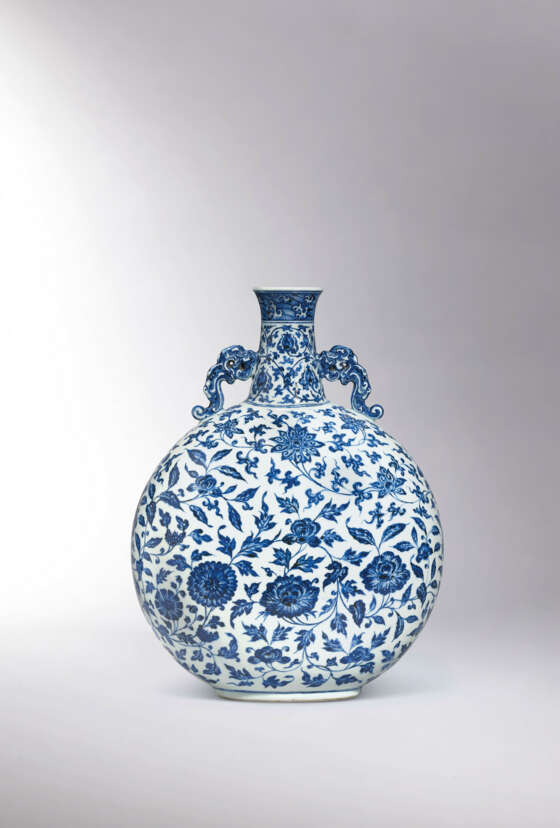


Lot 2711. Property from The Tianminlou Collection. A Magnificent Blue and White ‘Flowers of The Four Seasons’ Moonflask Yongzheng Six-Character Seal Mark in Underglaze Blue and of the Period (1723-1735), 41.5 cm high. Estimate: HK$18,000,000 – 26,000,000. Price realised HKD 32,440,000. © Christie's Images Ltd 2023
Provenance: Collection of the late Dr. Chang His-hai
Sold at Sotheby’s New York, 23-24 May 1974, lot 426
Sold at Sotheby’s Parke Bernet (Hong Kong), 16 May 1977, lot 93
Acquired from Lally & Co., New York, 19 May 1987.
Literature: - Chinese Porcelain in the S.C. Ko Tianminlou Collection, Hong Kong, 1987, no. 54
- Liu Liang-yu, A Survey of Chinese Ceramics, vol. 5: Ch'ing Official and Popular Wares, Taipei, 1991, p. 85
- Blue and White Porcelain from the Tianminlou Collection, Taipei, 1992, p.184-185, no. 75
- Sotheby’s Hong Kong –Twenty Years, Hong Kong, 1993, p. 154, no. 178
- Blue and White Porcelain from the Collection of Tianminlou Foundation, Shanghai, 1996, p. 200-201, no. 83.
Exhibited: - Hong Kong Museum of Art, Chinese Porcelain in the S.C. Ko Tianminlou Collection, Hong Kong, 1987, no. 54
- Chang Foundation, Blue and White Porcelain from the Tianminlou Collection, Taipei, 1992, no.75
- Shanghai Museum, Blue and White Porcelain from the Collection of Tianminlou Foundation, Shanghai, 1996, p. 200-201, no. 83.
Note: Moonflasks, known for their shape in reminiscence of a full moon, are particularly challenging to fire due to its particular shape in which an exceptionally wide body sits on a very narrow foot. Large-sized moonflasks exceeding 40 cm. like the current example are even more difficult to reach perfection. This explains why moonflasks have always been a form highly desired by connoisseurs. The current flask, superbly potted in elegant proportions and of powerful construction, is an exceptionally rare and fine piece.
The shape and decoration of the current lot are largely based on early 15th century prototypes, except the latter lacks the handles on the shoulder. A Yongle blue and white moonflask of very similar shape and decorated with a lotus scroll in the National Palace Museum Collection, for example, is unmistakably a source of inspiration for the current flask, illustrated in Pleasingly Pure and Lustrous: Porcelains from the Yongle Reign (1403-1424) of the Ming Dynasty, Taipei, 2017, p. 112 (fig. 1). Notably the painter of the current flask dabbled and added darker spots to the decoration to simulate the mottled ‘heaping and piling’ effect of 15th century wares.
Due to the difficulty and tremendous cost of firing such large-sized moonflasks, extremely few related examples are known. One Yongzheng-marked moonflask of almost identical shape, size and design is in the Palace Museum Collection, but the mouth of this example is decorated with lotus scrolls, differing from the wave band on the current vase. It is illustrated in The Palace Museum’s Collection of Blue and White Porcelains from Yongzheng Period of Qing Dynasty, Beijing, 2017, pl. 125 (fig. 2).
It is very rare to find Yongzheng marked porcelains of this bold and impressive large size, as the majority are known to be of smaller proportion and delicately potted. Moonflasks dating to the Yongzheng reign more commonly seen, decorated with more simplified handles, such as the example measuring 28.4 cm. high in the Palace Museum Collection, is illustrated in Gugong Bowuyuan cang Qingdai yuyao ciqi [Porcelains from the Qing dynasty imperial kilns in the Palace Museum collection], vol. 1, pt. II, Beijing, 2005, pl. 41 (fig. 3); and another measuring 37 cm. high, first sold at Christie’s London on 6 October 1980, lot 229 (fig. 4), and later again at Sotheby’s Hong Kong, 8 October 2013, lot 3022, for HK$11,440,000.


Lot 2715. Property from The Tianminlou Collection. An Exceptionally Rare and Exquisite Pair of Blue-Ground Gilt-Decorated ‘Melon and Vine’ Double Gourd-Form Vases, Qianlong Six-Character Seal Marks in Iron Red and of The Period (1736-1795), 29 cm high. Estimate: HK$16,000,000 – 22,000,000. Price realised HKD 40,305,000. © Christie's Images Ltd 2023
Provenance: Collection of J.M. Hu
Sold at Sotheby’s New York, Important Chinese Ceramics from the J.M. Hu Family Collection, 4 June 1985, lot 78
- Literature: Helen D. Ling and Edward T. Chow, Collection of Chinese Ceramics from the Pavilion of Ephemeral Attainment, vol. IV, Hong Kong, 1950, pl. 207
- Chinese Porcelain in the S.C. Ko Tianminlou Collection, Hong Kong, 1987, no. 117 (one of the pair)
- Splendour of the Qing Dynasty, Hong Kong, 1992, p. 361, no. 228 (one of the pair)
- Ming and Qing Polychrome Wares from the Collection of the Tianminlou Foundation, Shanghai, 1994, no. 16
- In Pursuit of Antiquities: 40th Anniversary Exhibition of the Min Chiu Society, Hong Kong, 2001, p. 298, no. 188
- The 1st World Chinese Collection Exhibition, Beijing, December 2010, p.88-89 (one of the pair)?
- Exhibited: Hong Kong Museum of Art, Chinese Porcelain in the S.C. Ko Tianminlou Collection, Hong Kong, 1987, no. 117 (one of the pair)
- Hong Kong Museum of Art, Splendour of the Qing Dynasty, Hong Kong, 9 June – 2 August 1992, no. 228 (one of the pair)
- Christie’s Shanghai, Ming and Qing Polychrome Wares from the Collection of the Tianminlou Foundation, Shanghai, 23-25 April 1994, no. 16
- Hong Kong Museum of Art, In Pursuit of Antiquities: 40th Anniversary Exhibition of the Min Chiu Society, Hong Kong, 6 July-26 August 2001, p. 298, no. 188
- China Capital Museum, The 1st World Chinese Collection Exhibition, Beijing, 30 September 2010-9 January 2011, p.88-89 (one of the pair).
Note: This pair of vases came from the collection of the distinguished connoisseur J.M. Hu. Our collector whimsically recalls after acquiring this fabulous pair, they noticed an old medical prescription handwritten in traditional calligraphy hidden inside one of the vases. They tried to enlist Chinese traditional doctors to decipher the prescription, but eventually to no avail. To this date, he is still wondering whether the prescription came from the Palace, which would suggest the medical use of these vases, or could it simply be a medical slip left behind by the previous owner.
This stunning pair of vases is elaborately painted in dazzling gilt enamels with two tones of gold, against a dark blue ground, creating a striking visual contrast. The exterior is densely decorated with melons and flowers on undulating vines, symbolic of an abundance of descendants; while the double-gourd shape alludes to immortality. The overall effect reflects the flamboyant and ostentatious taste prevalent during the dynamic reign of the Qianlong Emperor.
According to Qing dynasty palace archives, on the 30th day of 11th month of Qianlong 10th year (1745), the Qianlong Emperor decreed that:
‘A pair of gilt and blown-on blue double-gourd vases with scrolling flowers’ be handed to Hai Wang to be brought to Shengjing, the palace in Shenyang.
It is likely that the record refers to the current pair of double-gourd vases, indicating it was made very early on during the Qianlong reign.
The current pair is possibly unique, as no other identical piece appears to have been published to date. It is even more outstanding that it is preserved as a pair.
The current lot came from the distinguished collection of J.M. Hu, and was illustrated in the 1950 Zande Lou catalogue (fig. 1). J.M. Hu born in 1911 in Beijing, as the eldest son of the influential banker Hu Bijiang. J.M. Hu was given a rigorous education in the Chinese classics; supplemented by a Western-style education. He first encountered Chinese ceramics during his student years, and developed a lifetime passion for collecting Chinese art. He relocated to Hong Kong during wartime, and founded the prestigious collector’s club Min Chiu Society in 1960. J.M. Hu often spoke of the three necessary criteria in collecting: zhen (authenticity), jing (rarity and quality), and xin (condition). The collecting journey of J.M. Hu represents a lifetime’s dedication to connoisseurship and beauty, and he remains a celebrated figure amongst collectors of Chinese art.
Another type of gilt-decorated double-gourd vases, shorter in height and with a leaner body with handles on the shoulder, is more commonly seen. One such example is a blue-ground vase decorated with gilt lotus scrolls in the National Palace Museum Collection (20.8 cm. high), illustrated in Porcelain of the National Palace Museum: Enamelled Ware of the Ch’ing Dynasty, Book II, Taipei, 1969, pl. 15 (fig. 2). Another vase of this shape, decorated with gilt lotus scrolls against a teadust-glazed background, formerly in the J.M. Hu Collection (20.6 cm.), was first sold at Christie’s Hong Kong, 28 November 2005, lot 1311 (fig. 3); and later again at Sotheby’s Hong Kong, 6 April 2016, lot 3608, for HK$14,480,000.


Lot 2713. Property from The Tianminlou Collection. An Exceptionally Well Carved Celadon Glazed ‘Kui Dragons’ Vase, Qianlong Impressed Six-Character Seal Mark and of the Period (1736-1795), 31.6 cm high. Estimate: HK$12,000,000 – 20,000,000. Price realised HKD 22,155,000 © Christie's Images Ltd 2023
Provenance: Sold at Sotheby’s Hong Kong, 20 May 1986, lot 88.
Literature: - Chinese Porcelain in the S.C. Ko Tianminlou Collection, Hong Kong, 1987, no. 159
- Selected Chinese Ceramic from Han to Qing Dynasties, Taipei, 1990, p. 346-347, no. 154
- Ming and Qing Polychrome Wares from the Collection of the Tianminlou Foundation, Shanghai, 1994, no. 13
- In Pursuit of Antiquities: Thirty-fifth Anniversary Exhibition of the Min Chiu Society, Hong Kong, 1995, p. 194, no. 146
- In Pursuit of Antiquities: 40th Anniversary Exhibition of the Min Chiu Society, Hong Kong, 2001, p. 295, no. 185
- The 1st World Chinese Collection Exhibition, Beijing, December 2010, p.142-143.
Exhibited: - Hong Kong Museum of Art, Chinese Porcelain in the S.C. Ko Tianminlou Collection, Hong Kong, 1987, no. 159
- Christie’s Shanghai, Ming and Qing Polychrome Wares from the Collection of the Tianminlou Foundation, Shanghai, 23-25 April 1994, no.13
- Hong Kong Museum of Art, In Pursuit of Antiquities: Thirty-fifth Anniversary Exhibition of the Min Chiu Society, Hong Kong, 22 December 1995 – 18 February 1996, no. 146
- Hong Kong Museum of Art, In Pursuit of Antiquities: 40th Anniversary Exhibition of the Min Chiu Society, Hong Kong, 6 July-26 August 2001, p.295, no.185
- China Capital Museum, The 1st World Chinese Collection Exhibition, Beijing, 30 September 2010-9 January 2011, p.142-143


/image%2F1371349%2F20260327%2Fob_ea80a1_1000060128.jpg)
/image%2F1371349%2F20251215%2Fob_58f5d1_telechargement-61.jpg)
/image%2F1371349%2F20251215%2Fob_e86cf1_telechargement-24.jpg)
/image%2F1371349%2F20250316%2Fob_a520eb_telechargement-10.jpg)