

/https%3A%2F%2Fprofilepics.canalblog.com%2Fprofilepics%2F1%2F0%2F100183.jpg)
/https%3A%2F%2Fstorage.canalblog.com%2F03%2F02%2F119589%2F96711876_o.jpg)
/https%3A%2F%2Fstorage.canalblog.com%2F11%2F31%2F119589%2F94773502_o.jpg)
/https%3A%2F%2Fstorage.canalblog.com%2F20%2F83%2F119589%2F94772815_o.jpg)
/https%3A%2F%2Fstorage.canalblog.com%2F26%2F72%2F119589%2F75604929_o.jpg)
/https%3A%2F%2Fstorage.canalblog.com%2F59%2F60%2F119589%2F26458628_o.jpg)
A Very Rare And Well-Carved 'Hundred Boys' Celadon Jade Brushpot, Qing Dynasty, 18th Century


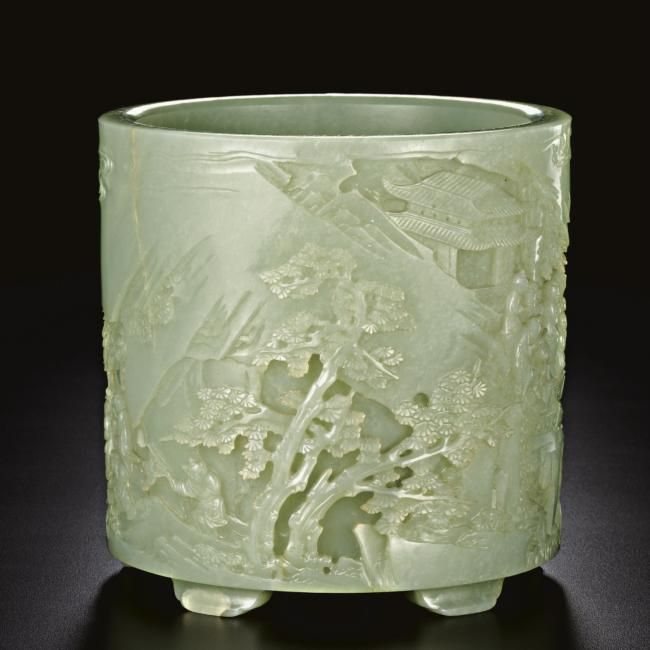


A Very Rare And Well-Carved 'Hundred Boys' Celadon Jade Brushpot, Qing Dynasty, 18th Century. photo Sotheby's
of wide cylindrical form supported on five evenly spaced ruyi-form feet, the exterior skillfully carved and undercut in deep relief with a continuous scene of boys at play in a garden landscape, one side carved with five boys in a procession marching towards a pavilion, one carrying a vase with millet sprays, one on a hobby horse, another playing with fire crackers, two more waving a banner, and one carrying a lantern, the other side further carved with six boys in a balustraded garden playing various musical instruments including a drum, a pipe, cymbals, and a gong, all within a rock garden with towering pine and plantain trees and beneath a band of wispy scrolling clouds carved along the mouthrim, the stone a pale celadon tone with some calcified white flecks, elaborately carved wood stand (2); height 5 3/4 in., 14.8 cm. Estimate 300,000—400,000 USD. Lot Sold 1,538,500 USD to an American Private
NOTE: Celadon jade brushpots of this size are rare due to the limited supply of the material. The superb quality of the carving reflects the preciousness of jade and is a fine example of the very high standard of carving achieved during the 18th century at the Qing court.
The present lot is decorated with the subject of the 'Hundred Boys', a popular motif in the decorative repertoire of the Ming and Qing dynasties as it symbolizes the Chinese perpetual wish for many sons. According to Terese Tse Batholomew in Hidden Meanings in Chinese Art, San Francisco, 2006, p. 63, the 'Hundred Boys' theme has its origins in the Western Zhou dynasty when King Wen of the Zhou adopted one son in addition to his ninety-nine sons to complete the number of one hundred.
Although the 'Hundred Boys' theme was popular in porcelain decoration, it is rare to find a jade brushpot carved with this subject matter. Rare examples include a brushpot formerly in the Imperial collection and now in the collection of the National Palace Museum in Taipei, illustrated in The Refined Taste of the Emperor: Special Exhibition of Archaic and Pictorial Jades of the Ch'ing Court, Taipei, 1997, no. 59, also carved with boys at play but of square cross-section.
Sotheby's. Fine Chinese Ceramics and Works of Art. 23 Mar 11. New York www.sothebys.com


/image%2F1371349%2F20250904%2Fob_99269d_1000029862.jpg)
/image%2F1371349%2F20240811%2Fob_440bf7_image.jpg)
/http%3A%2F%2Fstorage.canalblog.com%2F20%2F22%2F119589%2F134514340_o.jpg)
/http%3A%2F%2Fstorage.canalblog.com%2F90%2F06%2F119589%2F133931876_o.jpg)